Dialogues publishes contextual and visual essays, interviews and conversations, reviews, and experimental writing. It is a textual space that encourages critical thinking. At the same time, Dialogues extend conversations across borders, making visible insights and relationships that might still be unseen and helping grow this Network. If you have a collaboration proposal or an idea for a contribution to the Dialogue section, we’d be happy to discuss it.
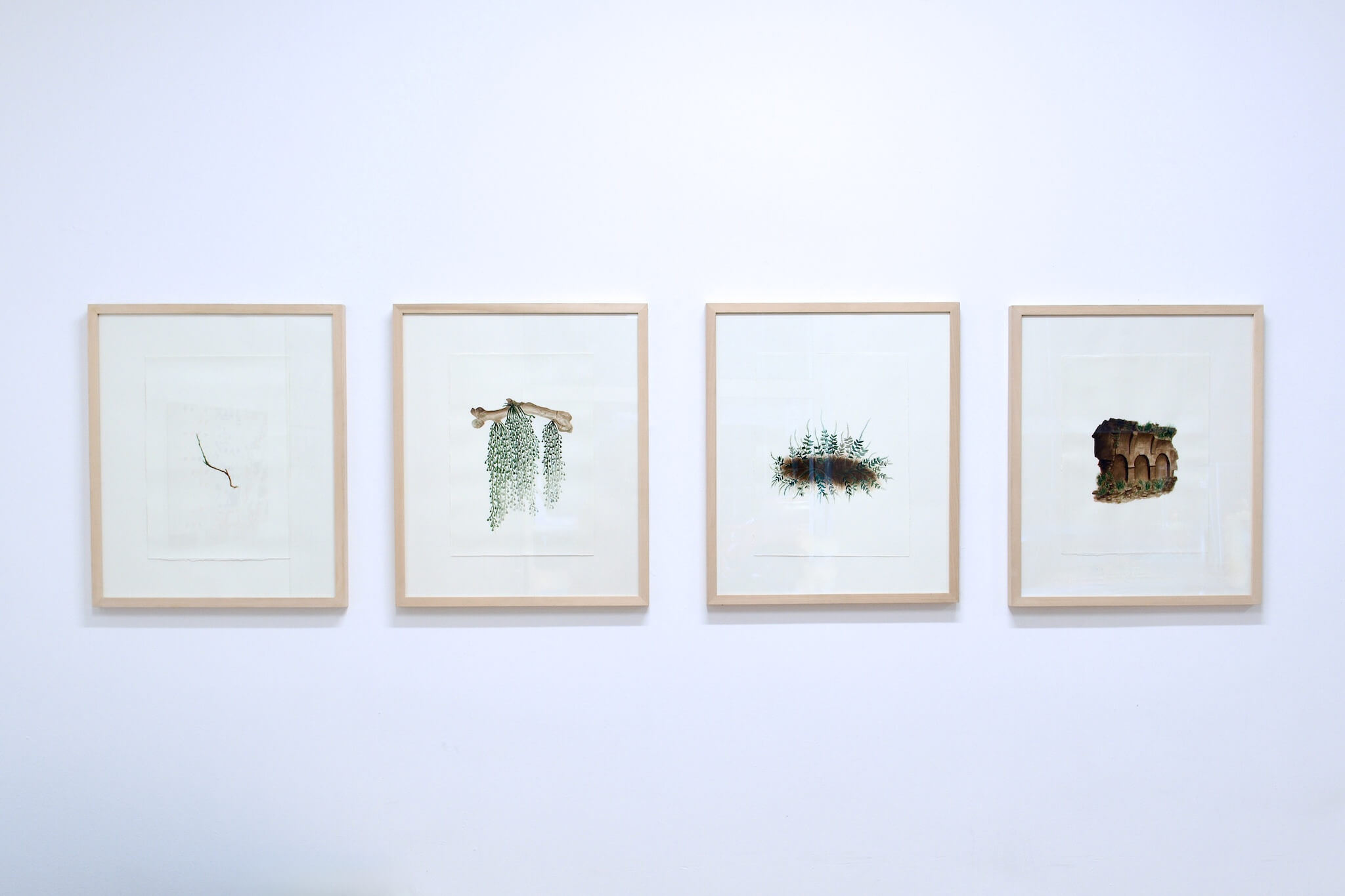
Since the early 2020s, Hüseyin Aksoy has been developing a distinctive visual language in his Istanbul studio through painting, video, installation, collage, and works on paper. His practice is deeply rooted in the cultural identity of Mesopotamia, the region where he spent his childhood and youth. In his research-based and observational works, Aksoy is drawn to ancient settlements, cities, and ruins that have disappeared from modern maps. These sites serve as both the origin of his serial works and the foundation for the spiral-shaped images that appear in them. His affinity for civilizations lost to the course of history enables him to construct a reference system through which he poses questions about the present. Through this approach, he creates a hybrid visual narrative that highlights the cultural and political potential embedded in every trace and ruin, for those who choose to see.
In 2024, Aksoy launched Harmel as a long-term project. This video work also became the conceptual center of other evolving works, including paintings and installations that developed through interdisciplinary processes. The project follows the traces of Peganum Harmala, also known as Syrian Rue, a plant that grows spontaneously among ancient ruins and cemeteries. The idea of “bearing witness” forms two distinct connections in these works. The first, which can be described as documentary, involves Aksoy recording what he sees—whether with a camera, brush, or pen. The plant evokes death and disappearance, emerging in deserted mountain landscapes, yet Aksoy keeps its ominous presence visible. This leads him to a second, more imaginative layer, culminating in the series titled Mind Map.
Mind Map is an installation composed of found objects, drawings, three-dimensional forms, stones, and dried versions of Syrian Rue in various stages of growth. All have been carefully studied by the artist. The accompanying drawings were produced using organic walnut ink—a deliberate material choice. This also marked the beginning of another Scab series. Scab represents Aksoy’s effort to develop a new pictorial language. It focuses on architectural elements such as walls, towers, and ziggurats, forms one might encounter at ancient ruins. The brown stains of walnut ink shape images of past dwellings that recall the landscape of his youth. Yet these works are not tied to any single archaeological site. The textures of ancient cities, the silence of abandoned lands, and the feeling of vastness form the structural elements of the imagery.
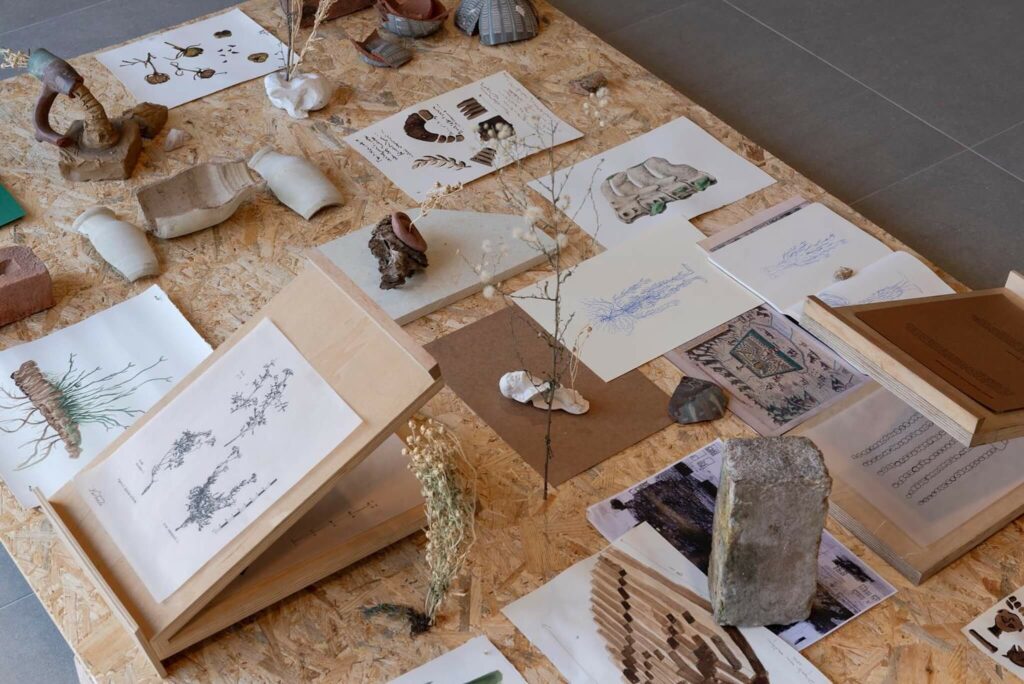
Much like the abstraction in Italo Calvino’s Invisible Cities1, Aksoy interprets these structures, walls, and stones as scabs—similar to the skin that forms over a wound. Scabs are a sign of healing and typically disappear once recovery begins. Treating ruins as scabs suggests a deeper interpretation: the places Aksoy draws upon function as zones of shared human memory. This idea extends beyond a humanist reading of the work.
From Aksoy’s perspective, the remnants of ancient civilizations are not passive fragments of the past. They appear as living terrains where imagined and mental landscapes emerge. This viewpoint references cycles of destruction and regeneration in Mesopotamian history, and touches on shifting political boundaries today. His work avoids linear perspective and spatial depth. Architectural forms—castles, churches, monumental gates, massive walls—appear suddenly and form the skeletal framework of a landscape. Amid brown-hued imagery, the artist introduces green plant motifs suggesting traces of life. These elements bridge the past and the present.
The Syrian Rue plant appears in its real size and form in Aksoy’s installations. In the Scab series, it takes on a metaphorical presence. Although these ruins and lost cities are devoid of human life, the plant becomes a signifier that bears witness to past events across time. Scholars have proposed various theories about the disappearance of ancient cities, including natural disasters such as earthquakes, floods, and social upheavals like war and forced migration. The images in Scab confront viewers with the process of disappearance, giving the works a presence that defies loss. This carries a strong parallel to today’s political reality. Aksoy draws the individual bricks of his monumental walls with meticulous care, emphasizing their enduring testimony. He rescues them from anonymous silence and presents them as carriers of memory and history. By stripping away regional or cultural identifiers, the series extends beyond Mesopotamia and becomes relevant to cultures worldwide.
Following this focus on unrecorded histories, Aksoy began working on a new series titled Beyond the Sea. In this group of watercolors made with ultramarine blue pigment, he reinterprets fragments of mythological sculptures. These figures—such as Caryatids or Eros—evoke stories from the distant past. Aksoy builds on the visual strategies developed in Scab. Once again, he draws on past imagery to suggest messages for the future. The silence of ancient ruins merges with the patina covering statue fragments. This embeds a sense of historical aura deep within the works. But Aksoy does not stop with the atmosphere alone. He constructs images that can be understood through logic and association. He offers viewers visual cues for making sense of the strange, fractured world we live in today.
Dr. Necmi Sönmez studied art history in Mainz, Paris, Newcastle, and Frankfurt. He completed his doctorate at Johann Wolfgang Goethe University with a dissertation on the sculptor Wolfgang Laib. He continues to work as an independent curator and art historian in Düsseldorf.
1 Italo Calvino, Invisible Cities, trans. Işıl Saatçioğlu, Yapı Kredi Publications, Istanbul, 2002
Hüseyin Aksoy, Saha Studio