Dialogues New
DIALOGUES is online publication for contextual and visual essays, experimental writing, interviews and conversations. It is a textual space that brings critical perspectives into circulation and extends conversations across borders, making visible insights and connections that might otherwise be unseen.
If you have a collaboration proposal or an idea for a contribution to the Dialogues, we’d be happy to discuss it.
Meanwhile, we invite you to subscribe to our newsletter and become part of this connected network. We use your email address only to send you occasional updates.
-
CoFutures—Bodhisattva Chattopadhyay and Merve Tabur
The text was previously published in French in the exhibition catalog ARABOFUTURS: science-fiction et nouveaux imaginaires (April 23 to January 12, 2025) at the Institut du Monde Arabe in Paris. The explosion of futurisms in the last three decades as transmedial movements that engage in processes of futuring (i.e. imagining and visualizing new futures) can be termed CoFuturisms. CoFuturisms include, for instance, Afro- and Africanfuturisms, Indigenous Futurisms, Aadivasi Futurisms, Chicanafuturism, Latinxfuturisms, Gulf-futurism, Arabfuturism, Sinofuturism, Desifuturism, South Asian Futurism, Dalit Futurism, Asia Futurism, Andean Futurism, Ricepunk, and Silkpunk, among many others. If one is to define CoFuturisms, it would be as…
CoFutures—Bodhisattva Chattopadhyay and Merve Tabur
The text was previously published in French in the exhibition catalog ARABOFUTURS: science-fiction et nouveaux imaginaires (April 23 to January 12, 2025) at the Institut du Monde Arabe in Paris.

Bodhisattva Chattopadhyay, ‘CoFutures Motif 3: It is interesting to contemplate an entangled bank’. Ħal Tarxien, 2018 The explosion of futurisms in the last three decades as transmedial movements that engage in processes of futuring (i.e. imagining and visualizing new futures) can be termed CoFuturisms. CoFuturisms include, for instance, Afro- and Africanfuturisms, Indigenous Futurisms, Aadivasi Futurisms, Chicanafuturism, Latinxfuturisms, Gulf-futurism, Arabfuturism, Sinofuturism, Desifuturism, South Asian Futurism, Dalit Futurism, Asia Futurism, Andean Futurism, Ricepunk, and Silkpunk, among many others. If one is to define CoFuturisms, it would be as follows. CoFuturisms are the assertion of three rights of equality and vision: the right of everyone to exist, the right to imagine one’s own future, and the right to difference. Such assertion is key to self-representation and a marker of separation from other identities which one might share. Self-representation is particularly important for those whose futures have been (and continue to be) colonized in various ways. Colonization may take the form of continued economic dependence resulting from the machinations of global capitalism, or the continual cycle of wars and coups resulting from geopolitical interventions by foreign powers, or, quite simply, cultural colonization that erases and obliterates other forms of thinking and being in the world.
Hence these futurisms are not tied geographically; they belong to the world as ways of being in the world. Generating their own manifestos, these CoFuturisms now resonate around the world, emanating from the cultural and artistic sphere and transforming into social and political phenomena. These futurisms engage in worldbuilding, imagining possible futures as well as rewiring historical knowledge to recognize what has been erased or left out of history. The philosophy of history as a political project has always recognized future histories as a speculative project, but in CoFuturisms futures are already historical. The apocalypses of the future, such as those resulting from planetary ecocide, are not futures to come but futures that have always been here for people living in the reality of the devastation. There are Arabfuturisms in Europe and elsewhere, just as there are Eurofuturisms in the rest of the world because these futurisms are all constitutive of the other. Difference is carving out a space of existence between worlds: to find a space for some identities that constitute us by separating us from others that constitute us, even if we belong to multiple ones.
Beyond these continuing colonizations, as many formerly colonized states and peoples transform into hegemonies and colonizing forces of their own, the explosion of futurisms is only inevitable, and likely to continue, to the point where futurisms will arise wherever human beings seek to mark their own existence. Other CoFuturisms, such as LGBTQIA2S+ Futurisms, Queer futurisms, Xenofuturisms, and Crip-Futurisms, are for that reason just as inevitable as geopolitically or ethnically oriented ones, since they too emerge from the same basic principles: the right to exist, the right to imagine, and the right to difference. CoFuturisms resist unity and are fundamentally unstable. This is necessary if they are to retain their political potential and charge, since no single movement can be a new form of unifying discourse that erases other identities to assert itself. Beyond and within CoFuturisms, which refer to these movements, lie certain fundamental ethical propositions: propositions that are referred to by the philosophical concept of CoFutures. CoFuturisms are simply an instance of these propositions. These ethical propositions termed CoFutures are generative and motile and permanently in a state of unfolding into instances such as various futurisms.
What propositions are these? To some extent, our unruly capitalization gives us away: in the “Co” of CoFutures. The “Co” of CoFutures stands for six different ethical propositions, of which three are most relevant in the discussion of CoFuturisms: complexity, coevalness, and compossibility.
Complexity is the principle of diversity, and it unmasks uniformity as a totalitarian project. This means that any form of thinking or system-building that seeks to unwrap itself into a new form of totality and unity is inherently suspect. Complexity thrives on the proliferation of identities, values, knowledges, languages, ideas, and constantly seeks new forms of becoming. Uniformity is the totalitarianism at the heart of the political project of nation states, as well as the prison of ideas: it seeks to make everyone look, act, speak, believe, eat, and think the same, and be the same in mind, body, and spirit, rather than support the proliferation of identities that we really are as beings in the world. Therefore, the prisons of totality and uniformity always contain within them the seeds of their own dissolution. Looking at CoFuturisms, it is easy to see why the constant proliferation of new movements has become a defining trait of our times: it is because even CoFuturisms suffer from the risks of being monolithic and totalitarian. As movements, they work only as long as there are temporary conditions of coming together to achieve certain political ends, but they are easy to dissolve and dissipate into ever new forms of togetherness, new futurisms, afterwards. True diversity exists in a philosophical and ethical acceptance of the death of things we consider fundamental, including our values and identities themselves.
Coevalness is the state of things being in the same time, which is perhaps only a principle of respect that challenges the spatialization and weaponization of time. Coevalness means the rejection of a value system that has long colonized the world, whereby some cultures, some people, some nations, some technologies, some religions, some gender, some species, some ways of living and being are futuristic and progressive as compared to others. Such a value system automatically privileges some over others: for instance, one religion (or lack of one) is more progressive because of its espousal of some values while another is backward because it believes in something else, or one part of the world is more advanced and futuristic than another because it has greater technological or financial resources, etc. This value system is the lifeblood of colonialism, which forces the same understanding of teleological progress to the whole world and is backed by international financial instruments, as well as military and political muscle. Coevalness does not force us to suspend our understanding of what is more efficacious or useful, or what one might simply prefer over another. It rather demythologizes time to make us recognize that everything is in the same time, rather than in different times, and values do not stem from things being in different times. It also makes us recognize that what we consider values might just be a function of the resources or the privileges we have.
Compossibility, the third co, is the principle of balance. As a term, it refers to two things being together possible. Many futures are possible, but not all futures are together possible. Some futures, say, ethnically and culturally homogenous, supremacist, and bloodline or purity-oriented futures, are just as possible as futures that aim for diversity, multiplicity, and heterogeneity. Without making a value judgment on which future is preferable, compossibility simply asks us first to recognize that both these futures are equally possible. However, these futures are not possible together since they tend to cancel each other out due to their varying demands on the future. If one is to maintain complexity and coevalness, then compossibility makes it happen by directing us to futures that are together possible. Compossible futures are where different kinds of being and becoming can thrive, where diversity is not merely skin-deep but truly open to infinite kinds of proliferation and combinations, ever evolving more layers of possibilities.
CoFuturisms, as an instance of these propositions, are in the world to proliferate rather than to contain futures. Thus, instead of thinking of CoFuturisms themselves as some sort of coming together of various futurisms, which risks turning CoFuturisms into a monolithic concept and designation, the ”Co” disrupts this coming together except as a temporary state of political affiliation, achieving certain ends and moving on to becoming something else.
Take for instance, Arabfuturism, which is a central theme of this exhibition. In his “Towards a possible manifesto; proposing Arabfuturism(s) (Conversation A),” Scotland based artist-poet Sulaïman Majali conceives of Arabfuturisms in the plural and gestures toward CoFuturistic visions rather than outlining a monolithic futurism movement. Framing Arabfuturisms as a proposition and the manifesto itself as a possibility, Majali refrains from defining the principles and guidelines of an aesthetic or political project. Indeed, in a reinterpretation of the manifesto published in 2015, an extended note explicitly delinks Majali’s conception of Arabfuturisms from its connotations of “movement” and defines futurism as a mode of “anticipating a future,” “a defiant cultural break, a projection forward into what is, beyond ongoing eurocentric, hegemonic narratives.” Rooted in counter-cultural challenges to hegemonic definitions of identity, belonging, and futurity, Arabfuturisms call for an examination and activation of alternate possibilities latent in the present to envision and create diverse futures.
In their invitation to explore different pathways to possible presents, Arabfuturisms’ propositions encapsulate CoFuturistic concerns with complexity, coevalness, and compossibility. One way in which Arabfuturisms aim at complexity is through the sustained critique of reductive and homogenized definitions of identity and belonging. Such critique addresses all forms of othering that seek to suppress the complexity and movement of diverse, entangled, and proliferating identities—or in Majali’s words, “the emergence of an autonomous hybrid sedimentation of identities” (151). Written in a polyvocal and patchy style as an ongoing conversation, the manifesto resists closures, definitions, and completion also in its form. With its emphasis on complexity and breaking down established boundaries, Arabfuturisms are more concerned with proliferating forms of becoming than with defining an ethnofuturist vision.
Searching for new forms of representation “beyond the logic of the state,” Arabfuturisms are as critical of Eurocentric and colonial discourses and Orientalist stereotypes around Arabness as they are of Arab nationalist discourses, which welcome certain identities while suppressing others (151). Moving beyond the logic of the state requires a thorough questioning and dismantling of nationalist discourses through the critical re-examination of history. Such discourses often mobilize restrictive conceptions of origins and teleological conceptions of time to claim the superiority/futurity of a group while relegating others to an insurmountable state of belatedness, backwardness, or lack. Arabfuturisms reject such hierarchical and essentialized divisions between peoples and highlight instead their coevalness. The futures are many; they are everywhere; and they are for everyone to envision and build, even if hegemonic value systems adhere to a hierarchical organization of futurity. The principle of coevalness does not accept such hierarchical divisions at face value and calls instead for an acknowledgement of the histories of dispossession and oppression that underlie power inequalities. This is why the re-examination of history and the unearthing of neglected histories are central features of many Arabfuturist works which imagine the future by rewriting the past. These works often demonstrate how hegemonic claims to the future are founded upon violent and dismissed histories of colonialism, imperialism, and racism. Arabfuturisms underscore the necessity of envisioning futures in conversation with these histories to produce new conceptions of futurity.
As an artist based in Europe, Majali’s Arabfuturist imaginary may have been inspired primarily by the experiences of discrimination faced by diasporic Arab communities in Europe. He writes, “There is something happening in Europe,” and adds “It is a citadel of illusion that has collapsed” (153). Yet, such citadels and their accompanying colonial and nationalist ideologies are not unique to Europe, and they are being challenged across the Middle East and globally by CoFuturisms. Particularly in the past decade, there has been a considerable growth in the number of authors, artists, and filmmakers who employ speculative and futuristic storytelling not only in Arabic speaking countries but also in Turkey and Iran, and their diasporas. Although the discussions around Arabfuturisms have so far focused predominantly on the work of visual artists in the diaspora, Arabfuturisms find expression also in the literature and music produced in the Middle Eastern and North African contexts. Arabic literary criticism often situates texts with Arabfuturist concerns within genre discussions on science fiction, utopia, and dystopia. Yet, many Arabfuturist texts cross genre and media boundaries; they merge classical and modern genres, colloquial and formal registers of language, and combine oral, visual, and performative modes of storytelling with writing. Arabfuturisms are CoFuturistic both in this transmediality and in the sense that their concerns extend beyond Arab identity and Europe toward a more global outlook. In seeking “collaborative genealogies” (153) that can establish solidarities with decolonization and social justice struggles elsewhere, Arabfuturisms invite us to envision different forms of becoming possible together.
References
Chattopadhyay, Bodhisattva. 2021. “Manifestos of Futurisms”. Foundation vol.50(2), no.139. 8-23.Chattopadhyay, Bodhisattva. 2022. “Speculative Futures of Global South Infrastructures.” In Urban Infrastructuring: Reconfigurations, Transformations and Sustainability in the Global South. Ed. Deljana Iossifova et al. SpringerNature: Sustainable Development Goals Series. 297-208.
Chattopadhyay, Bodhisattva. 2020. “The Pandemic That Was Always Here, and Afterward: from Futures to CoFutures.” Science Fiction Studies 47.3. 338-340
Majali, Sulaïman. 2015. ‘Towards a Possible Manifesto; Proposing Arabfuturism(s) (Conversation A)’. In Cost of Freedom: A Collective Enquiry. Ed. Clément Renaud. No publisher. 151-3. http://costoffreedom.cc (accessed 01 December 2023). [The reinterpretation is available on https://futuresofcolour.tumblr.com/post/161897827578/towards-arabfuturisms-manifesto-words-artwork]
Tabur, Merve. 2021. Ends of Language in the Anthropocene: Narrating Environmental Destruction in Turkish, Arabic, and Arab-Anglophone Speculative Fiction. Pennsylvania State University, PhD Dissertation.
Tabur, M. 2024. “Settling the Desert, Unsettling the Mirage: Urban Ecologies of Arab and Gulf Futurisms in Ahmed Naji’s Using Life.” Utopian studies, 35(1): 187-208. https://doi.org/10.5325/utopianstudies.35.1.0187
photo: Bodhisattva Chattopadhyay, ‘CoFutures Motif 3: It is interesting to contemplate an entangled bank’. Ħal Tarxien, 2018
-
A Journey Through Time is a Must! Events and Advent of Arab Futurisms (2024-2X%ø)—Joan Grandjean
The text was previously published in French in the exhibition catalog ARABOFUTURS: science-fiction et nouveaux imaginaires (April 23 to January 12, 2025) at the Institut du Monde Arabe in Paris. The adaptation of science fiction codes by certain artists from the Arab geocultural space has enabled them to present innovative and imaginative visions of the future within an original representational regime in contemporary art. Whether through fantastic archaeology coupled with military SF in In the Future They Ate from the Finest Porcelain (2015) by Larissa Sansour and Søren Lind, or through biotechnological anticipation bordering on absurd dystopia in Party on…
A Journey Through Time is a Must! Events and Advent of Arab Futurisms (2024-2X%ø)—Joan Grandjean
The text was previously published in French in the exhibition catalog ARABOFUTURS: science-fiction et nouveaux imaginaires (April 23 to January 12, 2025) at the Institut du Monde Arabe in Paris.
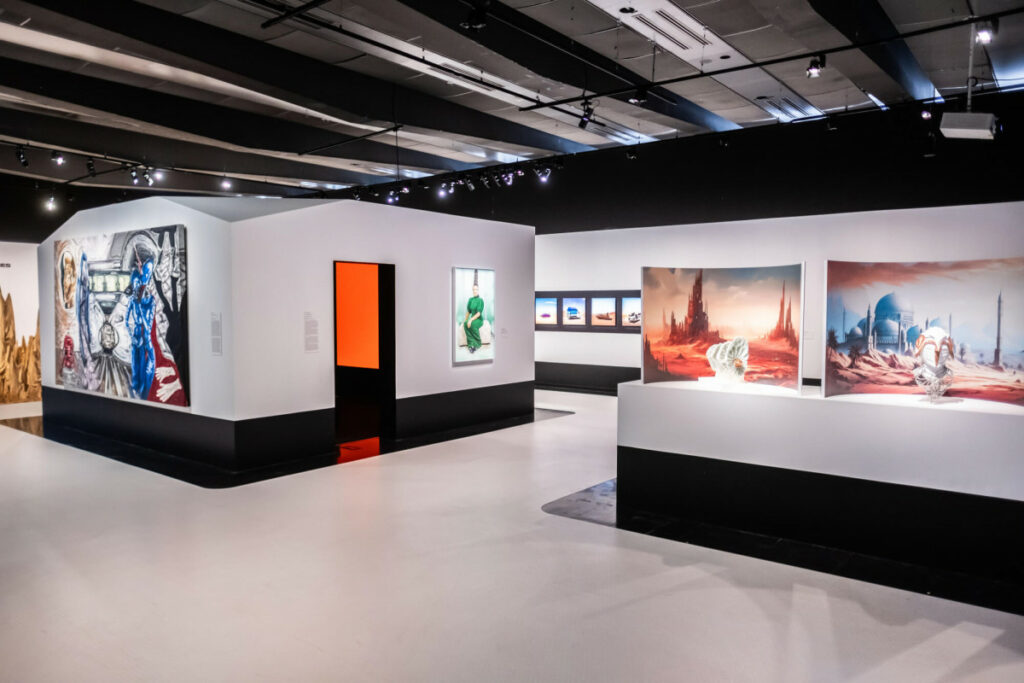
Exhibition view of “Arabofuturs: science-fiction et nouveaux imaginaires” (23 April 2024–12 January 2025), Institut du monde arabe, Paris. From left to right: Zahrah Al Ghamdi, Birth of Place, wood, cotton, clay, water, variable dimensions, 2021–2024; Gaby Sahar, Jour, oil, oil stick and graphite on linen, 330 × 185 cm, 2022; Meriem Bennani, Portrait of Amal on the CAPS, HD digital photography, 123.8 × 82.5 cm, 2021; Skyseeef, Culture is the waves of the future series, five digital photographs, inkjet print on satin paper laminated on Dibond, 2022–2024; Mounir Ayache, episode 0: the leap of faith of Hassan al Wazzan, also known as Leo Africanus, digital installation and joystick, 3 dioramas composed of 3D print and digital images, 2023–2024. Courtesy of the Institut du monde arabe, Paris. Photographer: Damien Paillard. The adaptation of science fiction codes by certain artists from the Arab geocultural space has enabled them to present innovative and imaginative visions of the future within an original representational regime in contemporary art. Whether through fantastic archaeology coupled with military SF in In the Future They Ate from the Finest Porcelain (2015) by Larissa Sansour and Søren Lind, or through biotechnological anticipation bordering on absurd dystopia in Party on the CAPS (2018) by Meriem Bennani, certain works offer a rich and diverse perspective on the possible transformations of contemporary societies. The multiplication of artworks by Arab artists exploring the question of the future has been accompanied by a multitude of events in the form of writings, exhibitions, and cultural programs highlighting the phenomenon of “Arab futurisms,” a label with unstable contours, difficult to define, more or less autonomous, and oscillating between dreamed unity and forced grouping.
Taking as a starting point the exhibition ARABOFUTURS, this essay aims to retrace the presence of certain events that brought together varied bodies of work and discourse, all driven by a shared interest in contemporary Arab art and reflection on the future. We will here attempt to explore the genesis of these artistic events, to return to the key moments that catalyzed the emergence of these clusters of works, as well as the discourses that accompanied them. By tracing the thread of time backward, we will be better able to understand how these dynamics were born, how they evolved, and how they nourished the phenomenon of “Arab futurisms.” So, fasten your seatbelt and prepare for a journey through a four-dimensional art history!
HOW TO “EXPRESS…
ARAB FUTURISMS”Our first journey takes us to Brussels four years ago, specifically between December 2020 and June 2021. It was at Bozar, the Centre for Fine Arts in the Belgian capital, that Arabfuturism was presented in collaboration with the Mahmoud Darwish Chair: a videographic polyptych accompanied by a session showcasing the performance. Owing to the Covid-19 pandemic, the festival was entirely reimagined in a hybrid format, attracting a worldwide audience. It spanned five dates and featured videos by Larissa Sansour and Monira Al Qadiri, and by Mariam Mekiwi and Bassem Yousri. There were also performances by Monira Al Qadiri and Malika Djardi. The link between this selection of works was justified by the fact that they explored “future beyond Arab uprisings and their de/illusions, beyond militarized territories and borders, beyond recent geopolitical narratives within on going civil protests,” but also because they “aim[ed] opening other narratives and critical thoughts on contemporary Middle east and beyond.” Focusing on the theme of “Arab futurisms,” this broad selection revolved around a reflection on science fiction resources to reimagine a notion of Arabness adaptable to the contexts of artistic creation in the early 21st century. Thus it is to be understood as an artistic constellation advocating emancipation from various contemporary forms of violence and oppression through the use of science fiction.
This curatorial approach of bringing together different artists around a theme was not limited to the context of exhibitions and screenings. It is also observable in the press. Nevertheless, while the articles do not provide detailed analyses of the works or the notions invoked, they inscribe this phenomenon within the framework of an artistic movement. Such is the case of “Arabfuturism: How Arab artists are building the world of tomorrow” (2023), published by Farida Ali for Middle East Eye. The author does not hesitate to speak of a “cultural movement” aimed at “reimag[ining] the world of tomorrow,” mixing contemporary artworks, cinematic and literary works, and supporting her argument with historical facts. This article can be read as a mirror to the text “Afrofuturism and Arabfuturism: Reflections of a Present-day Diasporic Reader” (2016) by journalist Lama Suleiman for the Israeli magazine Tohu. There, Suleiman articulated Arabfuturism as a new form of Afrofuturism, one proposed by Reynaldo Anderson and Charles E. Jones as a genre of Afro-diasporic cultural production and a framework for analysis and critique in various fields of Black technocultural studies. Also citing artworks and videos, such as those by Sophia Al-Maria and Larissa Sansour, Suleiman questioned the potential relevance of the concept to elaborate discourse on the cultural production of Arab diasporas, particularly Palestinian ones, with regard to the prospect of a future. Between these two articles, which crystallized the notion of Arabfuturism, Perwana Nazif published in the British magazine The Quietus the article “Arabfuturism: Science-Fiction & Alternate Realities in the Arab World” (2018), in which she stated that “Arabfuturism is a new and necessary artistic movement for countering the xenophobia and racism of Europe and America.”
Beyond the fact that she positions Arab futurisms within an artistic movement—as Farida Ali had done—Perwana Nazif also inserts them into a form of expression specific to the Arab diaspora—as Lama Suleiman had supposed—while adapting it to the various forms of racism present in the West. This article differs from the previous two in that the journalist met with Larissa Sansour and Sulaïman Majali to gather their views on the concept. Larissa Sansour clearly expressed her refusal to define, or even be associated with, the notion. As for Sulaïman Majali, who wrote Towards a Possible Manifesto, proposing Arabfuturism/s (Conversation A) (2015), he does not contest it, but emphasizes the importance of the impossibility of precisely defining Arab futurisms, asserting that this is precisely where its relevance lies: “Because defining is conquering and this is a way of pushing against that. Creating ambiguous versions of oneself. Right now, that’s the most subversive political act we can do.” I contributed to this discussion by adding that “the future of Arabfuturism therefore depends on this subversion,” words that concluded Arabfuturism(S) – Un Phénomène Passé À La Loupe, in ONORIENT (2019). Along similar lines, a review of Bozar’s programming published in La Boussole de la Gorgone (2021) remarked that “labeling has always been a colonial and conquering activity par excellence”, which may explain why “the instigators themselves blur the tracks.” Beyond this dialogical space established through these various writings, it is undeniable that the event organized by Bozar adopted a title that carried within it the weight of these exchanges and reflections. Yet it skillfully avoided the trap of categorization by refraining from offering a rigid definition, instead encouraging the invited artists and the public to forge their own conceptions.
THE STAKES OF “GULF FUTURISM”
BETWEEN APPRECIATION AND ASSIMILATIONLet us now move to Qatar and the United Arab Emirates, where numerous parallel initiatives have fostered forms of futurisms. If only a few are to be named, we could cite the biennial and international symposium “Tasmeem” in Doha in March 2022, themed “Radical Futures;” in January 2021, the launch of the Emirati Futurism Award by the Dubai Culture and Arts Authority and the Dubai Future Foundation; the appointment of artist Lawrence Abu Hamdan as artistic director of the Museum of the Future in Dubai in 2020, as well as the collective exhibition Speculative Landscapes (2019), bringing together Emirati artists Areej Kaoud, Ayman Zedani, Jumairy, and Raja’a Khalid at New York University Abu Dhabi’s gallery (NYUAD), to represent imagined territories.
Though very different from one another, highlighting different actors and overseen by distinct institutions, these initiatives are, overall, the result of the reception of Gulf Futurism. In the Gulf context, the term “futurism” has been used by artists to define a concept related to the region’s modernist ideology and its consequences in the contemporary period, as well as within the context of its artistic globalization. Gulf Futurism as an aesthetic was officially introduced in an interview published in the British magazine Dazed & Confused in November 2012, in which Sophia Al-Maria and Fatima Al Qadiri were interviewed. This interview was accompanied by a series of images—presented in ARABOFUTURS—featuring the two artists in futuristic stagings. In another jointly written text in the same magazine in 2012, they explained that Gulf Futurism documents the Gulf’s futuristic ideology. The latter is characterized by a phenomenon of rapid growth where substantial revenues, mostly from hydrocarbon reserves, are directed toward ambitious urban projects, forward-looking technological advancements, and consumer goods. This sudden change was fully experienced by the two artists as children and teenagers in the 1980s and 1990s, in Doha for one and Kuwait City for the other. Their approach, and more specifically that of Sophia Al-Maria, was therefore to reassess, from 2008 to 2016, certain hegemonic narratives of modernity and the effects of retro culture by engaging in extended interactions in the Gulf on specific subjects through a variety of media (music, writing, video, and contemporary art), deliberately blurring the lines between reality and imagination, tangible science and science fiction, the realization of a utopia and a plunge into dystopia. It is precisely this intermediary position—what Sophia Al-Maria calls the “threshold”—that gives the notion its power, even its critical potential, aesthetically, politically and socially.
SCIENCE FICTION AS A LABORATORY FOR ARTISTIC AND CURATORIAL EXPERIMENTATION
Let us move to Beirut in 2015. In that year, British curator Rachel Dedman brought together the works of Jananne al-Ani, Ali Cherri, Fayçal Baghriche, Ala Ebtekar, Joana Hadjithomas and Khalil Joreige, Assad Jradi, Mehreen Murtaza, and Larissa Sansour for an exhibition exploring the theme of space and SF. Entitled Space Between Our Fingers, the event was spread across five venues in Beirut (The Hangar UMAM, the Arab Image Foundation, Mansion, and the libraries of Ashkal Alwan and Dawawine), thus forming a kind of urban “constellation” situated in a zone of research and documentation where productions of Arab SF—in literature, cinema, and visual arts—were brought together for deep reflection.
In this exhibition, outer space appeared as a formidable tool for developing alternative pathways, not only to terrestrial spatial controversies but also for rethinking new historiographical strategies. In this vein, she sought to continue the reflection by inviting American-Lebanese screenwriter and director Darine Hotait, filmmaker and founder of the Lebanese comic collective Samandal Fadi Baqi (also known as The Fdz), and journalist Yazan al-Saadi to Ashkal Alwan in May 2015 to discuss the perspective of possibility that Arab science fiction might underpin. The discussion attempted to examine questions related to SF’s critical potential, its experimentation with the Arabic language, and the power of the genre’s marginal status in a regional context. Among the topics raised were various platforms and events, such as the Islam and Science Fiction blog (active between 2005 and 2022) by Muhammad Aurangzeb Ahmad in the United States of America, and the Sindbad Sci-Fi platform (active between 2013 and 2018) run by Yasmin Khan in the United Kingdom.
When Khan founded it, her goal was to materialize her desire to research and disseminate this theme to a broad British public, contributing to establishing cultural and artistic links on a European scale. Its activities took shape through a variety of panels held at several festivals to promote the study of SF produced in North Africa and West and South Asia while also focusing on real technological developments in society. This British platform was a key player in the rediscovery of Arab SF, its attempts at definition, and its associated discourses. It was during one of these panels in 2014 that Larissa Sansour presented the early stages of In the Future They Ate from the Finest Porcelain as a premiere. In 2017, Yasmin Khan notably oversaw a section devoted to Arab SF as part of the exhibition Into the Unknown: A Journey Through Science Fiction, first presented at the Barbican in London before touring two other European cultural institutions (2017–2019).
The participants of the roundtable coordinated by Dedman unanimously expressed the need for such a platform in an Arab country, emphasizing interdisciplinarity so that no medium would be favored over another. This did not happen. In continuity with these two events and the reflections addressed, Dedman organized a second exhibition linked to SF and North Africa and West Asia entitled Halcyon, which took place in August 2016 as part of the Transart Triennale in Berlin. The aim of this event was to bring together a group of artists, writers, and filmmakers (Mirna Bamieh, Tom Bogaert, Francis Brady, Darine Hotait, Muhammad Khudayyir, Lynn Kodeih, Mehreen Murtaza, Lea Najjar, Arjuna Neuman, and Larissa Sansour) to explore video and text exclusively, the media of choice for SF.
SCATTERING “ARAB FUTURISMS”
This curatorial formulation follows in the continuity of our most recent journey through time, which takes us to the city of Utrecht in the Netherlands during the Impakt Festival. It was October 28, 2012 when, in a small room at the Kikker Theater, an independent curator by the name of Nat Muller gave a lecture called Arab Futurism. According to her, nostalgia had permeated the Arab world for far too long, casting its veil over contemporary artistic production. However, she had observed that during the first decade of the 2000s, young artists from the Arab world had appropriated elements and temporal structures of science fiction, thereby creating alternative realities and innovative social narratives. Their intention was to weave a critical narrative by evoking themes of territory, history, geopolitics, identity, colonization, occupation, nationhood, alienation, but also possibility, hope, and resistance. What distinguishes the work of these artists is their desire to represent futures. Indeed, most of their works are tinged with dystopia, with dark, oppressive, undesirable, or chaotic societies or worlds. However, glimmers of hope pierce, here and there, the representations they depict. Nat Muller illustrated her argument with analysis of four works. 2026 (2010), by Maha Maamoun, is a short film featuring a time traveler who recounts his vision of Egypt in the year 2026 and his desire for revolution. The videos A Space Exodus (2009) and Nation Estate (2012) present Larissa Sansour’s vision of the Palestinian future, through a space exodus in the first and a futuristic skyscraper housing all Palestinians vertically in the second. In their documentary The Lebanese Rocket Society (2012), Joana Hadjithomas and Khalil Joreige provide an overview of Lebanon’s past space exploration efforts. Yet, in the final part of the film, animation takes over and imagines what the city of Beirut might have become had the Lebanese space project not been interrupted by the Six-Day War (1967) and then the Lebanese Civil War (1975–1990). Collectively, these films address the contexts of Palestine, Egypt, and Lebanon projected into the near future in order to inject them into a referential illusion produced from pre-existing realities. They are very different from one another in terms of aesthetics and working methods; what unites them is their call for awareness of the future while inviting viewers to reflect.
This lecture appears to be the first time the term Arab Futurism was officially introduced. Ten years separate it from the Bozar program, which bears the same title. While the two terms appear identical, a typographic space sets them apart. Yet this particular character, which inserts an empty interval into the text, says much about its formulation. This can be explained by its frequency of use in English—a language known for its organic quality, constantly absorbing new words to create an endless stream of neologisms. If the first question raised here is whether the term Arab-futurism—with or without a space—should be accepted within the history of art, a second question concerns the language in which it is not used—Arabic—though its geography is clearly referenced in its name. Al-mustaqbal al-‘arabi does not, however, sound out of place. While artists such as Wafa Hourani, Larissa Sansour, Maha Maamoun, and Sophia Al-Maria were among the first to adapt science fiction within the register of contemporary art in the latter half of the 2000s, the subsequent arrival of this notion in English reveals the ambition of certain foreign cultural agents to assemble bodies of work in order to establish a space of differentiation. On what basis can this be determined? It could be interpreted as an attempt to deconstruct the notion of a monolithic Arab contemporary art. Indeed, this field progressively took shape at the beginning of the 21st century, not only within the framework of the emergence of an art market in Europe and the Gulf but also in the context of a desire for dialogue between civilizations stemming from cultural diplomacy, and in the wake of the Arab revolutions and conflicts which profoundly reshaped regional geopolitics by creating new borders. These borders also carry an ideological dimension that has continually fueled a process of neo-Orientalist categorization, perpetuating a canon of otherness.
Should the reading of this art history thus begin with the study of the works themselves, or rather with the analysis of the discourses generated by the events that bring them together? A transnational and comparative approach would offer a perspective for rethinking the modes of perceiving the arts of the Arab geocultural space and their relevance to questions of the future. By placing this approach at the heart of institutional and artistic practices, it would become possible to deeply question the dynamics between knowledge and power. Contrary to Sulaïman Majali’s assertion that the strength of Arab futurisms lies in their indefinable nature, it seems rather to manifest in the recognition of the diversity of the individual voices involved—each contributing to the weaving of unique narratives, both in artistic creation and in its promotion by criticism and institutions. From this perspective, the exhibition ARABOFUTURS arrives at a timely moment. While it is one of the first events of its kind to take place in France, it also brought together three worlds of Arab futurisms: the artists, the institutional discourse, and the academy. Consequently, it opens new perspectives for discussing a phenomenon that will remain a subject of debate for some time to come.
“What if…” for Arab futurisms in art history? That is the question!
Joan Grandjean is an art historian specializing in contemporary art from the Arab world. He completed his PhD at the University of Geneva with a thesis on “Arab futurities” in contemporary art. From 2017 to 2024, he served as an academic assistant in Geneva and is currently a lecturer at the University of Rennes 2. His research explores the intersections of contemporary art, globalization, and imagined futures. His recent publications include co-editing “Photographe et Politique,” a double issue of the journal Tumultes(2023) with Prof. Dr. Christophe David, and the exhibition catalog Arabofuturs: Science-fiction et nouveaux Imaginaires (Institut du monde arabe, Paris, 2024) with Élodie Bouffard and Nawel Dehina. He is currently completing a book on Arab and Iranian artwork donations to the United Nations with Prof. Dr. Alexandre Kazerouni and Prof. Dr. Silvia Naef (2026). He is actively involved in several academic associations, notably ARVIMM and the Laboratory of Imaginaries, and co-founded the Manazir platform.
-
Halos of History and Memory: Threshold Rhythms in Yasmin Nourbakhsh’s Works—Pariya Ferdosse
Yasmin Nourbakhsh’s works use erasure and traces to create liminal spaces between presence and absence. Material memory and disrupted patterns invite selective perception, framing politics through displacement. The Iranian garden and carpet become sites of inquiry, merging beauty with critique.
Halos of History and Memory: Threshold Rhythms in Yasmin Nourbakhsh’s Works—Pariya Ferdosse
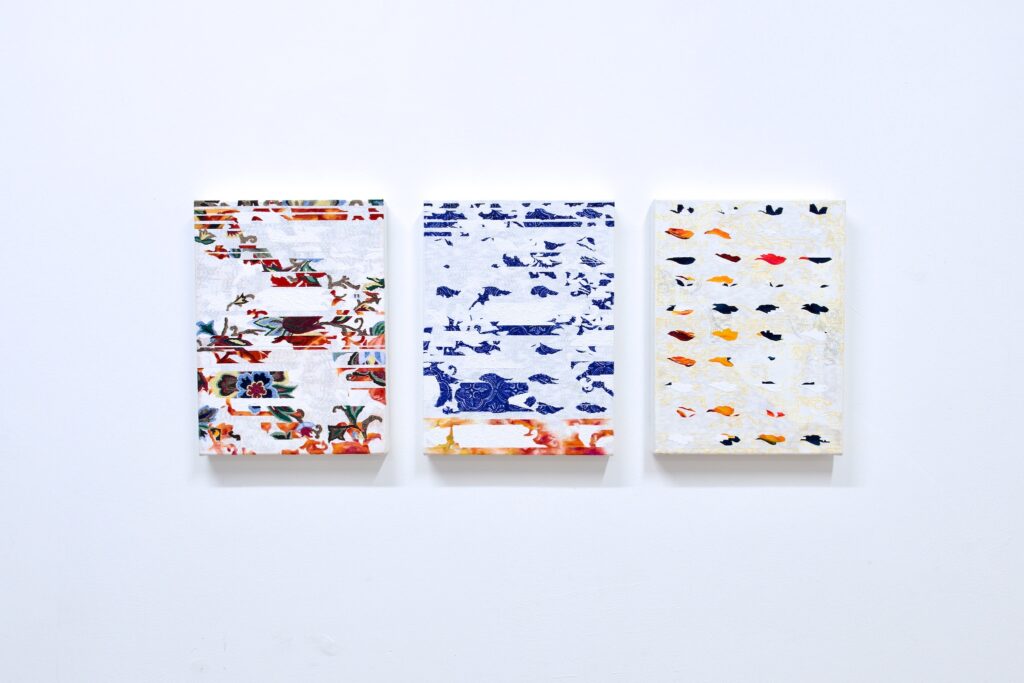
Yasmin Nourbakhsh, Soft Delete; Once Vivid;, Unseen Wholeness, 2025, Oil, acrylic, quartz sand and image transfer on canvas
exhibition Acts of Conflactions, Galerie AC. Art & Dialogue, Berlin 2025, courtesy of Sumac SpaceThere is no outside-text.
The trace is not a presence but the simulacrum of a presence that dislocates, displaces, and refers beyond itself.¹
_Jacques DerridaField of Vision… Field of Narrative
Yasmin Nourbakhsh’s works are not isolated objects but situational configurations: each generates a situation—a perception, a memory, a narrative. These are layered and liminal, occupying a space neither fully here nor there—mirroring where the artist lives: between Iran and the UK, between languages and memories; never entirely in one place.Yasmin Nourbakhsh’s work explores politics on a microscale, revealing it in the empty space where a pattern might have continued or in a colored shadow falling from glass. Rather than emphasizing slogans or grand icons, Nourbakhsh shifts our field of attention. In her art, politics is about how attention is regulated: she displaces the center and margin, alters intensity, and plays with light and dark.
Trace, Erasure, Palimpsest
Derrida uses the term trace for that subtle sign of absence that simultaneously enables meaning and its indeterminacy. Derrida’s trace signals both presence and absence; it always points beyond itself, remains unstable, and keeps meaning alive through continual interaction with other signs. In Nourbakhsh’s works, traces appear as thin layers of erased paint or partially covered images. Rather than stabilizing form, she suspends it; rather than making narrative uniform, she emphasizes ruptures. The work becomes a palimpsest: earlier writings emerge beneath the new—erased yet present, spectral.Walter Benjamin, when writing about “the true image of the past that flees in fragments and signs,” articulates precisely this logic: history is neither linear nor continuous; it shines in the flashes of moments, in fragments and seemingly insignificant grooves. Nourbakhsh frames these small sparks by shifting minor elements—a piece of vintage glass, an incomplete pattern, a faded floor plan, or a sliced map—inviting the viewer to listen to the fragment rather than merely observe the whole; a fragment that carries history.
Erasure in Nourbakhsh´s practice is not merely a formalistic gesture; it is not merely folding a surface for beauty, but rather revealing the politics of concealment. Erasure in her work is both an aesthetic and epistemic strategy: by removing parts of a pattern, covering sections of an image, she raises the question: What is seen? What is erased? Who decides? These questions mark the point where the critique of representation begins.
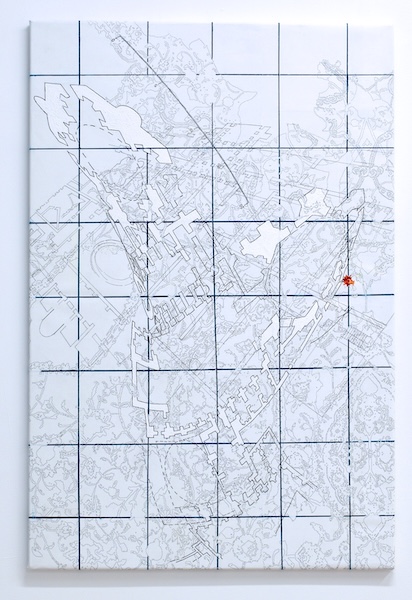
Yasmin Noorbakhsh, Reverse Palimpsest, 2022
80×120 cm, Acrylic pen, oil stick and image transfer on canvasSelective Perception
Every perception is selective. We see the world through filters we conceal: visual habits, media, collective memory, cultural biases. Nourbakhsh makes this selectivity the subject of her work. The repetition of motifs and modular grid form, when deliberately broken or incomplete, draws attention to the act of choice itself: a pattern can continue but is interrupted; why and how? A background sound may rise but remain on the threshold of audibility; for what reason? These threshold zones are the liminality of perception: boundaries where seeing/not seeing occur simultaneously, forcing the viewer to recalibrate their position.This selective perception in Nourbakhsh’s work extends beyond the material itself; it also carries the memory of the material—what touches a fabric recalls, what scratches a glass retains, and the paths colored threads have followed—each element becoming part of the work’s logic. Nourbakhsh works with tactile sensitivity: slow, precise, with deliberate pauses and thoughtful returns. In her work, memory and material engage in a dynamic dialogue; as a living archive, memory transforms from outcome to process, from action to being.
Nourbakhsh brings this duality to the surface: the beauty of a pattern beside the wound of erasure; symmetrical repetition alongside a gap of removal. In this sense, her works become a space where beauty and wound coexist, where the viewer moves from formal fascination to a deeper political inquiry.
In-betweenness and liminality
Nourbakhsh lives in a diasporic condition. This in-betweenness is not just geographical; it shapes the work’s being. Her work and life are dual and multilayered: languages overlap, translations slip, signs shift—Persian/English, text/sound, image/word. Translation is not a solution for understanding; form becomes difference. Where pattern is complete, a gap appears; where narrative takes shape, silence arises; where material seems familiar, something foreign emerges.Meanwhile, the presence of the Others from East in West—a subject discussed by Edward Said—is actively staged in Nourbakhsh’s work. Said argued that the Eastern Other (here: the West Asian Other)
In Western representational history, it is always constructed under the influence of power. Nourbakhsh reverses this logic: rather than aligning signs to confirm cultural expectations, she displaces and disrupts them. Familiar patterns are left incomplete, pleasant colors are juxtaposed with material silence, and nostalgic narratives are interrupted by signs of anxiety.
Her work disrupts the game of representation: instead of the East appearing as a consumable image in cultural vitrives, the vitrives themselves become sites of inquiry. Patterns, geometric motifs, and bright colors, stained glass: rather than fixed markers of authenticity, they become tools of critique. Here, the artist is not an exoticized subject but an agent of meaning; someone who disrupts the rules of seeing and shifts the position of the dominant gaze.
Nourbakhsh’s works create liminal spaces: thresholds between presence/absence, seeing/not seeing, speaking/silence. These manifest in the material (semi-transparent glass, worn fabric, unstable paint), form (incomplete patterns, disrupted geometry, broken frames), and meaning (narratives that begin but continue through the viewer). The audience becomes a co-author, filling gaps and generating meaning through their engagement.
Liminality shapes the ethics of engagement: Nourbakhsh’s work stands between formal pleasure and political provocation, keeping viewers at the threshold. This is also a curatorial gesture: the display creates a rhythm of near/far, light/dark, sound and silence/silence so that being on the threshold is experienced.
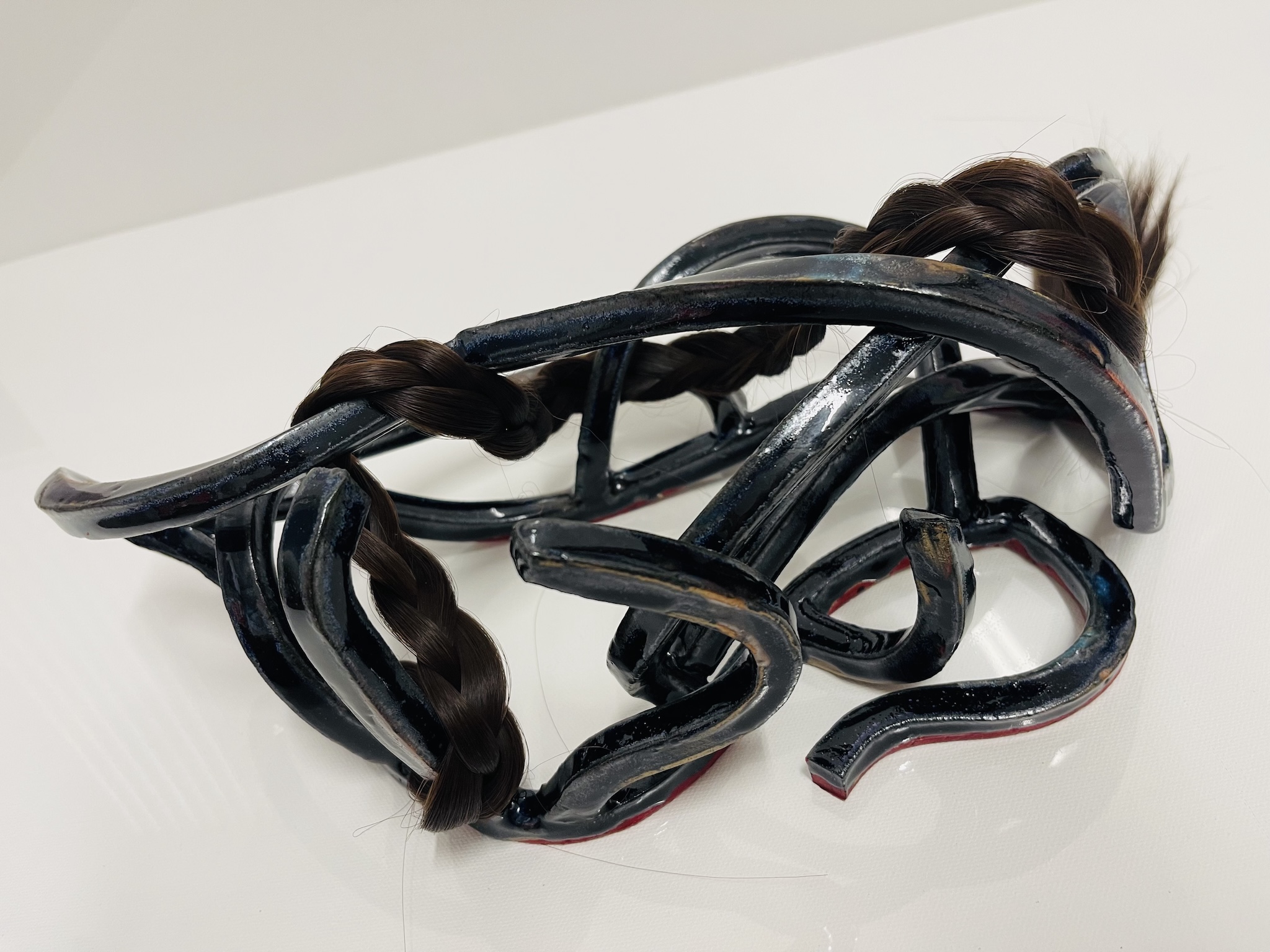
Yasmin Nourbakhsh, Unowned Ravel, 2023, double glazed stoneware ceramic sculpture and human hair Thinking Material
Material memory is a term describing Nourbakhsh’s relationship with material and effective image transfer. The painting surface, ineffective Quartz, masked edges, dust, and paint stains all carry time. Material is not merely something to work with; it is a deposit of time. Nourbakhsh treats material not as a servant of ideas but as a co-thinker. Hence, the acts of touching, washing, masking, collaging, cutting, removing, and placing all become conceptual gestures.This organic quality of pattern is evident: patterns grow, are cut, regrow; like plants, like skin, like memory. When a pattern is erased, its trace remains; when removed, its absence becomes active; when repeated, meaning transforms. This repetition/erasure simultaneously tests the semiotic system and our perceptual system.
Two Metaphors of Life-Space
The Iranian Garden and carpet in Nourbakhsh’s works serve as spatial metaphors that weave the themes of memory, refuge, and order. The carpet is the portable ground of the home; a soft geography on which we sit, sleep, and narrate. The carpet is a site of memory: fibers record footsteps; knots count moments. In Benjaminian reading, the carpet is “a miniature stage of history”: fragmented, layered, with margins and gaps. Nourbakhsh removes this scene from mere decoration, turning it into a site of inquiry: which narratives are fixed on the carpet’s surface and which are lost in its pile?The Iranian Garden, with its fourfold layout, waterways, light, and shadow, is reread in Nourbakhsh’s work as a site of control and uncertainty. The garden embodies a desire for heavenly order amidst worldly disorder; yet nature always overflows: a branch outside the line, a root breaking stone, water seeking its own course. Nourbakhsh exploits this duality: geometric patterns of the garden sit alongside organic growth patterns, showing that every order speaks with the life of disorder within itself.
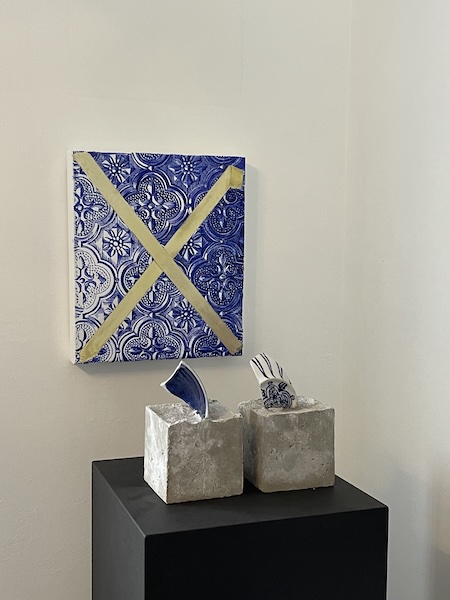
Yasmin Nourbakhsh, Sound Barrier, 2022, oil and acrylic on canvas
Sculptures: Set in Stone, 2022, hand glazed stoneware and concreteFrom Trace to Recognition
Yasmin Nourbakhsh’s works employ strategies that ultimately lead to recognition: the recognition of memory traces in material, the recognition of erasure as a tool of seeing, and the recognition of the Other as the viewer. This recognition is not a nostalgic return to origins, but an invitation to live with gaps: gaps in languages, geographies, and narratives.Nourbakhsh, as artist/researcher, demonstrates how beauty can be apprehended—without overlooking politics—and how politics can be enacted—without sacrificing formal subtlety. Through the economy of layering and erasure, the rhythm of repetition and rupture, and her sensitivity to material and time, she creates an experience where the audience not only sees but also thinks, hears, touches, and remembers.
What remains is “art as a living archive”: an archive that asks what is seen and why, what is erased and how, what remains and at what cost. And also “art as threshold”: a place to stand, pause, pass; a site where new possibilities of perception and dialogue are opened.
Nourbakhsh reminds us that memory is never fully present, yet its trace remains in material; repetition is never flawless, yet erasure aids seeing; the Other is never merely an object but can be a subject of the gaze; and text is never alone, always breathing in a network of other texts. It is in this networked breath that her works grow: organic, resilient, continuously reweaving themselves; like a garden whose geometry is meticulously arranged yet surprises with new growth each morning.
Pariya Ferdos[se]
Tehran, Semptember 2025References
- 1Derrida, Jacques. Writing and Difference, Translated by Ahmad Aram, Tehran: Nashr-e Ney, p. 45.
- Benjamin, Walter. Illuminations: Essays and Reflections. Edited by Hannah Arendt. Translated by Harry Zohn. New York: Schocken Books, 1968.
- Said, Edward. Orientalism. Trans. Dr. Abdolrahim Gavaahi, Tehran: Nashr-e Farhang-e Eslami.
- McAfee, Noel. Julia Kristeva. Trans. Mehrdad Parsa, Tehran: Nashr-e Markaz.
- Benjamin, Walter. The Author as Producer. Translated by Iman Ganji and Keyvan Mahtadi, Tehran: Nashr-e Zavosh.
- Adorno, Theodor, Judith Butler, and Georg Lukács. The Politics of Essays. Translated by Saleh Najafi, Morad Farhadpour, Reza Rezaei, and Amir Kamali, Tehran: Nashr-e Ney.
- Benjamin, Walter. On Language and History. Selection and Translated byMorad Farhadpour and Omid Mehregan, Tehran: Nashr-e Hermes.
- Noorbakhsh, Yasmin. Who Is It That Can Say Who I Am?: Reconfiguring Art in a Liminal Space. Critical Model dissertation
-
On Radicals Between Trees and Dicks—Agil Abdullayev in conversation with Davood Madadpoor
Davood Madadpoor. From what you said, Radicals Between Trees and Dicks is the result of several years of research you’ve done into the queer cruising culture in Azerbaijan, the Caucasus, and Central Asia. You visited around thirty different cruising spots—parks, saunas, and other hidden places. There, you spoke with people who shared their stories and experiences. You also included your memories in the work. All of this came together in a video composed of eleven acts. In it, you blended these personal stories with the broader social and political pressures that queer people face in these regions. Five dancers were…
On Radicals Between Trees and Dicks—Agil Abdullayev in conversation with Davood Madadpoor
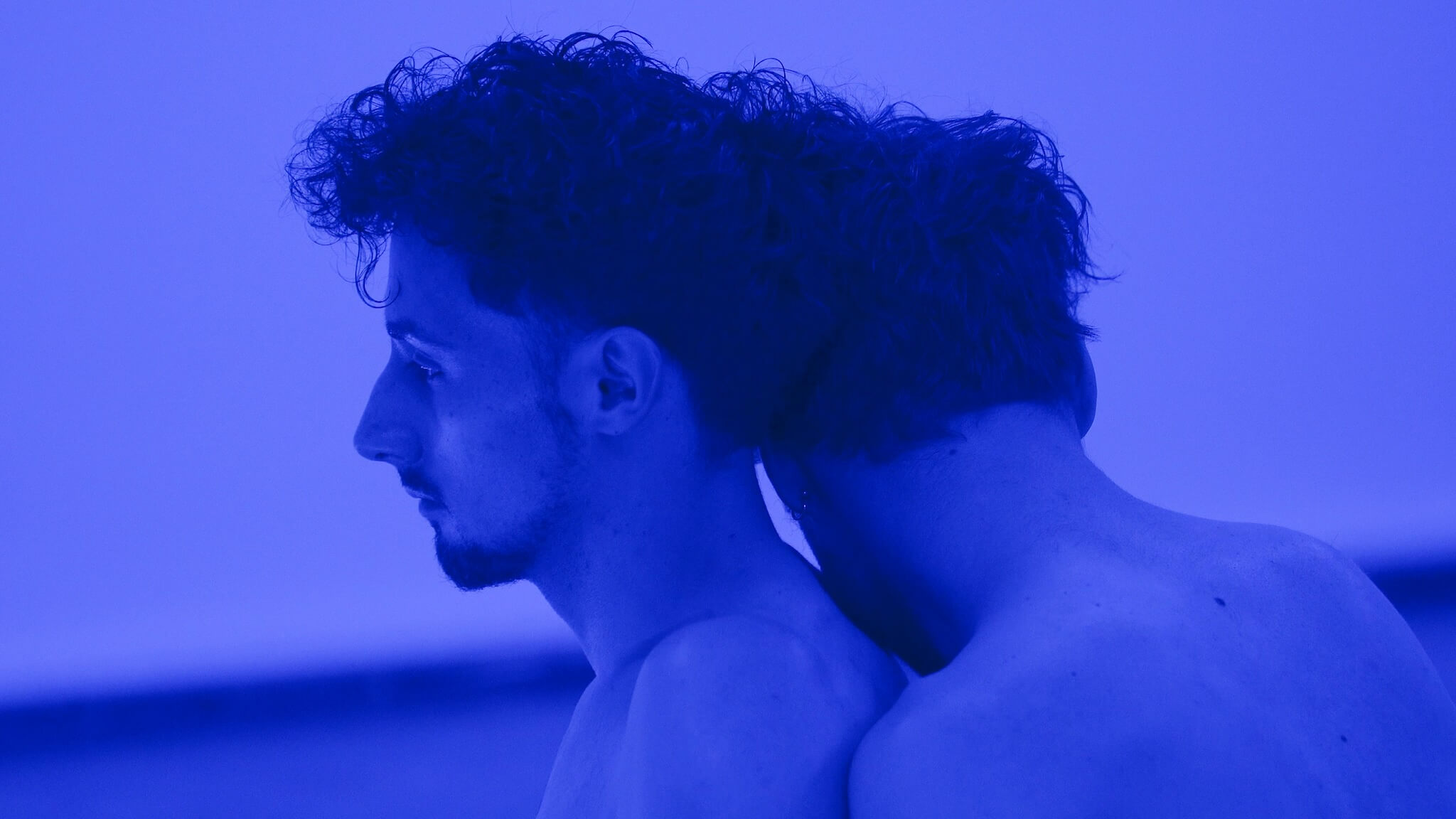
Still from Radicals Between Trees and Dicks, courtesy of artist Davood Madadpoor. From what you said, Radicals Between Trees and Dicks is the result of several years of research you’ve done into the queer cruising culture in Azerbaijan, the Caucasus, and Central Asia. You visited around thirty different cruising spots—parks, saunas, and other hidden places. There, you spoke with people who shared their stories and experiences. You also included your memories in the work. All of this came together in a video composed of eleven acts. In it, you blended these personal stories with the broader social and political pressures that queer people face in these regions. Five dancers were cast to choreograph and perform the collected stories, giving them physical and emotional presence. In addition, you referred to Azerbaijan’s cinematic history.Can you walk us through these acts, your process, and how they are interconnected?
Agil Abdullayev. All eleven acts in the film form a constellation rather than a sequence, not built to be read linearly, but to be felt relationally. Each act arises from a mode of queer endurance—looking, waiting, touching, withdrawing, fleeing—not as narrative events but as psychic and bodily states that recur across space and time. They do not resolve; more likely, they resurface.
The research spanned over thirty cruising locations across Azerbaijan, the Caucasus, and Central Asia, including public toilets, abandoned parks, shadowed forest paths, and saunas reclaimed in silence. I approached these sites as unstable topographies—sometimes haunted, sometimes overflowing, and always in flux. At times, some existed only as memories, carried in the voices of those who once moved through them. These sites became intervals—temporal clearings opened by desire and risk, emerging only under certain conditions: dusk, solitude, heat, fear, and proximity.
I tried to gather at least one audio interview from each location, but this wasn’t always possible. Sometimes it was unsafe, or people declined to participate. In those cases, what remained were my own observations. These were fragments written down hours later, gestures remembered by the body rather than captured by voice. Absence became a kind of data, a material in its own right—charged, resistant, opaque. These were developed into performances.
These acts are what I consider emotional architectures—ways people relate through repetition, breath, and rhythm. The film unfolds choreographically. Acts collapse, recur, and reconfigure. This structure mirrors the affective rhythm of cruising, a practice of seeking connection that rarely moves in a straight line. Cruising is elliptical: it loops, waits, and doubles back. This is why the film carries that same rhythm—in structure and breath.
In performance, working with queer performers was essential. They did not need personal histories of cruising in parks or clubs, such as LAB in Berlin. Instead, they needed to understand the subtleties of queer language and hold ambiguity without explanation. I wasn’t interested in literal reenactment. We also used micro-gestures from interviews—shifting a jacket, turning a face, or slowing a step. These gestures carried memory and passed from one body to another, like oral traditions. Dancers became vessels, interpreting emotional charge instead of narrative content.
Each act is shaped around a particular weight or frequency. Act I is not an introduction, but a disorientation—an invitation to dwell inside uncertainty. Later acts hold heavier political tension, but never address it directly. Even the most charged sequences maintain some opacity. The acts are linked by tonality, not plot—like movements in a score. In that sense, the film is more a fugue than a documentary. Its structure allows memory, fear, shame, and desire to blend into each other without the need for resolution.
I didn’t want to map cruising spaces in a documentary sense. I wasn’t interested in cartography, but in conditions. What must be true—socially, politically, sensorially—for these spaces to appear? In this way, Radicals Between Trees and Dicks becomes less a film about cruising, and more a film that cruises. It drifts between textures of vulnerability and resistance. The film touches histories both personal and collective, and always remains slightly out of reach.
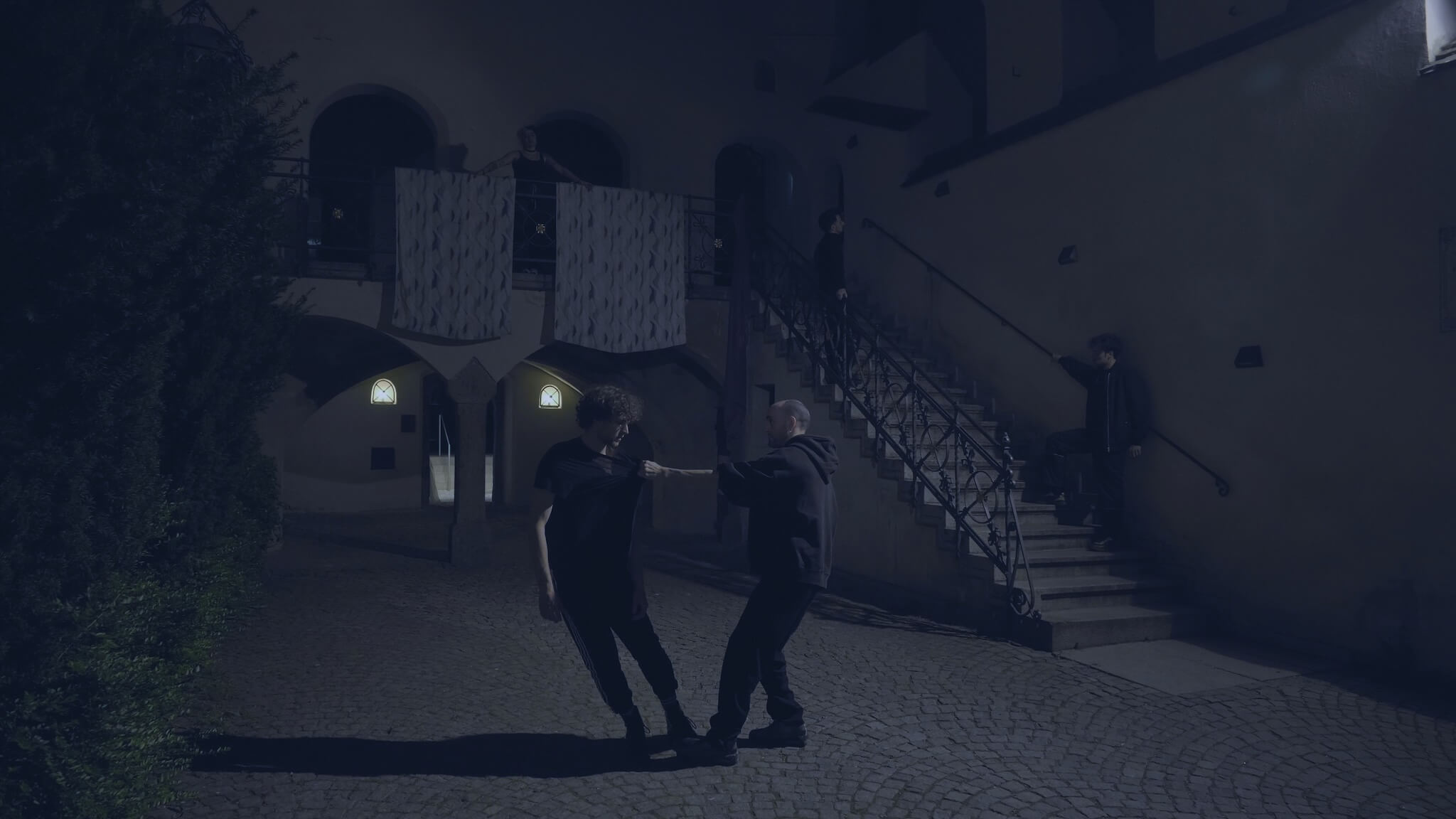
Still from Radicals Between Trees and Dicks, courtesy of artist 
Still from Radicals Between Trees and Dicks, courtesy of artist Davood. You work across film, photography, and painting, each with its strength—film’s temporal flow, photography’s stillness, and painting’s material presence. How do you use the special qualities of each to explore queer life, and how do they come together or clash in your work?
Agil. I don’t start with a medium. Instead, I begin with a question that slowly inhabits many forms. Painting, photography, performance, sculptural installation, and moving images don’t work in isolation for me. They are part of one ongoing body, each leaking into the others. A painted surface might still come from a video still. A filmic movement might mirror absence within a photograph. These references build until boundaries between media collapse.
Art is the only language I know that allows me to be heard without needing to fully explain myself. It’s how I make sense of what cannot always be said. Each medium in my practice is a way to approach silence. Photography’s stillness allows contemplation of erasure. Painting’s texture gives weight to absence. Film—being durational—allows the effect to unfold in fragments. This intermediality is essential to my practice. It reflects how queer life itself cannot be contained in a single form or narrative thread.
Davood. Your films begin in personal histories—childhood memories, diary entries—and grow into shared archives where individual and collective memories mix. In which moments or through which methods do you choose to blur the line between your own story and the broader queer archive? How does this merging open up new possibilities to build shared narratives? And how do you decide when to protect, distort, or reveal identities—especially in politically repressive situations?
Agil. The line between my memory and the collected archive is not something I intentionally blur. It becomes porous through how I approach people and experiences in research. I don’t separate what I encounter in the field from what I carry within myself. Whether it’s a conversation with someone in a park at dusk, or the feeling of a site lingering after I’ve left, these experiences inhabit me. I approach subjects—people, gestures, or landscapes—as I would experience in my own life.
Everything we experience leaves a trace within us. Research does too. What I hear, what I witness, and what I’m trusted with all become part of the emotional architecture of the work. The boundary between personal and collective dissolves—not because I force it to, but because they are already intertwined. Memory is relational. It’s built in proximity to others. The personal and collective don’t sit side by side; they fold into each other.
In this fold, I begin to build a shared archive. It’s not one that aims for historical completeness, but one that makes room for contradiction, opacity, and feeling. The stories shared with me are not simply data or testimony. They become part of a wider, unstable terrain of queer survival.
In politically hostile contexts, especially in post-Soviet regions, visibility is always a double-edged sword. It can empower, but also expose someone to danger, violence, or erasure. Many people I spoke with requested that they not be filmed or that their voices be excluded from the recording. I respect these boundaries completely. That’s why I invite performers to embody anonymized gestures. Through this process, performers also become part of the story. Many voices in the film are re-voiced by actors or digitally altered. These distortions are not about concealment. They are acts of care, preserving intimacy without reducing it to something easily consumed.
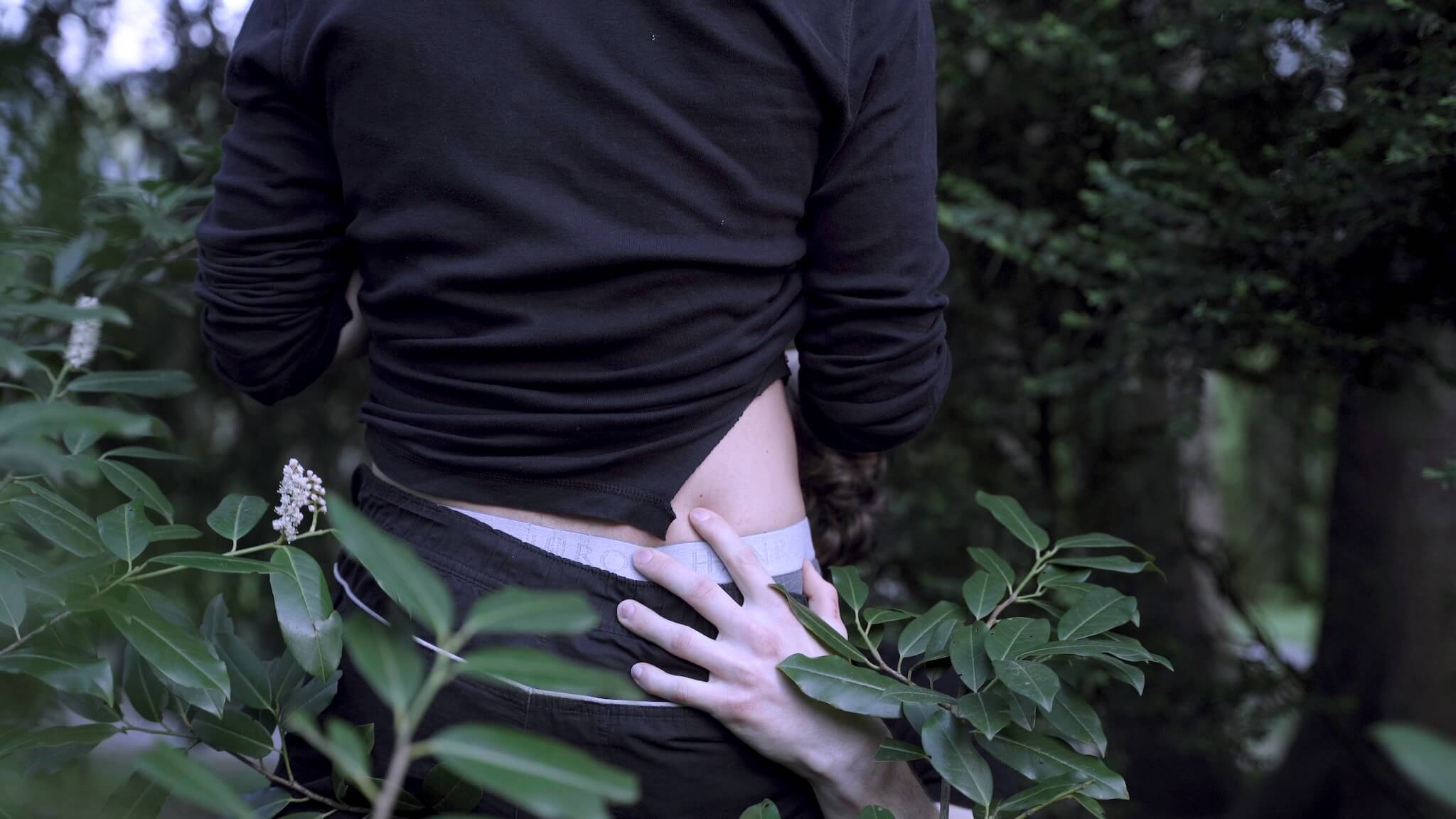
Still from Radicals Between Trees and Dicks, courtesy of artist Davood. I read that you, by revisiting “queer intimacy, self-reflection, anger, fear, and belonging,” aim to create a space of “hyper‑possibility” as sites where queer narratives aren’t handed down but actively fractured and remade. Can you elaborate on this, and how do you conceive the capacity of these hyper‑possibility spaces?
Agil. “Hyper-possibility” refers to how queer life must imagine itself beyond current conditions. In cruising, you enter a space that exists within, but also against, the city. It is part of the city, but not sanctioned. That duality creates a special imaginative force. The abandoned train yard in the final act of Radicals in Between Trees and Dicks is a scene of possibility. Will someone arrive? Will something happen? Or will you just wait and walk? That uncertainty is political because it refuses finality. In doing so, it becomes a form of hyper-possibility. It’s not just a lack of resolution. It is an opening to what hasn’t yet been imagined. This uncertainty is generative. It is full of potential for new configurations of desire, presence, and encounter.
Davood. It seems these spaces don’t deliver a single, coherent queer story but rather assemble fragmented moments that break conventional gazes and invite open room for surprise—rebellious joy, playful rage, and shared care. How does the fragmentary nature of your “hyper‑possibility” spaces generate new relational modes and emotional registers instead of simply transmitting pre‑formed queer narratives?
Agil. Fragmentation allows for multiple entry points. The film doesn’t provide a single story of queer life in the region. That would be a kind of violence. Instead, it accumulates impressions—like sweat in a shirt or the echo of footsteps in a dark corridor.
It is a method. It is an ethic. It allows me to sidestep dominant narrative structures and instead invite the viewer into a space of emotional attunement. Fragments ask you to assemble, but they never promise completion. They invite a different kind of attention—a more sensitive, intuitive relation to the work.
Davood. You draw on Soviet‑era Azerbaijani film aesthetics—not out of nostalgia but as raw material to be re‑coded into a queer archive through appropriation and formal intervention. What specific cinematic techniques or aesthetic codes from that film history did you appropriate, and how do they function within your work to challenge or subvert their original ideological purposes?
Agil. I delved into Azerbaijani cinema from the 1960s and 1970s a long time ago, while working on another film, If the Sun Sees You, which took its point of departure from Nizami’s Seven Beauties. I was drawn to these films immediately—they seemed to speak a visual and emotional language that resonated deeply with my own practice. Those films didn’t fully serve the state narrative, but also didn’t entirely rupture from it. Beneath their ambiguity and melancholic masculinity, I sensed an artistic tension that mirrored the kind of emotional undercurrents I often explore in my work.
These films, shaped by censorship, ideology, and scarcity, developed a language that feels ripe for reinterpretation. Their theatrical blocking, static frames, and muted tones were survival strategies. I don’t approach them with nostalgia, but as unresolved codes—forms waiting to be queered. In my own work, I retain this grammar but shift its gravity—from nationalism to queer affect, from collective ideals to emotional vulnerability.
Performance becomes a site for re-reading. I also turn to Azerbaijani folk dance, not as heritage but as choreography of gender. Male dancers were trained to embody dignity, strength, and restraint—gestures tied to patriarchy and militarized masculinity. In my work, I fragment and distort these movements: a lifted chest collapses, a sharp turn slows to hesitation. What happens when such gestures are re-inhabited by queer bodies, when pride softens into tenderness?
What emerges is a counter-folklore—a choreography of deviation. The body ceases to serve the state and instead holds memory, desire, and loss. Dance becomes a way to deconstruct and reinhabit the past—not as ideology, but as emotion.
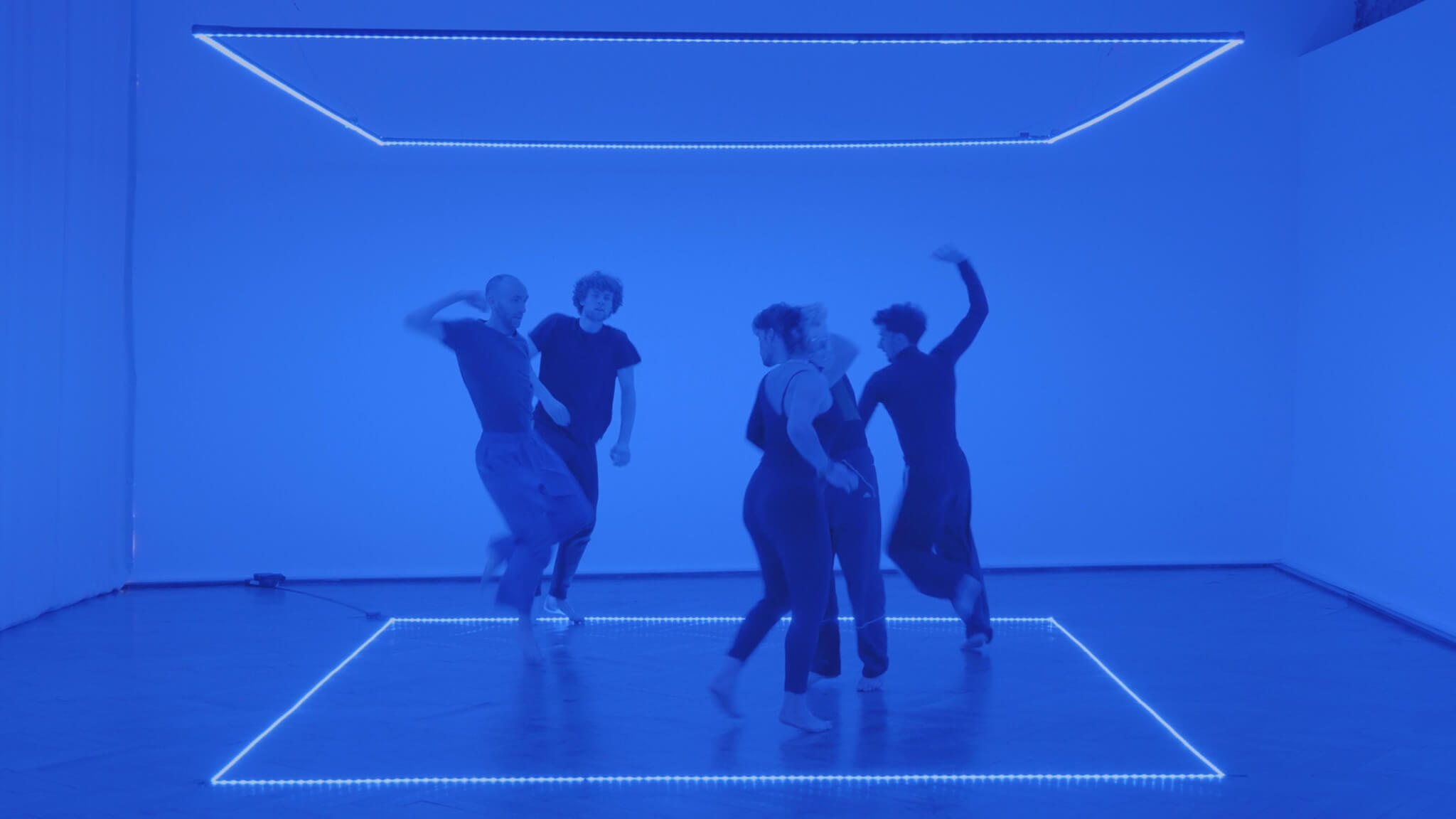
Still from Radicals Between Trees and Dicks, courtesy of artist Davood. The 2022 Russian mobilization and the resulting militarized surveillance disrupted cruising circuits, turning encounters into acts of resistance. How did the war‑driven rapture of cruising under Putin’s mobilization reshape the political dimension of those spaces in your film, and in what ways do you see cruising operating as a tool of queer dissent?
Agil. The political dimension of cruising shifted dramatically over the course of the research—almost in parallel with the transformation of my own role within these spaces. When I began the project in May 2019, the terrain already felt unstable, but it was still navigable. Over the following years, so many ruptures occurred: the outbreak of COVID-19 and global lockdowns, the closure of queer-friendly bars and community venues, the hardening of borders between Azerbaijan and its neighboring countries, the growing criminalization of LGBTQ+ life across the post-Soviet region, and a general intensification of surveillance and isolation. These events changed the world around me—so organically, they changed my relationship with work.
Even my own body changed during this time. During lockdown, I gained significant weight, and that physical transformation also altered my position within cruising culture. I became less of a participant and more of a witness. This shift was deeply personal, but also methodological: it marked a move from being inside the scene to observing how scenes themselves dissolve and reassemble. The project became less about the act of cruising and more about its disappearance—its conditions, its ghosts.
But it was the Russian invasion of Ukraine in 2022—and especially the first military mobilization in September—that fundamentally altered the political atmosphere in the region. I was in Tbilisi when the mobilization was announced, and suddenly the city became a refuge for queer people fleeing conscription in Russia. The air was thick with fear, uncertainty, and exhaustion. People didn’t know if they would be forced back, if new borders would close overnight, or if the war would expand. The sense of instability was no longer abstract—it was in every conversation, every gaze exchanged in the dark.
Within this context, cruising shifted from being a covert act of desire to a precarious form of resistance. Meeting someone in a park or a forest clearing, in a time when borders were closing and bodies were being conscripted into violence, became a radical insistence on relationality. Cruising asserted: I still exist outside the machine of war. I still desire. I still refuse to be folded into the logic of nationalism or death.
In the film, this transformation is not dramatized; instead, it is felt. The latter acts become quieter, darker, and more anxious. Encounters are more fleeting, gestures more cautious. I didn’t feel it was ethical—or even possible—to record the rawness of these moments directly. Instead, I turned toward abstraction: sound becomes muffled, bodies are partially obscured, and choreography replaces representation. The uncertainty of the moment demanded a new form of listening, a new ethics of presence.
This period reshaped not only the content of the work but my entire methodology. It forced me to slow down, to accept disappearance as part of the process. It taught me that some stories can’t be captured, only felt around the edges. Cruising, in this sense, operates not just as a form of queer intimacy, but as a fugitive politics—one that resists state violence not through confrontation, but through persistence, through softness, through remaining unpredictable and ungovernable.
-
Spiral Images—Necmi Sönmez
Since the early 2020s, Hüseyin Aksoy has been developing a distinctive visual language in his Istanbul studio through painting, video, installation, collage, and works on paper. His practice is deeply rooted in the cultural identity of Mesopotamia, the region where he spent his childhood and youth. In his research-based and observational works, Aksoy is drawn to ancient settlements, cities, and ruins that have disappeared from modern maps. These sites serve as both the origin of his serial works and the foundation for the spiral-shaped images that appear in them. His affinity for civilizations lost to the course of history enables…
Spiral Images—Necmi Sönmez
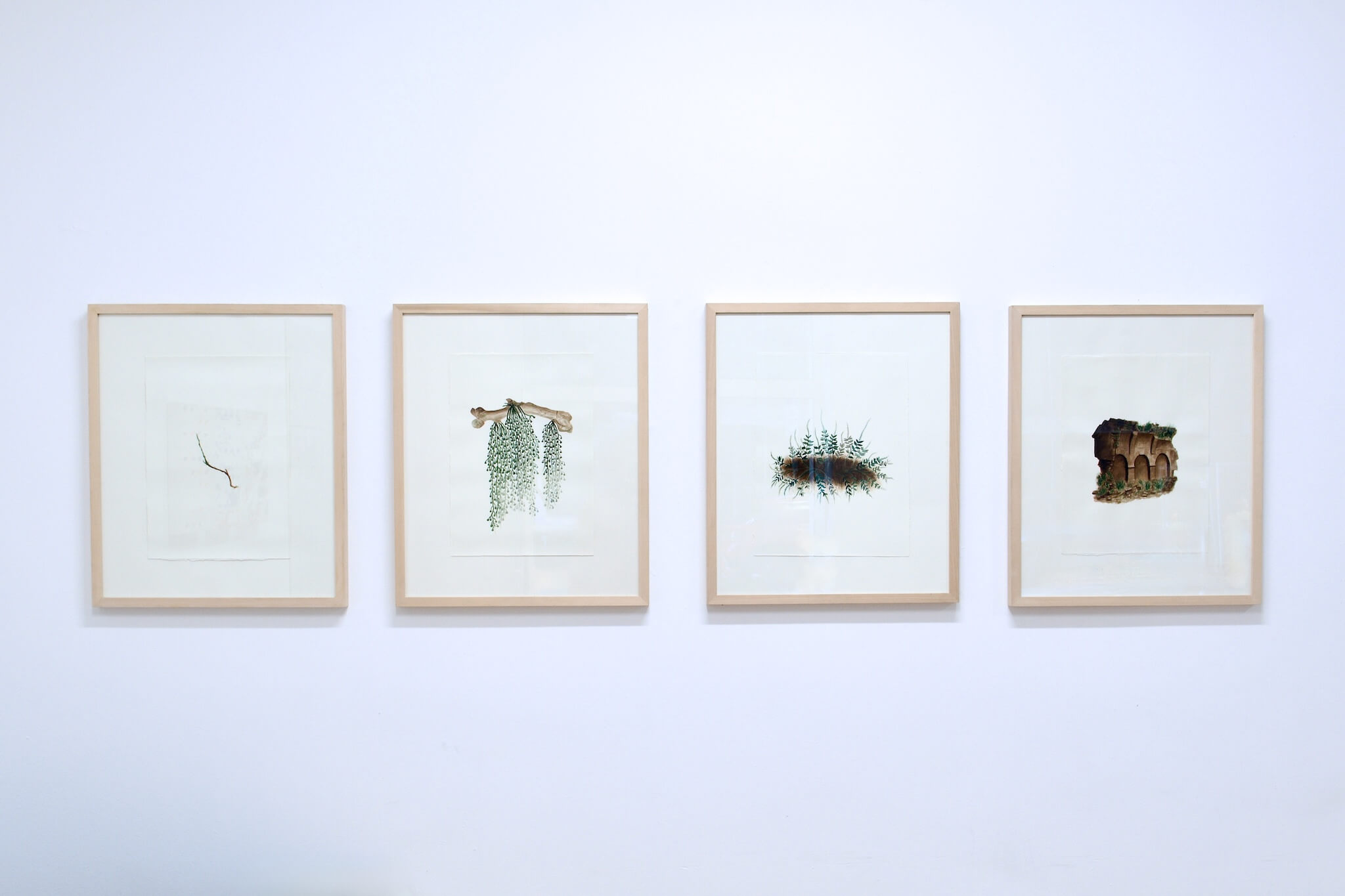
Hüseyin Aksoy, Scab, 2024, 32×42 cm, Walnut paint on papert, exhibition Acts of Conflactions, Galerie AC. Art & Dialogue, Berlin 2025, courtesy of Sumac Space Since the early 2020s, Hüseyin Aksoy has been developing a distinctive visual language in his Istanbul studio through painting, video, installation, collage, and works on paper. His practice is deeply rooted in the cultural identity of Mesopotamia, the region where he spent his childhood and youth. In his research-based and observational works, Aksoy is drawn to ancient settlements, cities, and ruins that have disappeared from modern maps. These sites serve as both the origin of his serial works and the foundation for the spiral-shaped images that appear in them. His affinity for civilizations lost to the course of history enables him to construct a reference system through which he poses questions about the present. Through this approach, he creates a hybrid visual narrative that highlights the cultural and political potential embedded in every trace and ruin, for those who choose to see.
In 2024, Aksoy launched Harmel as a long-term project. This video work also became the conceptual center of other evolving works, including paintings and installations that developed through interdisciplinary processes. The project follows the traces of Peganum Harmala, also known as Syrian Rue, a plant that grows spontaneously among ancient ruins and cemeteries. The idea of “bearing witness” forms two distinct connections in these works. The first, which can be described as documentary, involves Aksoy recording what he sees—whether with a camera, brush, or pen. The plant evokes death and disappearance, emerging in deserted mountain landscapes, yet Aksoy keeps its ominous presence visible. This leads him to a second, more imaginative layer, culminating in the series titled Mind Map.
Mind Map is an installation composed of found objects, drawings, three-dimensional forms, stones, and dried versions of Syrian Rue in various stages of growth. All have been carefully studied by the artist. The accompanying drawings were produced using organic walnut ink—a deliberate material choice. This also marked the beginning of another Scab series. Scab represents Aksoy’s effort to develop a new pictorial language. It focuses on architectural elements such as walls, towers, and ziggurats, forms one might encounter at ancient ruins. The brown stains of walnut ink shape images of past dwellings that recall the landscape of his youth. Yet these works are not tied to any single archaeological site. The textures of ancient cities, the silence of abandoned lands, and the feeling of vastness form the structural elements of the imagery.
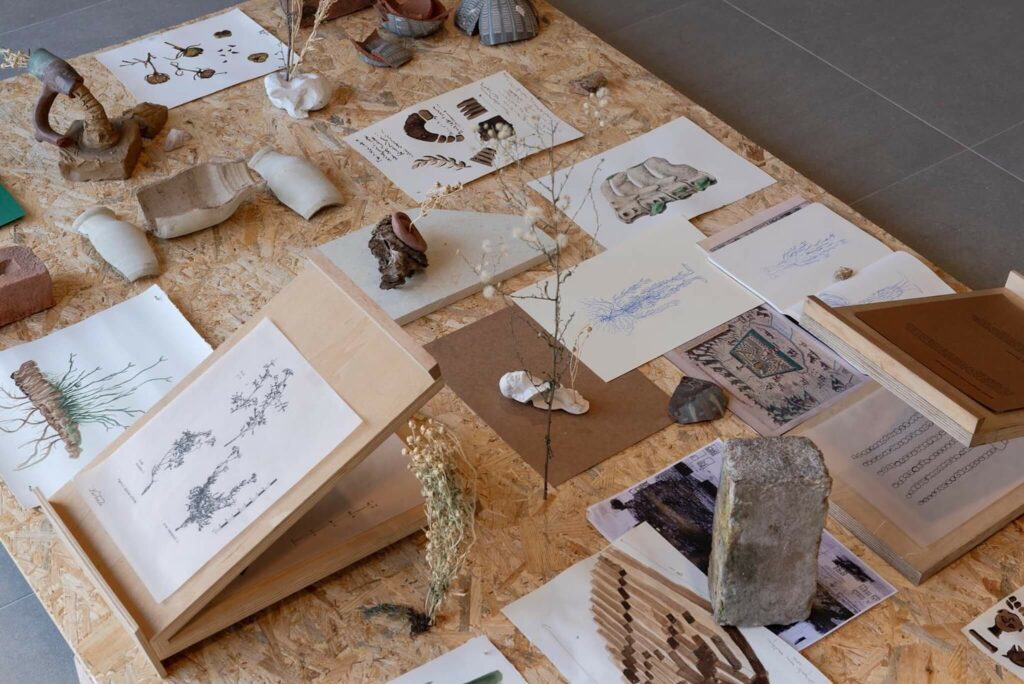
Found objects, paintings, sculptures, Harmel plant. site-specific installation at SAHA Studio, 2024, photo Kayhan Kaygusuz Much like the abstraction in Italo Calvino’s Invisible Cities1, Aksoy interprets these structures, walls, and stones as scabs—similar to the skin that forms over a wound. Scabs are a sign of healing and typically disappear once recovery begins. Treating ruins as scabs suggests a deeper interpretation: the places Aksoy draws upon function as zones of shared human memory. This idea extends beyond a humanist reading of the work.
From Aksoy’s perspective, the remnants of ancient civilizations are not passive fragments of the past. They appear as living terrains where imagined and mental landscapes emerge. This viewpoint references cycles of destruction and regeneration in Mesopotamian history, and touches on shifting political boundaries today. His work avoids linear perspective and spatial depth. Architectural forms—castles, churches, monumental gates, massive walls—appear suddenly and form the skeletal framework of a landscape. Amid brown-hued imagery, the artist introduces green plant motifs suggesting traces of life. These elements bridge the past and the present.
The Syrian Rue plant appears in its real size and form in Aksoy’s installations. In the Scab series, it takes on a metaphorical presence. Although these ruins and lost cities are devoid of human life, the plant becomes a signifier that bears witness to past events across time. Scholars have proposed various theories about the disappearance of ancient cities, including natural disasters such as earthquakes, floods, and social upheavals like war and forced migration. The images in Scab confront viewers with the process of disappearance, giving the works a presence that defies loss. This carries a strong parallel to today’s political reality. Aksoy draws the individual bricks of his monumental walls with meticulous care, emphasizing their enduring testimony. He rescues them from anonymous silence and presents them as carriers of memory and history. By stripping away regional or cultural identifiers, the series extends beyond Mesopotamia and becomes relevant to cultures worldwide.
Following this focus on unrecorded histories, Aksoy began working on a new series titled Beyond the Sea. In this group of watercolors made with ultramarine blue pigment, he reinterprets fragments of mythological sculptures. These figures—such as Caryatids or Eros—evoke stories from the distant past. Aksoy builds on the visual strategies developed in Scab. Once again, he draws on past imagery to suggest messages for the future. The silence of ancient ruins merges with the patina covering statue fragments. This embeds a sense of historical aura deep within the works. But Aksoy does not stop with the atmosphere alone. He constructs images that can be understood through logic and association. He offers viewers visual cues for making sense of the strange, fractured world we live in today.
Dr. Necmi Sönmez studied art history in Mainz, Paris, Newcastle, and Frankfurt. He completed his doctorate at Johann Wolfgang Goethe University with a dissertation on the sculptor Wolfgang Laib. He continues to work as an independent curator and art historian in Düsseldorf.
1 Italo Calvino, Invisible Cities, trans. Işıl Saatçioğlu, Yapı Kredi Publications, Istanbul, 2002
Hüseyin Aksoy, Saha Studio
-
From the Marshes to the City of Revolution: On Roots, Ruptured Histories, and Speculative Acts of Remembrance—Helena Tahir
There has always been a peculiar absence in our family’s story, one I often questioned as a child. Why was my father’s birthday never celebrated? It wasn’t until adulthood that I understood why: no one knew the exact date. He was born in 1952 to a peasant family working the fields near Al-Zubair, a city in southern Iraq, but his birth was never officially registered. At first, I found that strange, even unsettling, until I came to realize how common it was in that specific time and place. In rural Iraq during the 1950s, when government offices were scarce, roads…
From the Marshes to the City of Revolution: On Roots, Ruptured Histories, and Speculative Acts of Remembrance—Helena Tahir
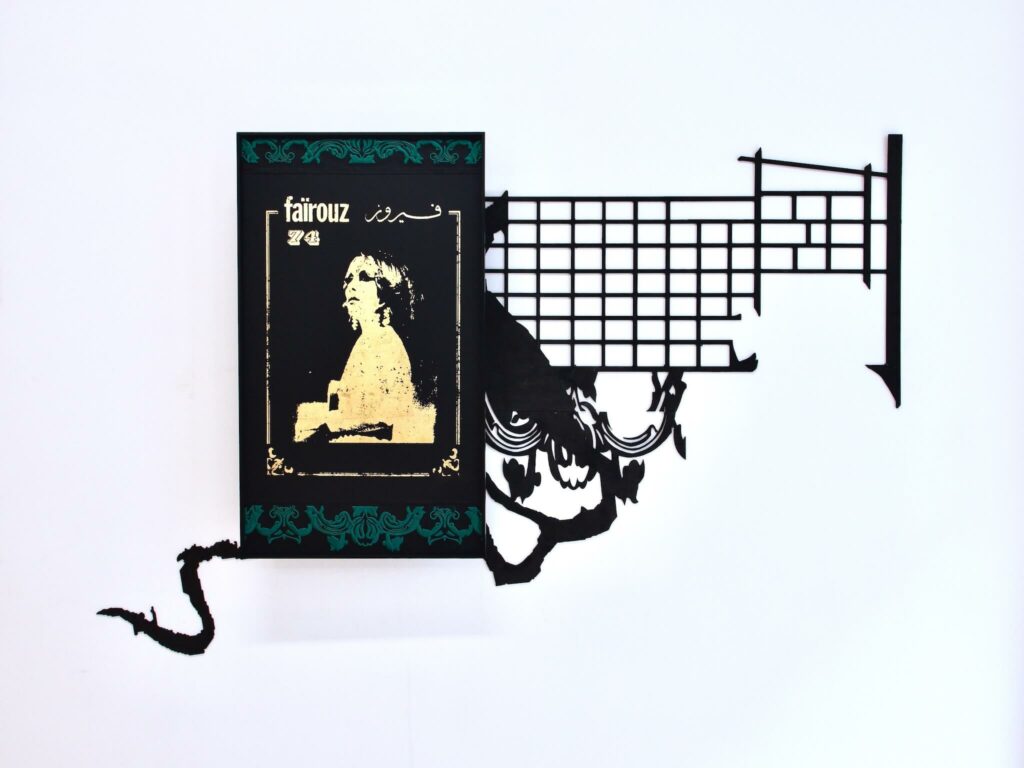
Helena Tahir, The Last Sector II, exhibition Acts of Conflactions, Galerie AC. Art & Dialogue, Berlin 2025, courtesy of Sumac Space There has always been a peculiar absence in our family’s story, one I often questioned as a child. Why was my father’s birthday never celebrated? It wasn’t until adulthood that I understood why: no one knew the exact date. He was born in 1952 to a peasant family working the fields near Al-Zubair, a city in southern Iraq, but his birth was never officially registered. At first, I found that strange, even unsettling, until I came to realize how common it was in that specific time and place. In rural Iraq during the 1950s, when government offices were scarce, roads were unreliable, and literacy rates were low, many births went unrecorded. All that was passed down was a year and a place, remembered not through official documents but through spoken memory, fragile and perhaps reshaped over time.
According to our family’s oral history, our roots trace back to Al-ʿAmārah in southern Iraq, where our ancestors lived as part of the Marsh Arab community. In the vast wetlands between the Euphrates and Tigris, people built arched reed houses on small islands on water, navigated narrow waterways in canoes, and lived by fishing, herding water buffalo, and farming. My family remained there until the mid-20th century, when, like many others, my grandfather was forced to leave. His departure was part of a broader story: state neglect, class exclusion, and environmental degradation that made rural survival increasingly difficult.
My father’s childhood unfolded during the final years of Iraq’s feudal system, a landholding structure entrenched under the British-backed Hashemite monarchy. This system granted shaikhs (tribal landlords) control over vast agricultural estates. These landlords lived off the labor of peasants, who often retained only 15 to 25 percent of their harvest after paying rent and various fees. It was a structure that kept rural families trapped in cycles of debt and dependency. Attempts at reform were largely superficial, intended to preserve elite power and foreign interests while deepening the struggles of those at the bottom. In places like Al-ʿAmārah, those who resisted were often expelled from their homes, sometimes with such brutality that it cost them their lives. Meanwhile, the region faced an environmental catastrophe. The 1940s brought waves of drought and flooding, broken irrigation canals, and the unpredictable behavior of the rivers.
Pressured by these circumstances, my grandfather abandoned rice cultivation and sought any work he could find to support his family. In the early 1950s, he secured a modest government post and was sent to a remote station near the Kuwaiti border to monitor smuggling routes. The family joined him there, settling in canvas tents in the desert, where isolation shaped their daily lives. There was little to do, and the children could attend school only every other day due to the long journey. My father remembers those years with sadness, shaped by hardship but also by the stillness and strangeness of that life. At times, those feelings never entirely left him, even though their time there was brief.
In 1958, Iraq’s Hashemite monarchy came to a sudden and violent end with a military coup. King Faisal II, only twenty-three, was executed at the al-Rihab Palace alongside members of the royal family. Yet it was Crown Prince ʻAbd al-Ilāh and Prime Minister Nuri al-Saʻid who suffered the most grotesque fates. The Crown Prince’s body was dragged through the streets, hung outside the Ministry of Defense, mutilated, burned, and eventually thrown into the Tigris. Nuri al-Saʻid, captured while fleeing in disguise, dressed as a woman, was shot on the spot. His body, buried hastily, was exhumed the next day and desecrated by an enraged mob. These were more than symbolic acts marking the fall of a regime. They seemed to channel something deeper and more primal: the fury of a long-oppressed, humiliated nation intent on erasing not only its rulers but any trace that the old order might return.
While crowds filled the streets in celebration, my grandfather, like many rural peasants who had suffered under the monarchy, welcomed the revolution with cautious hope. He likely understood the risks but still believed it might bring something better. However, instead of stability, it brought about another job loss and more uncertainty. So, he moved the family to Baghdad, joining thousands of others who were migrating in search of security amid the shifting political order.
As rural migrants arrived in Baghdad, families like ours were often labeled shurūg or shargawiyya—colloquial terms meaning “easterners.” These labels, used by established Baghdadis, marked newcomers from the south as outsiders and reinforced deep-rooted class and regional stigma. Yet many of these migrants were settled in the heart of Baghdad. My family, for example, made their home in the Sarifa slum of Shakiriya, an informal settlement that now stands where Al-Zawraa Park is located today.
Like thousands of others who arrived there with almost nothing, they initially built shelters from woven reed mats, materials brought from the south and traditionally used by the Marsh Arab communities. However, the colder, drier winters in central Iraq quickly showed that these homes were not suitable. Eventually, they turned to the clay-rich soil of Mesopotamia, which could be dried in the sun to form adobe bricks. These reed-and-mud structures became known as ṣarīfa huts, and by the late 1950s, Baghdad had approximately 44,000 of them, accounting for nearly 45 percent of the city’s dwellings. The neighborhoods where harsh conditions prevailed clustered around these huts. There was no running water or proper sanitation, and diseases like dysentery and tuberculosis were common. My father remembers the Shakiriya slums as places where crime and violence were part of daily life, with robberies, shootings, and assaults occurring regularly. Yet despite all this, many migrants still saw the city as a place of relative freedom, where at least they were no longer under the control of the shaikhs.
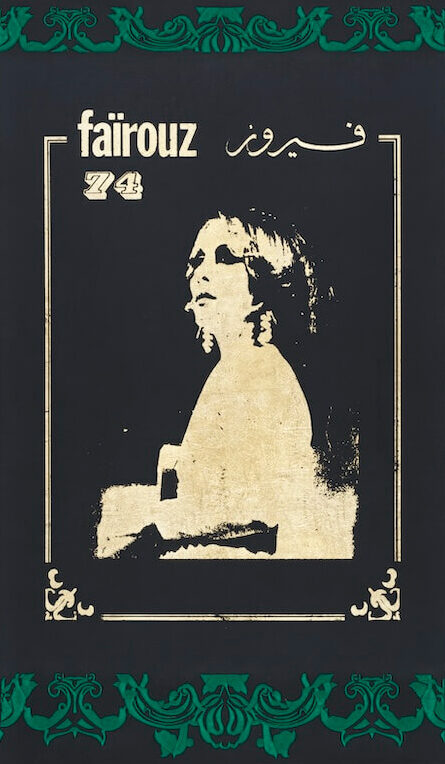
Helena Tahir, Print III. The Last Sector II, 2025, 90×50 cm
screenprint, golden leaf, embroidery on faux leather
photo: Jaka Babnik, MGLC archive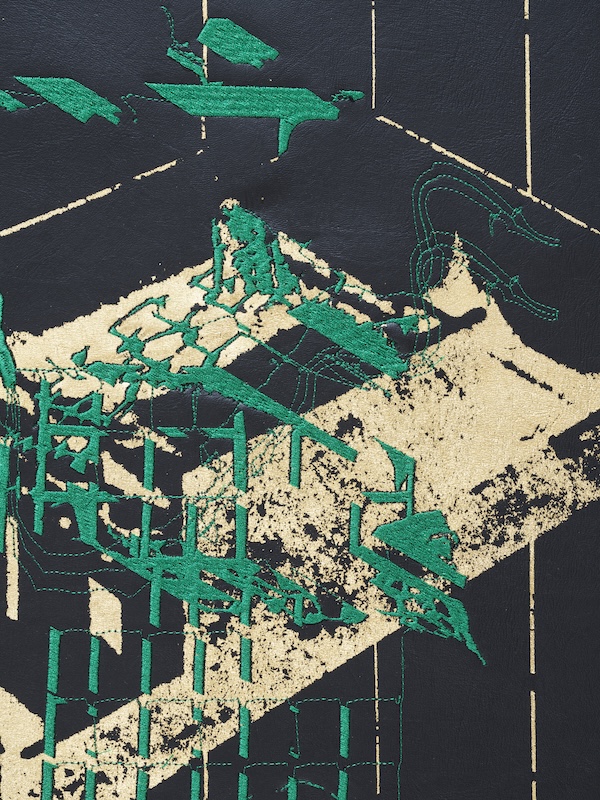
Print I. The Last Sector II, 2025 (detail)
photo: Jaka Babnik, MGLC archiveIn 1963, another rupture reshaped the country. The Baʻath Party, backed by elements within the military and rumored foreign assistance, seized power. Soon afterward, officials forcibly relocated my family, along with thousands of others, to a newly planned suburb on the outskirts of Baghdad. Madinat al-Thawra, or “City of Revolution,” was built. Not only through the state initiative, but also through the labor of the rural, my teenage father, among others, prepared the foundations and laid bricks by hand to construct the family’s modest home. Although the neighborhood was promised as a place of improved living conditions, it still lacked access to basic services. But on top of that, it brought a new layer of hardship: physical distance from the city and a deepening sense of social segregation.
The following years were marked by deepening ideological rifts. By the late 1960s, the Baʻath Party had consolidated its power, and Arab nationalism had become the dominant force in public discourse. Dissent was increasingly silenced. It was in this climate that my father began to form his political identity. His daily routine as a student laid bare the country’s class divisions. Each morning, he walked for hours from the slums of Madinat al-Thawra to the Institute of Fine Arts in the city center. Many of his classmates arrived there by car, dressed in freshly ironed uniforms. The poor, unable to afford such clothes, often rejected them altogether, both out of necessity and as a form of protest. Yet inside the classrooms, these rigid divisions began to soften. Students from diverse backgrounds, including those from wealthy and low-income families, as well as Sunni and Shia, Christian, and Kurdish communities, formed friendships that challenged the hierarchies imposed outside the school walls.
The regime’s escalating violence against the Kurds deepened my father’s disillusionment with the Baʻath Party and led him closer to communism. This was not only a reaction to state repression but also rooted in a more extended history of dispossession in the south. Most residents of Madinat al-Thawra, including my family, had come from southern provinces where generations of neglect and exploitation turned communism into more than an ideology. It became a promise of justice, solidarity, and collective dignity.
By the mid-1960s, my father began contributing illustrations to Tariq ash-Shaab (“Path of the People”), the official newspaper of the Iraqi Communist Party, which continued to operate underground even after the Baʻath Party seized power. Despite increasing repression, he remained steadfast in his political convictions. Realizing he could no longer stay safely in Iraq, he fled the country. In 1968, he left for Yugoslavia.
As the Non-Aligned Movement gained momentum, Yugoslavia positioned itself between the Cold War blocs and fostered cultural and educational ties with post-colonial states, such as Iraq. Although Iraqi students were officially welcomed under South–South solidarity, the regime denied my father, who had no affiliation with it, any financial support. In Ljubljana, he learned Slovene, enrolled at the Academy of Fine Arts, worked by day in various factories, and spent his nights at the print studio. Although he eventually gained professional recognition, he continued to face constant pressure. He was harassed by Baʻathist-affiliated students and monitored by UDBA, the Yugoslav State Security Service. At the 1983 Biennale of Graphic Arts in Ljubljana, one of his works was nearly censored after the Iraqi embassy intervened. Officials claimed that the print contained Arabic text offensive to the Iraqi state, taking advantage of the fact that few attendees could read the language. The work was temporarily withdrawn but later reinstated after a review found the accusation to be baseless.
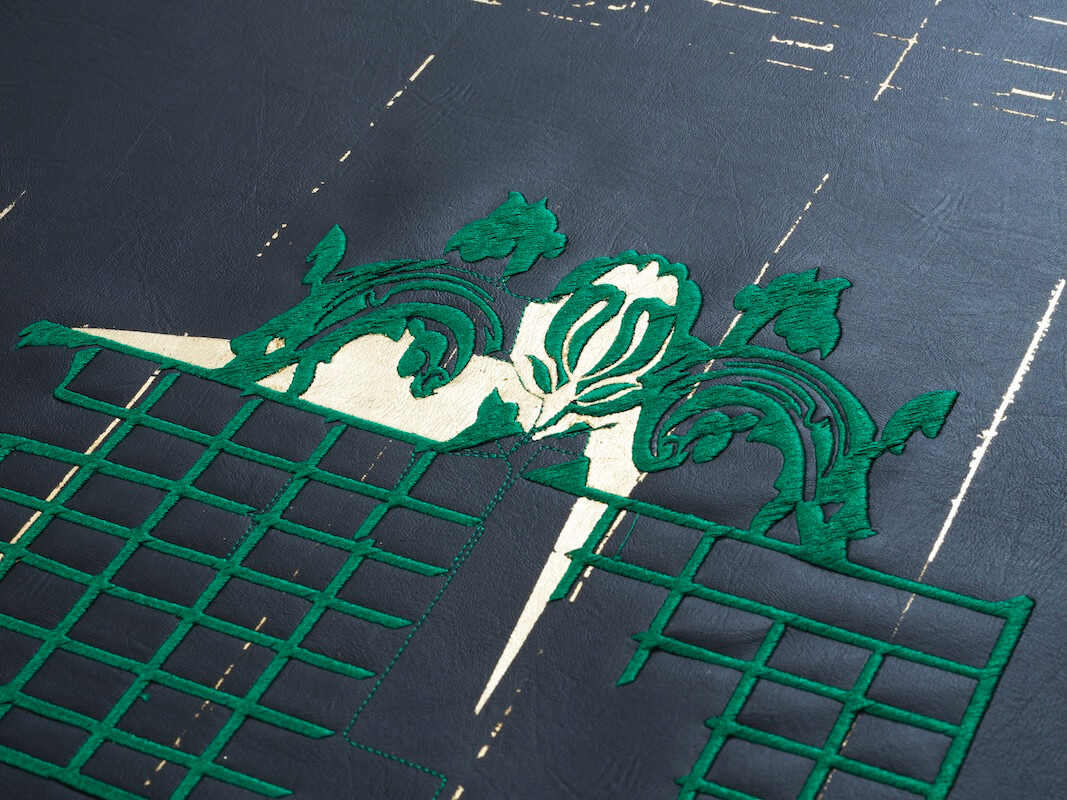
Helena Tahir, Print II. The Last Sector II, 2025 (detail), screenprint, golden leaf, embroidery on faux leather
photo: Jaka Babnik, MGLC archiveBy the 1980s, Iraq had descended into a climate of absolute fear. Political opponents were hunted, tortured, disappeared, and executed. While my father built a new life with my Slovenian mother, his residency status remained uncertain. Deportation loomed, and a return to Iraq could have meant imprisonment or worse. His brother, a member of the Communist Party, had already vanished without a trace. To this day, we still do not know what happened to him. Branded as a traitor, any contact with his relatives became too dangerous. To protect everyone, my father made the painful decision to sever ties with them entirely.
After decades of silence, I began asking questions about our Iraqi family, but my father had few answers. He had never written to them or spoken with them again. Eventually, I discovered a videotape sent by our Iraqi relatives after the fall of the regime. It was an invitation to reconnect, one that my father could not answer. Nearly two decades later, I did. That moment became the starting point for my project, The Last Sector.
I traveled to Baghdad for the first time in 2023. I discovered the material remains of the neighbourhood once known as the City of Revolution, later renamed Saddam City, and now referred to as Sadr City. The title of the project relates to a specific area within the subdivided area: the 38th sector, where my family resides. This was the outer edge of the district when my father emigrated. Although the city has since expanded, the name “The Last Sector” endures among its residents. The boundary has taken on a symbolic meaning, although its full significance remains unclear to me.
There, I met my Iraqi family for the first time. I explored the history and urban development of the area where they live and uncovered layers of family history I had never known. I documented what remained: homes made of brick and concrete, walls lined with fading photographs, and gold and green portraits of Imam Hussein that speak to their Shia tradition. I traveled south, canoed through the marshes, and observed the architecture of the arched reed houses that once defined our ancestral landscape.
These impressions formed the visual vocabulary of the project. I translated those references into compositions using screen printing, gold leaf, digital embroidery, and laser-cut wall reliefs. The visual language drew on a wide range of motifs: Fairuz, the iconic singer whose voice shaped my father’s childhood and marked his absence, and elements from our family’s carpet patterns, which I deconstructed and reassembled, layering them with the urban grid of what was once “City of revolution.” The compositions bridge personal and collective topographies.
What began as a search for closure evolved into an exploration of the unresolved space between my father’s estrangement and my own search for identity. It connects a home remembered in fragments with one never fully known. I return, speculatively, to the City of Revolution, a landscape shaped by dislocation, failed state planning, and the endurance of those pushed to the margins. I examine how political histories leave their mark on the built environment, and how those spaces, in turn, continue to shape the lives of those who inhabit them. Though the place now bears a different name, for me it became precisely what it once claimed to be: a site of revolution, of transformation, and a threshold where an old understanding collapsed and something new, uncertain, and unfinished began to take form.
References
Batatu, Hanna. The Old Social Classes and the Revolutionary Movements of Iraq: A Study of Iraq’s Old Landed and Commercial Classes and of Its Communists, Baʻthists, and Free Officers. Princeton: Princeton University Press, 1978
Gupta, Huma. Migrant Sarifa Settlements and State-Building in Iraq. PhD diss., Massachusetts Institute of Technology, 2020
Tahir, Hamid. Application for Yugoslav Citizenship and Permanent Residency
Translated documents, ca. 1980s. Unpublished family archive -
Collective Memory and Visual Representation: The Feminist Photography of ZînKolektif—Serenay Anık Gök
ZînKolektif is an independent collective of women and queer artists united through photography. Functioning as a space of solidarity, the collective not only brings together individual photographic practices but also fosters shared ways of thinking, aesthetic approaches, and visual languages. Central to ZînKolektif’s ethos is a feminist perspective that profoundly shapes both the themes they engage with and their photographic methods. This approach resists dominant narratives and visual hierarchies by prioritizing collaborative processes, ethical representation, and contextual sensitivity. Their work often explores subjects such as memory, space, identity, and belonging through a lens that foregrounds lived experience, relationality, and resistance.…
Collective Memory and Visual Representation: The Feminist Photography of ZînKolektif—Serenay Anık Gök
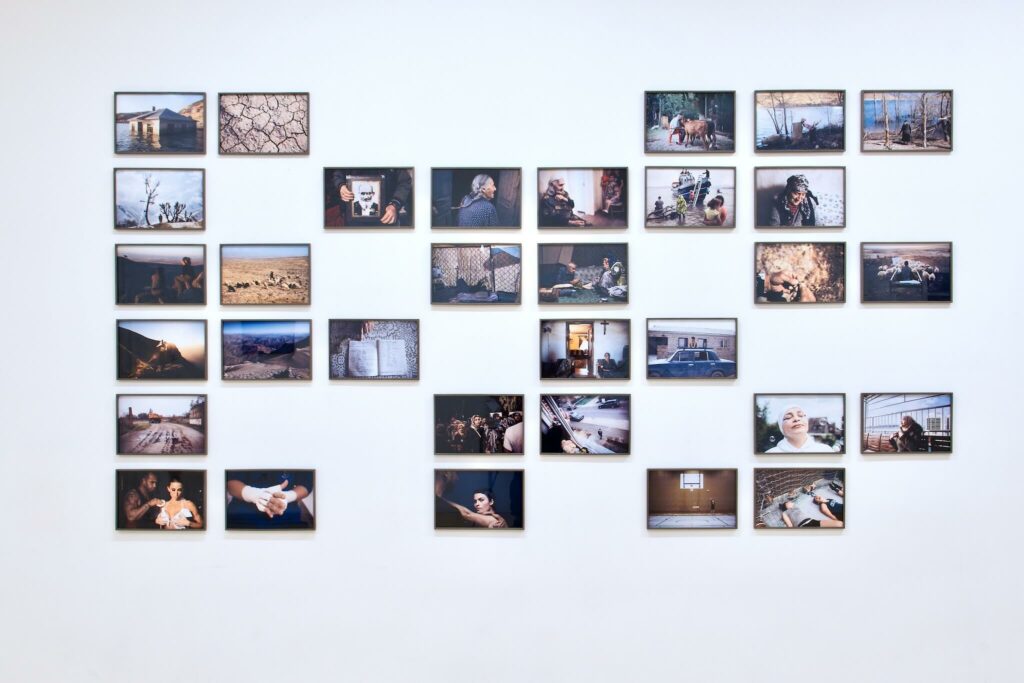
ZînKolektif, Witness To The Moment, exhibition Acts of Conflactions, Galerie AC. Art & Dialogue, Berlin 2025, courtesy of Sumac Space ZînKolektif is an independent collective of women and queer artists united through photography. Functioning as a space of solidarity, the collective not only brings together individual photographic practices but also fosters shared ways of thinking, aesthetic approaches, and visual languages. Central to ZînKolektif’s ethos is a feminist perspective that profoundly shapes both the themes they engage with and their photographic methods. This approach resists dominant narratives and visual hierarchies by prioritizing collaborative processes, ethical representation, and contextual sensitivity. Their work often explores subjects such as memory, space, identity, and belonging through a lens that foregrounds lived experience, relationality, and resistance. Instead of objectifying their subjects, members of the collective frequently center voices that are historically marginalized, challenge masculine-coded visual aesthetics, and embrace experimental or process-based storytelling. In doing so, they not only increase the visibility of women and queer photographers but also reimagine photography as a critical tool for feminist inquiry and collective memory.
Each member of ZînKolektif comes from a distinct academic and professional background, contributing to the collective’s layered and pluralistic identity. Serra Akcan, trained in economics and professional photography, has produced long-term visual works on gender, identity, and migration. Aylin Kızıl, a pharmacist by education, focuses on urban transformation and displacement through photography and film. Fatma Çelik, a psychological counselor, explores memory, ecology, and gender through documentary photography and video. Serpil Polat, an educator from Dersim, documents social movements, environmental issues, and women’s rights. Gülşin Ketenci, with a background in mathematical engineering, centers her practice on feminist photographic methodology. Çiğdem Üçüncü, trained in the visual and performing arts in Germany, works on personal narratives of migration and ethnic identity. Their relationship with photography centers on an intuitive yet intellectually grounded process, shaped by lived experience and sustained political sensitivity. Each member constructs their own visual language, which gains new meaning within the collective. The richness of ZînKolektif’s work lies not in uniformity but in its intentional plurality—where diverse expressive forms coexist without aesthetic confusion, allowing solidarity and shared inquiry to emerge as guiding principles.
In Acts of Conflations, ZînKolektif takes individual stories as a starting point to discuss the broader issue of collective memory and representation. Rather than constructing a direct political narrative, they present narratives in which individual experiences are intertwined with aesthetics shaped by intellectual explorations. The works do not place the viewer in a fixed viewing position; they also invite them to question, engage with their memories, and think critically about the images. This exploration of memory and belonging inevitably raises questions about the tools and strategies of visual representation. These tools shape how such experiences can be shared and understood.
Çiğdem Üçüncü, Displaced, 2015–2024 Navigating the Boundaries of Representation
The collective members’ productions adopt an approach that questions the representational power of photography. This questioning is both an aesthetic choice and an ethical stance. Rather than documenting a particular social group, a geography, or an individual memory, most of the projects in the exhibition reflect on the visual strategies that make these representations possible. Issues such as the positioning of the subject, the angles from which the narrative is constructed, the direction of the gaze, and the way in which gaps are built form the basis of each work. In this context, the visual language does not employ photography as a mere documentary tool. On the contrary, it becomes a space for thinking, remembering, and questioning. The fictional approach seen in several works, including Displaced by Çiğdem Üçüncü, emphasizes that photography is not a device that reflects truth, but a medium that reconstructs, interprets, and transforms it. Therefore, the form of representation, its ethical framework, and the meanings it evokes come to the fore rather than the accuracy of the representation. These reflections on representation open into a more intimate terrain: the entanglement of body, space, and memory, where questions of visibility and presence become central.
Fatma Çeli̇k, The People Of Sasun, 2017-2019 
Serpil Polat, Fairy Escaped Water, 2018 Relationship between Body, Space, and Memory
Each story in the exhibition traces the relationship between body and space. Artists such as Fatma Çelik and Serpil Polat explore how memory is embedded in space. They consider how the body integrates or conflicts with this spatial memory. In Fairy Escaped Water, Polat documents the ecological destruction and forced displacement caused by dam construction in Dersim, framing the landscape as both witness and archive. Similarly, Serra Akcan’s photographic work on urban space and daily life examines how women’s bodily presence interacts with transforming environments. In several works, the artists use their own bodies as narrative objects—insisting on visibility and challenging the limits of representation. The position of the body before the camera, the orientation of the frame, and its interaction with light and space all become conceptual anchors that interrogate what photography reveals and what it conceals.
Serra Akcan, Recollecting, 2017–2018 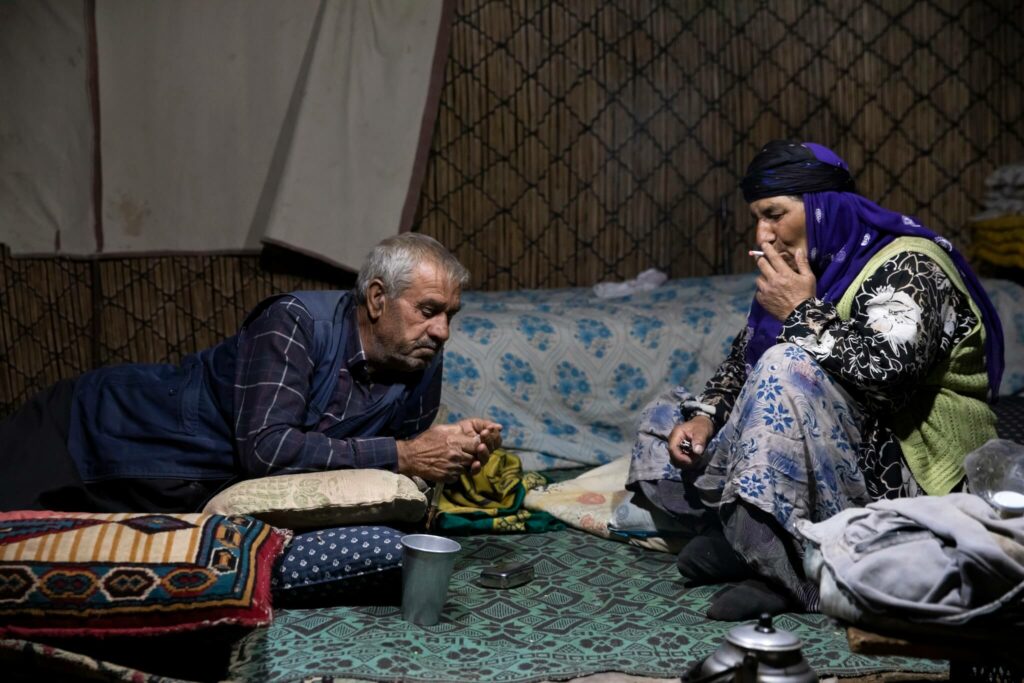
Aylin Kızıl, Xaniyasor, 2020-2021 (Red House/Home” in Kurdish) Aylin Kızıl, who often works at the intersection of film and photography, brings bodily presence into relation with shifting urban and social landscapes. Her lens captures fragmented spatialities where physical absence evokes emotional density—suggesting that memory persists in and through disrupted spaces. Gülşin Ketenci, on the other hand, employs a self-reflexive feminist photographic methodology that places women’s labor and visibility at the core of spatial inquiry. Her work treats the female body not as an object to be seen but as a knowing, active presence that reclaims public and domestic spaces alike.
Along with the body, space is also key in ZînKolektif’s works. These spaces are not fixed or singular in meaning. In some projects, mountains, stones, water, or emptiness appear. They are not only geographical representations but also convey emotions, memories, or a sense of belonging. Here, space acts as an active narrative component, not just a backdrop.
These visuals focus on images that work through direct association, such as childhood homes, abandoned spaces, lost objects, or water. These images carry personal experiences and are also part of collective memory. By situating the body within shifting spaces of memory, the works gesture toward photography itself as a process of thinking—an open-ended practice that operates beyond documentation.
Gülşin Ketenci, Women Athletes–Sports Against All Odds, 2015–2019 Photography as a Form of Visual Thinking
For the members of ZînKolektif, form is as important as content in their production processes. The methods used by each in their own practice range from analog printing to digital editing and from archival work to performative approaches. This diversity transforms the productions into a structure that enriches, nourishes, and fosters discussion among its members. Photography is used to establish a narrative, to interrupt, to create silences, and to leave gaps. These gaps turn into spaces where the viewer steps in and constructs meaning through their own experience. This approach demonstrates that they take a stance that invites the viewer to think together, rather than presenting them with a passive position.One key feature is the emphasis on group discussions throughout the production process. Each develops a narrative and shares ideas with others to broaden perspectives. The collective is not a temporary partnership. It fosters a lasting and sustainable practice of solidarity. This shared method of visual thinking reinforces the collective’s foundation in dialogue and solidarity, showing how memory and representation can be reshaped through collaboration.
ZînKolektif’s work shows that visual memory can be shaped collectively and individually. This memory encompasses recorded events, recalled details, forgotten memories, and reconstructed stories. Each visualizes a different layer of this memory. Their projects navigate the boundaries of representation, utilize emptiness, and evoke silence. They create alternative visual spaces for women and artists. ZînKolektif shares, shapes, discusses, and transforms this space together. This selection presented in the exhibition reflects ZînKolektif’s visual and intellectual partnership. It should be seen as a shared field of art, solidarity, learning, and shared production. Each frame carries a question, a trace, and a direction.
After receiving her BA in Sociology from the Faculty of Humanities at Anadolu University, Serenay Anık Gök earned her MA in Art and Design at Eskişehir Osmangazi University with a thesis titled The Relationship Between Photography and Memory: The Reproduction of Visual Representations. She is currently in the thesis stage of her degree in Proficiency in Art, focusing on female documentary photographers and the female gaze. Since 2020, she has worked as a research assistant. Her research interests include photography, visual sociology, memory, and cultural studies.
-
Decision Made. We Are Crossing the Lake by Bicycle—Ipek Çınar
Karar verdik. Gölü bisikletle geçeceğiz. Decision Made. We Are Crossing the Lake by Bicycle. I don’t know how to swim, so water remains unfamiliar territory to me. I love the bicycle: casual, accessible, always ready to carry more than expected. My bike has a faulty gear, a loose chain, and a bent fender. It demands a gentle approach. It is better to travel at night. I learnt how to ride quite late. My engagement with art universities also came late, but quickly, as if trying to make up for all the years that had passed. Once I entered that world,…
Decision Made. We Are Crossing the Lake by Bicycle—Ipek Çınar
Karar verdik. Gölü bisikletle geçeceğiz.
Decision Made. We Are Crossing the Lake by Bicycle.1I don’t know how to swim, so water remains unfamiliar territory to me. I love the bicycle: casual, accessible, always ready to carry more than expected. My bike has a faulty gear, a loose chain, and a bent fender. It demands a gentle approach. It is better to travel at night.
I learnt how to ride quite late. My engagement with art universities also came late, but quickly, as if trying to make up for all the years that had passed. Once I entered that world, I worked at institutions focused on diversity, inclusion, and social justice. These institutions often seemed to know their intended outcomes before their programs had even begun. Even though this signals a systemic absurdity we might all agree on, I found myself wondering: in my own work, how often did I already know the outcome from the start?
Crossing the lake by bicycle means doing something constantly—keeping the pedals turning (maintenance)—while also learning how to swim, in the water, and while cycling. There is so much life around us, and at some point, the sentences quietly shifted from “I” to “we.”
Here, “we” is sometimes just me and myself. Almost always, it is Ece Gökalp and me, co-founders of Orta Okul. Sometimes it is us and the marine species: shorter-term collaborators and participants. And sometimes, it is our wider habitat: a cloud of activists, feminists, dreamers, and weirdos who inspire us.
Much of the institutional work on diversity and inclusion felt performative to us. The institutions themselves were so dominant that these policies seemed to serve their image more than the bodies and groups they were supposedly centered on. We were trying to learn art, make art, survive. We hold onto our passion while juggling within a system where institutions, not life, stand at the center.
And then, we found each other. After countless conversations, often interrupted by excitement and urgency, Ece and I founded Orta Okul.
Decision made. We are crossing the lake by bicycle.
Karar verdik. Gölü bisikletle geçeceğiz.Orta Okul, meaning Middle School, was born from big dreams and strong intentions. Initially, we described it as an arts and crafts school that invites communities to be co-creators, particularly those excluded from art education due to barriers such as socioeconomic status, social class, or age. Over time, we began to shape its identity as multilingual and nomadic.
Then, our areas of struggle became clearer: We focused on educational justice, anti-institutional art, participation, and reclaiming public space. With each new conversation and collaboration, Orta Okul gained more layers. Eventually, we began asking ourselves how we could remain engaged with so many issues while working with limited resources.
This led us to rethink what the school could be. It became a mobile structure mounted on a bicycle trailer, carrying all its materials and traveling to (semi-)public spaces, associations, schools, shelters, and neighborhood houses. In each educational program, we began collaborating with local organizations, art spaces, and individuals to activate existing community resources. Beyond its physical form, this mobile and adaptable structure also started to reflect precarious stories, such as those of migration, displacement, and the lived experiences of marginalized communities.
Each educational program we organize is shaped by the needs, resources, and intentions of its participants. Every occasion borrows something from Orta Okul’s toolbox of struggles and tactics, and transforms it into something new. In this way, the school remains impossible to define fully. It moves across boundaries, embraces the flexibility of transition, and carries the responsibility of drawing new lines when necessary. This fluidity also pushes us away from fixed methodologies and pre-designed models.
Since it is impossible to cover everything in one text, I will focus on a more modest aim. I want to explain, as clearly as possible, the three core principles that continue to guide our work.
Art with the community, not art for the community. Orta Okul is grounded in co-making. We support collaborative artistic practices that evolve through dialogue and shared experiences, rather than through the representation or reproduction of a community by an outside artist. For us, participation means more than just being present. It involves the redistribution of power. As Claire Bishop writes in Artificial Hells, quoting Guy Debord: “Participation rehumanizes a society rendered numb and fragmented by the repressive instrumentality of capitalist production.”2 In this way, participation challenges traditional art models, which often focus on final products and are commodified, thereby removing them from their social context.
An artwork does not become participatory just by including people. Many of the projects we designed with participation in mind ultimately became events where participants chose not to participate. In some cases, the work did not resonate and remained symbolic.
Still, each of these attempts became an opportunity to learn. By reflecting on what did not work, we began to understand what could. For example, when the curriculum was intentionally left light, shifting from a set of instructions to a series of open-ended questions, it created space for people to engage. A curriculum that breathes invites co-ownership. Trust also grew when facilitators came from within the community and shared lived experiences with participants. This kind of resonance made engagement feel natural and immediate.
One example was the Grupa Podrške (Support Group) seminar facilitated by Jelena Fužinato.3 It brought together women from BCMS (Bosnian-Croatian-Montenegrin-Serbian) backgrounds who had given a pause to their art careers due to gendered reasons. Jelena herself was part of this community. Her presence built trust from the very beginning. Eventually, the group continued independently of Orta Okul and became a collective of its own. This was something we were oddly proud of stepping back.
Maintenance over development. This principle is inspired by Mierle Laderman Ukeles’s Manifesto for Maintenance Art,4 where she contrasts the glorified idea of development with the often invisible labor of maintenance. She committed to valuing maintenance, what, as she put it, takes “all the fucking time.”
In this spirit, Orta Okul prioritizes care, sustainability, and community engagement over the constant search for the new, the exciting, or the prestigious.
Maintenance demands long-term commitment. The difficulty lies in balancing energy, time, and funding. We keep returning to the same questions: What happens when the resources run out? Who continues the work— the initiators, the participants, or the institution?
At Orta Okul, we respond by starting small. We design our seminars as short-term programs, four sessions, not just to introduce a topic but also to meet participants and see whether something deeper might develop. If the interest is there, we find ways to continue together.
Last year, thanks to a rare and almost utopian opportunity, Ece and I co-created an educational program that lasted more than a year. We met the group every week and focused, on average, two days each week on this project. After nearly eleven months, one of the participants called it “our project”. This moment (which I did not witness and only know through Ece’s retelling) felt like a quiet arrival. Orta Okul had become what we had aimed for. As a group, we had begun with hesitation and disconnection. We established a shared space of trust as we invested time. And we stayed.
Sometimes, things do not click. What is required of us is to stay and to keep showing up until we become familiar with it. This led to the final principle of Orta Okul.
Participants before curriculum. This principle draws inspiration from Black Mountain College, founded in 1933 in North Carolina, which nurtured community life rather than enforcing fixed curricula. The 1952 Prospectus declared that “the student, rather than the curriculum, is the proper center of the general education.”5 The school’s discomfort with the word “school” echoes Ivan Illich’s Deschooling Society,6 which challenged the belief that education must take the form of formal instruction, certificates, and titles.
At Orta Okul, we build our structure around social justice, participation, and safer space practices, while encouraging participants to shape the specifics of the curriculum with us. Facilitators are not selected for their titles, but for their flexibility and ability to connect with the group. The pace of a seminar, the materials it uses, and even the space where it unfolds are all shaped through collective dialogue between the Orta Okul team, participants, facilitators, and sometimes caregivers.
By now, I am no longer sure how much of what I have written reflects what truly happened, and how much belongs to what we hoped would happen. That uncertainty may be a natural part of the process. One way to keep this school alive is to value small, everyday victories.
What we try to center –in contrast to the systems we observe, read about, or resist– is something nomadic rather than fixed, fluid rather than standardized, alive rather than institutional. And more often than not, it includes a deep appreciation for lightness and the small-scale.
In the end, crossing the lake by bicycle becomes easier when we stop trying to turn it into a ship. Instead of growing into an institution, Orta Okul might discover new paths by staying small, holding onto its simplicity, and showing up, week after week.
- Bener, V. O. (n.d.). Yorumsuz. In Kapan (pp. 41–42). ↩︎
- Bishop, C. (2023). Artificial hells: Participatory art and the politics of spectatorship. Verso books. ↩︎
- See: https://www.ortaokul.info/2024/grupapodrske ↩︎
- Ukeles, M. L. (2018). Manifesto for Maintenance Art 1969! Proposal for an exhibition Care. Journal of Contemporary Painting, 4(2), 233-238. ↩︎
- Black Mountain College. (1952). Black Mountain College Prospectus for Spring Semester, February 11–June 7, 1952. Reprinted in V. Katz (Ed.), Black Mountain College: Experiment in Art (p. 202). Cambridge, MA: MIT Press. ↩︎
- Illich, I. (1971). Deschooling Society; Ivan D. Illich. Calder and Boyars. ↩︎
Ipek Çınar is an artist and researcher working predominantly with participatory and socially engaged art practices. She uses play, joy, and unexpected encounters as means of expression. She studied Political Science at METU Ankara and Art in Context at UdK Berlin, and is currently a PhD candidate at the Academy of Fine Arts Vienna. Alongside her artistic production, she also works in the field of anti-discrimination and social justice. İpek Çınar loves the word “Orta” (Middle): She is co-editor of Orta Format and is a co-founder of Orta Okul.
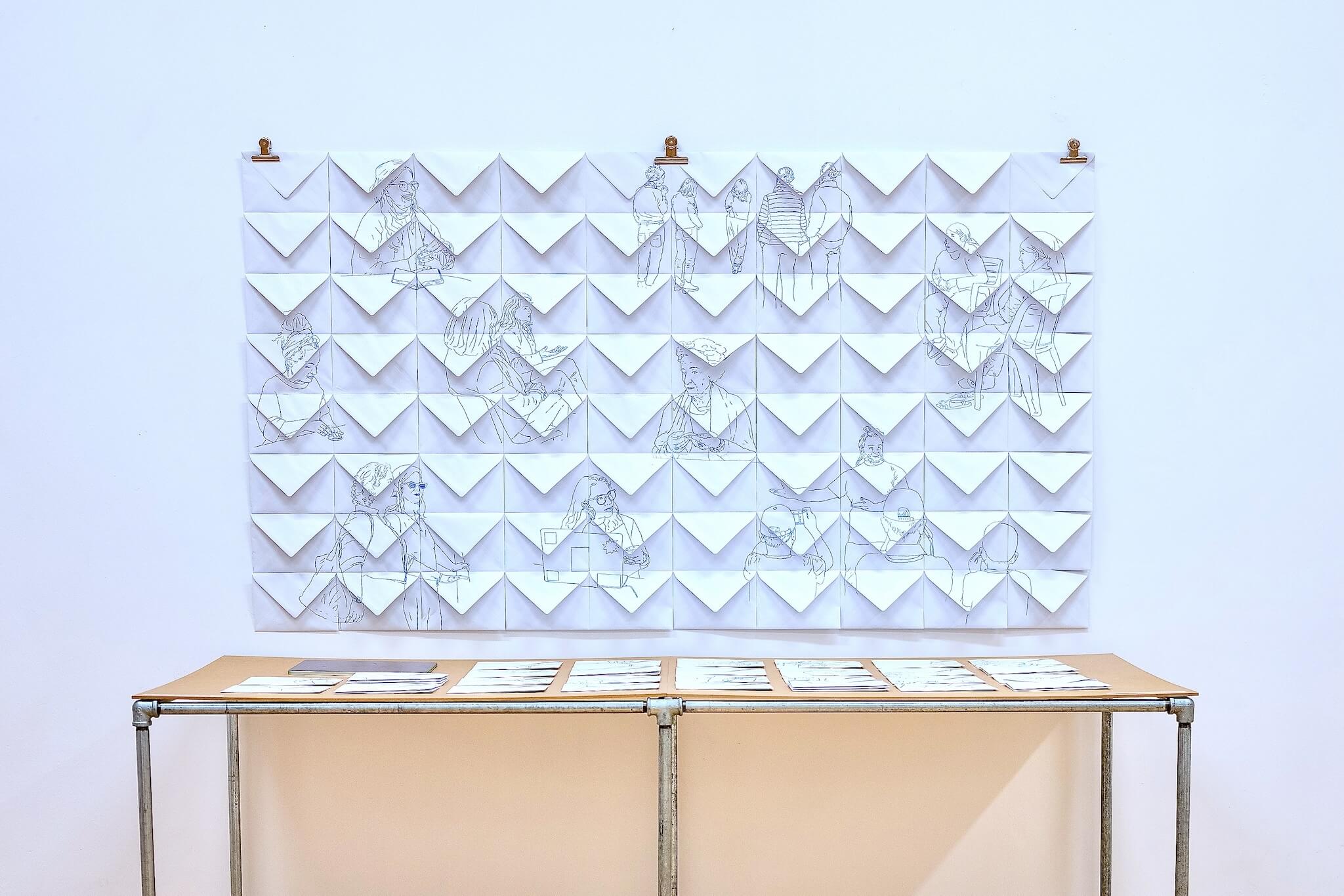
Orta Okul, This Is Not A Curriculum, 2025, exhibition Acts of Conflactions, Galerie AC. Art & Dialogue, Berlin 2025, courtesy of Orta Okul 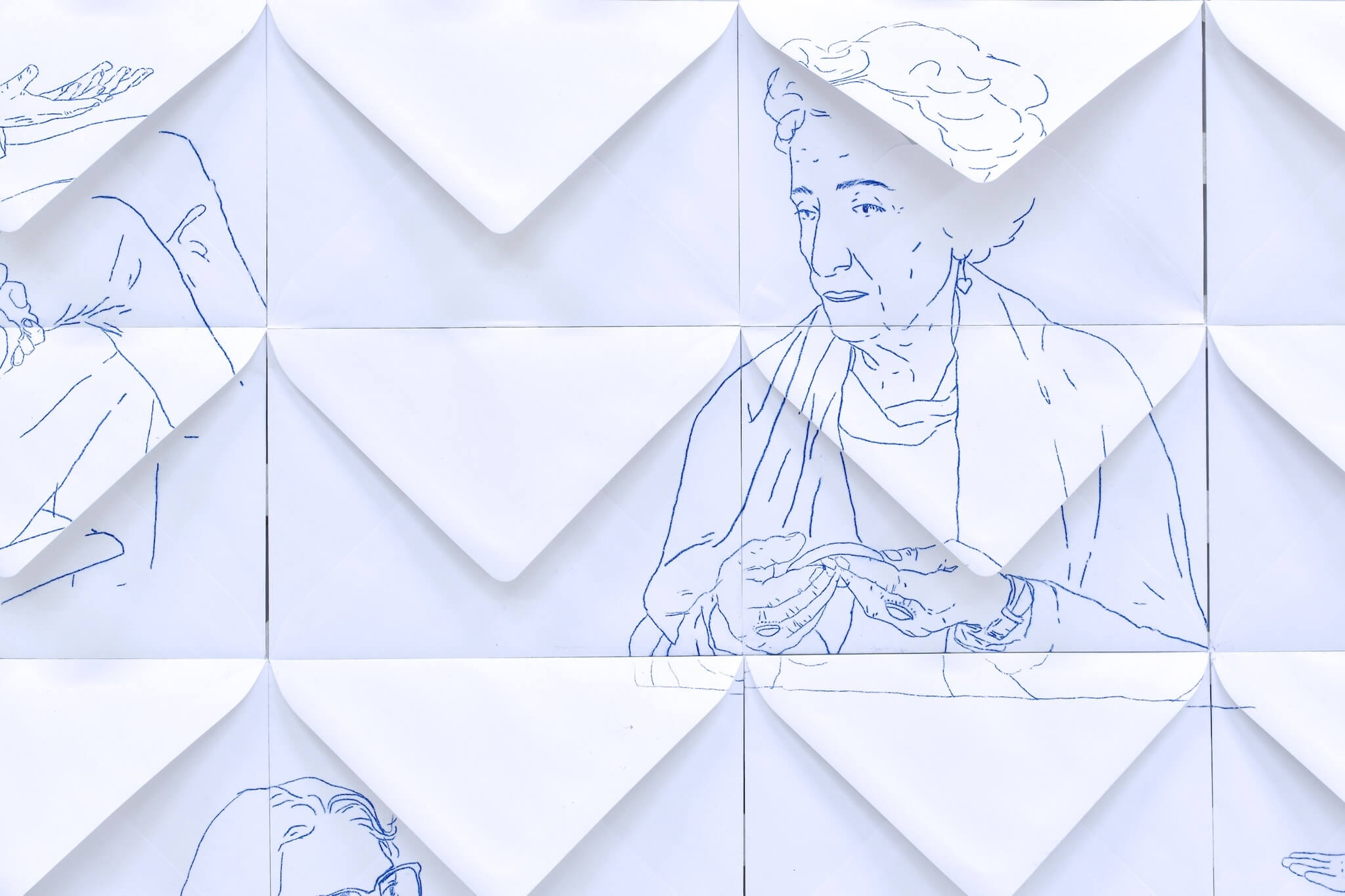
Orta Okul, This Is Not A Curriculum, 2025, exhibition Acts of Conflactions, Galerie AC. Art & Dialogue, Berlin 2025, courtesy of Sumac Space 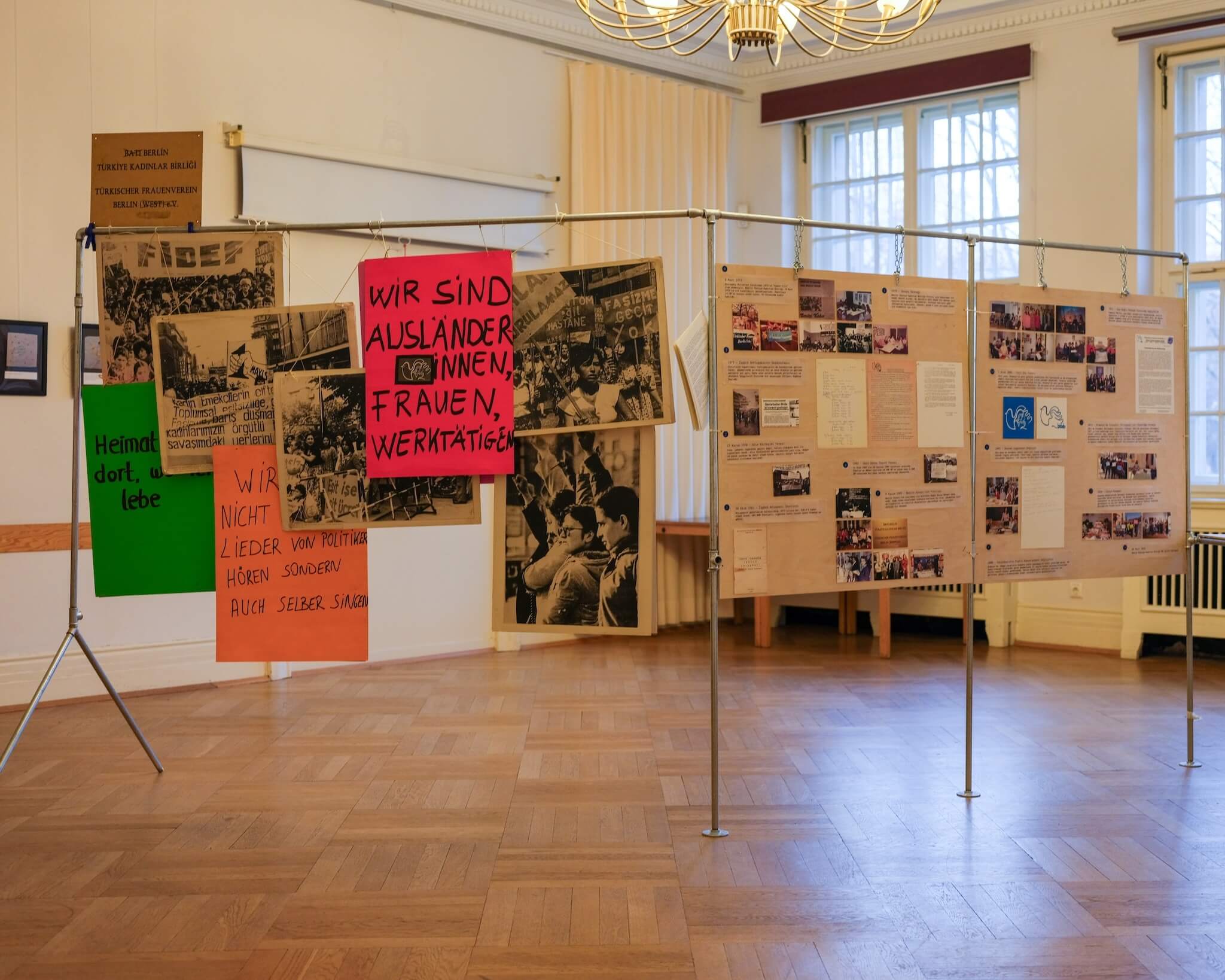
From 50 Jahre Türkischer Frauenverein Berlin: Frauenpower, Brücken bauen und Wandel inspirieren exhibition, curated and photographed by Orta Okul 
From إطار مفتوح program, with unaccompanied refugee children, facilitated by Mohamed Badarne, photographed by Orta Okul 
From Themed Tour to Exhibition of Invisible Borders, with unaccompanied refugee children, photographed by Orta Okul 
From Movement Workshop: Şiirden Dansa, with women speaking Turkish, facilitated by Gizem Aksu, photographed by Orta Okul -
Holding the Dilemma, Sitting with the Question—Reyhaneh Mirjahani in conversation with Ipek Çınar
İpek Çınar: At first glance, our practices and outcomes may appear quite different, but I sense they stem from similar concerns and struggles. That makes me especially curious about this exchange. So let me start directly: How would you describe what you do at the intersection of art, participation, and politics? Reyhaneh Mirjahani: I would describe my art practice primarily as a mode of critical investigation. Rather than positioning art as an end in itself, I approach it as a methodological and epistemological tool—one that enables me to examine and intervene in a socio-political situation, an issue, or a tension.…
Holding the Dilemma, Sitting with the Question—Reyhaneh Mirjahani in conversation with Ipek Çınar
Reyhaneh Mirjahani, Holding the Dilemma, Sitting with the Question, exhibition Acts of Conflactions, Galerie AC. Art & Dialogue, Berlin 2025, courtesy of Sumac Space
İpek Çınar: At first glance, our practices and outcomes may appear quite different, but I sense they stem from similar concerns and struggles. That makes me especially curious about this exchange. So let me start directly: How would you describe what you do at the intersection of art, participation, and politics?Reyhaneh Mirjahani: I would describe my art practice primarily as a mode of critical investigation. Rather than positioning art as an end in itself, I approach it as a methodological and epistemological tool—one that enables me to examine and intervene in a socio-political situation, an issue, or a tension. Ideally, it serves as a mode of inquiry capable of activating forms of knowledge production that are embodied, situated, and relational.
I rarely begin with art as such. I tend to start with a question or conflict, using art to probe, study, re-read, and reframe a situation. I am especially curious about the entanglements between power, counter-narratives, ethics, and lived experience. I focus on how these forces shape one another and structure the conditions for participation, responsibility, or agency. Initially, my interest was grounded in theoretical frameworks. Over time, I have become more drawn to the capacity of artistic practice to generate alternative research modes. These modes resist abstraction and instead foreground affect, contingency, and embodied experience.
I try to approach art not only as a representation, but as a speculative and experimental space. Here, dominant logics can be discussed, redefined, or reimagined. Art enables the exploration of new ways of relating, the rehearsal of ethical positions, and the co-creation of shared meaning. I am interested in how these spaces can offer conditions for critical reflection that go beyond cognition. They are also embodied and effective. This brings the possibility of more nuanced and plural understandings of participation, responsibility, and the political.
İpek: Your earlier works address identity and belonging through guest/host and self/other tensions, but later take on a more transnational, relational focus. Looking back, what questions or dilemmas prompted this shift in direction for you? Was it a gradual evolution or a response to particular challenges?
Reyhaneh: We grow up in systems that are keen to define our lived experiences through dichotomies. It is a way to simplify situations, and we are taught to think in the same terms. Over the years, I have shifted my attention toward what lies between these categories. I want to grasp the complexity of relationships and to resist static interpretations of events.
This has transformed my practice. My work is no longer primarily about my own identity or position. Instead, I focus on how, as subjects, we navigate the contexts and systems in which we live. Dialogue and participation become essential. They create opportunities to explore and understand the diverse, dynamic experiences of others. At the same time, they help reveal the politics that shape participation and dialogue.
Reyhaneh Mirjahani, Holding the Dilemma, Sitting with the Question, exhibition Acts of Conflactions, Galerie AC. Art & Dialogue, Berlin 2025, courtesy of Sumac Space 
Reyhaneh Mirjahani, An Experiment on Agency #5, Skogen, Gothenburg, Sweden, 2022 İpek: From what you’ve described, art for you seems to exist as both something projected into the future (the not yet) and as a process that unfolds. In your participatory works, many elements are involved: planning, realization, documentation, participant input, unexpected encounters, and the tensions of the moment. All of these meet in a speculative space. With so many variables, how do you see your role in this process? For example, how do you position yourself in the room?
Reyhaneh: I would describe my role in participatory projects as a facilitator. During the preparation and development phases, I established a framework with specific elements and cues. These questions or concerns are what I want to explore with participants. These elements act as subtle guideposts, not strict instructions.
Once the work begins, I try to step back and leave space for participants to interpret and respond on their own terms. I consider this openness essential. It allows the unexpected to emerge in both content and group dynamics. Sometimes I intervene during the activation phase, usually by asking a question or subtly shifting the group’s attention. My aim is to stay responsive rather than directive. I try to inhabit a space between author and participant. This lets me guide without closing possibilities, and to unfold relationally, shaped by the moment—whether social, political, or interpersonal.
But this brings me to a key question about your own practice: How do you define your role within the Orta Okul project that you initiate? In your view, how does your positioning affect dynamics, openness, and the potential for unexpected outcomes?
İpek: Initiate is the correct word. I usually describe myself not as an artist, but as an initiator. Even this role can influence a project’s dynamics more than I expect or want to admit. My solution is to carefully specify which groups I work with and spend more time with them. I dedicate time to understanding the community’s dynamics and learning about them. Whenever possible, I exchange ideas with them before the project begins. This helps my vision align with the community’s reality and wishes.
Reyhaneh Mirjahani, An Experiment on Agency #7, Connective Symposium, Fontys University of the Arts Tilburg, Netherlands, 2022 This approach involves compromises. Instead of working in galleries, museums, or staging public interventions, I often work in spaces where the community feels safer. Sometimes, I commit to longer-term collaborations. For example, in a recent project with Orta Okul, we spent several months meeting with the community every Friday. Sometimes, we did nothing more than ask, How do you perceive what we are doing together? Ultimately, we did not produce exactly what we had planned. But the process taught us about participation, empowerment, and building connections. Some women began referring to it as our project rather than your project. A few even wanted to take the initiative to continue it independently. This was an unexpected, yet deeply valuable, outcome.
I would like to specifically focus on your upcoming work, An Experiment on Agency #8, which will be part of Acts of Conflations and is the reason we met. This project continues a series that has already engaged diverse geographies, including Latvia, the Netherlands, Italy, and Sweden. Could you discuss the overall framework of this work and how you have adapted it to various contexts?
Reyhaneh: This work is designed to create a space where friction, disagreement, and discussion are not only possible but necessary. I have noticed that conversations around agency often get trapped in rigid dichotomies: either one has agency or one does not. In An Experiment on Agency, I seek to disrupt these binaries by foregrounding contexts in which agency is ambiguous, unstable, or constantly shifting. The work invites participants to explore subjective understandings of power and responsibility, rooted in lived experience rather than abstract definitions.
While I actively shape each version of the work based on its context, the project itself also evolves. The context not only informs the realization of the work, but also transforms it. Each iteration responds to dilemmas specific to the setting. These may relate to geography, sociopolitical conditions, or the group’s composition. During the activation phase, participants further shape the work, often steering discussions toward their own concerns and group dynamics. For example, in Riga, one participant group consisted of humanities secondary school teachers. In the Netherlands, it was a group of artists and researchers in socially oriented and academic practices. Each setting brought new questions: What kind of language emerges around the concept of agency? How do we discuss responsibility in a group of nations in conflict? What does it mean to claim neutrality? What happens when the agency shows up as refusal, withdrawal, or silence rather than action? And how do aesthetics operate in this participatory format?
İpek: Sharing agency is as challenging and risky as political, often feeling like the subject investigates you as much as you investigate it. Why is it so central to the series?
Reyhaneh: At first, I approached the agency as something granted, and I was interested in how we could exercise it. Later, during research phases, I began to question that premise entirely. Some scholars argue that agency can be imposed, involuntary, or even illusory. This was a turning point for me—not only for the project, but also for my own understanding of the concept. From there, the focus shifted toward examining different forms of agency and the structures that either limit or enable it, as well as the dilemmas and liminal spaces in between that we need to navigate.
I personally had the privilege of growing up around some activists and civic actors in my hometown of Tehran. That environment initiated many questions about our agency, responsibility, and ethics, situated between an authoritarian regime and imperial powers. For me, these questions are inseparable from my lived experience, regardless of where I am or the privileges I hold. I believe that engaging with this subject reveals much about our own subjective positions, standing in contrast to purely empirical research on the topic and challenging the binary frameworks through which the world is so often understood.
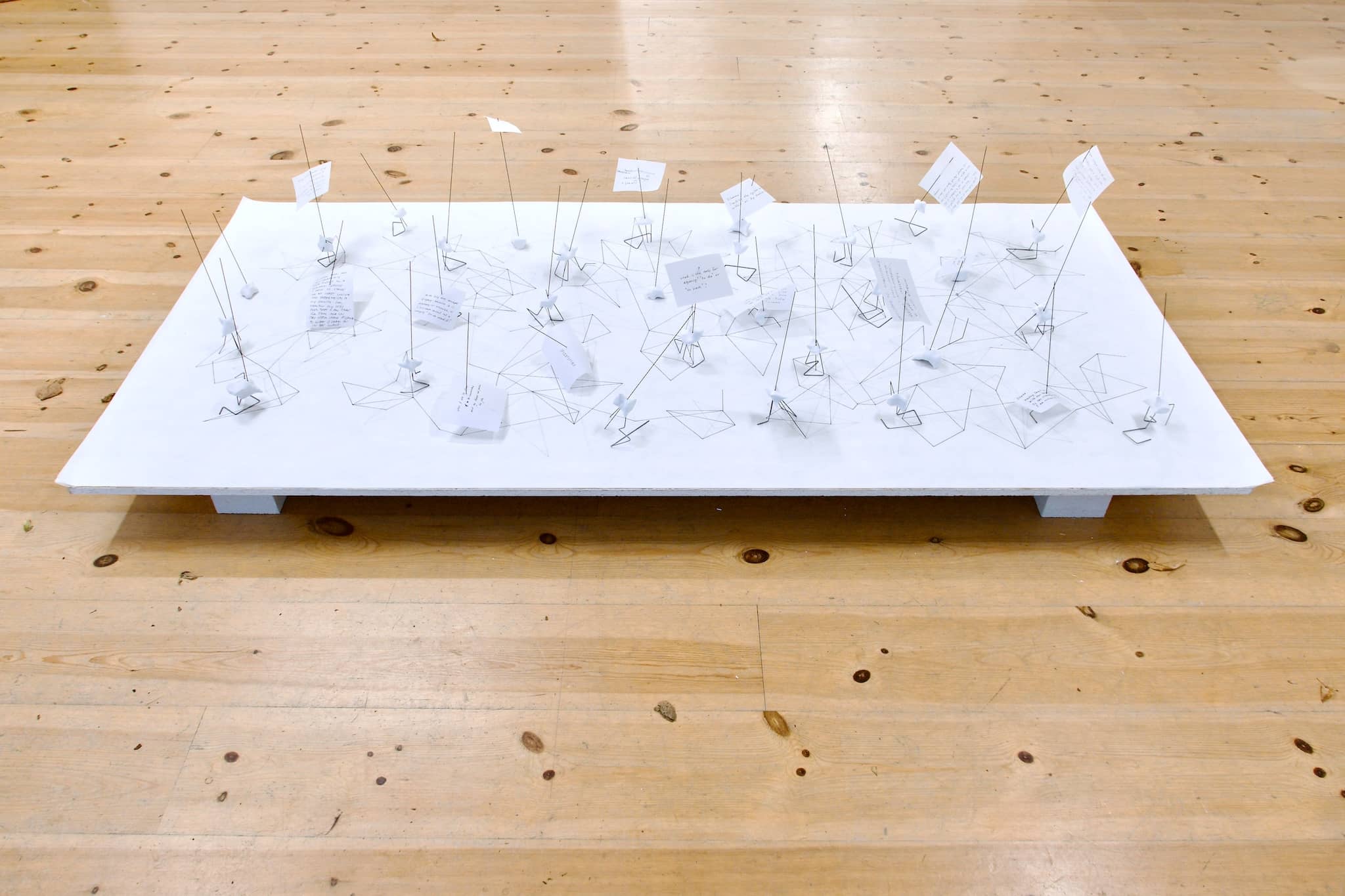
Reyhaneh Mirjahani, Holding the Dilemma, Sitting with the Question, Installation view exhibition Acts of Conflactions, Galerie AC. Art & Dialogue, Berlin 2025, courtesy of Sumac Space İpek: And what will you be exploring specifically in the Berlin context?
Reyhaneh: In Berlin, I am particularly interested in continuing this investigation at a time when violence is intensifying. Specifically, in the context of the ongoing genocidal acts and the immense human suffering of the civilian population in Gaza, the response we’ve seen in Germany—mirroring similar trends in some other Western countries—reveals a growing repression of protest and political movements. Within this climate, a central question emerges: how can we hold space for conflict without collapsing into consensus? And how can we meaningfully engage with the notion of agency when speaking out becomes a risk, and visibility itself can be weaponized?
I am not sure that it will open up new ways in a radical sense, but it will emphasize the already existing resources in our society: the capacity to share and to listen. I do not mean this passively; rather, it is a deliberate engagement with doubt, dilemmas, and insecurity, creating a space where these tensions can be acknowledged and discussed. The aim is not necessarily to provide answers, but to trace and understand the different structures at play in shaping experience and agency. This is what I hope to realize in the exhibition.
At the same time, I also want to acknowledge my own doubts. To what extent can conversation alone generate alternative approaches to entrenched situations? How much space can we truly give to antagonism in a context where we are still confronting the very real legacies of oppression and violence? Under what conditions, and when, are we allowed to engage in agonism, and when must we prioritize care, listening, or safety?
I’m curious about your perspective on working in Berlin today. How do the specific conditions, tensions, and opportunities here shape the way you think about agency in your own projects? And how does this affect your work with Orta Okul or similar participatory initiatives?
İpek: What you say is extremely important and a pressing issue in Germany, one that we all face in different ways. We are confronted both with the complicity of the country we live in regarding genocide and with the hypocrisy of institutions that have benefited from post-migrant, anti-colonial, and feminist discourse, which remain silent and try to silence us. Yet we remain here, because there is no other place to go.
At Orta Okul, we have dedicated our first three years to topics related to this: Urgency (2024), Community (2025), and Resilience (2026). Our aim is to strengthen collective bonds and allocate the limited resources we or our fellows have. I find both ease and political engagement in empowering individuals, using the methods you mentioned: care, listening, and creating safer spaces, especially for those in more difficult positions. It may sound simple, but after seeing how institutions complicate these topics, I believe we need a bit of simplicity and directness. And more spaces to discuss. Perhaps for this reason, we need An Experiment on Agency now more than ever.
Reyhaneh Mirjahani is an artist working at the intersection of visual art, curating, artistic research, organizing, and publishing, focusing on participatory art. She uses collaborative, interdisciplinary approaches to create dialogic spaces exploring agency, participation, counter-narratives, and spatial politics. She holds an MFA in Fine Art from HDK-Valand, Gothenburg University, and has completed the postmaster programs Commissioning and Curating Contemporary Public Art at HDK-Valand and CuratorLab at Konstfack.
Ipek Çınar is an artist and researcher working predominantly with participatory and socially engaged art practices. She uses play, joy, and unexpected encounters as means of expression. She studied Political Science at METU Ankara and Art in Context at UdK Berlin, and is currently a PhD candidate at the Academy of Fine Arts Vienna. Alongside her artistic production, she also works in the field of anti-discrimination and social justice. İpek Çınar loves the word “Orta” (Middle): She is co-editor of Orta Format and is a co-founder of Orta Okul.
-
The Word Dismantled to Compose a Single Silence—Safoora Seyedi
Yaqeen Yamani’s work Checking In—a collection of eighteen text messages sent to Palestinians amid an unfolding genocide—transcends sociological critique, evolving into a meditation on language as both witness and accomplice to erasure. These messages, phrased in the rhetoric of care yet hollow in their affect, invite viewers to navigate the architecture of the Symbolic Order: a structure that polices truth, conceals complicity, and transforms human suffering into ritualized performance. Through the lens of French feminist thought, this essay explores how Yamani’s work illuminates the quiet complicities embedded in language. It reveals the mechanisms by which Western discourse enacts Abjection—the casting…
The Word Dismantled to Compose a Single Silence—Safoora Seyedi
Yaqeen Yamani, from Checking In series, courtesy of artist Yaqeen Yamani’s work Checking In—a collection of eighteen text messages sent to Palestinians amid an unfolding genocide—transcends sociological critique, evolving into a meditation on language as both witness and accomplice to erasure. These messages, phrased in the rhetoric of care yet hollow in their affect, invite viewers to navigate the architecture of the Symbolic Order: a structure that polices truth, conceals complicity, and transforms human suffering into ritualized performance.
Through the lens of French feminist thought, this essay explores how Yamani’s work illuminates the quiet complicities embedded in language. It reveals the mechanisms by which Western discourse enacts Abjection—the casting out—of the Palestinian subject. The critiques that Julia Kristeva, Luce Irigaray, and Hélène Cixous directed at Phallogocentrism—that paternal, logic-bound tongue—resonate with the colonial narratives that continually attempt to erase Palestinian identity and pain. In this light, Checking In is not merely an artwork but an intervention—a confrontation with the ways language itself can be weaponized, sanitized, or rendered inert.
Yaqeen Yamani, from Checking In series, courtesy of artist 
Yaqeen Yamani, from Checking In series, courtesy of artist Julia Kristeva: The Rhetoric of Performance and Political Abjection
In Kristeva’s theory, Abjection names the primal force that assaults the boundaries of the self, demanding expulsion to preserve the illusion of psychic coherence. It is not a matter of filth alone, but an existential rupture—an unthinkable presence that threatens the fragile separation of “I” and “Other.”On a geopolitical scale, the explicit acknowledgment of genocide, the affirmation of Palestinian subjectivity, and the confrontation with systemic complicity destabilize the Western Symbolic Order itself. These truths are the political abjects of our time. The brief “checking in” message operates as a defensive mechanism—a linguistic anesthetic—that allows the complicit subject to maintain distance from this disturbance. The query “How are you?”, uttered amid catastrophic erasure, functions as a shield against unbearable reality. By omitting “Palestinian” and refusing to name the violence precisely, these messages exile both subject and suffering to the margins, absolving the sender of responsibility while preserving the illusion of ethical concern.
Kristeva defines the Symbolic Order as the domain of law, custom, and language that regulates the untamed forces of the Semiotic—rhythm, emotion, instinct. Within Checking In, the language of care emerges as a symptom of this order’s collapse. Grammar and syntax remain intact, yet affective depth has been drained. The Semiotic pulse that animates authentic empathy is absent. What remains is a hollowed-out ritual: the performance of empathy without its substance, a gesture designed to maintain social composure and avert acknowledgment of moral collapse.
By collecting and exhibiting these eighteen messages—and framing them explicitly as a critique of complicity in genocide—Yamani reinjects the abjected real into the public sphere of art. The work fractures the veneer of serenity maintained by the Symbolic, forcing the viewer and the complicit subject alike to confront what had been expelled: real suffering, lived experience, and ethical accountability. This is a Semiotic rebellion, a return of the repressed, revealing the quiet power structures embedded within language.
Luce Irigaray: The Politics of Denied Difference and Critical Mimicry
Irigaray’s critique of Phallogocentrism—the patriarchal logic that recognizes only one subject, the masculine One—extends to political discourse as an indictment of the denial of difference. In Checking In, this critique is rendered vividly: the refusal to name “Palestinian” is not incidental, but central to the work’s examination of systemic erasure.As patriarchy permits only a single gendered subject, global discourse often permits only a single narrative of power. By failing to name “Palestinian,” the messages participate in this denial, reducing a particularized struggle into abstraction. The Palestinian, as a subject defined by historical specificity and political identity, is denied recognition. This linguistic flattening transforms a complex colonial reality into a neutralized humanitarian story, where suffering is generalized and history obscured.
Irigaray theorized mimicry as an insurgent strategy: the deliberate over-performance of the role assigned by the dominant order to expose its hollowness. Yamani enacts this principle through the exhibition itself. By re-presenting these phrases of hollow empathy, the artist mirrors the language of power to reveal its emptiness. In Acts of Conflations, mimicry becomes an act of resistance: the repetition exposes the mechanisms of erasure embedded in everyday communication, transforming passive compliance into a critical intervention.
Irigaray’s emphasis on the materiality of the body resonates in Yamani’s choice of medium: text on glossy paper. This materialization transforms abstract messages into objects of presence. The gloss, the weight, and the tactile quality of the paper restore the Palestinian subject where language had imposed absence. Within the exhibition space, the texts assert themselves as objects demanding recognition, reminding viewers that language, when materialized, carries accountability.
Yaqeen Yamani, from Checking In series, courtesy of artist Hélène Cixous: Reclaiming the Body’s Voice and Narrative Sovereignty
Cixous’s notion of Écriture Féminine—writing from the body, from instinct, from breath—sought to dismantle the sterile grammar of the paternal tongue. In Checking In, this principle manifests as the reclamation of the Palestinian voice, reviving a silenced narrative.The “checking in” dispatches are echoes of a disembodied tongue, stripped of emotion and instinct. They sever the link between word and lived suffering. The sender, unwilling to inhabit another’s pain, shelters in a rhetoric of composed detachment. This mirrors the paternal tongue Cixous critiques: rational, coherent, but emptied of human resonance.
Cixous emphasizes the power of silence, the force of the unsaid. In Yamani’s work, the truth resides in what is omitted: the erased words—“Palestinian,” “genocide,” “occupation”—carry more weight than the phrases that remain. These silences are not passive voids but instruments of suppression, sustaining systemic erasure. Yamani turns these absences inside out, transforming silence into presence, and demanding that viewers acknowledge what language refuses to name.
Emerging from dialogues with Palestinians in the United States, Checking In is inherently communal. It assembles dispersed experiences into a chorus of voices, transforming individual narratives into a shared language of resistance. Through these eighteen fragments, the Palestinian lived experience becomes palpable, political, and plural—insisting upon recognition, refusing isolation, and asserting sovereignty over its own narrative.
Across the work, the interplay of silence and speech, absence and presence, reveals the ethical stakes embedded in language. By foregrounding the empty gestures of empathy, Yamani’s artwork calls attention to the ways linguistic structures maintain complicity. It demonstrates that language is never neutral: it shapes, erases, and validates, and it is within this field that resistance must operate. Checking In compels viewers to confront not only what is said, but how it is said, and what remains unspoken.
The juxtaposition of minimal material—text on paper—with maximal ethical and affective force allows the installation to operate on multiple registers simultaneously: aesthetic, linguistic, and political. The exhibition space becomes a site where the unseen machinery of erasure is revealed, where the abjected subject returns, and where the viewer is implicated in the act of witnessing.
Where Words Return: Echoes of Presence
With the simplest of tools—text and paper—Yaqeen Yamani excavates the structures of linguistic violence that silently sustain erasure. Through the lens of feminist psychoanalysis, Checking In reveals how the dominant language—the Phallogocentric Symbolic Order—erases the Palestinian subject even while claiming to convey care.Yet the work does more than reveal: it restores. By making visible the mechanisms of complicity, Yamani brings presence, materiality, and voice back into the space where absence once prevailed. Through mimicry, through silence, and through the return of the abjected real, Checking In transforms the gallery into a space of ethical and critical engagement. Here, language itself becomes a site of reclamation, a vessel for witnessing and bearing responsibility.
The Palestinian subject, once removed and silenced, reemerges—not as abstraction, but as a living, speaking presence. In this careful return, each word, each absent word, each deliberate silence resonates. The exhibition Acts of Conflations is no longer merely a site of display; it becomes a crucible where language, presence, and witness converge. Through this act, Yamani restores not only what was lost to erasure but also the possibility of recognition, justice, and the enduring affirmation of identity.
Safoora Seyedi is a writer and researcher exploring art, literature, and memory through a feminist lens. She holds an M.A. in International and World History from Columbia University, with a thesis titled “Narrative as a Historical Document.” Seyedi contributes essays and art reviews to various journals and engages in collaborative reading projects, examining how stories and images shape collective memory.
-
The Return of Wafa Hourani’s Cinema Dunia—Davood Madadpoor
The text will be published in Italian in the upcoming issue of Arabpop—Contemporary Arab Arts and Literature magazine. Wafa Hourani’s work does not just imagine futures: it builds them, piece by piece, often in miniature. Born in 1979 in Hebron, Palestine, Hourani grew up as one of 21 siblings in a refugee household shaped by displacement and history. His art crosses boundaries—sculpture, photography, poetry, painting, film, and sound—but at its core is the act of building worlds: not imagined escapes, but worlds rooted in present conflict, shaped by both personal loss and shared memory. He works at the edges of perception:…
The Return of Wafa Hourani’s Cinema Dunia—Davood Madadpoor
The text will be published in Italian in the upcoming issue of Arabpop—Contemporary Arab Arts and Literature magazine.
Wafa Hourani’s work does not just imagine futures: it builds them, piece by piece, often in miniature. Born in 1979 in Hebron, Palestine, Hourani grew up as one of 21 siblings in a refugee household shaped by displacement and history. His art crosses boundaries—sculpture, photography, poetry, painting, film, and sound—but at its core is the act of building worlds: not imagined escapes, but worlds rooted in present conflict, shaped by both personal loss and shared memory. He works at the edges of perception: between physics and poetry, memory and myth, war and imagination. Based in Ramallah, in the occupied West Bank, his work holds the contradictions of life under occupation without reducing them to slogans.
Hourani believes fiction can tell the truth in ways reality cannot. In his work, different pieces come together to create scenes that are both real and unreal. A flower might become a fighter jet. A gun might contain an impressionist landscape. The medium matters less than the method: rearranging what already exists to show what else could. His approach is deeply tied to science; not in terms of data, but in the urge to understand how things relate. Quantum physics, superposition, and systems theory all influence his visual logic. He draws from math as easily as from myth.
Wafa Hourani builds futures that are political, personal, and unfinished—not to offer answers, but to make space for new ones. He does not make art to explain Palestine to the world. He makes art that asks the world to look at how it describes itself. His art does not close stories; it opens them. Through layers and contradictions, he creates new ways of feeling: a world that has not arrived yet.
Cinema Dunia once was a vibrant cultural space in Ramallah, hosting events from screening Cecil B. DeMille’s Samson and Delilah to jazz concerts and bodybuilding competitions. It was a central gathering place that attracted audiences not only from Ramallah itself but also from nearby Al-Bireh, Jerusalem, and surrounding villages. This rich mix of cultural programming made Dunia a unique place of collective experience. However, its life was disrupted during the First Intifada in 1987, when Palestinian chose to close down cinemas as a strategic decision to prioritise resistance over entertainment. The building was eventually demolished, its land first converted into a parking lot and now replaced by a commercial tower housing international fast-food chains, marking a stark shift from a communal cultural space to a site of global consumerism.1
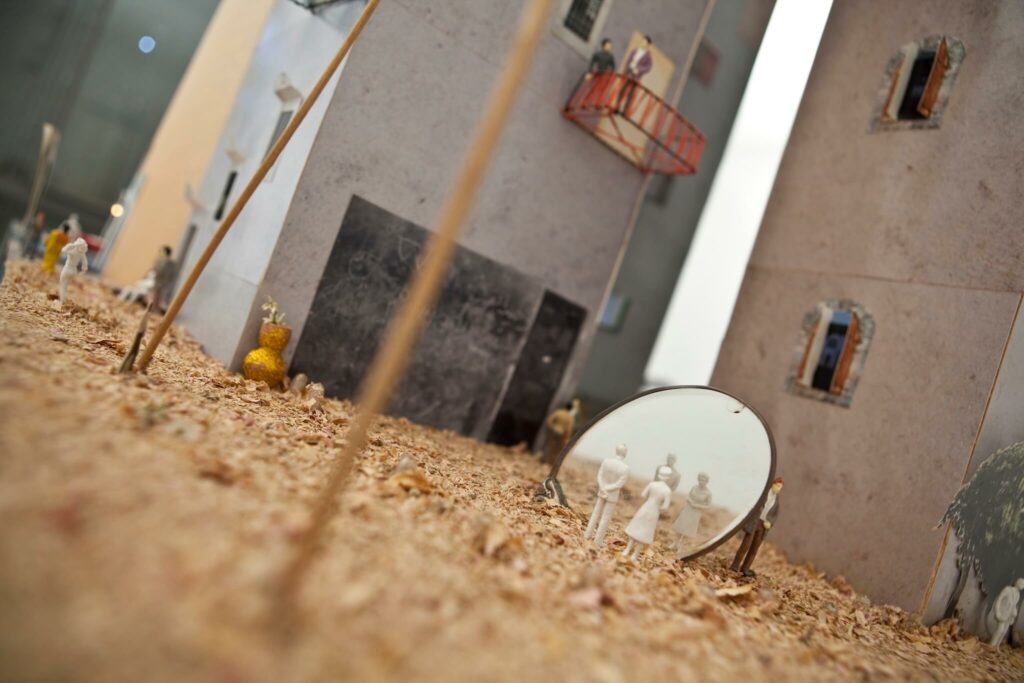
Wafa Hourani, Cinema Dunia, 2012, courtesy of artist, detail Wafa Hourani’s artwork, a meticulously crafted model of Cinema Dunia, is far more than a miniature replica of a demolished building. Inside the model, he places Mirror Garden, an imaginative public plaza where viewers confront their reflection; mirrors here function politically (the Mirror Party) as a way to make social accountability visible and to prod internal critique and resistance to external occupation. Cinema Dunia is a dense, layered object that functions as a site of political critique, a vessel for collective memory, and a trigger for the imagination. He also reads Dunia’s closure as an internally driven rupture in Palestinian cinematic life. He stages this loss in the model through an 11-minute looped montage of Palestinian fiction fragments, which gestures toward the archive’s unrealised potential. Still, in The Historical Timeline of Qalandia 1948-2087, he refuses total erasure: Cinema Dunia endures in his future narrative, folded into the Mirror Party timeline where walls become mirror-surfaces and the site is repurposed as a space for reflection and political imagination.2
Hourani’s Cinema Dunia operates at the intersection of two poles, simultaneously critiquing the world’s desire to contain and beautify the Palestinian narrative and extending a profound invitation to reconstruct what has been violently erased poetically.
Susan Stewart, in her work On Longing, argues that the miniature appeals to us because it offers a world over which we can exert total control. It creates a relationship of power where the viewer becomes a giant, a god-like figure gazing down upon a self-contained, manageable universe. From this perspective, Hourani’s Cinema Dunia is a profoundly political and critical object. It takes the painful history of a public place—a history of cultural flourishing, political resistance, closure, and eventual submission to global capitalism—and transforms it into an artefact. The complex reality of cinema is miniaturised into an object that can be displayed in a pristine gallery, observed from a safe distance, and even possessed by a collector. The body of the viewer is necessarily excluded: one cannot enter this cinema, but from a controlled distance one can hear its films. This act of creation is a sharp, implicit critique. Hourani presents the world with what it seems to want: a Palestinian story that is contained, beautiful, and possessible. He grants viewers a sense of mastery over a history they might not truly comprehend, but which enables them to become a tourist of trauma, able to appreciate the form without feeling the full weight of its content.3
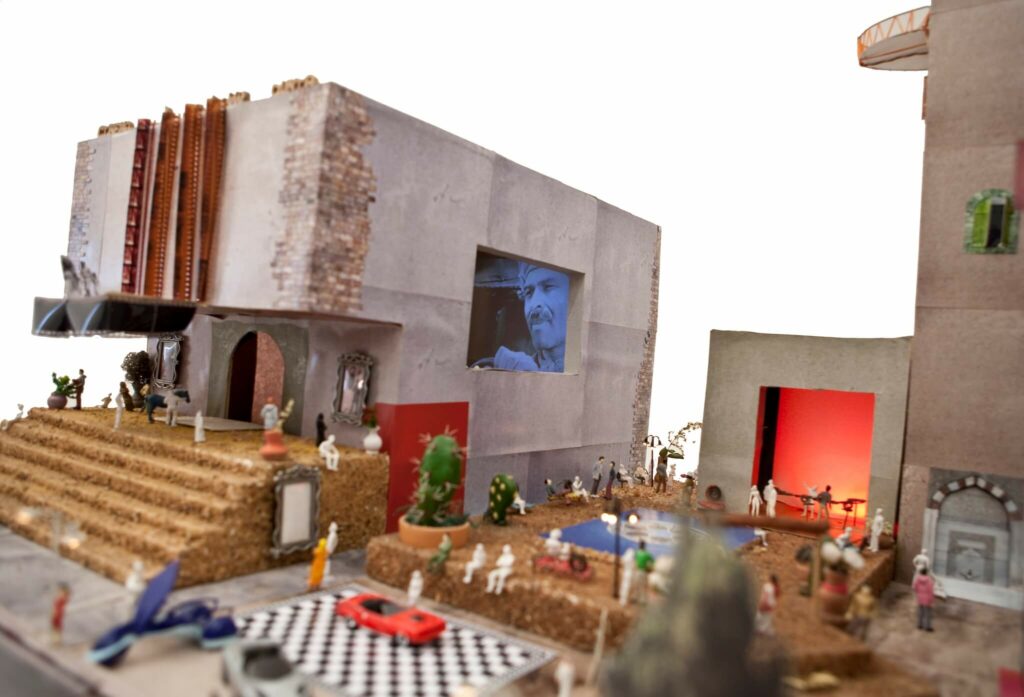
Wafa Hourani, Cinema Dunia, 2012, courtesy of artist, detail 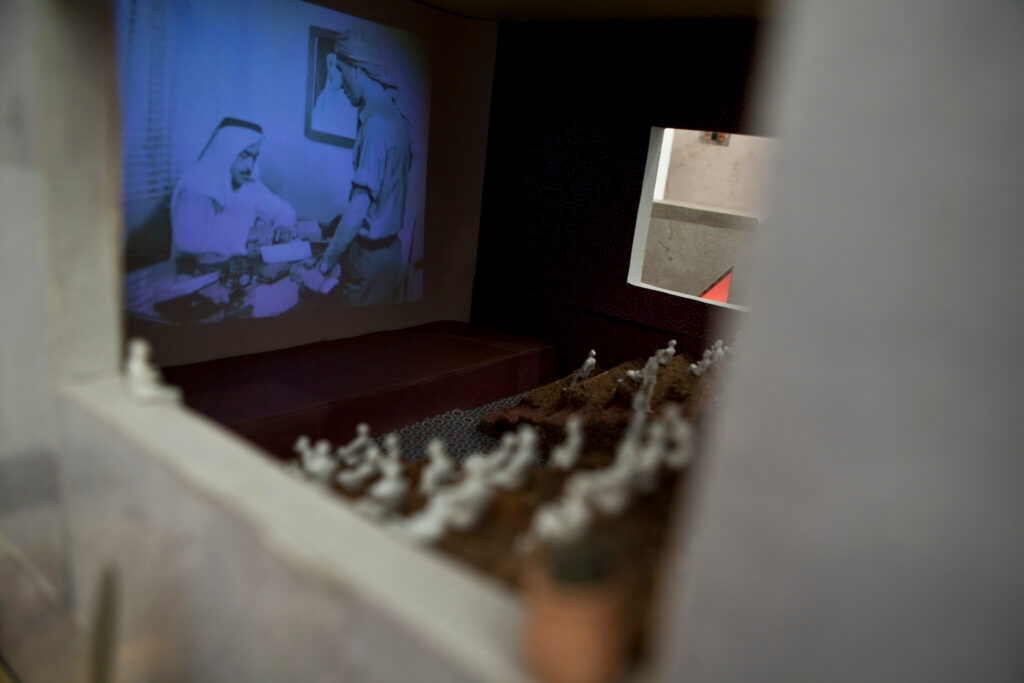
Wafa Hourani, Cinema Dunia, 2012, courtesy of artist, detail However, the work goes beyond Stewart’s lens of control. We should not miss its poetic power, knowing that Wafa´s book of poems might be published soon. At this point one should move to Gaston Bachelard’s The Poetics of Space. For Bachelard, the miniature is not an object of control but a catalyst for reverie. It does not shrink the world; it expands the imagination. He posits that a small object, when contemplated, can unlock a universe of intimate immensity. From this vantage point, Hourani’s Cinema Dunia is not a contained object, but an explosive one. It is a machine for generating daydreams.4
Looking at the model in 1 x 2 x 1.7m scale, the viewer’s imagination is not subdued but ignited. It invites us to join the vivid life of cinema and its surroundings. We are prompted to inhabit the space mentally, to reconstruct the scenes that the historical fragments describe. The architectural details—the privileged penwar5 seats, the mezzanine, the narrow stage—cease to be mere formal elements and become stages for forgotten human dramas. Hourani populates these stages with figures and Houses: anonymous whites that stand as the audience, coloured characters that mark the people of Ramallah, and houses with varied antennae that double as a critique of mass media and propaganda.
Bachelard’s idea speaks to the power of the human mind, particularly through imagination, to grasp and interact with the world profoundly, going beyond mere perception or scientific understanding: it is not an act of political domination, but one of intimate, tender care. We do not possess the story; we are entrusted with it. The model becomes a sacred space where the ghosts of a community’s past are invited to gather in a future. At the same time it allows for a poetic journey, a way of feeling the immensity of the loss precisely because of the smallness of the object that represents it.
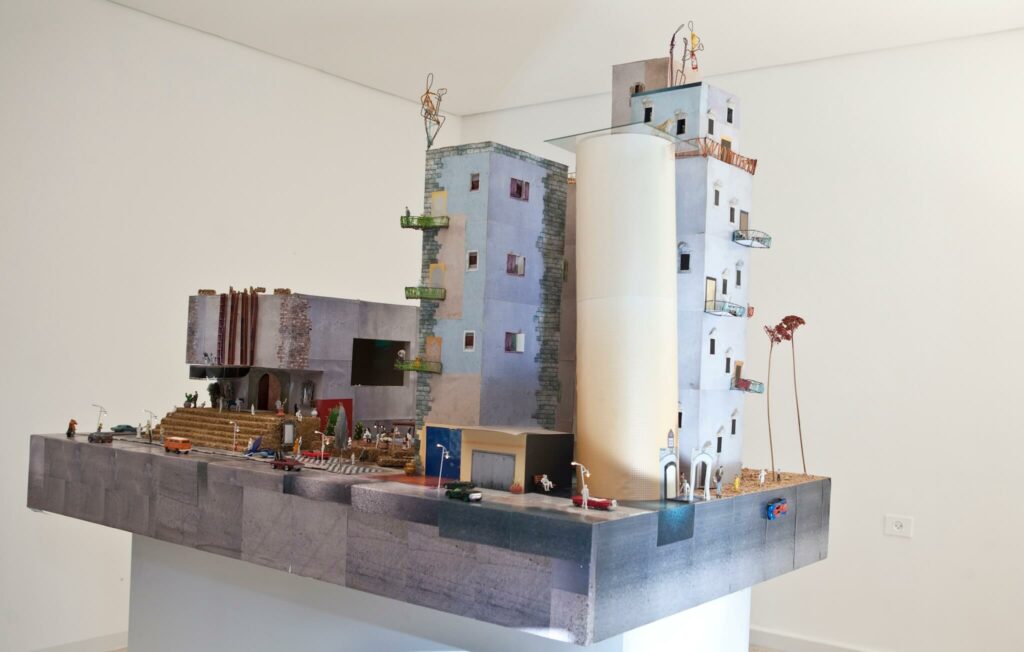
Wafa Hourani, Cinema Dunia, 2012, courtesy of artist Wafa Hourani’s Cinema Dunia flickers between two states: an object of critique and a receptacle of imagination. It confronts us with our gaze, forcing us to ask whether we are consuming a tragedy or participating in an act of remembrance. It is a statement about how memory is packaged for an external audience, and simultaneously a deeply personal invitation to rebuild a lost world within the vast theatre of the mind. Hourani does not simply mourn a demolished building: for him, Cinema Dunia is still there. He claims that while a physical space can be erased and paved over, the world it once contained—its dreams, its fears, its culture, its life—can be resurrected, immense and powerful, within the quiet confines of a box.
1 Yassin, Inas. 2010. Projection: Three Cinemas in Ramallah & Al-Bireh. Institute for Palestine Studies. https://www.palestine-studies.org/en/node/78362
2 Hourani, Wafa. The Historical Timeline of Qalandia 1948-2087. The Broken Archive. https://www.brokenarchive.org/artist/wafa-hourani
3 Stewart, Susan. On Longing: Narratives of the Miniature, the Gigantic, the Souvenir, the Collection. Baltimore: Johns Hopkins University Press, 1984
4 Bachelard, Gaston. The Poetics of Space. Translated into Farsi by Maryam Kamali & Mohammad Shirbacheh. Tehran: Roshangaran, 2013
5 The penwar seats, regarded as the most exclusive, were situated in the front balcony. They were reputed to be more comfortable and were enclosed by a modest barrier, resembling private boxesBorn and raised in Tehran, Davood Madadpoor is a Berlin-based curator and photographer. With a background in visual arts and curatorial studies from Florence, his practice explores speculative artistic strategies—particularly fictioning—as ways of reimagining contemporary realities shaped by transition, constraint, and shifting socio-political landscapes. He co-founded Sumac Space, an ongoing project dedicated to contemporary art in West Asia. It develops exhibitions and dialogues that emphasize critical thinking in art practices.
-
Artist’s Dilemma: Authorship, Power, and Social Responsibility—Mojtaba Amini in conversation with Pariya Ferdos[se] and Davood Madadpoor
Mojtaba Amini explores the dual roles of artists as creators and social commentators, highlighting the tension between artistic freedom and societal pressures and the influence of political power on creative expression. His work is closely connected to his personal experiences and the violent histories of the materials he uses, which serve as metaphors for larger societal issues. Amini also critiques the ignorance and absence of serious curators in Iran’s art scene, pointing out that the dominance of galleries and commercial interests stifles true artistic expression and hinders significant artistic movements.
Artist’s Dilemma: Authorship, Power, and Social Responsibility—Mojtaba Amini in conversation with Pariya Ferdos[se] and Davood Madadpoor
[Scroll down for Farsi Version]
Davood Madadpoor: One of the concerns that have recently occupied my mind, and I would like to know your perspective on this, is the concept of being an artist. We who work and live in the Middle East, focusing on its social and political geography, might see our artistic activities take on a different hue, whether for me as a curator or you as an artist. Considering that this region is constantly undergoing social and political changes, how has your relationship with art evolved over time?
Mojtaba Amini: An artist’s beliefs and ideologies compel them to interpret and analyze political and social conditions. They then try to align these beliefs with their academic background, compare them with the realities of society, and ultimately intervene in their path forward. These alignments and contradictions can lead to growth, change, and evolution in the art and the artist’s character. Changes in society stem from the policies of power, and the citizen-artist, depending on their relationship with power, can present a form of art that constantly needs to evolve.
Pariya Ferdos[se]: Is this structural belonging a necessity? And if belonging to this structure limits the audience, can the artist find a way to overcome this limitation in presenting their work, both in the manner of presentation and in the scope of the audience?
Mojtaba: It would be better to answer this series of questions with Mikhail Bakhtin’s view on the artist, the audience, the artwork, and society. Bakhtin believes that Art is inherently and intrinsically social; when the external social environment influences art from the outside, it encounters an immediate and internal resonance within it. These two factors (art and society) are in no way alien forces that influence each other: the structure of one influences the structure of the other…Even that internal part of the artist that manifests in their work still has a social root in the artist’s subconscious, and the political or social situation of the environment provokes the artist to react in various ways. There will be no specific obligation, but there will be resistance from the artist regarding the form of presentation and the content of their works concerning environmental influences. Suppose the social conditions impact the artist as an individual in society, resulting in an artistic work and the construction of meaning. In that case, the reception of this meaning is completed in the same context where the work is created. The effort to transcend these limitations is somewhat subject to becoming fashionable.
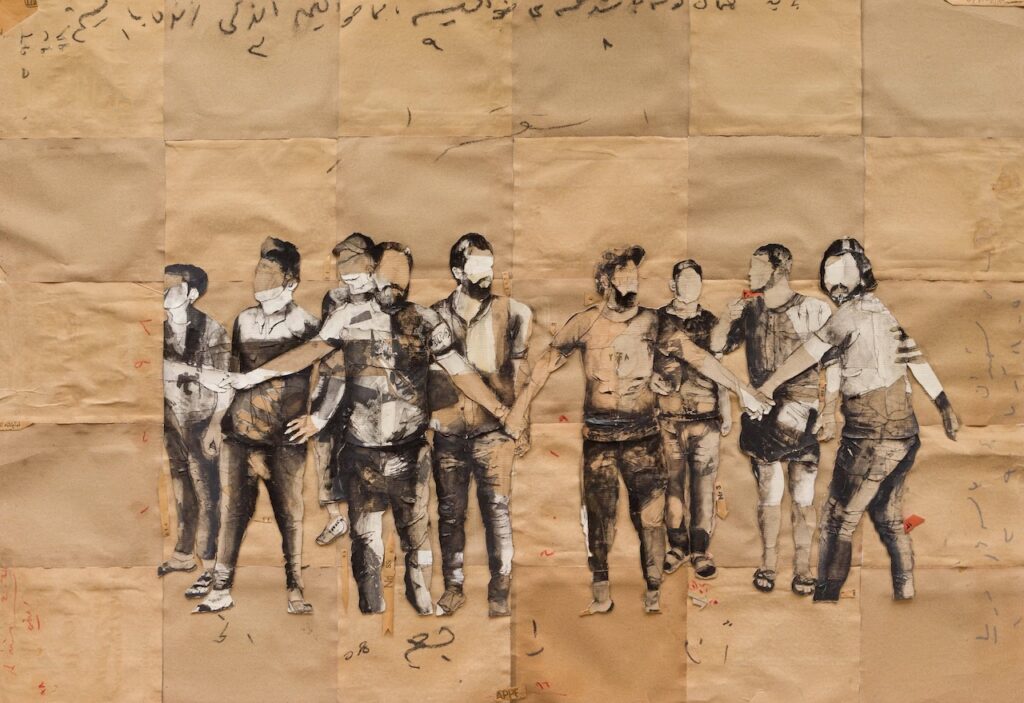
Mojtaba Amini, Untitled, 2020, from I Will Return series, 138×191 cm, mixed media (paper, sandpaper and paint) 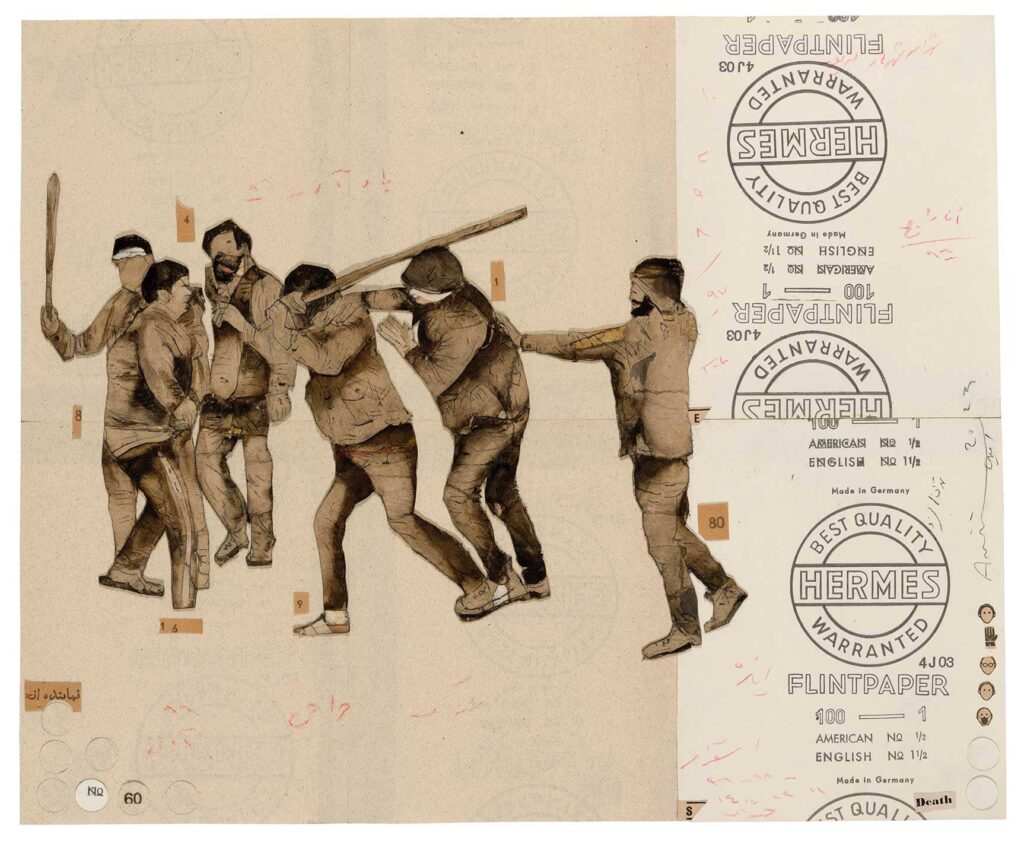
Mojtaba Amini, Untitled, 2020, from Tear in Town series, 75×54.5 cm, collage (paper, sandpaper and paint) Davood: By accepting the artist’s role, do you think we are caught up in a system that forces us to engage with it and consequently question and address it? Do you think the artist now, beyond the “traditional” role of being an artist, also assumes other roles?
Mojtaba: I think artists oscillate between the role they choose for themselves and their assigned role. Where society gives them meaning and credibility, compulsion will also be present in their work.
Davood: So, if I understand correctly, we should pause again to discuss the freedom and limitations of artists, correct? And have you, as an artist, accepted this compulsion from society? Should we call it compulsion, or perhaps a term like responsibility would better capture the sense of obligation?
Mojtaba: Artists are free, and no one has the right to tell them what to do or not do. However, when the artist, as Albert Camus says, becomes temporarily famous and derives their credibility from society and the people, they are compelled to stand with the people.
Pariya: Accepting that the artist, in your view, should stand with the people, to what extent is this possible, and if achieved, how impactful, inspirational, and effective can it be? Should the artist feel obligated to be influential?
Mojtaba: A famous artist with social capital can be influential to some extent by raising awareness and intervening in society.
Davood: Can you explain the nature and manner of these influences? Do these influences follow a particular direction?
Mojtaba: I think one of the best examples of intervention in power and the social influence of an Iranian artist is Mohammad Reza Shajarian due to his correct stance concerning the political-social events of recent years, which led to the banning of his works from state television and, more specifically, the removal of Rabbana from Iranian radio and television. His act raised many questions among the people, especially the religious part; it’s an example of the most accurate form of awareness-raising by a socially influential and well-known artist.
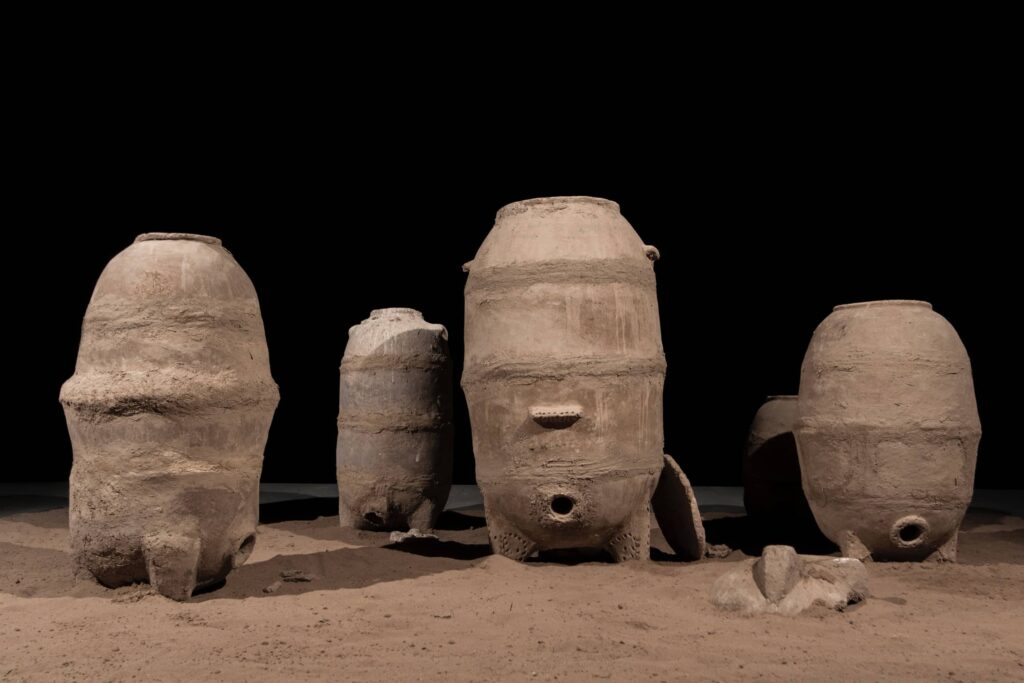
Mojtaba Amini, Majâ’a, 2016, (lit. a year of severe famine in which many men and beast die | Jar (lit. a container for grain and flour), Variable: 80×160. 110×220. 155×200 cm 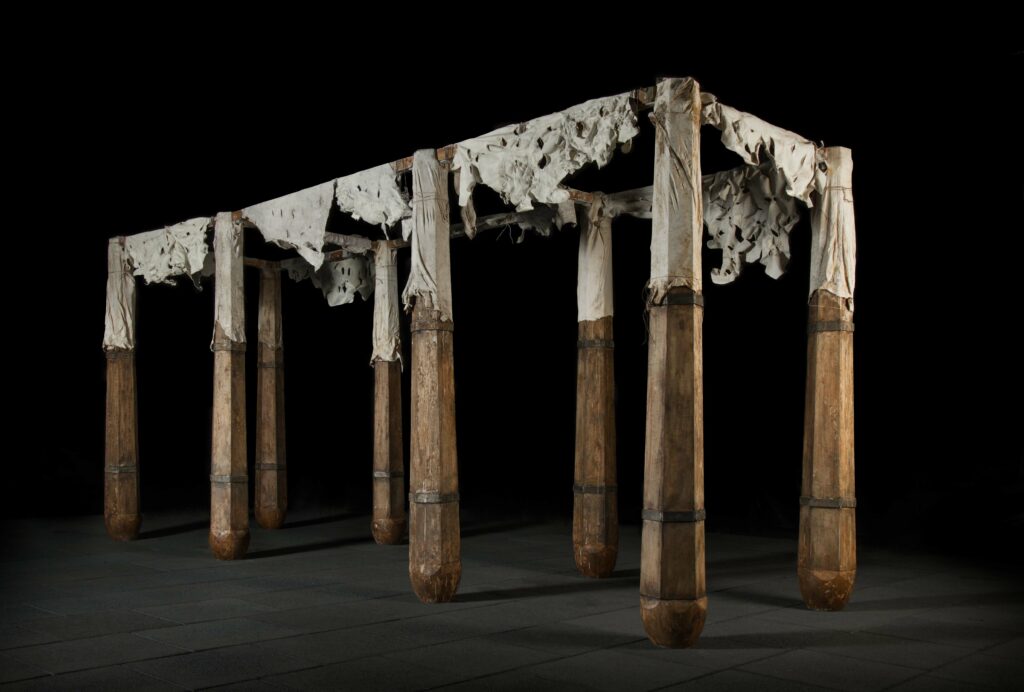
Mojtaba Amini, Halab! Halab!, 2017, 136x230x505 cm, wood, iron, animal glue, goatskin, salt Pariya: Given that we have discussed the influence of political and social context and the dominant structure on the artist, how do you think, besides these factors, the intrinsic nature of the artist as a human being and their lived experience (in the form of psyche and body) impact the creation of their work?
Mojtaba: Any form of personalization in the artist’s work and the creation of art is something in continuity with others and resembles others. I mean that the creation of artistic work takes place in dialogue with others and under the influence of others in society. The “self” of the artist is not an independent existential entity; moreover, the artistic work is produced within a medium with history and past influences.
Pariya: In addition to the role and presence of the artist as a socio-political and artistic figure whose content is derived from the environment, in your work, the nature of the material and its becoming (in interaction with the environment and other materials) is evident. Where does this perspective and attention to the importance of the passage of time and the subjective nature of the material come from?
Mojtaba: I have previously answered this question elsewhere, in the book “It Transpired” Material and language have a nearly equal serious presence in my work. The material in my work has two aspects: personal and impersonal. Skin, fat, soap, and wool have a connection to my past and childhood as someone who lived in a rural farming family and witnessed the violence inflicted on animals, all of which these materials in my work are exactly “the remnants of violence” from the bodies of animals. In conjunction with the linguistic aspect of my work, which is a form of “language of violence” for me, they create that critical and socio-political meaning I intend from art. The other part of it is impersonal materials, similar to oil and tar, which are directly influenced by our political and social life, and it’s clear that no further explanation is needed here.
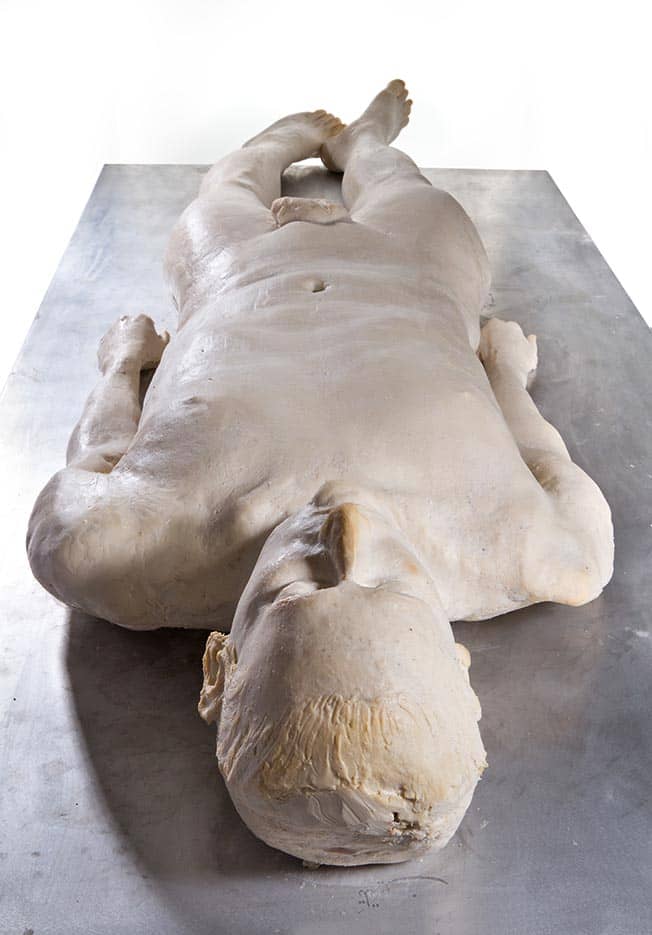
Mojtaba Amini, Talqin; Instructing The Dead, 2012, 90x190x40 cm, soap, aluminium; in state of degradation Pariya: And continuing, is it only the artist in this geography who should be expressive, or should other artistic roles like gallery owners, curators, dealers, etc., also be directly involved and function as an influential group or puzzle? How should this juxtaposition be?
Mojtaba: Certainly, all these elements that you mentioned are important and influential because for the three aspects of the artwork, the artist, and the audience to function correctly, the presence of all of them is necessary. However, in Iran, this coexistence does not work properly. There is no serious concept of a curator because galleries’ absolute dominance and the market’s logic do not feel the need for a curator’s presence. As a result, the artist has also lost their role and importance in this dominance. This is why we do not witness serious and specific art trends, and artists mostly produce commodities for this economic cycle.
Davood: In your opinion, what is the solution to break this flawed cycle? How can we create real convergence among artists, curators, gallery owners, and other factors to witness the formation of serious and meaningful trends?
Mojtaba: Breaking this cycle depends on the existence of independent and governmental institutions that support artists who are not inclined towards the market’s demands and tastes, as well as the existence of experimental, artist-run, and collaborative spaces.
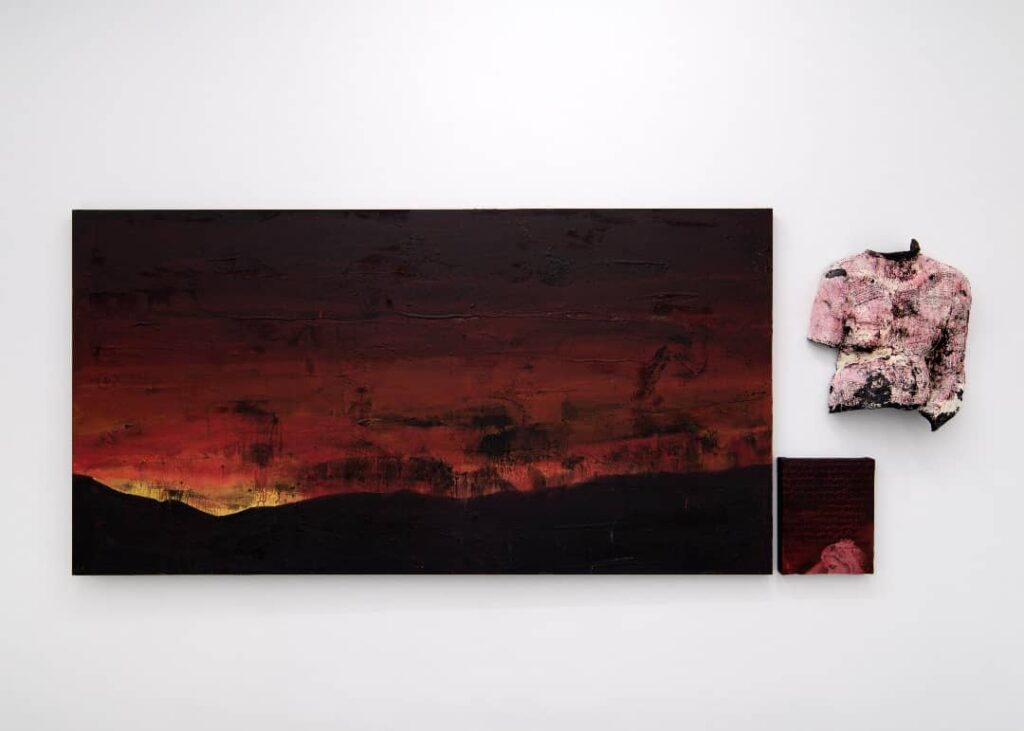
Mojtaba Amini, Not Everyone Will Taken Into The Future series, 2023, installation view Paria: In this process and interaction between local and global art, where do you see Iranian art in the big picture of global art?
Mojtaba: Due to the significant dispersion of the Iranian population worldwide, what is seen and presented as Iranian art is mostly within the realm of economy and market, and among this migrant population, there is nothing beyond that.
دشواریِ هنرمند: مولف بودن، قدرت، و مسئولیت اجتماعی
داوود مددپور: یکی از دغدغههایی که اخیراً ذهن من را مشغول کرده و دوست دارم در گفتگوهایم نقطهنظر مخاطب را در این باره (دربارهاش) بدانم، مفهوم هنرمند بودن است. برای ما که در منطقه خاورمیانه، با تمرکز بر جغرافیای اجتماعی و سیاسی آن، کار و زندگی میکنیم، ممکن است فعالیتهای هنریمان رنگ و بویی دیگر به خود بگیرد؛ چه من به عنوان کیوریتور و چه شما به عنوان هنرمند. با توجه به اینکه این منطقه که دائماً دستخوش تغییرات اجتماعی و سیاسی است، رابطهی شما با هنر چگونه در طول زمان تکامل یافته است؟
مجتبی امینی: هنرمند دارای یکسری اعتقادات و باورهای فکری است که او را به تفسیر و تحلیل شرایط سیاسی و اجتماعی وامیدارد. سپس، سعی میکند این اعتقادات را با پسزمینهی مطالعاتی خود تطابق دهد، آنها را با واقعیتهای جامعه مقایسه کند و در نهایت، در مسیر پیشروی خود مداخله نماید. این تطابقات و تضادها میتوانند موجب رشد، تغییر و تکامل در هنر و شخصیت هنرمند شوند. تغییر و تحول در جامعه ناشی از سیاستهای قدرت است و شهروند–هنرمند، با توجه به نسبتی که با قدرت برقرار میکند، میتواند شکلی از هنر را ارائه دهد که به طور مداوم نیاز به تغییر داشته باشد.
پریا فردوس: آیا این تعلق بافتاری یک امر الزامی است؟ و اگر تعلق به این بافتار، جامعهی مخاطب را محدود کند، آیا هنرمند میتواند راهی پیدا کند تا این محدودیت را در ارائهی آثار خود کنار بزند؟ چه در نحوهی ارائه و چه در گسترهی جامعهی مخاطبان؟
مجتبی: شاید بهتر باشد که این مجموعه از سوالات را با نظر میخائیل باختین دربارهی هنرمند، مخاطب، کار هنری و اجتماع پاسخ دهم. باختین معتقد است: “هنر به شیوهای ذاتی و درونی، اجتماعی است؛ هنگامی که محیط اجتماعیِ برون هنری از بیرون بر هنر تاثیر میگذارد، در آن با طنینی درونی و بیدرنگ مواجه میشود. این دو عامل (هنر و اجتماع) به هیچ وجه عواملی بیگانه نیستند که بر هم تاثیر میگذارند: ساختبندی اجتماعی بر ساختبندی دیگر تاثیر میگذارد…” حتی آن بخش درونی هنرمند که در اثرش تجلی مییابد، باز هم در ناخودآگاه هنرمند ریشهی اجتماعی دارد، و وضعیت سیاسی یا اجتماعی محیط، هنرمند را به شیوههای مختلف به واکنش وا میدارد. الزام خاصی در کار نخواهد بود، اما مقاومتی از سوی هنرمند برای شکل ارائه و محتوای آثارش نسبت به تأثیرات محیط وجود خواهد داشت. اگر شرایط اجتماعی بر هنرمند بهعنوان فردی در اجتماع تأثیرگذار است و نتیجهاش اثر هنری و ساخت معناست، دریافت این معنا در همان بافتار ساخت اثر کامل میشود. تلاش برای گذر از این محدودیتها به نوعی تابع مد شدن است.
داوود: با قبول و پذیرش نقش هنرمند، آیا فکر میکنید ما درگیر شرایط و سیستمی شدهایم که ما را مجبور به ارتباط با آن و در نتیجه به پرسش کشیدن و مورد خطاب قرار دادنش میکند؟ آیا فکر میکنید که هنرمند اکنون، خارج از نقش “سنتی” هنرمند بودن، نقشهای دیگری نیز بر عهده دارد؟
مجتبی: من فکر میکنم که هنرمند بین نقشی که خودش انتخاب میکند و نقشی که به او محول میشود، در رفتوآمد است. جایی که جامعه به او معنا و اعتبار میبخشد، اجبار نیز در کارش خواهد بود.
داوود: پس اگر درست متوجه شده باشم، در اینجا باید مجددا روی آزادی و محدودیت هنرمندان مکث کنیم، درست است؟ و آیا شما به عنوان هنرمند، از سوی جامعه این اجبار را پذیرفتید؟ آیا باید اسمش را اجبار گذاشت یا شاید استفاده از واژهای مانند مسئولیت، بیشتر ادای دین کند؟
مجتبی: اساساً هنرمند آزاد است و کسی حق ندارد به او بگوید چه کند یا نکند. اما در مواقعی که هنرمند، همانطور که آلبر کامو میگوید “موقتاً مشهور” میشود و اعتبارش را از جامعه و مردم میگیرد، مجبور است که سمت مردم بایستد.
پریا: با پذیرش اینکه از نظر شما هنرمند باید سمت مردم بایستد، تا چه حد این امر امکانپذیر است و در صورت تحقق، چقدر میتواند تاثیرگذار، الهامبخش و کارآمد باشد؟ آیا هنرمند باید خود را موظف به تاثیرگذاری بداند؟
مجتبی: هنرمندی که مشهور است و سرمایه اجتماعی دارد، میتواند تا حدی با آگاهیرسانی و مداخلهگری در جامعه تاثیرگذار باشد.
داوود: میتوانید در مورد نوع و نحوه این تأثیرات برایمان توضیح دهید؟ آیا این تأثیرات سمت و سوی خاصی را دنبال میکند؟
مجتبی: به نظرم یکی از بهترین نمونههای مداخلهگری در قدرت و تأثیر اجتماعی هنرمند ایرانی، محمدرضا شجریان است. موضعگیریهای درست او در ارتباط با وقایع سیاسی-اجتماعی سالهای اخیر باعث ممنوعیت پخش آثارش از صدا و سیما، بهویژه حذف “ربنا” از این رسانه شد، که این موضوع پرسشهای زیادی را در میان مردم، بهخصوص قشر مذهبی، برانگیخت. این اتفاق نمونهای از آگاهیرسانی به شیوهای صحیح توسط هنرمندی با سرمایه اجتماعی و شناختهشده است.
پریا: با توجه به اینکه دربارهی تأثیر بافتار سیاسی و اجتماعی و ساختار غالب بر هنرمند صحبت کردیم، به نظر شما علاوه بر این عوامل، خودِ ذاتی هنرمند بهعنوان یک انسان و حیات زیستهاش (در قالب ژست روان و تن) چه تأثیری بر تولید اثر دارد؟
مجتبی: هر شکلی از شخصیسازی در کار هنرمند و تولید اثر، چیزی است در امتداد دیگری و شبیه به دیگری. منظورم این است که تولید اثر هنری چیزی است در گفتگو با دیگری و تحت تأثیر دیگری در اجتماع. “خودِ” هنرمند به عنوان یک فرد وجودی مستقل نیست و علاوه بر این، اثر هنری تولیدی است درون مدیومی که با تاریخ و تأثیرات گذشته قرار دارد.
پریا: علاوه بر نقش و حضور هنرمند به عنوان یک فیگور سیاسی-اجتماعی و هنری که محتوایش را از محیط میگیرد، در کارهای شما ذات کارماده و صیرورت آن (در تعامل با محیط و کارمادههای دیگر)، مشخص است. این نگاه و توجه به اهمیت گذر زمان و ذات سوبژکتیو کارماده از کجا میآید؟
مجتبی: پیشتر هم در کتاب “شد آنچه شد” از پروژههای ۰۰۹۸۲۱ به این پرسش دقیقاً پاسخ دادهام. در کار من، ماده و زبان هر دو به یک اندازه حضور جدی دارند. مواد بهکاررفته در آثارم تا حدی دو وجه شخصی و غیرشخصی دارند. پوست، چربی، صابون، و پشم به گذشته و کودکیام برمیگردند؛ بهعنوان فردی که در یک خانواده روستایی دامدار بزرگ شده و شاهد خشونت علیه حیوانات بوده است. این مواد که در واقع “اضافات خشونت” از بدن حیوانات هستند، در کنار بخش زبانی آثارم، که آن هم بهنوعی برایم “زبان خشونت” است، معنای مورد نظر من از هنر را به شکل انتقادی و سیاسی-اجتماعی میسازند. بخش دیگر مواد غیرشخصیاند، مانند نفت و قیر، که مستقیماً از زیست سیاسی و اجتماعی ما تأثیر میگیرند و نیازی به توضیح بیشتر ندارند.
پریا: و در ادامه، آیا تنها هنرمند است که در این جغرافیا باید بیانگر باشد، یا باقی سمتهای هنری مانند گالریدار، کیوریتور، دیلر و… هم باید به صورت مستقیم و بهعنوان یک گروه یا پازل تاثیرگذار باشند؟ بهنظرتان این کنارهمقرارگیری (juxtaposition) چگونه باید باشد؟
مجتبی: قطعاً همه این عناصر که شما نام بردید اهمیت دارند و تاثیرگذارند، زیرا برای اینکه سه وجه اثر هنری، هنرمند و مخاطب بهدرستی عمل کنند، حضور همهی آنها لازم است. اما به نظرم این کنار هم بودنها در ایران درست کار نمیکند. کیوریتور به معنای جدی وجود ندارد، زیرا سلطه بیچونوچرای گالریها و منطق بازار نیازی به حضور کیوریتور احساس نمیکند و در نتیجه، هنرمند نیز نقش و اهمیت خود را در این سلطه از دست داده است. به همین دلیل است که جریان جدی و خاصی در هنر را شاهد نیستیم و هنرمندان بیشتر در حال تولید کالاهایی برای این چرخه اقتصادی هستند.
داوود: به نظر شما راهکار شکست این چرخه نادرست چیست؟ چگونه میتوان همگرایی واقعی میان هنرمند، کیوریتور، گالریدار و سایر عوامل را ایجاد کرد تا شاهد شکلگیری جریانهای جدی و معنادار باشیم؟
مجتبی: شکستن این چرخه نیازمند وجود نهادهای مستقل و دولتی است که از هنرمندانی حمایت کنند که تمایلی به تبعیت از خواست و سلیقه بازار ندارند. همچنین، ایجاد فضاهای تجربی، هنرمندگردان، و اشتراکی نیز ضروری است.
پریا: در این روند و تعامل میان هنر محلی و جهانی، هنر ایران را در کجای مختصات تصویر بزرگ هنر جهانی (big picture) میبینید؟
مجتبی: به دلیل پراکندگی بخش قابلتوجهی از جمعیت ایران در جهان، آنچه از هنر ایران دیده و ارائه میشود، بیشتر در حیطه اقتصاد و بازار قرار دارد و در میان این جمعیت مهاجر، چیزی بیش از این نیست.
-
Agency and Quotidian Practices as Resistance Against Omission—Mitra Soltani in conversation with Pariya Ferdos[se] and Davood Madadpoor
Mitra Soltani shares how her experiences with instability, lack of agency, and being a woman have shaped her projects. The conversation explores the evolving roles of the artist, the unique imprints they leave, and the intersection of gender, embodiment, gesture, and indigenous context in her work. The conversation not only addresses the duties and limitations of artists in society but also emphasizes the crucial role of the artist in shaping societal narratives, the power of juxtaposition, and the role of art professionals in bridging the local and global art scenes.
Agency and Quotidian Practices as Resistance Against Omission—Mitra Soltani in conversation with Pariya Ferdos[se] and Davood Madadpoor
[Scroll down for Farsi Version]
Mitra Soltani shares how her experiences with instability, lack of agency, and being a woman have shaped her projects. The conversation explores the evolving roles of the artist, the unique imprints they leave, and the intersection of gender, embodiment, gesture, and indigenous context in her work. The conversation not only addresses the duties and limitations of artists in society but also emphasizes the crucial role of the artist in shaping societal narratives, the power of juxtaposition, and the role of art professionals in bridging the local and global art scenes.
Davood Madadpoor: I want to start the conversation with a general question about being an artist. The concept of being an artist differs in local and international contexts. Coming from the Middle East (with a focus on its social and political geography), we may add a different flavor to the concept of being an artist through our artistic activities. Considering living in a region constantly undergoing social and political changes, how has your relationship with art evolved?
Mitra Soltani: In recent projects like Showing Transparency and A Number of Monuments, my direct experience with the subject has been central to my work. The daily experience of insecurity and lack of any form of stability is a state that deprives the human/artist of any sense of “agency.” For me, art’s function is a way to fight or resist the feeling of being objectified in such a situation. My work involves collecting archives, working with low-value or ephemeral materials, and exploring the lifestyle and art of local tribes and nomads.
Davood: Mitra, you made an interesting point! How can we reconcile the contradiction between the lack of agency for the artist and using artistic methods as a form of struggle?
Mitra: The example is local women’s way of life and art, inspiring this project. These women live in challenging conditions with countless restrictions imposed by society, family, and nature. However, all these limitations do not result in them being passive; instead, they impact their surroundings by employing art and rituals bit by bit. This impact deepens and spreads to the point where it even infiltrates their society’s most challenging and male-dominated structures. For me, defining agency is something like this.
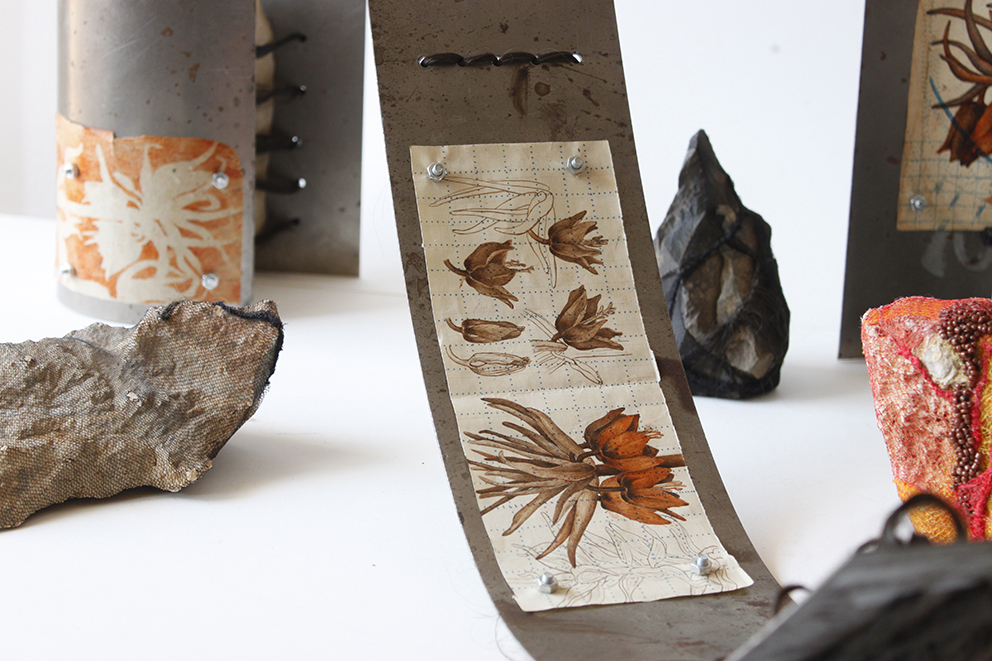
Mitra Soltani, Untitled 2021/2022, Iron, paper, stone and hair, 30×60 cm Davood: By accepting the artist’s role, do you think we are engaged in a particular situation and system that compels us to interact with it, thus questioning and addressing it? Do you think the artist now has other roles beyond the “traditional” role of being an artist?
Mitra: I find this question challenging. I don’t fully understand the concept of an artist’s “traditional” role. Perhaps it means that the role of art in its traditional form was static and has changed over time. However, I’m afraid I have to disagree with this idea. Every example that comes to mind, whether historical or traditional, shows the artist constantly asking questions, challenging assumptions, and transforming. Therefore, the artist has not assumed a new role; what has changed is the way of thinking and expression, which has evolved with the times.
Regarding the first part of the question, since I consider freedom the most essential characteristic of art, I don’t think the artist is “compelled” in any field. However, I feel trapped in a system and am trying to find a way out.
Pariya Ferdosse: Given that you mentioned being trapped in a system, I will rephrase Davood’s first question differently: is this contextual attachment a necessity? And if this attachment to the context limits the audience, can the artist overcome this limitation in presenting their works? (Both in presentation and the audience)
Mitra: For me, the work was created within the context of my living environment, making it impossible to think or develop detachedly. Essentially, this compulsion and a sense of helplessness shaped the idea of the work. Regarding the audience limitation, it is natural for each work to have its audience. I have created many projects in nature, Indigenous environments, and public and urban spaces that have attracted a wide range of audiences, and works like this project probably have a more limited audience. In other words, I am not particularly insistent that all my works have the same or a broad audience.
Pariya: In this context, how does the intrinsic nature of the artist as a human being and their lived experience (in the form of a posture – both mental and physical) impact the production of the work, considering that some of your works remind me of Hannah Wilke and particularly Ana Mendieta? (I ask this question in line with your discussion about the lifestyle of nomadic women and how gender and embodiment have entered your methodology and working style.)
Mitra: It is hard to imagine an artist who can think about art or create something detached from their lived experience. The only question is how tangible this impact is. Essentially, this work and most of my projects are based on my lived experience in a native and ritualistic culture, both in subject matter and working method. I am inclined toward a form of conceptual art that relates to ritualistic actions, literature and nature are other essential components of my artistic practice. All these elements directly arise from the life of my mind and body in such a context. A specific example is works entirely based on ritualistic behaviour, and ritual cannot be understood from the outside. This topic underscores the importance of the body and gender in my works, as the relationship between body and gender and their dialogue with nature gives rise to rituals.
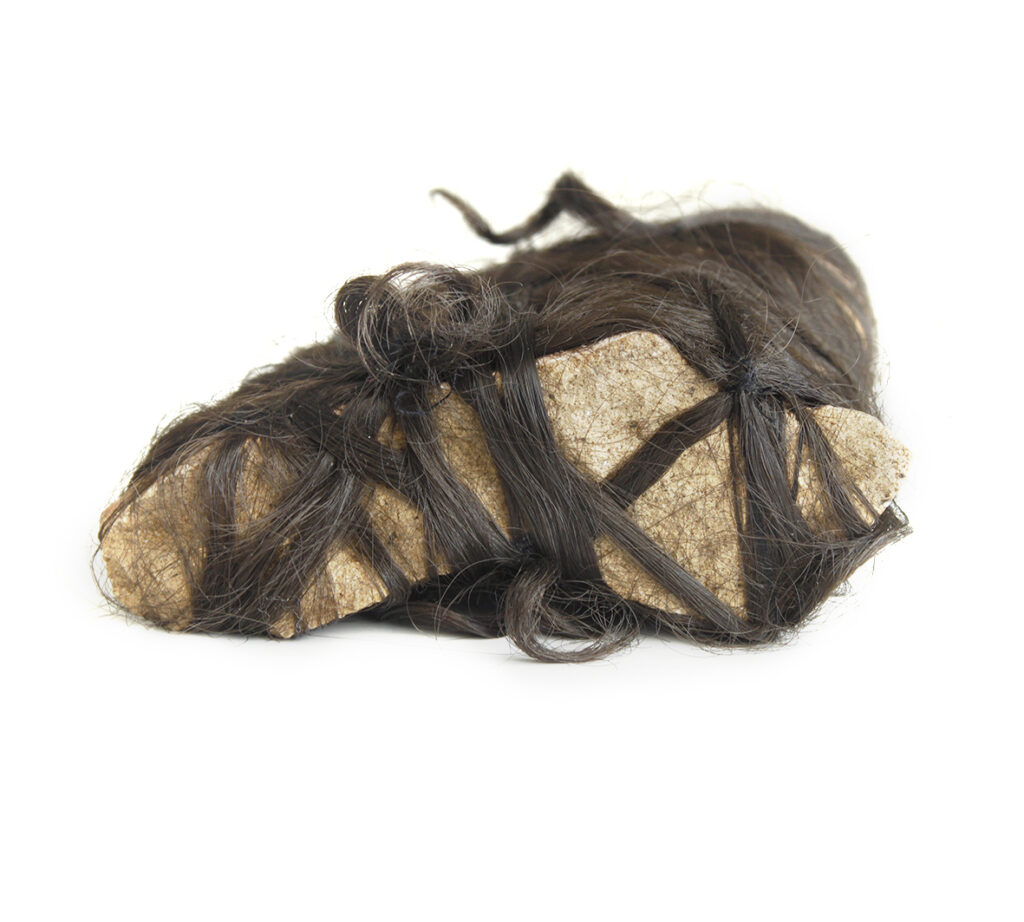
Mitra Soltani, MC-1 2020/2021, 13x11x7 cm, Lace fabric and plastic beads on stone Davood: What differentiates an artist who feels responsible towards society from groups like politicians or social scientists who seek to imagine and create a new future?
Mitra: It is more logical to think about the similarities rather than the differences because this distinction is fundamental. An artist uses their freedom, sensitivity, and creativity. They can internalize issues and present intangible aspects. They move independently of the boundaries and limits of any discipline and thus deal not with explaining issues but with perceiving disasters or ideal situations. For example, my experience with some artworks with socio-political concerns (amid the constant flow of world news and information, which quickly trivializes every important matter) has been like a pause or break. This pause suggests different ways of seeing and thinking and keeps the hope for change alive through creativity.
Pariya: Assuming that you believe the artist should stand by the people, how feasible is this, and if achieved, how impactful, inspiring, and functional is it? Should the artists consider themselves obligated to be impactful?
Mitra: I believe the artist should not necessarily stand by the people, and I can’t define a “should” for the artist. I only know that art is closer to freedom than anything else, or at least it should be. Therefore, in a dictatorial society, the side of freedom is likely the opposite of power in most cases.
Regarding obligation, as I said, I cannot impose a duty on the artist; I think more about the commitment to art itself. I am still determining its functionality, which significantly depends on the social conditions in which we are active. Still, regarding inspiration, I agree that artistic endeavor is fundamentally inspiring, and we can think about its quantity and quality.
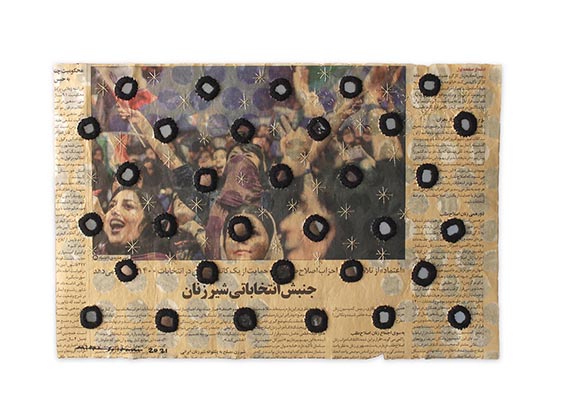
Mitra Soltani, Untitled 2020/2021, Embroidery and mirror on newspaper, 18×25 cm Pariya: In this context, is it only the artist who should be expressive, or do other artistic roles like gallery owners, curators, dealers, etc., also have a direct impact and function as a group or puzzle? How do you see this juxtaposition?
Mitra: Any form of expression or impact in art results from a set of choices. Naturally, in these choices, other players in the art field, such as gallery owners, curators, dealers, critics, etc., play an important role. As we have often seen, artists with prominent discourses have been marginalized while less significant productions have been highlighted. In the case of my projects, this juxtaposition has usually not been very successful because in such projects, the roles of others, including gallery owners, curators, etc., are more significant in presenting the work, and many challenges make them less inclined towards such projects.
Pariya: In this process and the interaction between local and global art, where do you see modern (contemporary) Iranian art in the big picture of global art?
Mitra: I am not very optimistic about works that have a closer connection to indigenous contexts. I only know a few successful examples of such art. By success, I mean being recognized in the global picture, as you mentioned. Because I think the global/Western view of other societies is still negligent and colonial in that they always pay attention to easily accessible and exotic images and ideas, not those that require a deeper understanding.
Mitra Soltani is an interdisciplinary artist interested in the relationship between literature, culture, and everyday life. She always uses objects that reflect the history and identity of the culture. Her work seeks new experiences of dealing with material and concept by exploring indigenous art practices and literature. She received a bachelor’s degree in painting from Shahed University of Tehran and a master’s degree in graphics from Tehran University of Art. Soltani has participated in more than thirty group exhibitions and art festivals and biennials and has made a number of projects in urban spaces and nature. Instagram
Pariya Fedros[se] is a curator, researcher, writer, and architect working on intersectional curatorial methodology and practices based on comparative methods, discourses, and texts. She started her career in art as an art director at age 26. After being cofounder and art director of two galleries, and because of her background in studying computer science, architecture, and philosophy (especially Eastern), she decided to extend her experiences to interdisciplinary research/text–oriented curating and architectural projects. She curated and designed Tehran’s Trilogy in three different exhibitions in Tehran’s central and ancient neighborhood (2017-2018). She was a researcher in the project exhibited in CAAM [Contemporary Art Museum in the Canary Islands]. Named Human All Too Human based on the ideas of the Iranian philosopher Suhrawardi (2018-2021). She curated an exhibition called Melencolia I with nine artists from four countries following comparative methodology and bridging art history inspiration, cinema, and psychology; this project took nine months (2022-2023). She was one of the writers in the book Rethinking the Contemporary Art of Iran by Hamid Keshmirshekan (2023). Recently, she’s been working on curational and publishing projects on different topics, such as Iranian literature, mysticism and immigration.
عاملیت، فعل (یا رویههای) روزمره به مثابه مقامتی در برابر حذف شدن
میترا سلطانی چگونگی شکلگیری پروژههایش براساس تجربیات خود از بیثباتی، فقدان عاملیت و زن بودن را به اشتراک می گذارد. این گفتگو به بررسی نقشهای رو به تکامل هنرمند، اثر منحصر به فردی که از خود به جا میگذارند، و تلاقی جنسیت، بدنمندی، ژست و بافتار بومی در آثار او میپردازد. این گفتگو نه تنها به وظایف و محدودیتهای هنرمندان در جامعه میپردازد، بلکه بر نقش حیاتی هنرمند در شکلدهی روایتهای اجتماعی، قدرت همنشینی و نقش متخصصان هنر در پل زدن میان عرصههای هنری محلی و جهانی تأکید میکند.
داوود مددپور: میخواهم گفتگو را با یک سوال کلی درباره مفهوم هنرمند بودن آغاز کنم. من معتقدم که مفهوم هنرمند بودن در دو بافتار مختلف؛ محلی و بینالمللی، متفاوت است. ما که از خاورمیانه (با تمرکز بر جغرافیای اجتماعی و سیاسی آن) میآییم، ممکن است با فعالیتهای هنریمان رنگ و بویی دیگر به مفهوم هنرمند بدهیم. با توجه به زندگی در این منطقه که دستخوش تغییرات اجتماعی و سیاسی مداوم است، چگونه رابطهی شما با هنر در طول زمان تکامل یافته است؟
میترا سلطانی: در پروژههای اخیرم مانند Showing Transparency و A Number of Monuments، تجربهی مستقیم از موضوع کارم بوده است. تجربهی روزمرهی ناامنی و فقدان هر شکلی از ثبات، وضعیتی است که انسان/هنرمند را از احساس هر گونه “عاملیت” خالی میکند. در حال حاضر، کارکرد هنر برای من راهی برای مبارزه یا مقاومت در برابر احساس شیء شدگی در چنین وضعیتیست که این راه شامل جمعآوری آرشیوها، کار با متریال کمارزش یا کمدوام و همچنین جستجو در شیوهی زندگی و هنر اقوام و عشایر میشود.
داوود: میترا نکتهی جالبی را مطرح کردی! به نظرت چگونه میتوان این تناقض بین تهی بودن از عاملیت هنرمند و بهرهگیری از شیوهی هنری به عنوان راهی برای مبارزه، را کنار هم قرار داد؟
میترا: مثالش همان شیوهای است که در شکل زندگی و هنر زنان محلی میبینم که در این پروژه نیز الهام بخش من بوده است. این زنان بیشتر در شرایطی بسیار دشوار و با محدودیتهای بیشماری از سوی جامعه، خانواده و طبیعت زندگی میکنند. اما همهی این محدودیتها باعث نمیشود که آنها از عملکرد انفعالی برخوردار شوند، بلکه با بهکارگیری هنر و آیین ذرهبهذره، تاثیرگذاری بر محیط اطراف خود دارند. این تاثیرگذاری عمیقتر میشود و به گسترش میپیوندد تا جایی که حتی بر سختترین و مردانهترین ساختارهای جامعهشان نیز نفوذ میکند. برای من، تعریف عاملیت یک چنین چیزی است.
داوود: با قبول و پذیرش نقش هنرمند، آیا فکر میکنید که درگیر یک شرایط و سیستم خاصی شدهایم که ما را مجبور به ارتباط با آن و در نتیجه، به پرسش کشیدن و مورد خطاب قرار دادنش میکند؟ آیا فکر میکنید که هنرمند اکنون خارج از نقش “سنتی” هنرمند بودن، نقشهای دیگری را نیز بر عهده دارد؟
میترا: خود این سوال به نظرم ایجاد چالش میکند. من مفهوم نقش “سنتی” هنرمند بودن را بهطور کامل درک نمیکنم. شاید منظور این باشد که نقش هنر به شکل سنتیاش تنها کارکرد استاتیکی داشته باشد و در طول زمان این کارکرد تغییر کرده باشد. اما من با این ایده موافق نیستم. هر مثالی که به ذهنم میآید، هرچند ممکن است تاریخی یا حتی سنتی باشد، هنرمند را همواره در حال طرح پرسش، به چالش کشیدن فرضیات و تغییر و تحول میبینم. بنابراین، فکر نمیکنم که هنرمند اکنون نقش جدیدی پذیرفته باشد؛ آنچه تغییر کرده، شیوه فکر کردن و بیان است که به اقتضای زمان تغییر کرده است.
درباره بخش اول سوال، از آنجاییکه مهمترین ویژگی هنر را آزادی میدانم، فکر نمیکنم که هنرمند در هیچ زمینهای “مجبور” باشد. اما به شخصه، احساس میکنم در یک سیستم گیر افتادهام و در حال تلاش برای یافتن راهی به بیرون هستم.
پریا فردوس: با توجه به اینکه از سیستمی نام بردی که در آن گیر افتادی سوال اول داوود را طور دیگری مطرح می کنم؛ آیا این تعلق بافتاری یک امر الزامی است؟ و اگر تعلق به این بافتار، جامعهی مخاطب را محدود کند آیا برای هنرمند راهی وجود دارد که این محدودیت را در ارایه ی آثار خود کنار بزند؟ (چه در ارایه و چه در جامعهی مخاطبان)
میترا: دست کم برای من و در شرایطی که اثر مورد بحث ساخته شده، بله من ناچار بودم و امکان اینکه منفک از بستر زیستم فکر یا خلق کنم را نداشتم . اساسا همین ناچاری و یا احساسی از درماندگی ایدهی اثر را شکل داد. در مورد محدودیت مخاطب به نظر من طبیعی است که هر اثر محدودهی مخاطب خود را داشته باشد. من پروژه های زیادی را در طبیعت، محیط های بومی و فضا های عمومی و شهری ساختهام که طیف گستردهای از مخاطب را در بر داشته است و آثاری شبیه این پروژه، که احتمالا مخاطب محدودتری دارد. به عبارت دیگر چندان اصراری ندارم همهی آثارم مخاطب یکسان یا گستردهای داشته باشند.
پریا: در این راستا خود ذاتی هنرمند به عنوان یک انسان و حیات زیستهاش (در قالب یک ژست -روان و تن-) چه تاثیری بر تولید اثر دارد با توجه به اینکه برخی از کارهای برای من یادآور هانا ویکله و به خصوص آنا مندیتا است؟ (این سوال را در راستای صحبت خودت در مورد شیوهی زیست زنان عشایر مطرح میکنم و اینکه چهطور جنسیت و بدنمندی در روشمندی و شیوهی کاری تو ورود کرده است)
میترا: تصورش برای من سخت است که هنرمندی بتواند فارغ از تجربهی زیستهاش به هنر فکر کند یا چیزی خلق کند. شاید تنها این مساله باشد که تا چه میزان این تاثیر ملموس است یا نه. اساسا ایده ی این اثر و بیشتر پروژه های من کاملا بر اساس تجربهی زیستهام در یک فرهنگ بومی و آیینی پدید آمده است، چه از نظر موضوع و چه از لحاظ شیوهی کار. من به نوعی از هنر مفهوم گرا که در ارتباط با کنش های آیینی است گرایش دارم و ادبیات و طبیعت دیگر مولفه های مهم در تمرین هنری من هستند. همه این موارد مستقیما از حیات ذهن و جسم من در چنین موقعیتی ناشی میشود. مثال مشخص آن آثاری است که کاملا بر اساس رفتار آیینی شکل میگیرد و آیین مساله ای نیست که بتوان بیرون آن ایستاد و درکش کرد. همین موضوع به اهمیت مسئله تن و جنسیت درآثار من اهمیت میدهد چرا که نسبت میان تن و جنسیت و همچنین نوع گفتگوی این دو با طبیعت است که آیینها را پدید میآورد.
داوود: از منظر شما چه عامل یا عواملی باعث تفاوت بین یک هنرمندی که احساس مسئولیت در قبال جامعه میکند با گروهی مانند سیاستمداران یا دانشمندان علوم اجتماعی که در پی تصور کردن و ساختن آیندهای جدید هستند، وجود دارد؟
میترا: به نظرم حتی منطقیتر است که به شباهتها فکر کنیم تا تفاوتها، به این دلیل که این تفاوت بسیار اساسی است. هنرمند آزادی، حساسیت و خلاقیتش را به کار میگیرد. او میتواند مسائل را درونی کند و جوانب غیر قابل لمس را به نمایش بگذارد. او مستقل از حدود و مرزهای هر دیسیپلینی حرکت میکند و از این رو نه به تشریح مسائل بلکه به ادراک فاجعه یا موقعیت ایدهآل میپردازد. برای مثال، تجربهی خودم از بعضی آثار هنری با دغدغهی سیاسی-اجتماعی (در حرکت مدام میان اخبار و اطلاعات جهان امروز؛ موقعیتی که هر مهمی را به سرعت به امری پیشپا افتاده فرو میکاهد.) شبیه به یک وقفه یا مکث بوده است؛ وقفهای که شیوههای دیگر دیدن و اندیشیدن را پیشنهاد میدهد و با کمک به خلاقیت، امید به تغییر را زنده نگه میدارد.
پریا: با پذیرش اینکه از نظر تو هنرمند بایستی سمت مردم بایستد تا چقدر این امر شدنیست و در صورت تحقق چقدر تاثیر گذار، الهامبخش و کارکردی است؟ و آیا هنرمند بایستی خود را موظف به تاثیرگذار بودن بداند؟
میترا: نظر من الزاما این نیست که هنرمند باید سمت مردم بایستد و اساسا نمی توانم بایدی برای هنرمند تعریف کنم. من تنها میدانم که هنر بیش از هر چیز به آزادی نزدیک است یا بهتر است باشد. بنابراین در جامعهای دیکتاتوری احتمالا در بیشتر موارد سمت آزادی سمت مخالف قدرت است.
در مورد موظف بودن هم چنان که گفتم نمیتوانم وظیفه ای برای هنرمند قائل باشم، در مورد خودم میتوانم بگویم بیشتر به تعهد نسبت به خود هنر میاندیشم. در بارهی کارکردی بودن آن مطمئن نیستم و خیلی بستگی به شرایط اجتماعی که در آن فعال هستیم دارد اما دربارهی الهام بخش بودن، موافقم که تلاش هنری اساسا الهامبخش است و میتوان دربارهی کمیت و کیفیت آن فکر کرد.
پریا: و در ادامه آیا تنها هنرمند هست که در این جغرافیا باید بیانگر باشد یا باقی سمتهای هنری مانند گالریدار، کیوریتور، دیلر و … هم تاثیرگذاری مستقیم و به شکل یک گروه و یا پازل را دارند؟ یا با تعبیری این کنارهمقرارگیری (juxtaposition) به نظرت چگونه باید باشد؟
میترا: فکر میکنم به هر شکلی از بیانگری یا تاثیرگذاری در هنر فکر کنیم حاصل مجموعهای از انتخابهاست. در این انتخابها طبیعتا بازیگران دیگر عرصه هنر همچون گالریدار، کیوریتور، دیلر، منتقد و.. نقش مهمی دارند. چنانکه بارها دیدهایم هنرمندانی با گفتمان برجسته به حاشیه رفته و تولیداتی نه چندان مهم در معرض توجه قرار گرفتهاند. در مورد پروژههای من معمولا این کنار هم قرارگیری چندان موفق نبوده است، زیرا در چنین پروژههایی هم نقشهای دیگر از جمله گالریدار، کیوریتور و.. اهمیت بیشتر در ارائه اثر دارند و هم چالشهای بسیاری وجود دارد که آنان را کمتر به چنین پروژههایی متمایل میکند.
پریا: در این روند و تعامل هنر محلی و جهانی، هنر مدرن (امروز) ایران را کجای مختصات تصویر بزرگ هنر جهانی (big picture) میبینی؟
میترا: در مورد آثاری که به زمینههای بومی تعلق بیشتری دارند، من خیلی خوشبین نیستم. یعنی چندان نمونههای موفقی از نوع هنر را نمیشناسم. موفقیت منظور به رسمیت شناخته شدن به قول شما در مختصات تصویر جهانی. چرا که به نظرم نگاه جهانی/غربی به جوامع دیگر سهلانگارانه و همچنان استعماری است. به این معنا که همواره به تصاویر و ایدههایی سهلالوصول و اگزوتیک توجه نشان میدهند نه ایدههایی که به شناخت عمیقتر وابسته است.
-
Transversal: Commons Tense and Antihegemonial Tactics—Fatih Aydoğdu
In “Transversal: Commons Tense & Antihegemonial Tactics,” Fatih Aydoğdu examines how art, media, and activism intersect to influence contemporary socio-political conditions. He argues that art’s visual language is deeply connotative, embedding cultural semantics that extend beyond mere representation. Digital arts, distinct from traditional forms, engage audiences actively, transforming art into a platform for socio-political critique. Aydoğdu highlights mass media’s role in shaping public opinion and emphasizes networked societies as new public spaces for communication. He situates art within broader socio-economic changes, advocating for its role in challenging hegemonic structures and fostering alternative social visions. “The limits of my language…, the…
Transversal: Commons Tense and Antihegemonial Tactics—Fatih Aydoğdu
In “Transversal: Commons Tense & Antihegemonial Tactics,” Fatih Aydoğdu examines how art, media, and activism intersect to influence contemporary socio-political conditions. He argues that art’s visual language is deeply connotative, embedding cultural semantics that extend beyond mere representation. Digital arts, distinct from traditional forms, engage audiences actively, transforming art into a platform for socio-political critique. Aydoğdu highlights mass media’s role in shaping public opinion and emphasizes networked societies as new public spaces for communication. He situates art within broader socio-economic changes, advocating for its role in challenging hegemonic structures and fostering alternative social visions.
“The limits of my language…, the limits of my world …” 1
An art practice, which operates by means of individual criteria and frame conditions, does not necessarily establish lasting (museal) merits, but creates a proper aesthetics of communication. Categories of analysis, tactical media, activist interventions react upon and/or influence the current social conditions. Via its pragmatics, swift or uncomplicated media produces a modality, which embraces the implementation of different procedures – aesthetical, activist or partly theoretical ones.
The connotative level of the visual, from the point of view of its contextual reference and positioning in different discursive meaning and association realms, denotes the point where al- ready coded signs meet the depth of the semantic code of a culture and adopt additional, more active dimensions. Here, there exists no pure objective (denotative) – and least of all natural – representation. Each visual sign (in a specific language) connotates a characteristic – a value or a conclusion – which is present depending on its connotating position as implication or implicated meaning.
The fields of preferred concepts hold social structures in the form of meanings, practices and opinions: the popular knowledge of social structures, of how all practical concerns function within this culture, of the ranking of power and interest and of the structures of legitimating, limitations and determinations. Thus, the chosen signs have to be related by means of codes to the order of the social life, to the economic, political power and the ideology, in order to make them readable. The term “reading” does not merely point at the capability to identify and decode a special number of signs, but it also addresses a subjective ability to relate these to other signs in a creative approach: a skill that is a precondition for conscious acting within an environment.
As long we can reflect upon ourselves through the world of art and reflect upon art through our world, the meaning of art can take on various forms and purposes, such as counter-balancing political conditions in the form of an upside-down-pissoir. Digital arts, takes the network society as its plane of resonance. Different than traditional/modern art, digital arts invites the audience to actively take part in the art work rather than merely provoking them. This quality is, of course, contained in the very nature of art. In a way, art functions to re-invent itself, time, and environment by responding and commenting on the socio-cultural and political contexts. By so doing, it creates other alternate visions while incorporating various available medium and technologies in order to achieve this goal. Here, politicization is not just an attitude operating through practices of production but it is an essential component of a concrete structural positioning. Art consists of a platform, which blends its field of interaction with creative, technical, and social energies by which it resolves and redefines such forces. It functions to pinpoint and question the contradictions and inconsistencies that operate within such forces that falls in its scope of analysis.
The strategies used or described in art are not limited to innovation or tradition. In this sense, each artwork may function as a ‘shifter’ among other artworks, meaning, it comments on the world on the basis of its differentiation to other artworks. From a societal perspective, this differentiation does not only function to ‘label’ the work of art according to its form (such as ‘revolutionary’, ‘innovative’, ‘epigonal’). Rather, art attains its meaning on the basis of its positioning within a certain social context, which entails artworks that are not as strongly related to the public domain such as Art in Public spaces, Street Art, mobile- applications or participatory art. Top- down-art is art that we obtain one way or another, bottom-up-art is art that we need to obtain one way or another. Each artwork is a question addressed at society at large.
Despite the common association of network society with omnipresent control and surveillance (which could perhaps explain why traditional arts tend to lean towards individualization and a-socialization), social media, network structures, and the Internet are perhaps the final “public space” that we possess as individuals today.
Massmedia (as a passive consumption device), which have rapidly influenced our everyday life since the second half of the 19th century, play a strong role in determining our agenda at present. Since the decrease in the political and social connotations of “public space” in a modernist, transparent, and cognitive society, “massmedia” has taken on a central role in the creation and dissemination of meaning, taking public opinion under its hegemony and replacing “knowledge” -so important to cognitive society- with metaphors of “meaning” and “opinions”.
Here, “public” denotes a passive monitoring formula. On the one hand, “public” designates the impossibility of going beyond the internal operations of the system; on the other hand, it points to the possibility of new types of communication with other external systems. Hence, the meaning and ideas produced by the media do not actually represent the opinion of the public.
The rapid rise of the turbocapitalist system resulting from the fall of the iron curtain in 1989 and the cold war, the loss of public commons as a result of the privatization necessary for “economic growth”, the crises of participatory democracy, the dilemma between transnationalism and nationalisms, the decrease of individual rights after 9/11 under the banner of protection from terror, religion wars, our irresponsible consumption of world resources, financial crises, bankruptcies emerging from the management of democratic states as private companies released from social responsibilities, the diminishment of working rights and essential social structures of a society, moving towards (social, political, and economic) erosion as a result of the growing gap between different classes, in society: although we may have become accustomed and insensitive to the daily catastrophic images imposed on us by massmedia, we believe that this description of our current situation is not exaggerated.
1 Ludwig Wittgenstein: Tractatus logico-philosophicus
This text is published before, in the catalogue of the Exhibition “Commons Tense/Müşterekler Zamanı” (amberTXT/BIS), Curated by Fatih Aydoğdu and Ekmel Ertan, Den Haag/NED 2012
In frame of the Todays Art Festival 2012By connecting social media with discussions on ecology, society, and participatory democracy from a social organizational perspective, “Commons Tense/ Müşterekler Zamanı” establishes an alternative platform for re-constructing urgent societal questions, to search for solutions to existing and future crises, to advocate the need for self-organization within the hegemony of market economy, which privatizes all aspects of everyday life.
Digital Commons are platforms offering tools, information, theory, art, and culture that are open for public and are free. Commons are what we share with others. Commons/ Müşterekler is a new form of expression that goes beyond the hegemony of the market and centralized modes of control and, therefore, it is a kind of language.
“Commons Tense / Müşterekler Zamanı” designates a hypothetical language that goes beyond local and national data to discuss certain problems, and to produce alternative options within the current social, economic, and political systems in which we live in.
It establishes a foresight to think beyond borders physically and intellectually, within and without the system.
https://issuu.com/ekmelertan/docs/commons_tense
Fatih AYDOĞDU (b. 1963 | Turkey) lives and works in Vienna and Istanbul. He studied at the Academy of Fine Arts in Istanbul and graduated from the Academy of Fine Arts in Vienna. Aydoğdu is a conceptual visual artist, designer, curator, writer, and sound artist, focusing on concepts of media aesthetics, migration & identity politics, and linguistic issues. He participated in numerous exhibitions throughout Europe, Asia, and the USA. He was the publisher of Turkey’s first media art magazine, “hat” (1998). He worked a.o. as a member of the Curatorial Board of ‘amberPlatform,’ an art & technology platform based in Istanbul, between 2011 and 2019.
-
History and Image as National Memory Beyond Nationalism—Parham Taghioff in Conversation with Milad Odabaei
Milad Odabaei: Parham, the images of Asymmetrical Authority are at once familiar and strange to the imagination imprinted with the political history of contemporary Iran. They recall the 1979 Revolution that deposed the Pahlavi monarchy and brought about the Islamic Republic as well as the eight years of war with Iraq (1980-88) that immediately followed. But the colors, folds, shapes, and cuts that give form to your photographs make the familiar a bit strange. Can you tell us about the images? Parham Taghioff: As you know I was born just a couple of months before the Revolution. Like yours, my childhood…
History and Image as National Memory Beyond Nationalism—Parham Taghioff in Conversation with Milad Odabaei
Milad Odabaei: Parham, the images of Asymmetrical Authority are at once familiar and strange to the imagination imprinted with the political history of contemporary Iran. They recall the 1979 Revolution that deposed the Pahlavi monarchy and brought about the Islamic Republic as well as the eight years of war with Iraq (1980-88) that immediately followed. But the colors, folds, shapes, and cuts that give form to your photographs make the familiar a bit strange. Can you tell us about the images?
Parham Taghioff: As you know I was born just a couple of months before the Revolution. Like yours, my childhood memories are of a highly uncertain and extreme ideological atmosphere of the post-revolutionary decade during the war. During those years I developed a game with my grandfather. I would wait for him to read the newspaper, which I remember him doing with an extremely worrisome and disheartened look on his face. We would then play with the paper, fold it, cut it, and make it into different shapes and forms. This was the origin of Asymmetrical Authority, and really, all of my experimentations with history and image. In my game, the documented history of the earlier generations’ struggles and achievements, became the raw material for creation. Today, over three decades later, I have started a new game with the similar images of the past but, this time, as an author.
In the last few years many books of documentary photographs have been published in Iran. Books, for example, of the archival news images of the Revolution or the Iran-Iraq War. A noteworthy example is a book modeled on the 2002 volume “Century: One Hundred Years of Human Progress, Regression, Suffering, and Hope” published by Phaidon (London and New York). The history of these books goes back to the publications of bilingual, English and Persian, books of documentary images of the war. Three decades later, these books still serve various ideological purposes and reproduce orthodox narratives of our lived history of the Revolution and the war. They emphasize, for example, the popularity of the Revolution or that the war was internationally imposed on Iran and the Iranian response was a “holy defense.” [The war with Iraq is often referred to as jang-e tahmili (“the imposed war”), and defa-e moqadas (“the holly defense”) in Iran.]
The sources of my images are drawn from such books and similar archives of Iranian documentary and news photography. In our time when an academic and critical interpretation of photography is not entirely accessible to the general public, rapid reproduction and circulation of images provide answers to difficult historical predicaments. Images, along with other forms of easily accessible information, function as an authoritative source and dispel other forms of interpretations. In Asymmetrical Authority, I have reproduced historical images but have tried to empty them of their signification and excavate other possible interpretations.
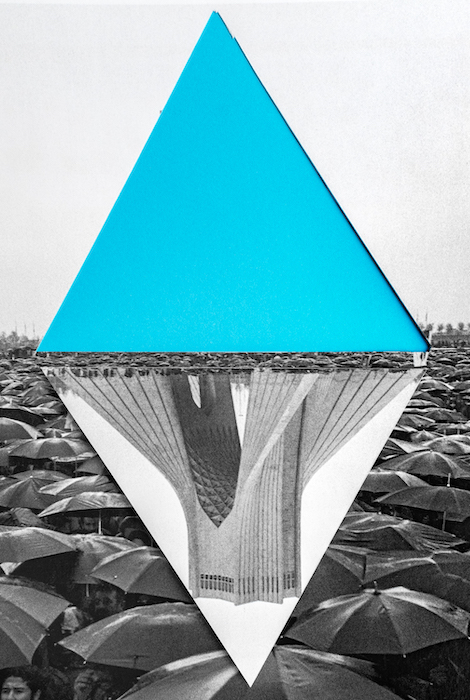
Parham Taghioff, Asymmetrical Authority #22, 2018 Milad: In what you are saying I hear echoes of not only critical reflection on art and modern reproducibility, but also post-revolutionary Iranian debate on national historiography. Asymmetrical Authority, it seems to me, breaks with the doxas of both leftist and Islamic narratives of the Islam and the Revolution and poses national (meli) history and historiography as an unresolved problematic in the form of a question. Can you speak about the capacity of photography to confront a political world saturated with ideology and myth? How do you mobilize photography for critical historiographic exploration?
Parham: Transforming our understanding of time, the camera has the capacity to challenge our understanding of the past. Through reproduction, as Walter Benjamin notes, photography undermines the authority of the original and the sanctity of the author. Popularization of photography has enabled everyone to confront the world through the mechanical or digital eyes of the camera, and to tie together being and time in a click. Citizen journalists, with the capacity of both capturing and circulating “the news,” have challenged the monopoly of traditional news makers as well as the national and international jurisdictions of traditional journalism. Today, news media often follows the images that appear on social media by lay image-makers.
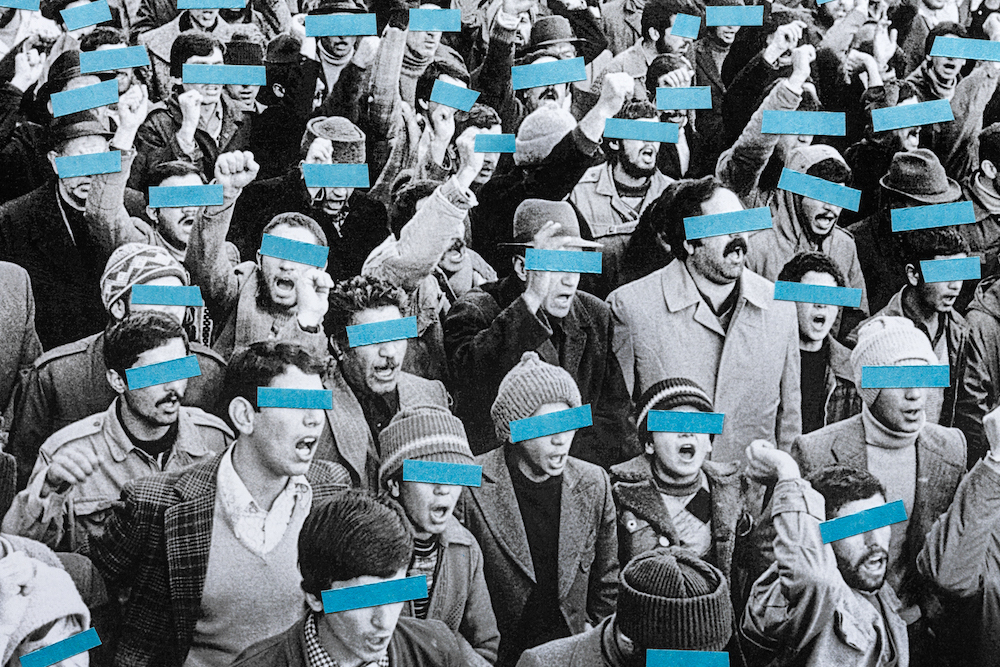
Parham Taghioff, Asymmetrical Authority #18, 2018 At the same time, however, the sheer volume of the images in our daily lives diminishes our capacity to discern the historicity of the past. Everyone has acquired the power to establish the meaning of images and by extension, the meaning of history. Digital photography challenges traditional regimes of citationality, facticity, and authority and instead, emphasizes discursivity. Today, more than ever, the meaning and significance of images are established in the context of their circulation and reception. The truth of images, in other words, lies beyond their genealogy in a particular time and place. The question is how we locate images in historical narratives and memories, and how do we draw on living images to tie together the past, the present, and the future. In her book On Photography, Susan Sontag emphasizes an important point: “Cameras are the antidote and the disease, a means of appropriating reality and a means of making it obsolete.”
Milad: The tension between traditional and professional forms of authority on the one hand, and democratic authority as well as populist dissolution of authority on the other, is central here. Can you speak about the title of the collection, Asymmetrical Authority?
Parham: When I started to work on this collection I came across an article by Lutz Koepnick titled “Photographs and Memories”. I found a deep resonance between what I was doing to the images of the past in the studio and Koepnick’s attention to time and history in photography. Koepnick draws on Sontag and her Wittgensteinian approach to photography to move beyond a purely representational analysis of photography. He writes:
The most essential question is therefore not how different technological inventions cause different representations of temporality, but how we place certain images—digital or analog—in larger narratives of history and memory; how we make use of both their formal inventory and exhibition in order to connect different pasts and presents; how we rely on different strategies of naming, description and inscription, of discursive en-framing, in order to infuse them with temporal texture or pass them off as souvenirs of frozen time; and last but not least, how we engage older myths of reference, objectivity, and truth in order to define the relationships between image-makers, photographic subjects, and viewers as relationships of either asymmetrical authority or mutual recognition. No image, whether computer-processed or not, has an existence or memory of its own. It is what we do with them that decides over their life and afterlife. It is how we situate them against the backdrop of other narratives, discourses, images, and strategies of representation that enables them to speak in various ways about the past and its bearing on the present. [Citation: Koepnick, Lutz. “Photographs and Memories.” South Central Review 21.1 (Spring 2004): 94-129.]
My photographic practice tries to confront the force of technological representation and reproduction and explore possibilities of creative intervention.
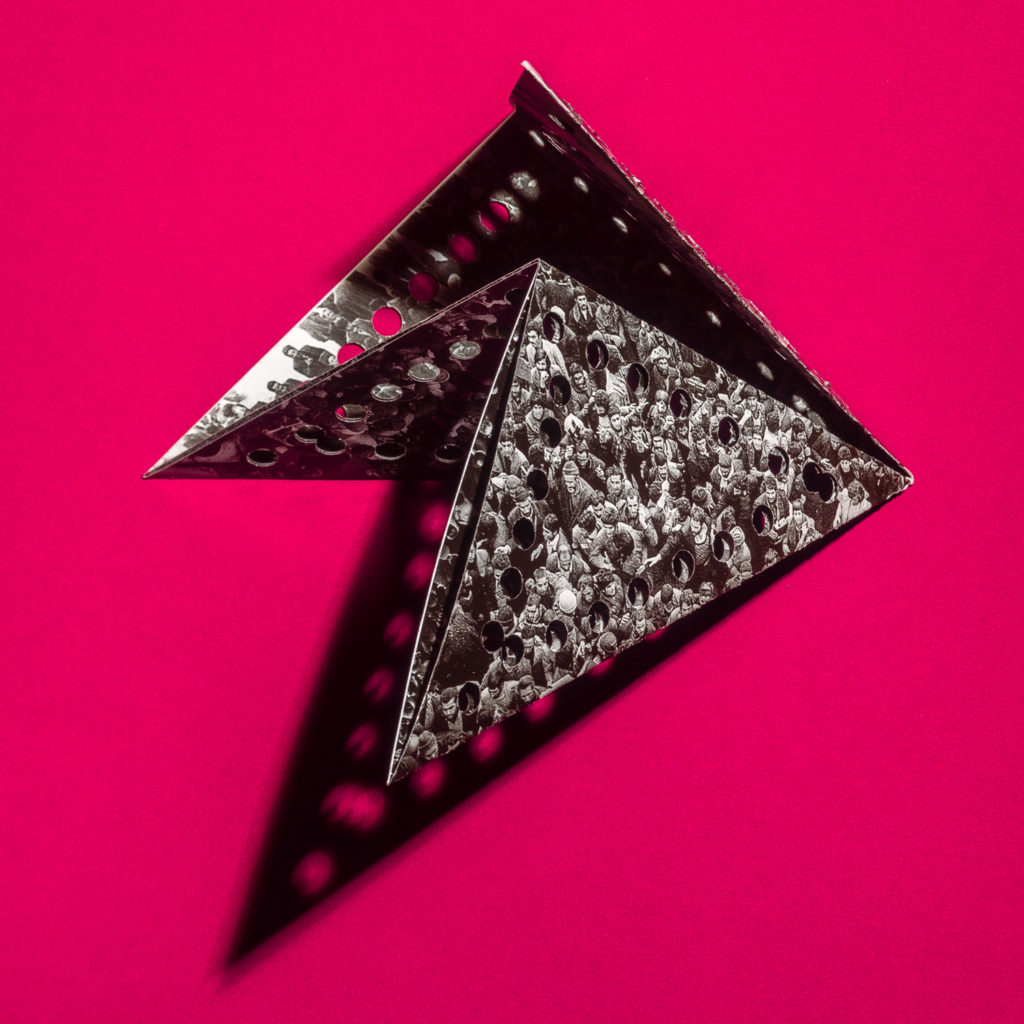
Parham Taghioff, Asymmetrical Authority #4, 2018 Milad: Central to questioning of authority is a kind of distancing. Asymmetric Authority, and your previous collections that it builds upon, all perform a form of photographic distancing. Let’s talk about your last collection, Hands On Hands Off, which was produced in 2014 at the height of negotiations between Iran and the G5+1 over Iran’s nuclear program, you produced images of hands and gestures of politicians who were negotiating the fate of the deal and with it, supposedly our collective existence. Can you address your use of distancing, zooming in and out, and what it achieves technically and otherwise?
Parham: During the negotiations between Iran and the G5+1 we were experiencing a very complex situation. Any exchange between the two sides had a direct effect on our lives, not simply socioeconomically, in terms of easing of economic sanctions, but also politically. The international negotiations were deeply tied to highly divisive domestic political contestations. The images of negotiations saturated the Iranian and international news. For the first time after the Revolution, the foreign ministers of Iran and the United States were part of the same conversations, along with other G5 leaders and Germany. In these images the gestures of politicians had attracted my attention. Under the attentive gaze of the camera, the bodily gestures of politicians provided the disempowered viewer with important information. Using a macro lens, I focused on the news media images of the negotiations and reproduced the gestures of politicians as they appeared on the camera monitor. Printing the result in large frames, I then challenged the viewer ability to discern the representational content of the image in the exhibition. In close proximity, the viewer would only be able to see the LEDs lighting behind the image. He or she would have to step back to be able to see the image. My aim was to create a theatre of my own, and through techniques of separation, combination, magnification and rearrangement, bring to the viewer’s awareness the work of power in news media and in the mediation of our lives.
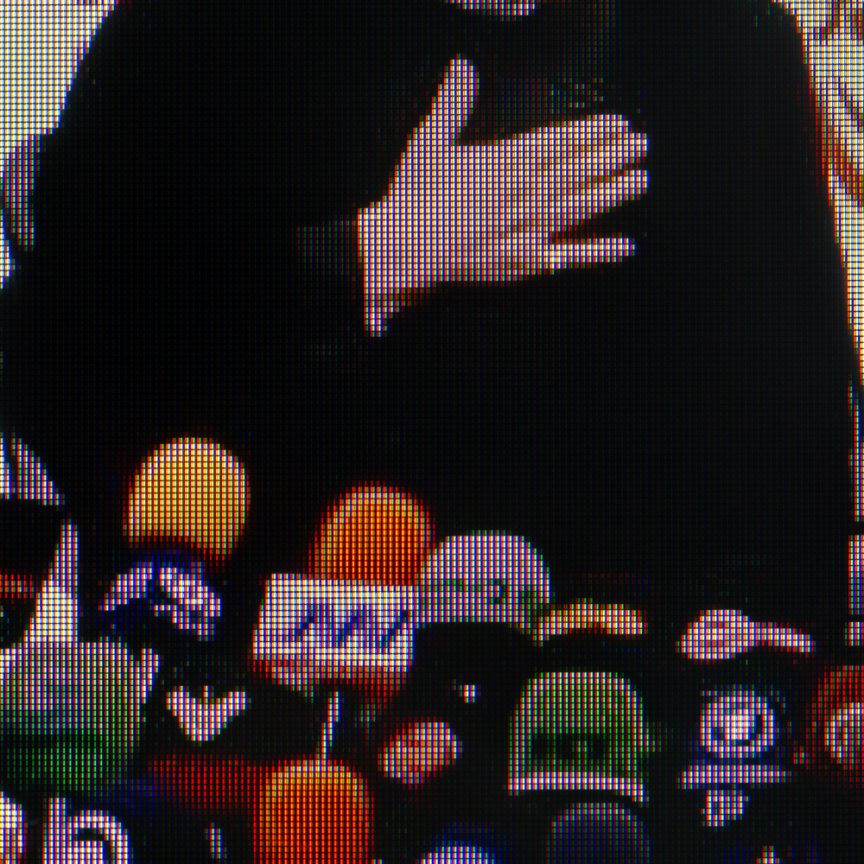
Parham Taghioff, Hands On / Hands Off #3, 2014 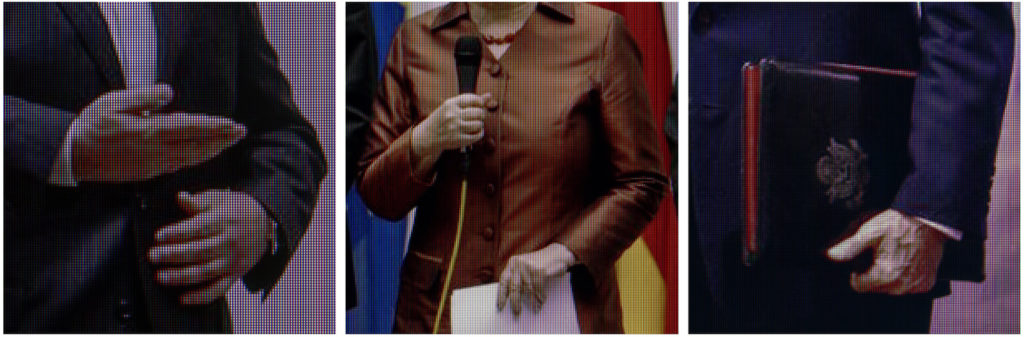
Parham Taghioff, Hands On / Hands Off #9, 2014 How do you think of your images as working within and against a national imagination? How do you think the reception of your photographic response to the Revolution and the war is generationally mediated?
We all have different imagination of our respective national identities. But are all born into particular histories. We might think that what has happened in the past is in the past and unchangeable. But every historical examination shows of a different image of the past, and as a result, the past, the present, and the future are reconfigured anew. Iranian national ideology is largely steeped in myth and ideology. In my opinion, we urgently need to pose new questions of our pasts and develop our engagement with the images of our history toward critical cultural and historical studies.
Indeed, Asymmetrical Authority has received different responses from our generation and those before and after us. But history, perhaps in a Hegelian sense, is the synthesis of different and at times conflicting interpretations and pursuits and irreducible to any one account or project.
Milad Odabaei is a postdoctoral research fellow at Princeton University. His research brings together anthropological and critical methods for the study of modern Iran.
-
Frames Cracked by Lines of Doubt—A Trialogue
Anahita Razmi / Jaroslava Tomanová / Fabrizio Ajello [Scroll down for the Italian Version] In the Greek language, dialogue comes from διά-through and λογος-speech, it is a conversation, a movement through an open space between distant dimensions of feeling, thinking, acting, where everything could happen. We developed another space and dynamic seeking our own format: a trialogue, a meeting of us three, who were in a continuous conversation without a specific goal known beforehand. Holding space and time together in regular online convenings, we tested how we can take and give space to each other in exchange free from assigned…
Frames Cracked by Lines of Doubt—A Trialogue
Anahita Razmi / Jaroslava Tomanová / Fabrizio Ajello
[Scroll down for the Italian Version]
In the Greek language, dialogue comes from διά-through and λογος-speech, it is a conversation, a movement through an open space between distant dimensions of feeling, thinking, acting, where everything could happen. We developed another space and dynamic seeking our own format: a trialogue, a meeting of us three, who were in a continuous conversation without a specific goal known beforehand. Holding space and time together in regular online convenings, we tested how we can take and give space to each other in exchange free from assigned roles, expectations and structures.
Through the following map, we, Anahita Razmi (artist), Jaroslava Tomanová (curator/researcher) and Fabrizio Ajello (writer/artist) set up a confrontation, triangulating our research and processes of thought and artistic experiences about stereotypes, deconstruction, decolonisation, translation and the figure of a Trickster, completed by a series of stringent questions on the topics addressed. Including links to resources such as articles and books, the presented map can be seen as a curated library visualising the relations between topics we discussed. We hope it will be a starting point for further growth, an ever-changing creature of thought which can hopefully take the form of a tetralogue, pentalogue, and so on.
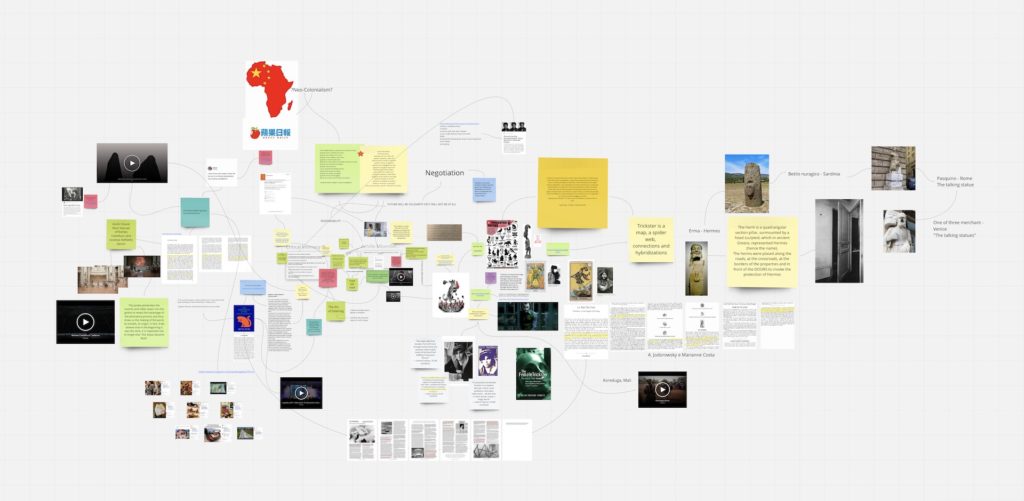
The following questions can be understood as flexible nodes prompting a discussion when needed. They do not determine any structure or form; they can be left alone and invited back when we forage for thoughts and intuitions together.
- What relations do we see between practices of deconstruction and decolonisation today? What possibilities does the notion of deconstruction hold regarding present-day cultural stereotypes?
- How do sites of power (institutional, economic, academic…) operate and choose today?
- What are figures that can propose alternatives and subvert systems of representation and power?
- The Meme? The Trickster? The Fool? The Fake Account?
- Trickster as an alter-ego: how can she confuse, destabilise, shake the ground of white privilege and Western modern, patriarchal gaze?
- How can appropriation be deployed to dismantle cultural stereotypes and ideological constructs?
- What relationships exist between tradition, translation and originality in contemporary art and aesthetic languages?
- Can irony form a kind of ‘critical intimacy’? (see Spivak on map)
- Is cynicism/nihilism the opposite of ‘critical intimacy’?
- What is a misunderstanding?
- What does “lost in translation” mean? How can accidental slippages of one’s unconscious bias reveal an ideological grip?
- What happens when grammar, the system of rules of one language, is applied in another language?
- Can it tell a story of past trauma? Can it give a testimony of a colonised mind?
Fabrizio Ajello graduated from the Faculty of Literature and Philosophy in Palermo with a thesis on Contemporary Art History.
In the past, he has actively collaborated with the magazines Music Line and Succoacido.net. Since 2005 he has been working on the public art project, Progetto Isole. In 2008, together with the artist Christian Costa, he founded the public art project Spazi Docili, based in Florence, which in recent years has produced explorations of the territory, interventions, workshops and lectures in public and private institutions, exhibitions and artistic residencies.
He has also exhibited in Italian and international galleries and museums and participated in various events such as: Berlin Biennale 7, Break 2.4 Festival in Ljubljana, Slovenia, Synthetic Zero at BronxArtSpace in New York, Moving Sculpture In The Public Realm in Cardiff, Hosted in Athens in Athens, The Entropy of Art in Wroclaw, Poland. He teaches Literature at the Liceo Artistico di Porta Romana in Florence.Anahita Razmi studied Media Art and Sculpture at the Bauhaus-University Weimar and the Pratt Institute New York before studying Fine Arts at the State Academy of Art and Design Stuttgart under Rainer Ganahl and Christian Jankowski.
Working with installation, moving image and performance, her practice is exploring contextual and geographical shifts – with a focus on shifts between an ‘East’ and a ‘West’. Using her own Iranian-German heritage as a reference, Razmi’s works are testing grounds for possibilities of import/export, hybrid identities and in the constructions and ambiguities of cultural representation.Jaroslava Tomanová is a researcher and a writer currently based in Kassel, Germany. Alongside ongoing voluntary and informal art-related activities, her professional background is a combination of working in the visual arts, contemporary dance and performance, academic research and writing. In the past she worked as Curatorial Assistant at Thyssen-Bornemisza Art Contemporary (TBA21) and as International Collaborations Coordinator at Tanec Praha. Her commitment to art and politics of solidarity, equality and justice drives her motivation to develop curatorial research, writing and practice alongside an overarching long-term research interest in the connection between language and power. Her university education has primarily focused on the relation between the arts and the state, and her PhD research at the University of Leeds is a critical study of neoliberal cultural policy discourse. As a writer and art critic she has contributed with reviews and essays to Corridor8, This Is Tomorrow and Freedom News.
Frames Cracked by Lines of Doubt–Un Trilogo
Anahita Razmi / Jaroslava Tomanová / Fabrizio Ajello
Nella lingua greca, dialogo viene da διά-attraverso e λογος-parola/pensiero, è una conversazione, un movimento attraverso uno spazio aperto tra differenti dimensioni di sentire, pensare, agire, dove tutto può accadere. Cercando un format adeguato, abbiamo sviluppato un’altra tipologia di spazio e un’altra dinamica di confronto: un trialogo, un incontro a tre, una conversazione continua senza un obiettivo specifico predeterminato. Dialogando e lavorando insieme attraverso spazio e tempo in regolari sessioni online, abbiamo testato come sia possibile condividere ed collaborare insieme in uno scambio libero da ruoli assegnati, aspettative e strutture.Attraverso la seguente mappa, noi, Anahita Razmi (artista), Jaroslava Tomanová (curatrice/ricercatrice) e Fabrizio Ajello (scrittore/artista) abbiamo impostato un confronto, triangolando le nostre ricerche e i processi di pensiero ed esperienze artistiche su temi quali: stereotipi, decostruzione, decolonizzazione, traduzione e la figura del Trickster, il tutto corredato da una serie di domande stringenti sui temi trattati. Includendo link a risorse come articoli e libri, la mappa presentata può essere vista come una biblioteca che mostra in un unica visione le relazioni tra gli argomenti trattati. Questo progetto vuole essere così un punto di partenza per un’ulteriore crescita, una creatura di pensiero in continua evoluzione che presto prenderà la forma di un tetralogo, pentalogo, e così via.
La mappa presentata serve come pietra angolare della nostra conversazione in evoluzione e continuerà a cambiare durante il processo collaborativo. Se vuoi unirti ai nostri incontri liberi, irregolari, informali e non moderati che ruotano liberamente intorno alle domande proposte, invia una richiesta di modifica della mappa o mettiti in contatto via email: editorial [at] sumac [dot] space.
Le seguenti domande possono essere intese come nodi flessibili, tese a stimolare una discussione e un confronto in fieri. Non determinano o precludono alcuna struttura o forma; possono essere affrontate singolarmente, o utilizzate come punto di partenza per focalizzare e processare insieme pensieri e intuizioni.
- Quali relazioni vediamo oggi tra le pratiche di decostruzione e decolonizzazione? Quali possibilità ha la nozione di decostruzione rispetto agli stereotipi culturali attuali?
- Come operano e scelgono oggi i luoghi del potere (istituzionale, economico, accademico…)?
- Quali sono le figure che possono proporre alternative e sovvertire i sistemi di rappresentazione e di potere?
- Il Meme? Il Trickster? Il Matto? Il Fake Account?
- Trickster come alter-ego: questa “figura” è in grado di confondere, destabilizzare, scuotere il terreno del privilegio bianco e dello sguardo occidentale moderno e patriarcale?
- Come può l’appropriazione essere impiegata per smantellare stereotipi culturali e costrutti ideologici?
- Quali relazioni esistono tra tradizione, traduzione e originalità nell’arte contemporanea e nei linguaggi estetici?
- L’ironia può formare una sorta di “intimità critica”? (vedi Spivak sulla mappa)
- Il cinismo/nichilismo è l’opposto dell’”intimità critica”?
- Cos’è un malinteso?
- Cosa significa “lost in translation”? Come possono gli slittamenti accidentali del proprio pregiudizio inconscio rivelare una forzatura ideologica?
- Cosa succede quando la grammatica, il sistema di regole di una lingua, viene applicata in un’altra lingua?
- Questo fenomeno può raccontare la storia di un trauma passato? Può dare una testimonianza di una mente colonizzata?
-
On the Creation of Virtual Spaces with their own Temporality–Ali Eslami in conversation with Katharina Ehrl and Davood Madadpoor
In this exchange between Davood Madadpoor, Katharina Ehrl, and Ali Eslami, Eslami delves into his ongoing project “False Mirror” and its implications for understanding the intersection of virtual reality, identity, memory, and artistic practice. He reflects on how “False Mirror” has evolved from a speculative future to a complex parallel world, intricately intertwined with his daily experiences. Through meticulous attention to detail and the exploration of memory within the virtual realm, Eslami challenges conventional notions of truth and expands the possibilities of artistic expression.
On the Creation of Virtual Spaces with their own Temporality–Ali Eslami in conversation with Katharina Ehrl and Davood Madadpoor
On the occasion of the exhibition The Tellers at Villa Romana
In this exchange between Davood Madadpoor, Katharina Ehrl, and Ali Eslami, Eslami delves into his ongoing project “False Mirror” and its implications for understanding the intersection of virtual reality, identity, memory, and artistic practice. He reflects on how “False Mirror” has evolved from a speculative future to a complex parallel world, intricately intertwined with his daily experiences. Through meticulous attention to detail and the exploration of memory within the virtual realm, Eslami challenges conventional notions of truth and expands the possibilities of artistic expression.
Davood Madadpoor / Katharina Ehrl: I’m assuming you’re thinking a lot about futures by engaging on such a lengthy project, False Mirror, which began in 2017. As an extension of that, I’m saying you’re thinking about every detail of this future. As you mentioned, the primary motivation for this project is wondering if humans would ever be supposed to live in a virtual world and how we would do so. What about this future intrigues you? What is it about this that compels you to devote all of your time to it?
Ali Eslami: I think that’s how I saw it initially, as a pre-construction of a future that could happen, but the more I spent time building it, the more it became intertwined with the present and my daily experiences in life. So it’s kind of hard to think of False Mirror as a future world at the moment, but for me, it implies a space that contains its temporality in which I respond to it by contributing my time to this parallel world.The concept of expansion, engineering of a new reality, this whole process has remained the core of my practice for a long time. The more I tend to model every detail and function within this world, the more complex and sometimes out of control it gets. It has become a sandbox reality that I can rebuild, grow, modify, archive, and play with all at once.
To a great extent, it’s similar to a kid in a playground playing with modular toys (Lego); the tools at hand and building blocks can be reshaped through imagination. They can be torn apart, destroyed, rebuilt, and expanded.
As a practice, this engineering of other worlds brings a lot of exciting methods and reflections to the reality of life itself. So it functions almost like a feedback loop between the real and unreal. And I think that’s the main reason it remains an exciting parallel world to work on and approach as a process that’s always ongoing rather than a project with an end goal.
Besides, it’s pretty amazing and fun at times to see different aspects of the world that become incompatible and cause various bugs and glitches, which can be quite inspiring when it happens! That’s something I’ve learned by making this world: that it always has certain unstable corners/moments in which things fall apart and get loose, and I find it quite fascinating and surprising when it happens.
For example, two years ago, I encountered this glitch (because of an error in my programming) that would load different spaces all together overlapping each other (instead of unloading the previous ones), resulting in multiplied spaces that in VR was a magnificent experience in itself!
DM / KE: In False Mirror, not only is the world expanding, but the body is also evolving, acquiring skills, becoming more capable, and becoming more alienated. Do you believe that this new identity—or as we’ll refer to it, this new virtual identity—is needed to escape reality? Can’t we just be ourselves in this fictitious world?
AE: I think the whole idea of the body, at least in my work, is an element that gets explored in relation to its virtual surroundings. So these bodies we talk about have the role of a pawn. They are vessels that allow anyone to embody and navigate the new world through them. Almost like what a car is for us. We drive the car, and as driver, we become one with the vehicle itself.When I put the VR headset on and start an experience in False Mirror through a modular posthumous body, I am indeed still my (real) self, but the mechanics of my body has been replaced by a new form. I’m curious how these virtual bodies that we take over can merge with those who inhabit them. Identity becomes a question mark when anyone can embody a character in False Mirror.
This aspect of virtual identities sometimes gets overblown in the mainstream digital culture, where it’s mainly being advertised as a space to ‘freely be yourself’. However, this doesn’t take into account how much of your new body, which represents you in these worlds, shapes who you are and, to some extent, blurs with your own identity.
DM / KE: The future is derived from what was and what is. How are memories connected to these alternate realities you create? Or what role do they play?
AE: The fact is that the project’s been growing since 2017. I have always had a tendency to record and archive as much as I can because having an archive of memories of a world in expansion is a fantastic tool for thinking and reflecting back on quite deep levels and layers of the ground reality that is being shaped around you.In fact, in this video performance I’m showing at The Tellers, I explore the memory within the context of False Mirror. The sandbox notion of this world allows us to rethink what memory can be like. For instance, throughout my walkthrough video I reveal some memories of things that never happened or have a chance of happening in the future!
Another way of playing with it is that memories in this example are pinned to virtual zones within spaces, and they can only be seen/revisited by navigating to those zones. This makes me think about what a world might look like if we could only access our memories based on our location in the world. In that world, would we keep moving from place to place to access more memories or the other way around?
No matter how ridiculous it might sound, one can speculate about it in a virtual world like False Mirror.
DM / KE: You stated that reality becomes more fictional as your artistic practice develops; I’m curious as to where you wake up in the morning. In the False Mirror or your Amsterdam apartment?
AE: I think the distinction between fiction and non-fiction is itself a human construct. What we call non-fiction or ground truth is based on a lot of things we take for granted.The same concept applies to a virtual world. The more time spent, the more presence, makes it more accurate, and of course it becomes more real to someone like me—who spent lots of time creating and, at the same time, experiencing it—than to a person who’s only spent 1 hour in there.
Another way to look at it is by comparison with how social media feels like a world of its own. When I scroll through Instagram while I’m on a train ride, I get sucked completely into its world and, whether I like it or not, my brain functions and even feels things differently in those states. And in effect, we constantly shift between these micro realities in our routine daily life.
DM / KE: How do you perceive False Mirror’s position as an artwork? I came to this question through the intersection of several concepts; in one sense, if you have a title such as Virtual Reality Developer, it implies that others might wonder whether False Mirror is a game. Additionally, during our discussions about putting together the exhibition The Tellers, we came across the need for additional technology and skills to show how virtual reality works, even though I was doubtful that we have the necessary infrastructure to do so.
AE: I think the process of world-building in general, whatever the medium, is an artistic practice. It requires the involvement of so many different disciplines such as architecture, game design, sound, system design, cybernetics, and so forth. As a result, all these come together and merge with the power of imagination.But speaking of media—in my case VR as an emerging technology—I’m aware of how demanding presentation of the work can be technically. This makes the presentation of the work to a large extent inaccessible. And that’s what I found challenging in my artistic practice. And in response, I realized that my outcomes/results don’t have to stay in the VR headset waiting to be experienced. My source of work remains in VR, but the outcome can become manifest in different media such as live performance in video format, text, films, or even a physical installation.
Of course, the final experience of the work itself is radically different when it’s being watched instead of experiencing hands-on VR. But at the same time, there are things that one can express in a video format that are not possible in VR, and I try to respond to these constraints in a way that, as far as possible, doesn’t compromise the core conceptual intentions within the work.
DM / KE: During our conversation, you said that you’re shifting to narrative video. You mentioned trying to deal with the untranslatability of various aspects of reality when attempting to incorporate it into a False Mirror world, both technically and emotionally. Could you elaborate on this and discuss your new approach?
AE: As I said, the core of my practice remains in VR (where the world is being built). But video, which is a new field for me, opens up a lot of great potential for storytelling and narrative, which I can’t express otherwise.The notion of editing and how you can play with time fragments is almost inaccessible in VR. In a VR experience, everything happens in real-time and moment to moment. In a video, temporality is more liquid and can be shaped to tell a broader narrative. On the other hand, I’ve also been working with VR for seven years already and I feel this shift can be quite refreshing and there are a lot of amazing things to learn that I can grow further with. Meanwhile, making a physical installation that carries the video work is another thing I’m exploring that adds a new dimension to the creative process. Some aspects of the narrative and world-building can be maintained in the real world or emphasized using tangible physical objects that respond to the overarching narrative of the film.
Ali Eslami is an artist and engineer from Iran based in Amsterdam who has been active and experimenting with virtual reality since 2014. His work involves long-term research projects that build up and grow over time through speculations and world-building by carefully observing the nature of reality, the human condition, and constructs that are taken for granted, and trying to push it further to extreme or twisted thresholds.
An obsession with cybernetics deriving from his engineering background leads to creating worlds in aspects of both form and function. These experiences manifest as realities that blur fictional and non-fictional narratives, striving to articulate possible futures while questioning the restraints of space, time, and body.
In 2016, his VR project won the IDFA DocLab Award for Best Immersive non-fiction and in 2020 the Golden Calf for Best interactive at the Nederlands Film Festival (Nerd_Funk). Aside he is co-curator at STRP Festival and programme advisor at IDFA Doclab. -
Living in the Moment Post-Cinematically—Parisa Aminolahi in Conversation with Adela Lovric
I’d like to start by asking you to reminisce a bit. I think it’s a good way to begin the conversation about your work since it is so strongly revolving around memory. Can you describe the context in which you started making Fragments? What inspired you or moved you in this direction? Restrictions and enthusiasm. The idea of the Fragments series was initiated after I made a short film in 2012. I was eager to continue filmmaking, yet I was struggling with time because I have two kids. After my second child was born, I couldn’t allocate personal time to…
Living in the Moment Post-Cinematically—Parisa Aminolahi in Conversation with Adela Lovric
I’d like to start by asking you to reminisce a bit. I think it’s a good way to begin the conversation about your work since it is so strongly revolving around memory. Can you describe the context in which you started making Fragments? What inspired you or moved you in this direction?
Restrictions and enthusiasm. The idea of the Fragments series was initiated after I made a short film in 2012. I was eager to continue filmmaking, yet I was struggling with time because I have two kids. After my second child was born, I couldn’t allocate personal time to long-term projects and I couldn’t maintain contact with other artists. Despite everything, I decided to embark on this journey but with one condition: not to put myself under stress or impose restrictions. That meant I could not get a hold of special equipment, nor could I commit to teamwork with a crew. All I had was my mobile phone. It has a camera and that was all I needed. I took the first video of this series while I was strolling with my daughter around our neighborhood in Amsterdam. It was autumn and the weather was a bit gloomy but inspiring nonetheless. The whole process is about placing myself and then the audience in an uncertain abstract state, something between delusion, haste, and uneasiness.
What were the incentives and the challenges in the process of making this series of short DIY films?
I was always interested in cinema and filmmaking but it is not easy to make a film all on your own. I had the chance to make a short film with the help of a professional crew here in the Netherlands and Iran, and one animation with the collaboration of some talented artists, but other than that, I was doing everything on my own – script, shooting, editing – when I made a few short documentary films. It might sound difficult but I realized I prefer to work this way which, I have to admit, does limit my options. You don’t have access to other people’s talent and expertise. But as I usually don’t follow a specific, direct plan, it would be difficult to ask someone else to join while I am on a personal journey and the road or the path is not clear to me. Working alone has its limitations but this strategy maintains the private nature of the work I’m trying to create.
Blending different media formats has always been very appealing to me, so this time around, I decided to make a collage with different video pieces under one principle: not to generate a rational idea but to be spontaneous and instinctive. When I shoot, and later while editing, there is no rationale throughout the process; I don’t tend to come up with a hidden meaning for every single shot. I am just relying on uncertain feelings and interpretations. The most gratifying part is editing; I usually have ten to fifteen small video pieces, and then I choose the order and speed in which they will appear. Another motivating part is adding sound, which, I believe, is not interfering with your feelings as obviously and directly as music does, but it adds something very subtle. That is how it all started. The desire for making visual narratives made me use my mobile phone as a tool.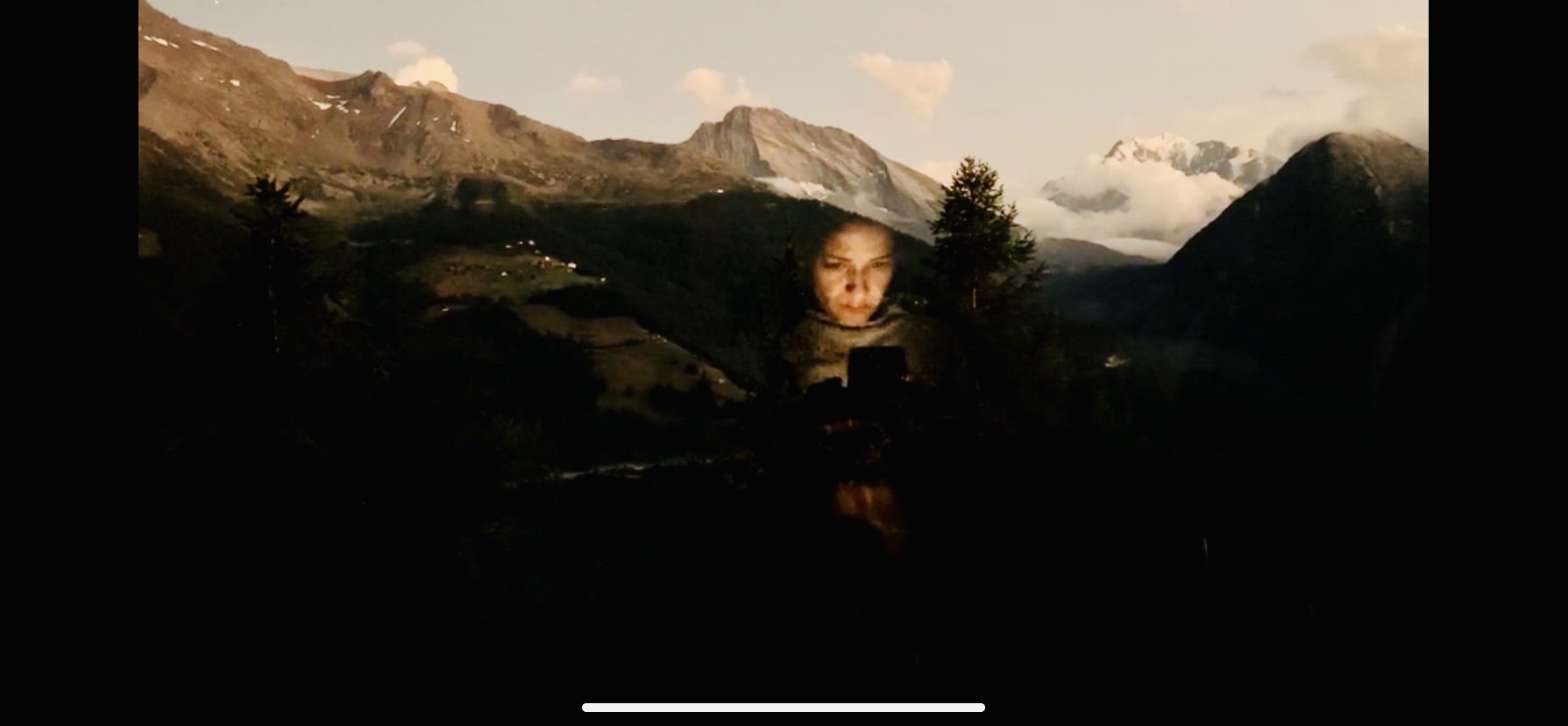
Fragments #17, Video still In these videos, you point your iPhone camera at your surroundings, at your everyday, but you edit the recordings in a way that estranges reality and invites introspection and psychoanalytic interpretation. It’s a highly subjective perspective that gives off a sense of detachment or even dissociation. Can you explain what this approach means to you?
I would like to reach a perceptual situation that I normally don’t deal with in my daily life; that is the game that I started to play with myself since the first Fragment. Every hour of the day we are visually being bombarded, massively, through our phones, computers, TV, and so on. And in the end, our feelings are not always natural, we feel disoriented. So, I thought, what if I manipulate this vast ocean of visuals through my own process and reach a state that is not clear but is also a new sense. Being detached and dissociated is a tactic to reach that state, to start anew, to dig into my perceptions, and reach something different. These visual Fragments are my answers to myself; I would like to place myself in a situation in which I feel something that I don’t experience in the mundane world, something uncanny, a feeling that is not clear and thus has no name. These short fragments are a discovery for me. I wanted to immerse myself in this very new situation of feeling and later digging my soul. What do I feel? Fear? Suspense? What is it? I really like having this kind of conversation with myself and later the viewers.
Fragments are the latest in your line of surrealist work. Why do you favor this type of expression?
My answer is in the challenge of deciphering meaning. Surrealism is not direct. It is not leading the viewer to a ready-made insight; on the contrary, it creates a unique abstract atmosphere. I like this uncertainty and the opportunity to discover, being engaged, and being part of the concept by one’s own interpretation.
The editing in the Fragments series is very dynamic. The sequences are very short, and so is each of the videos. Sometimes they are at a higher-than-normal speed or filmed in movement, while walking or driving. Was it a calculated decision to show things in acceleration?
Yes, these Fragments are trying to visually attack the viewer’s senses. To achieve this I referred to my own personality, I’m always in a rush, can’t focus for a long time but, in the end, I want to gain something. This behavior is being reflected in the way I shoot or edit. I love watching long shots in a film, but when I edit a really short moment, I would like to get a filmic confrontation.
Fragments #16, 2020, 2’02”, Video still It makes me think of how we experience the world via screens – compressed, accelerated, and overwhelmed. Our reality is non-stop scrolling and browsing. We tend to repackage our lives into fragments small enough to fit them into the way things are experienced online. Considering the fact that you used an iPhone to film Fragments, I’m wondering if they were born out of these conditions, of the way we interact with our phones, and the way this shapes our seeing, thinking, and feeling?
That is true. If I didn’t have a smartphone, in my case an iPhone, if I had another kind of camera, the result would have definitely been different. You can have a smartphone everywhere, in any situation, without anyone noticing it, and that ability empowered me to forget any restrictions. The quantity of the films you have increases because you have more space. I have this directive for myself, for the moments that I shoot – the filming shouldn’t go beyond 30 seconds because I know I won’t use longer recordings. And it’s all because we are constantly using our phones, recording anything we find “interesting“ and in the end, we have a pile of junk images and videos that we will forget ever even existed. Smartphones are replacing our minds and eyes. This madness, this chaos, and daily visual bombardment definitely affected me as well, and the Fragments is a result of it. All the quick movements of the camera, the fast speed pieces, are the outcome of the smartphone era and the visual onslaught. I also use social media every day, consequently, that has a big impact on how I see the world and the way I want to create and respond. But if I had a bigger camera, the kind that we used to have while studying documentary filmmaking, the situation would have been different. With those chunky cameras, my movements were limited, I knew I had to be very careful about what I’m filming, not wasting time, and films, and thinking in advance. With a mobile phone, you record a lot and if you don’t like it, you simply delete it at once. It’s kind of like garbage for our eyes and of course minds, but that’s the kind of game I want to play through this visual anarchy.
In this sense, it is somewhat surprising to hear poetry classics in one of your videos; they require a very different sensibility and a slower pace of consumption. What role does poetry play in this video series, and in your art- and filmmaking?
From the time I started studying art, poetry has been my main source of inspiration. I don’t think I would’ve been able to start this process without being motivated by it. To me, poetry is the goddess of all forms of art. Even though I don’t read poems as much as I used to, I still carry all those poems I read throughout all these years with me. They’ve been carved into my soul. I immediately connect with any content with the slightest reference to poetry – a film, a painting, or anything particular. In that particular video, I was eager to perceive and experiment the existence of poems following the visuals.
Fragments #16, 2020, 2’02”, Video still 
Fragments #16, 2020, 2’02”, Video still Some of the recurring topics in your work are home and yearning for home, displacement and the confusion of being uprooted, family relations, and memories of Tehran. How do you situate Fragments in regards to these topics and your older pieces?
The series I did before, related to the topics mentioned, was started when I moved to the Netherlands. I was living in a small city in the north of the country. It was a sort of a cultural shock to me and I felt very isolated. That’s when I became creative, to express what I was going through. During that time, my main concern was displacement and a form of self-imposed exile. But gradually, I moved on and started to live in the present. Fragments are the result of longing to live in the moment.
Adela Lovric is a Berlin-based cultural journalist, curator, and producer. Her research focuses on the representations of migration and counter-narratives in film and video art. Currently, she is working as part of several institutional and independent collectives, developing publishing projects, producing events, and experimenting with curatorial strategies.
-
On Seeing, Searching, and the Book “Let My Eyes Have a Glimpse of You”—Sara Sallam
Once in a while, something vanishes. It gets lost and disappears out of sight. Instinctively, we begin to search for it. However, when we fail to find it, we are left perplexed. We wonder why it is not where we expected. We wonder whether anyone else has seen it. We tell ourselves; someone must have crossed paths with it. The longer our search remains fruitless, the more frustrating it is to come to terms with our insufficient knowledge and limited vision. —Excerpt from the book’s epilogue It was in March 2015 that I noticed for the first time a missing person’s poster.…
On Seeing, Searching, and the Book “Let My Eyes Have a Glimpse of You”—Sara Sallam
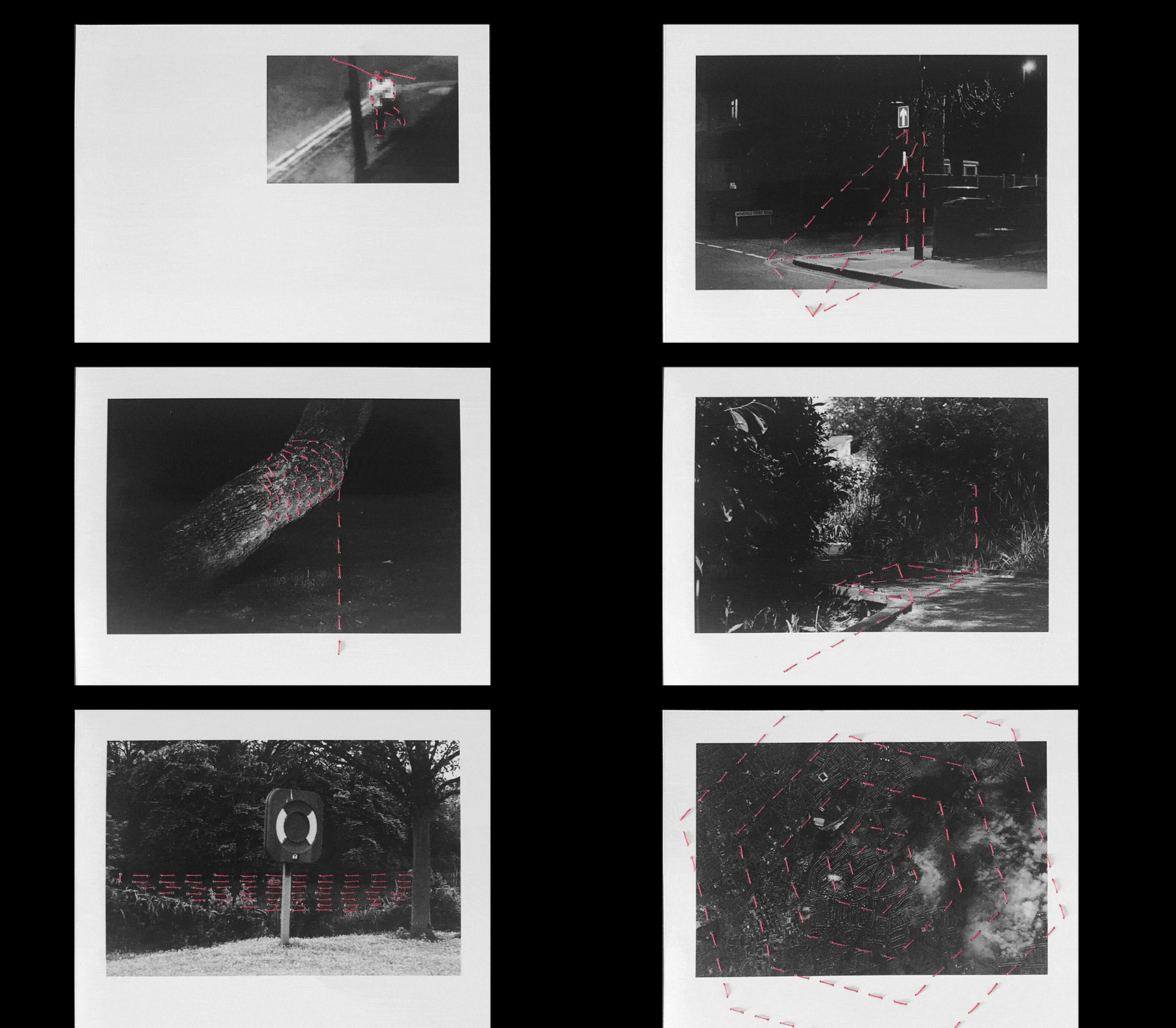
Once in a while, something vanishes. It gets lost and disappears out of sight. Instinctively, we begin to search for it. However, when we fail to find it, we are left perplexed. We wonder why it is not where we expected. We wonder whether anyone else has seen it. We tell ourselves; someone must have crossed paths with it. The longer our search remains fruitless, the more frustrating it is to come to terms with our insufficient knowledge and limited vision. —Excerpt from the book’s epilogue
It was in March 2015 that I noticed for the first time a missing person’s poster. I was waiting for the tube in London. I stared long at that face in the poster, trying to memorize it, wondering whether I could later recognize it. That evening, I began an intense and emotional journey as I became obsessed with the ongoing search for a boy who disappeared thirty-five years ago.
K was a sixteen-year-old boy living in the south of London. One night in March 1986, he walked out of his house to visit the local grocery store. He was never seen ever since. Twenty-nine years later, I was standing in front of his house, only to discover that not only he has disappeared, but the neighborhood he once knew has likewise vanished. His family no longer owned his home. His school was demolished. The store is now a restaurant. Even the police station where he was reported missing is no longer operating.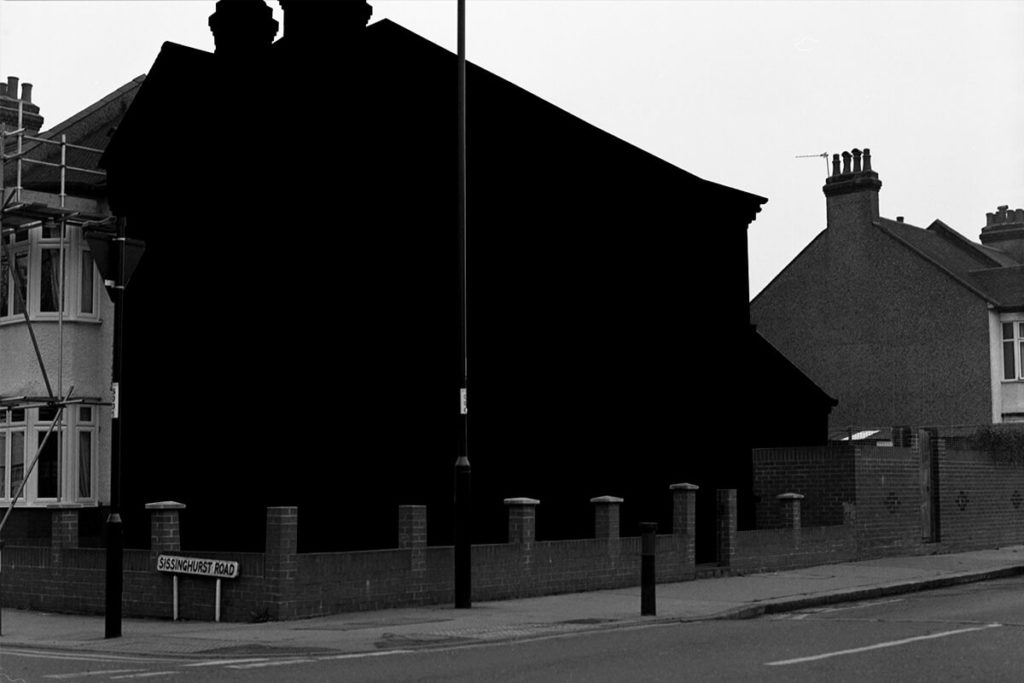
In essence, searching involves the thorough act of looking for what one seeks to find. ‘To look for’ is a linguistic synonym to searching, which already highlights the central role of the eye in the process. When we carefully analyze the act of searching, where one moves around to locate something lost, we discover that finding is the equivalent of seeing. Once we see the searched-for thing, it is found. Reaching for it or acquiring it comes after seizing it through our gaze. —Excerpt from the book’s epilogue
My experience studying documentary photography in London that year was centered around my investigation of this cold case. I was collecting archival material from newspaper snippets, police documents, missing persons’ appeals, and blog posts discussing K’s unresolved disappearance. I was particularly struck when I discovered the ongoing search led by K’s younger sister. Until today, she continues to spread appeals hoping for closure, hoping to see her now assumed fifty-one-year-old brother.
The curiosity driving my research led me to philosophical readings about sight, invisibility, and not knowing. As I wondered about how the search is for both a sixteen-year-old boy and a fifty-one-year-old man, I was reading about Schrödinger’s cat and the state of quantum superposition. And when I encountered the age-progressed computer-generated portrait of K, I was reading about the mythical Gorgons with faces that no one can look at. The more I delved into such contemplations, the more I returned to the same question: What truly lay at the centre of my obsession?
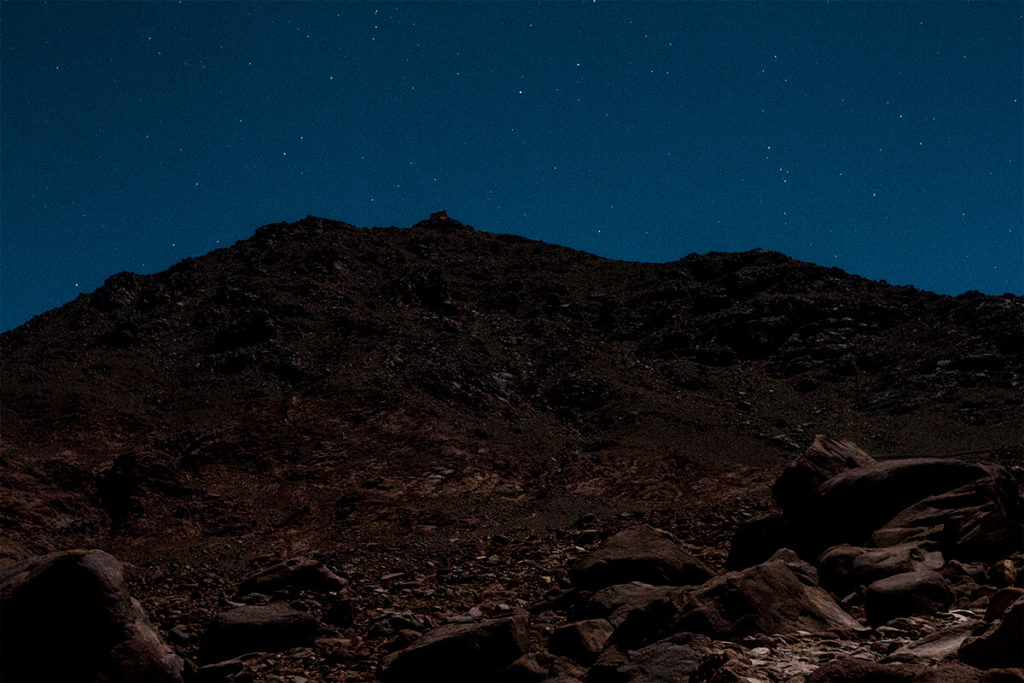
It was quite late at night, a few hours before dawn.
There was a full moon lighting the sky
and casting shadows on the ground.
Soft wind stroked a layer of sand from time to time.
Other than that, barely anything else moved around
until I heard a sound coming from afar.
I did not wonder for long what it was,
for then I saw a man rushing towards the valley.
His pace was fast, and at once, I recognized his face.
He came here years ago, and just like now,
he looked as if he had been walking towards someone else,
someone he could not wait to be nearby.
—Excerpt from the book’s mystical taleMy journey, which began in the south of London in the winter, brought me to the Sinai peninsula in Egypt in the summer. There, I was retracing a mystical tale I had read in the Quran: The collapse of a mountain in the presence of Moses who asked to see a glimpse of God, despite being allowed to hear Him. At the centre of this tale, I saw the human dependence on sight, in spite of which faith is paradoxically formulated. In juxtaposition, the ongoing search for K by his younger sister with appeals featuring his age-progressed face became a reflection of the strength of faith in the face of uncertainty.
By the end of my study in London, I had put together several publications. I made seven zines, each exploring an aspect of K’s case. I designed two booklets titled The Search for the Invisible In a Space of Infinite Possibilities I and II. In Part I, I curated the archival textual and visual research material I had been collecting. For Part II, I made a series of photographs which I embroidered that retrace the search for K. With the embroidery, I invited the reader to reveal the photographs hidden behind the threads. As for the tale in Sinai, I juxtaposed it with the case in London in a photobook titled The Invisible: Faith as a Phenomenon. In their totality, these handmade books acted like a research dossier that reflected my obsession with what it means to search for what the eye cannot see.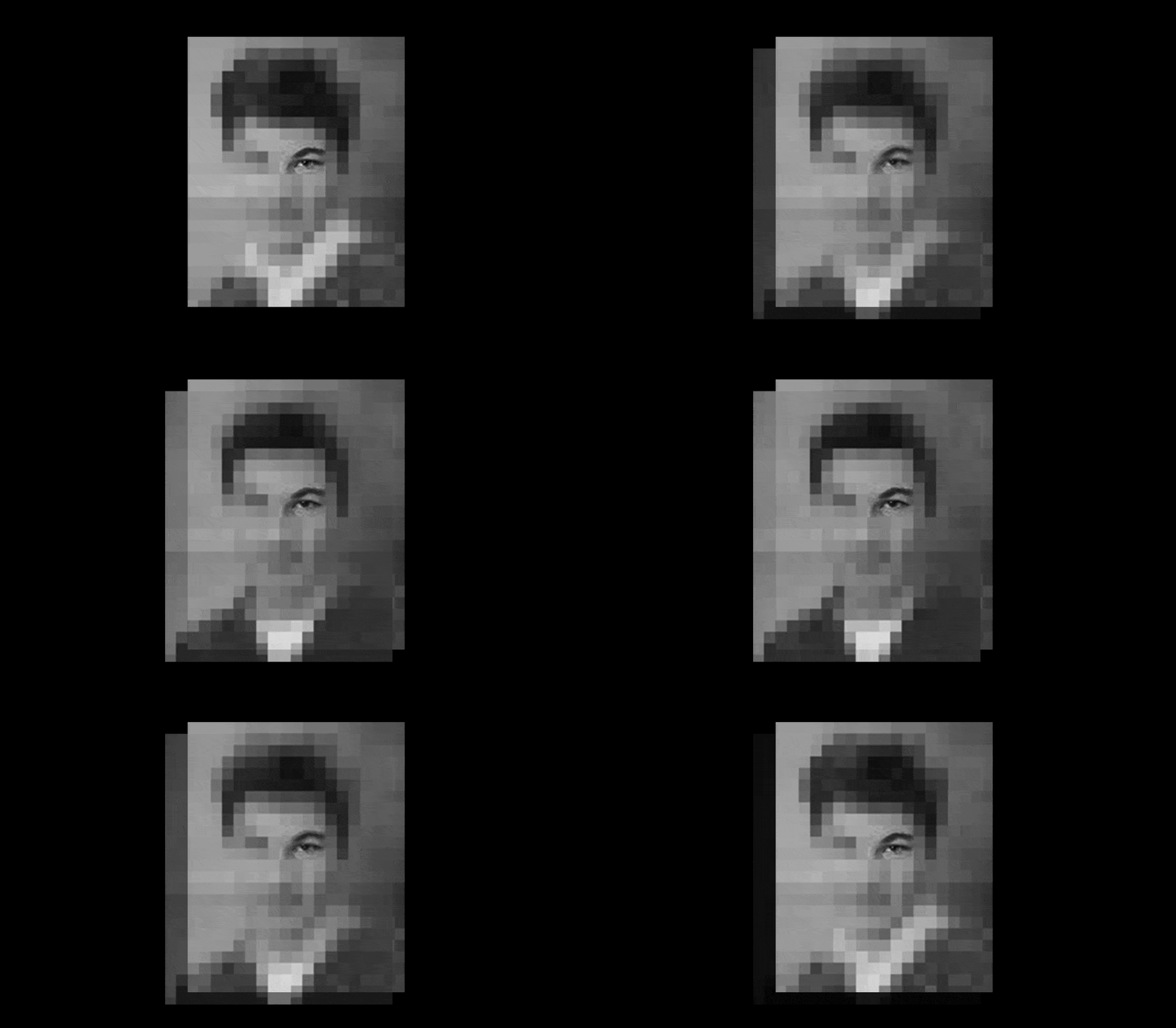
Creating and then relying on non-photographs when searching for the Vanished is proof of our inability to detach ourselves from the visible world. Even when trying to approach what is impossible to perceive, we still depend on a visual medium which, by all means, fails to fulfill the task demanded of it, for it can only speak through its visibility using its visual language. We are, thus, left with a real-looking fictional representation that facilitates the search via the only approach we know, satisfying, in turn, the desire of our eyes to see. —Excerpt from the book’s epilogue
Six years later, I decided to revisit these publications with the intention to transform their essence into a concise narrative. Instead of several booklets that reflect the complexity of this multi-faceted project, I wanted to design a new book that would invite a more immersive experience. And so, I began to conceptualise the book’s form, layout, and binding technique. I re-edited the photographic narrative, focusing on how best to interweave the tale from Sinai with the case from London. I reworked the epilogue’s essay and wrote a story narrated from the perspective of a mountain to illustrate the mystical tale. Then, I focused particularly on further developing the embroidering concept.
With a Stitch-Me edition for the resulting book titled Let My Eyes Have a Glimpse of you, I am inviting the readers to embroider the photographs themselves. Using red thread referring to what the missing boy was wearing, the embroidery accentuates areas within the photographed scenes. It acts as a tactile invitation to imagine what may have happened in this cold case. As the book readers engage with the intimate and time-consuming practice of stitching, I hope they reflect on the long and difficult journey traveled by those longing for years to see the faces of their loved ones.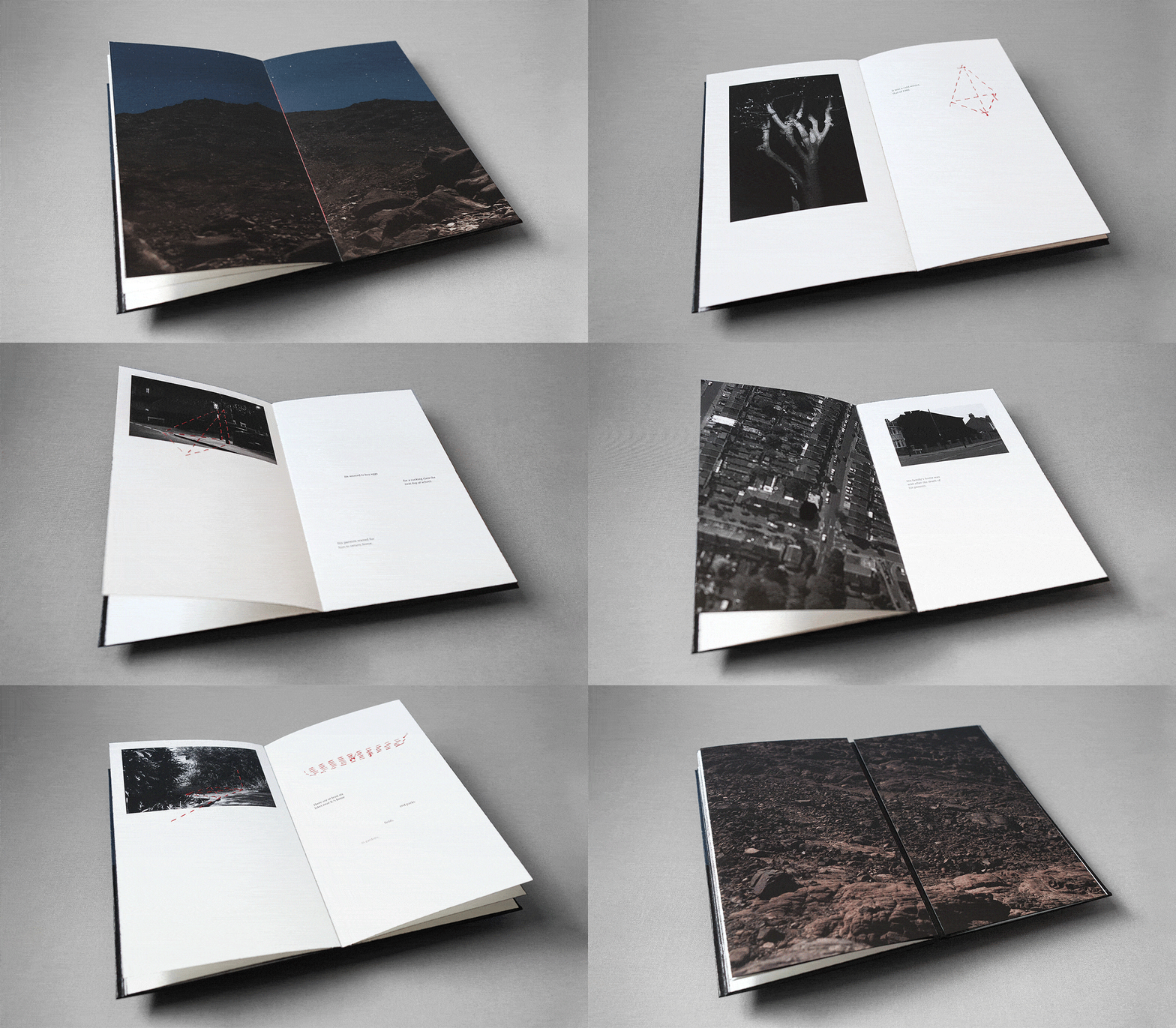
Let My Eyes Have a Glimpse of You
• 13 cm x 21 cm, 72 pages
• First Stitch-Me edition of 35, signed and numbered
• Hand-sewn, with hardcover, an exposed spine, and hand-painted edges
• Self-published in April 2021
• The book includes 17 photographs, 6 archival images, 4 over-painted
photographs, 5 maps, a story tucked in a double gatefold, and an epilogue. 12 of the images are embroidered with red thread.Sara Sallam (1991) is an Egyptian multidisciplinary artist, designer, visual researcher, and book maker based in the Netherlands. She works with photography, video, and writing, often re-appropriating and manipulating archival material to invite hidden meanings to emerge. Themes of absence, loss, and longing run throughout her work in which she explores ways of visualizing things we cannot see and portraying people we can no longer meet.
If you’d like to learn more about Sara’s work, visit her website, subscribe to her free newsletter, or join her on Patreon to read similar insights into her process. -
The New Gods—Omar Houssien in Conversation with Srđan Tunić
The New Gods is a mixed media artwork series by Egyptian artist Omar Houssien. Here the ancient deities of Egypt are reinterpreted through the lens of contemporary society, culture, and symbology. We see the god of disorder, Seth, as an Arab Spring protester, the goddess of joy and femininity, Hathor, as a belly dancer, the supreme Ra as an omnipotent president, or Nephthys as an influencer. Combining the languages of pop art, advertising, and popular culture, the artist aims to create a critical reflection of contemporary and Egyptian society, as well as to offer a vision that is locally grounded,…
The New Gods—Omar Houssien in Conversation with Srđan Tunić
Dialogues publishes contextual and visual essays, interviews and conversations, reviews, and experimental writing. It is a textual space that encourages critical thinking. At the same time, Dialogues extend conversations across borders, making visible insights and relationships that might still be unseen and helping grow this Network. If you have a collaboration proposal or an idea for a contribution to the Dialogue section, we’d be happy to discuss it.
[sibwp_form id=5]
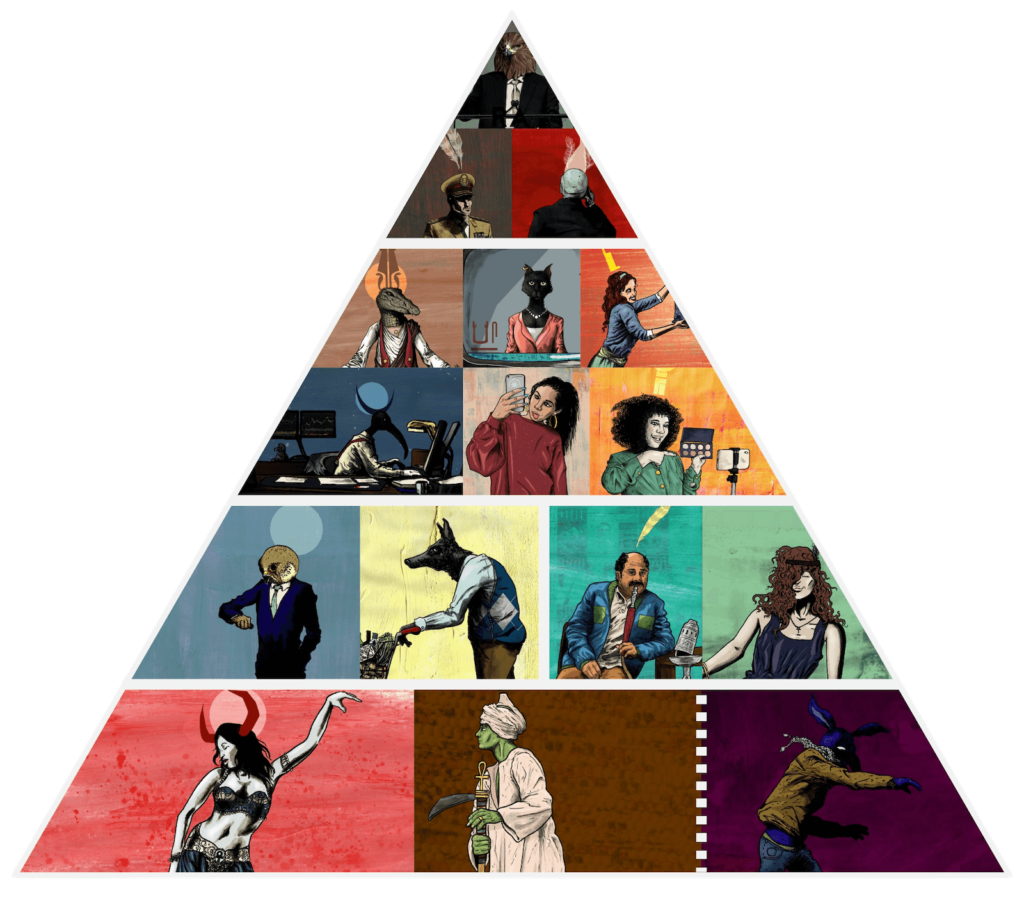
The New Gods is a mixed media artwork series by Egyptian artist Omar Houssien. Here the ancient deities of Egypt are reinterpreted through the lens of contemporary society, culture, and symbology. We see the god of disorder, Seth, as an Arab Spring protester, the goddess of joy and femininity, Hathor, as a belly dancer, the supreme Ra as an omnipotent president, or Nephthys as an influencer.
Combining the languages of pop art, advertising, and popular culture, the artist aims to create a critical reflection of contemporary and Egyptian society, as well as to offer a vision that is locally grounded, given that the Egyptian gods have become among the fantasy genre’s stock figures. All artworks were made between 2013 and 2019, during and as a reaction to the Arab Spring.
Each artwork (Mixed Media, 22×35 cm) is accompanied by a bronze engraved plaque (Faux-bronze, 10×15 cm), with a description of the deity. Similar to museum labels, each plaque had “technical information” such as major cult centers and names in hieroglyphs. The descriptions were written in a way that would accurately describe the deity, but push the viewer to draw parallels to the version represented.
Conveniently, we will take the image of the pyramid to visually convey the power stratification of The New Gods: from the supreme gods representing the state and military (such as Ra), then gods serving the government in various ways (like propaganda and religion), followed by independent shapers of the society (like Horus and Shu), and lastly ones outside the mainstream power.
Curator Srđan Tunić speaks with the artist about each individual god for Sumac Space in order to understand their past and contemporary image.
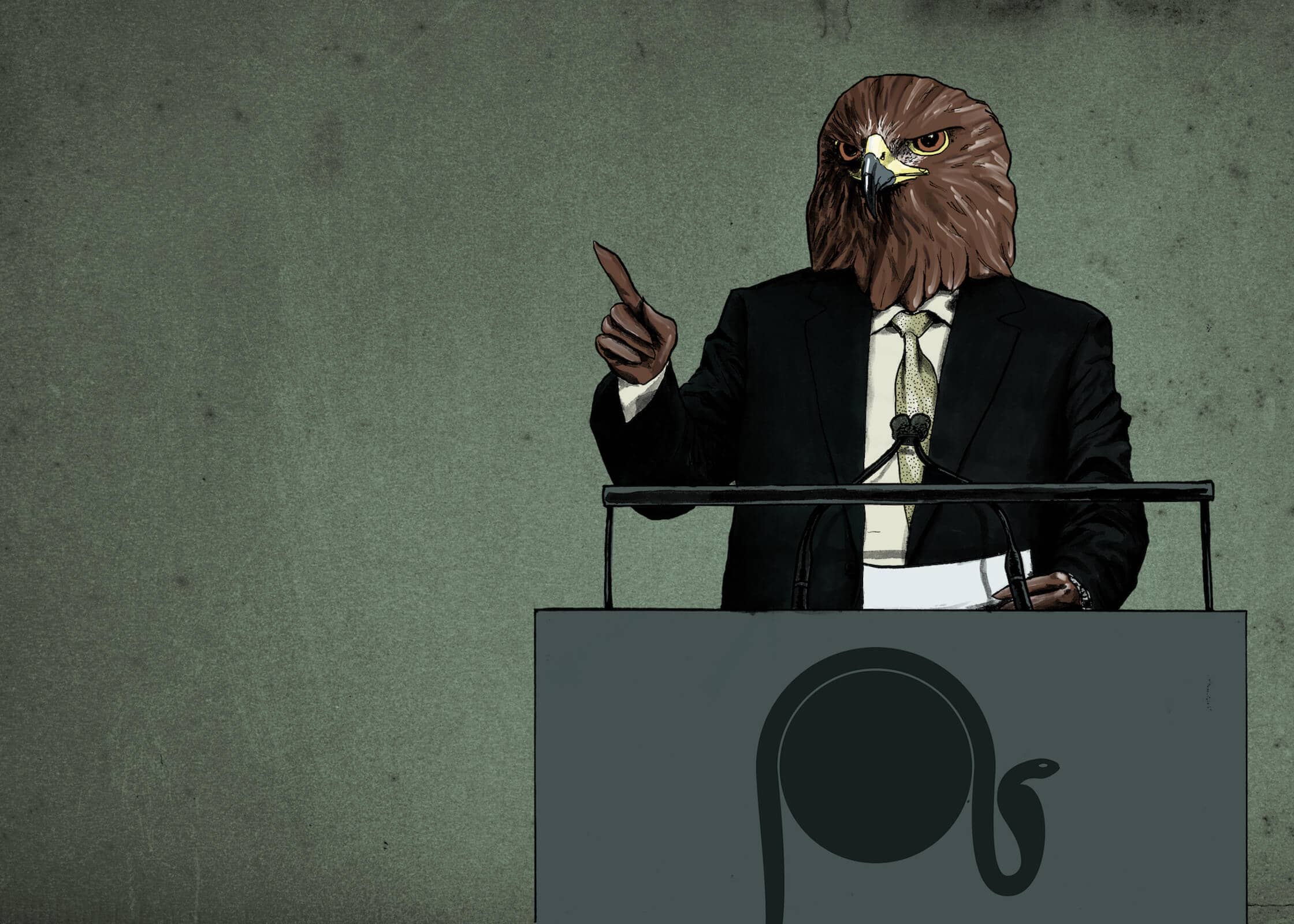
RA: listen to me, I’ll tell you… (2014)
Srđan Tunić: Ra had supreme power over the existing world. He was also the god of the sun and the kings. According to some interpretations, he was also the king of the gods and the creator of the universe. He was often presented with a falcon’s head, like Horus, with whom he was also paired as the god of the sky.
Omar Houssien: InThe New Gods, he swaps his falcon head for that of an eagle (the official emblem of Egypt and several Middle-Eastern and African countries) appearing as a generic politician, ruler, president, but – he is the face of the government. While he maintains the supreme power, unlike other gods (except for Seshat), the symbol is not on or behind his head, but on the podium, featuring the sun disk and the coiled serpent. With this detail, I wanted to pinpoint that it’s not the focus on the person, but on the position itself, the institution of the government. Ra is whoever stands behind that podium. In nurturing the personality cult, it doesn’t matter who takes the position, it is always the same (Ra).
AMUN: the people and the army are one hand (2013)
Srđan: One of the major deities of ancient Egypt, Amun was omnipresent but invisible, self-created and a creator deity. He was often paired with Ra (as Amun-Ra), making him the ultimate chief deity, and protector of the poor. His headdress has two vertical plumes which he (or it?) kept in your image.
Omar: I see him as the Egyptian military: omnipresent but never in the spotlight, maintaining the monopoly (and consequently the corruption) of power, and creating a model (one is forced) to be associated with as a dark presence looming over every government and president elected by the citizens. Historically, in order to succeed in ruling Egypt, you need somehow to appease the army. On the other side, it can be seen as an open and publicly-owned institution – one of Egypt’s few platforms for success based on meritocracy and social mobility. Military service is mandatory for all Egyptian men and so, the army IS the people. It is also one where the traditional protection of the poor is frequently implied. The military is a synonym for efficiency and is the country’s handyman, doing everything that needs to be done, also setting the desired role model for an average citizen.
OSIRIS: deep state (2014)
Srđan: One of the most important gods for understanding ancient Egypt’s obsession with the afterlife, Osiris was the god of life, death, afterlife, and resurrection, among others. Pharaohs were identifying with him, hoping to join him and become one in death. Traditionally depicted with green skin (color of vegetation and rebirth) and distinctive Atef crown. And this is the only god you depicted from the back, why?
Omar: Purposefully simple and mystical, I see Osiris as the deep state of Egypt. The power behind the power, completely in control yet cloaked from the public. While Ra was the role model during one’s lifetime, Osiris was celebrated in order to provide eternal (after)life. In such a system, where rulers were living for eternity, society doesn’t change and stagnates, being sacrificed to achieve this goal, like in necropolitics.
SOBEK: bow to me (2014)
Srđan: Sobek is the god of the Nile and the army, which had a very fluid and complex nature: at the same time benevolent and dangerous, warding off evil and protecting innocents, sacred and feared (as Sekhmet). Like head and tail on a coin, he embodies an army’s protection and terror aspects. Crocodiles in the Nile river were seen with the same double role: they were killing the pests hurting the crops, but also could eat humans.
Omar: In my interpretation, Sobek kept the crocodile appearance and the double-edged sword role. Posing and vested as a generic religious figure, his clothing combines elements of Christianity (white and purple robe) and eastern religions (halo, red ribbon, solar disk, and other attributes). Fluid and malleable as religion, bringer of peace, and fundamentalist terrorism, Sobek embodies religious authority which is responsible for a variety of conflicts in the Middle East. I think the religious authorities (embodied by the Muslim Brotherhood or the Salafist movement) were also pivotal in undermining the Liberal revolutionary movements post-Arab Spring.
BASTET: caTV (2013)
Srđan: The goddess of Lower Egypt and domesticated cats, also a protector against evil spirits and contagious diseases, and one of the defenders of the pharaoh. In the beginning, she appeared more as Sekhmet, the fierce lioness warrior, while later transformed in this more gentle aspect.
Omar: Here she’s presented as a TV anchor, one of the many talking heads on Egyptian Television, playing on the saying that there’s a cat in every home (in ancient times of course), now replaced with a TV. Despite being a protective deity, her role is not naive: representing the media, she is entering people’s private space. In the upper right screen, one can see a baboon (her helpers, also sacred) with a remote controller and inscription Latlata meaning gossip. The bottom left has a few elements, the first being the ka, which stands for one’s spirit or essence after death.
By incorporating it with the image of the media, I’m playing with the idea that the media (or propaganda) is after our soul. The background of the print is made of old state newspapers in Arabic.
ISIS: buy, buy, buy (2013)
Srđan: She was the ideal woman and mother, patron of nature and magic. Isis is personifying the pharaoh’s throne, directly representing the pharaoh’s power. Her headdress is literally the hieroglyph of the throne. She is one of the first gods, coupled with Osiris as her husband, from whom the first stories originated. And here – let’s start with the details, what’s in the background?
Omar: The background of the print semi-transparently shows home delivery and hotline ads from daily newspapers. The goddess herself advertises a product with a twist: while a product could be almost anything, generic and abstract in its shape (detergent? chips? dog food?), framed with a masonic eye and inscription Khara meaning shit. The Eye of Providence (the all-seeing eye of God) has roots in Christianity rather than Egypt and is often associated with freemasonry. That’s why here I wanted to create a visual pun, alluding to conspiracy theories that are often found in adverts and mass communication. This rather negative view of marketing as propaganda is reinforced with my own disillusionment with the advertising world. Additionally, Isis is also the emblem of Banque Misr, Egypt’s first national bank with Egyptian financing, further reinforcing her contemporary symbol for consumerism and propaganda.
THOTH: knowledge is power (2013)
Srđan: The god of wisdom and knowledge, master of physical and divine law, it is said he himself calculated the making of heavens, stars, earth, and everything in them. A creative deity, he is recognized by the sacred ibis and baboon. Also related to magic and death – in the judgment of the dead, he was the one to record the results after measuring one’s sins.
Omar: In the new light, he is seen in an office, working as an analyst, related to the economy and the stock market. While time is money for Horus, knowledge is power for Thoth. Through data, he defines society as a white-collar level bureaucrat. Other potential reading could be surveillance. Whatever the case, he is an essential part of the system.
SESHAT: data harvesting (2019)
Srđan: Overlapping with Thoth, his consort, Seshat is in charge of wisdom, knowledge, and writing. She is the goddess scribe and record keeper, Mistress of the House of Books, in charge of libraries and archives (consequently treasury). She was recording the passage of time, mainly the pharaoh’s time on earth.
Omar: In our contemporary world, she switched to information gathering and data harvesting – the record keeper has moved online. The biggest social media companies are earning money based on collected data from their users, which is the reason why Euro bills are the background image. While everything gets digitized, not all data is important, which makes the record keeping pointless, emphasized by her making grimaces while taking selfies with her smartphone. Record-keeping is also inaccurate (our lives on social media are misrepresentations of our real lives) which is why on her bronze plaque, her name is misspelled. Just like in Ra’s case, her emblem – a stem with star-shaped petals and inverted horns – is not on her head, but on the item. The phone becomes the record keeper and an object of divination.
NEPHTHYS: the lady of the house/influencer (2019)
Srđan: I was trying to find more info on this one, but it’s rather scarce. This goddess was part of the top nine gods, known as the Great Ennead. Her function was the protection of the dead and “the lady of the house/temple”, signifying the pharaoh’s palace and priesthood. Her symbols are a house-shaped hieroglyph and a basket, also her headdress. Compared to some other gods from the pantheon, little is known about her and interpretations are fluid.
Omar: This gap definitely influenced my depiction. Nephthys is an influencer, creating a makeup tutorial. Like Bastet, she has access to other people’s private space and home through technology. Nephtys was heavily present in funerary rites, rituals mourning the dead and is a deity of protection, magic, and embalming. However, like you mentioned her largest role was that of the “lady of the house”. She is not a housewife, but influences the household, by setting the standards and desired image. The household in this sense is intended to mean the temple, the sacred space. Think about a subtle message: the temple or pharaoh’s palace could be your home.
Her hair, unlike the other gods, is typically Egyptian, curly, and natural, her role hasn’t changed in modern times. In some rural parts of the country, certain mourners are still hired to cry and scream at someone’s funeral, a similar job that existed back in ancient times by the priestesses of Nephthys. The background stripes are metaphorical mummification bands, relating it to her funerary aspect, which could be also linked to the makeup (understood as preservation of course).
HORUS: time is money (2013)
Srđan: One of the oldest worshipped gods from ancient Egypt, he is the god of the sky, war, and hunting. Usually depicted as a falcon or falcon-headed man, he is truly a symbol of majesty and power and served as a role model to the pharaohs. In your interpretation, he looks like a cool businessman, dressed in a smart casual way, looking at his watch, with a solar disk (a precursor of the Christian halo if I may note) above his head. Tell me more about his new image.
Omar: This is actually the first of this series to be produced. Horus is business and time related: time is money, money is business, business is power. He is a desired model of the all-powerful, an image of the entrepreneur. His image is still widely in use in Egypt (for example, EgyptAir’s logo and many businesses around the country). As such, I see him both as a protective deity and a sign of competition, through his ancient hunting role.
ANUBIS: shopping for eternity (2013)
Srđan: Anubis is of the most recognizable Egyptian deities, represented as a black jackal. The black color was associated both with the rotting flesh and the black earth of the Nile valley. He is the god of mummification and underworld, who weighs one’s heart before deciding if one’s spirit (ka) be destroyed or live eternally.
Omar: I depicted him as an elderly-looking shopper, he is an image of materialism, consumerism, and consequently capitalism.
Srđan: My initial interpretation focused on the cart, where most of the conserved products and their packaging could outlive our physical bodies, being fully or semi-artificial. But…
Omar: I’d suggest that the supermarket is related to another transitory and non-place, the tomb and the underworld. Through the process of mummification, people’s organs were preserved, and the burial included material possessions, sometimes even favorite pets and servants, ready to follow their master to the afterlife. I’ve alluded to this with the background, with its thick grainy brushstrokes simulating the earth. This stacking could also relate to the saying that you can’t take it all with you to where you’re going after death…
SHU: busybody (2019)
Srđan: A primordial god, Shu stands for air and wind, but is also “considered to be a cooling, and thus calming, influence, and pacifier”, often metaphorically seen as separating the sky and earth. The ostrich’s feather in him is seen as a symbol of lightness and emptiness.
Omar: In The New Gods, he’s smoking shisha, while in the background are warning messages from tobacco packaging. While his air symbolism is traditionally seen in a rather positive light, the pacifying role has been reverted to a vice. His pose is frequent in the Arab world: as a human CCTV, he’s monitoring others and creating a form of social pressure. After all, Shu has been separating the lover’s Nut, the goddess of the sky, and Geb, the god of the Earth.
A busybody who knows everything, imposing standards of behavior, looks, and norms. Interestingly, “Egypt is one of 15 countries worldwide with a heavy burden of tobacco-related ill health”, according to a 2015 report by the World Health Organization.
Another, more cultural and social take on Shu could be that of emptiness: the image of men smoking shisha in cafes is commonly associated with unemployment. The more time men spend doing this, idling as they watch and harass or judge neighborhood passersby, the more it’s apparent that they clearly don’t have work to get to.
MAAT: in vino veritas (2013)
Srđan: Justice, (the rule of) law, truth, balance, and morality, are closely associated with Maat. Her symbol is the ostrich’s feather and she was responsible for cosmic harmony. She, as a principle, was seen as a way to establish social order among the variety of conflicting groups and people living in ancient Egypt. In the Duat (the Egyptian underworld), she was one of the gods a person encountered in the afterlife when the hearts of the dead were weighed against her single feather.
Omar: My version shows Maat as happily drunk, with messy hair, clothes, and the ostrich’s feather. It’s as if you caught her at the end of a party. This viewpoint might seem desacralized, depicting the justice goddess’ fall from her duties. However, justice is elusive and can be manifested through excess (the bottle says in vino veritas in Latin, in wine lies the truth). She is also intended to be celebratory as Hathor.
PTAH: the crafter (2019)
Srđan: Another creator god, a pra deity, who, according to legend, existed before all other things and who conceived the world by thought and word. He is closely related to physical creation and is, therefore, the protector of all manual craftsmanship, as well as agriculture and the land. What’s his story now?
Omar: In this image, his agricultural aspect is emphasized, reminiscent of farmers who make up the majority of the population, but are neglected and unappreciated. He has the traditional green skin color, while his staff with symbols (ankh-djed-was) is transformed into a plowing tool. Farmers tend to be (and seen as) uneducated and poor, but a critical part of the society – after all, the whole ancient society came to be thanks to the fertile ground around the Nile. Even today, Egypt, despite being mostly a desert, is actually an agricultural country. Populist leaders (in Egypt, from Nasser to Sisi) often needed to get the farmers’ support to gain traction, and so they would do something for “the people”. The background is inspired by kilim tapestry patterns from rural areas.
HATHOR: dance, dance, dance (2013)
Srđan: The goddess of joy, feminine love, sexuality, music, and motherhood, she was also one of the companions of the deceased’s soul to the afterlife. She is usually depicted as a cow, or with a headdress with cow horns and the sun disk. I think this piece really needs the local context to be properly understood.
Omar: This is my favorite piece of the series. In my interpretation, she is a belly dancer, celebrating the body, femininity, entertainment, music, and love. She has the life symbol (ankh) and is one of the rare gods with a positive image in the series. I consider belly dancing – which originated in Egypt – is not given its rightful importance as part of contemporary dance. On one side, it’s recognized as part of Egypt’s popular culture (though ignored just like the pyramids and pharaohs), but on the other is also targeted by the conservative community due to body exposure, sexualized movements, and considered immoral. There is even an Act No. 430 of the law on censorship introduced in 2018, which states that “the dancing suit should cover the lower body, with no side slits, and should cover the breast and stomach area”, which Hathor happily refuses to comply with. The reading really depends on and reveals the onlookers’ ethics. If they are more on the liberal spectrum, they see the joyous tone of the piece, if they are more on the conservative side, they view her more within the same category as sex workers and consider it a cynical piece. Either way, it is one of the pieces I get asked most about, The role model for this image is the famous Egyptian actress and belly dancer Samia Gamal.
SETH: it’s either me or chaos! (2013)
Srđan: A complex and mysterious deity, Seth according to the myth of Osiris was responsible for killing Osiris and battling with Horus, and was seen as a god of chaos and disorder. He is depicted as what Egyptologists call Sha or Set animal, which appears to be a hybrid of “aardvark, a donkey, a jackal, or a fennec fox”. It’s not known if it was a real, misattributed, or extinct animal or even a fictional image. He was also the god of the desert, storms, and foreigners.
Omar: In The New Gods, Seth is a rebel, protesting and throwing a Molotov cocktail, wearing the Palestinian scarf (keffiyeh), which aside from being a symbol of Palestinian resistance, was used by protesters in Tahrir to protect themselves from teargas grenades. As such, he also represents the young people of the Egyptian Revolution. Here, just like with Hathor, the image is a test of personal beliefs, in this case, the political one. In one of his final public televised speeches in January 2011, president Hosni Mubarak famously said the revolution is a choice between chaos and stability, which was a constant justification for staying in power. Interestingly, during the Arab Spring, all the protesters at Tahrir square were accused of being foreigners, or foreign mercenaries, by the government, an accusation typical of oppressive and anti-democratic regimes. So depending on one’s interpretation of the events of the Arab Spring, this piece can be seen as either accurate or ironic.
Although traditionally portrayed as evil and adding to conflicting interpretations as an Arab Spring protester, I claim Seth is as important as his antipode, Horus. He is not bad or evil, rather creating a disbalance, a sign of social changes and otherness, the underdog.
Omar Houssien (b. 1990) is an Egyptian-Australian artist with a background in design, illustration, and visual communication. Having completed his studies at the European Institute of Design in Milan, Italy, he returned to Cairo where he contributed work to art spaces and cultural initiatives, development programs, and various advertising campaigns.
In 2017, he participated in his first artist residency as part of the East Type West Type program at AGA Lab, culminating in a two-week exhibition at the Bijzondere Collecties (Amsterdam). From 2014 to 2018, he worked on the independent film Poisonous Roses (Cairo), which premiered at the Rotterdam Film Festival and won several awards, eventually becoming Egypt’s 92nd Academy Awards submission for Foreign Film. In 2019, his work The New Gods was exhibited in Roznama 7, organized by Medrar for Contemporary Art (Cairo). He has had previous exhibitions in Cairo, Amsterdam, Milan and Belgrade. Instagram @oh.youfoundmeSrđan Tunić (b. 1984) is a freelance curator and researcher based in Belgrade, Serbia. He is a co-founder of Trans-Cultural Dialogues (as part of Cultural Innovators Network), Kustosiranje / About and Around Curating and Street Art Walks Belgrade initiatives. He is collaborating with art professionals, researching fields such as contemporary art, curatorial practices, street art and graffiti, science fiction, art appropriation, cultural diversity, experiential learning, independent cultural scene and self-management.
His texts have been published in the Kultura Journal, AFRIKA – Studies in art and culture, Transcultural Studies Journal, IJOCA – International Journal of Comic Art, SAUC – Street Art & Urban Creativity Scientific Journal, as well as web portals SEEcult, Uneven Earth, Balkanist, Makanje and Seismopolite magazine. www.srdjantunic.wordpress.com -
Of Cities and Private Living Rooms—Huda Takriti in Conversation with Huda Takriti
Some of the information presented in this text might be fictional. Thus, the author is leaving complete freedom for the reader to decide upon what might be factual or fictional. The presented self-interview of Huda Takriti interrogates her multi-media installation of cities and private living rooms (2020) and reveals central interests of her work: the agency of lost archives and hidden biographies. In of cities and private living rooms a domestic mystery unfolds into a visual essay where images, family archives, various landscapes combined with text and memory intertwine with fiction, reality, the (hi)stories of migration and diaspora, identity and representation.…
Of Cities and Private Living Rooms—Huda Takriti in Conversation with Huda Takriti
Some of the information presented in this text might be fictional. Thus, the author is leaving complete freedom for the reader to decide upon what might be factual or fictional.
The presented self-interview of Huda Takriti interrogates her multi-media installation of cities and private living rooms (2020) and reveals central interests of her work: the agency of lost archives and hidden biographies. In of cities and private living rooms a domestic mystery unfolds into a visual essay where images, family archives, various landscapes combined with text and memory intertwine with fiction, reality, the (hi)stories of migration and diaspora, identity and representation.
Q: Could you take us chronologically through the background of your work? When and how did you find out about your great-grandmother’s “secret” identity?
A: It all happened by the end of 2011, during a conversation with my older brother. He mentioned that he was wondering if there is a possibility to get a Polish passport if he can prove the origin of Fatima. Nevertheless, he was not sure if my mom or her family would want to speak about this openly!That’s when I found out that my great-grandmother whom I had never met in person, but still have heard so much about, was in fact not completely the person I thought I knew. Fatima was not Lebanese. At least, not for her entire life.
You can imagine how shocking it would have been for me to hear that piece of information. I thought that I already had a complex background; A Lebanese/Palestinian mother and a Syrian/Iranian father. Suddenly something else was added to the already complex batter.
My brother did not have much information. According to him, Fatima was Polish who managed to come to Syria with her family before or during WWII. She later moved to Lebanon. His source was one of our relatives who managed to track down a couple of Fatima’s relatives on Facebook. She even ended up meeting one of them; The grand-daughter of Fatima’s sister “Jamile” who now lives in the USA. My mom asked him not to share this with anyone when he tried to get more information from her. But it was too late for him to back off!
A Screenshot of a Facebook post, where the grand-daughter of Fatima’s sister is asking if Fatima is Victoria.
Q: And what happened next?
A: Well, the first step I took was to go to my mom and ask her if this was true and for what reason was this kept a secret… At first, she refused to talk about it and constantly repeated, “There’s no need to talk about this” and “It’s already buried in the past, there’s no point in digging it up now”. However, after insisting for a while she shared her version of the story with me; Fatima was born in Damascus in 1887 to Polish parents whom have immigrated to Ottoman Syria1. Her birth name was Victoria. Later in her life, Victoria traveled to Lebanon where she got married to a Lebanese Journalist and founder of Al-Ababeel newspaper, my great-grandfather “Hussain Al-Habbal2”, who gave her the name Fatima. She lived her life between Saida, a city in the south of Lebanon, Damascus and Kuwait. She died in Saida in 1967.
A Screenshot of a Facebook post with a photo of Hussain Al-Habbal
Q: So, your mother and your brother’s stories were somewhat incoherent?
A: To some extent, yes! Some of the details shared commonalities. I must mention both my mother and my brother were very sure of their versions. My mother was raised in Saida by her grandmother “Fatima” as her parents were working in Kuwait and wanted her to grow up in Lebanon. She says that Fatima was her best friend till the day she died. So, I consider her to be a reliable source of information. On the other hand, my brother’s source of information was proven by Fatima’s extended family member in the USA.The more family members I’ve asked, the more versions of stories I encountered. Such discrepancies between the narratives became the starting point for this work. When Victoria’s/Fatima’s birth certificate showed up, it became even more confusing. The stories, at first, had a common thread, Poland. Moreover, after I finished the work last summer there was a new story mentioning Russia as the place of origin of Fatima’s parents.
Before the new story come to surface, there was a debate on which city or village did she come from. Some said Warsaw and others said Gdansk, and a debate considering the historical period of their departure. With an aim to find a trace of some kind of a historical record or a document which may lead me somewhere further, I left to Poland.
Still, of cities and private living rooms, film installation, 2020
Q: But you have mentioned finding Victoria’s birth certificate. Didn’t it lead you somewhere in your research?
A: The birth certificate was issued under the name Fatima Al-Shami, and it was later revealed that my great grandfather, Hussain, had this document made for her after their marriage. She kept this name when she chose to convert to Islam later in her life.Q: It seems like you’ve got a lot of fiction going on in your family’s history. How do you reflect on what is factual and what is fictional in your work? Is it important for you that the viewers are able to distinguish between the two?
A: The work consists of two parts, a film installation and a family photo archive. Hints were implemented for the viewers here and there. In the film, I don’t only reflect on what is there I try to reflect on what is not there as well. By borrowing items from the photo archive and implementing them into the film.The archive is shown via slide projection, the photos are real, what the viewers see is real. Nevertheless, the material and the form of the photos are manipulated. I don’t know if the original photos still exist somewhere but one relative had a digital copy of the photos uploaded to Facebook.
The photos I am using were downloaded from Facebook and then returned to their analog state. In this process, some information and details of the photos were hidden away. The viewers can still see pixels and parts of the torn photo edges in the slide projection. Moreover, I leave it to them to decide what could be real and what not.
Q: The act of restoring or returning the photos to a unity that might not exist anymore suggests a form of fictional archive. Does it exemplify your tendency to collaborate with and rework historical material?
A: Honestly, I didn’t have a good sense of what exemplifies my work while working on this project. I’ve always been drawn to fictions that have documentary tendencies, and documents that open fictional pathways. It’s more clear for me now that I love to be on the edge between the factual and the fictional.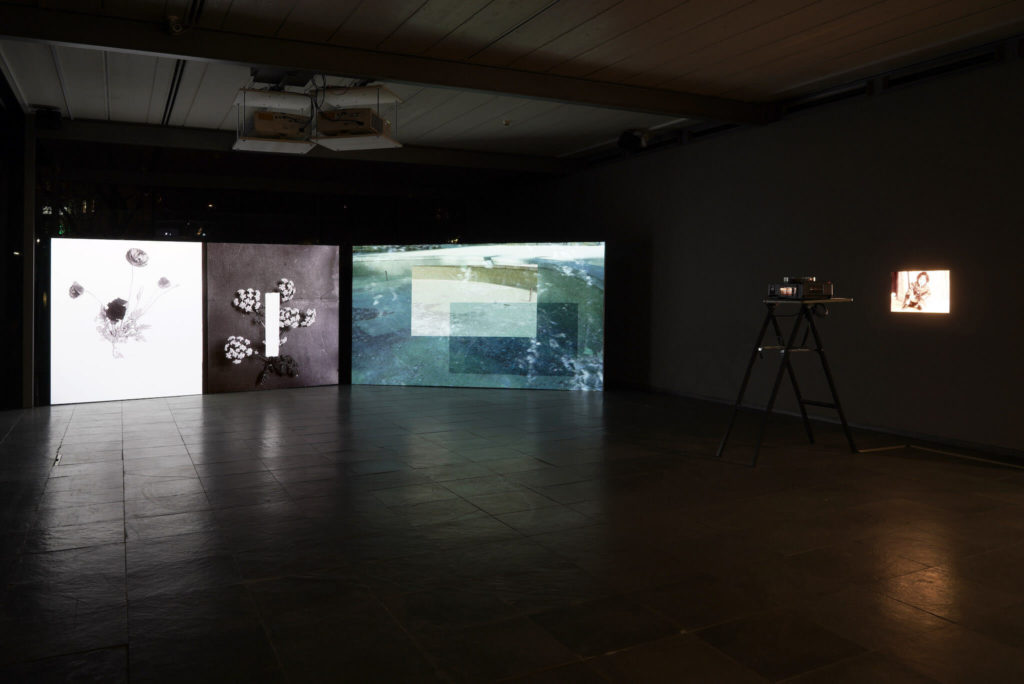
of cities and private living rooms, Installation View @Kunsthalle Wien, 2020, Photo: Kunsthalle Wien
Q: In your video installation, the first question the viewers are confronted with is “Do we need the truth?”. One can say that the phrasing of the question is a key to the work. To whom are you addressing the question? Are you including yourself with the viewers?
A: There’s a big difference between saying “Do we need the truth?” and “Do we want the truth?”. Personally, phrasing the question this way was a reflection on the stage of my research where I realised that there is no point of seeking the truth anymore; Funny that these were my mom’s first words to me and it took me about eight years to realise that. Moreover, it was a hint left to the viewer about the process and how seeking the truth, this one truth in regard to others, appears to get lost further and further.Q: This question comes after we hear your moms’ voice reciting what seems to be a memory of her grandmother at first which turns out to be a dream. Can you elaborate on the sequence of the narrative in the work and on the way the archive and the video installation engage in conversation with one another?
In the work, both the photo archive and the film installation are connected to each other. as you mentioned, the film begins with my moms’ voice reciting a dream she had the night Fatima died in 1967 during a phone call we had. At the time I was in Poland. She always finds a way of talking about a dream she had had when she is questioned about any topic. And that found its way to the visual narrative of the work which is constantly blurring the lines between dream and reality.The narrative throughout the film is set to unite it with the photo archive. It starts by listing items and objects we can see in the photo archive, as if the narrator is looking straight at it. The narrative continues with comparisons and reflections on the images and places we see in the video. Geographies and archive images melt together into a visual essay.
Q: You shot the video in Poland. Can you speak about the connection between the locations you filmed in and the story you are narrating?
A: I went to Poland with an aim to find a lead to some kind of truth. Instead, I was surrounded by a landscape that carries a certain history. A history which most of my family members relate themselves to without being 100% sure of. I began to think about spaces and memory, how we relate ourselves to an unknown space.I don’t know if you are familiar with Masao Adachi’s3 so-called Landscape Theory or Fukeiron, a strategy that Adachi implemented in his 1969 film AKA Serial Killer, which suggests the possibility of creating a portrait of someone through capturing the physical landscape that shaped them.
I was not interested in dogmatic adaptation of Adachi’s theory. My interest here lies in reversing it and searching for possibilities of positioning a person to a certain site or historical context. Time in Poland had me thinking of possibilities of creating someone’s portrait made up of patchy memories and unproven facts.
The landscape we see surrounded me during my time there, the narrative we hear is constantly referring to this landscape as one from a memory or a connection from the past. I never reveal the mystery of the work or the place it was filmed in till the last scene of a marathon in Warsaw; Warsaw becomes somewhere in-between a question and an answer – an imaginary ending point of sorts.
Still, of cities and private living rooms, film installation, 2020
1 Ottoman Syria refers to divisions of the Ottoman Empire within the Levant, usually defined as the region east of the Mediterranean Sea, west of the Euphrates River, north of the Arabian Desert and south of the Taurus Mountains. The Middle East and North Africa: 2004, Routledge, p1015.
2 Hussain Al-habbal was born in Beirut in 1869, founded Ababeel newspaper in 1895, which was a political one. He criticized the alliance that had been established between France and Britain to divide the Middle East, so the French High Commissioner General Maxime Weygand sentenced him to prison in 1919. I. Kreidieh, Sons of the East p 496 – 497.
3 Masao Adachi (足立正生 Adachi Masao, born May 13, 1939) is a Japanese screenwriter and director who was most active in the 1960s and 1970s. He is best known for his writing collaborations with directors Kōji Wakamatsu and Nagisa OshimaHuda Takriti (Damascus, 1990, lives and works in Vienna, Austria) is a transdisciplinary artist based in Vienna. In her artistic practice, she explores the relationship in between history, politics, memories and counter memories and the construction of our own subjectivities. She uses different media to work with these issues, such as video, film, installation, painting, and performative situations. In most of her works, she tempts to generate questions about how we relate to others, how we tell personal stories in the frame of the collective history and how do we deal with our patrimony and traditions.
Takriti has participated in many international group exhibitions and festivals, including exhibitions at Universitätsgalerie im Heiligenkreuzerhof (Austria), Kunsthalle Wien (Austria), Afro Asiatisches Institut (Austria), [.Box] Video Art Project Space (Italy), STIFF Student International Film Festival (Croatia), Stiftung Mercator (Germany), Kunstraum Lakeside (Austria), Centre d’art Sa Quartera (Spain), Addaya Centre for Contemporary Arts (Spain), Krinzinger Lesehaus (Austria) and University of Applied Arts _ Die Angewandte (Austria). Huda received Kunsthalle Prize 2020 (Austia), Ettijahat Production Award, Laboratory of Arts, 7th Edition 2020 (Lebanon), Styria-Artist-in-Residence fellowship 2016 (Austria) and BMUKK and Kulturkontakt Austria residency fellowship 2014 (Austria). -
Between Research, Perspectives, and Artworks—Ahoo Maher in Conversation with Farzaneh Abdoli
Ahoo Maher and Farzaneh Abdoli discuss their artistic practices, with Abdoli focusing on self-reflection and Maher on documenting everyday life and social observations. Both artists emphasize the importance of personal experience and perspective in their work, with Maher drawing inspiration from her Iranian background and Abdoli from psychological defenses.
Farzaneh Abdoli: I would like to start by sharing my own experience as an artist and see if anything resonates with the way you see your practice. One of the most fascinating phenomena that I have experienced during my artistic activity is that I am continually identifying myself throughout my work, and I am continually questioning myself in relation to the purity and accuracy of my choices. I have studied Freud’s psychological defenses a bit and I have recognized that my work portrays this; my artistic activity becomes a foundation to improve this kind of cognition. Psychological defenses are those individual reactions that we show automatically and unknowingly to escape and avoid difficulty and stress. A person cannot consciously perceive them because they frequently occur in us before learning the language. The human mind reacts subconsciously before experiencing emotional pain in situations where it may be stimulated.
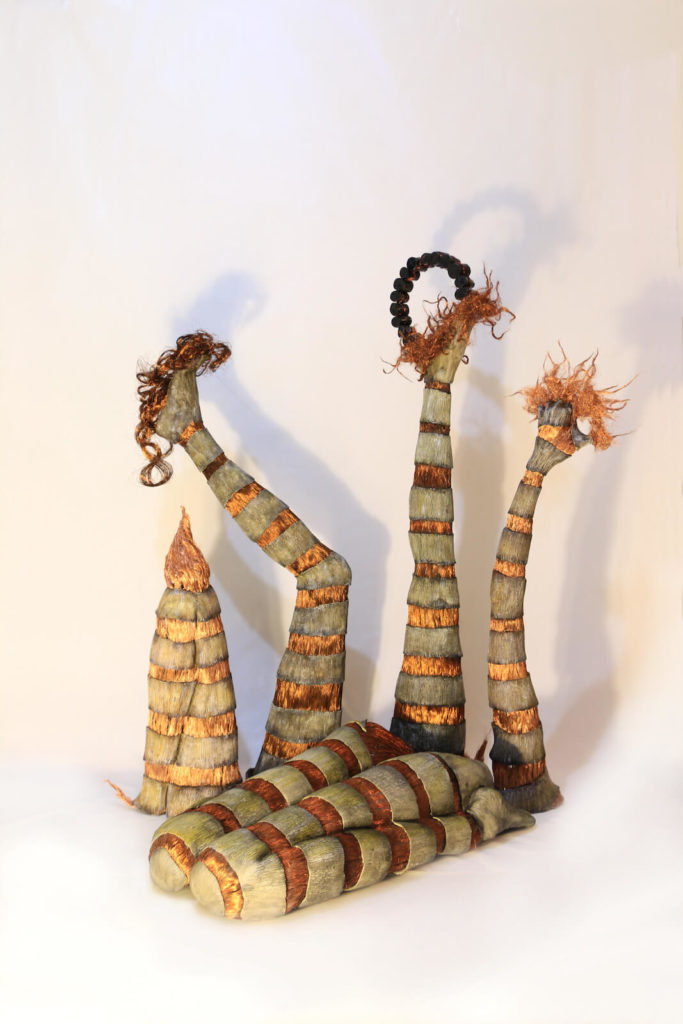
Farzaneh Abdoli, Melancholia Series, 2020, Copper, resin, charcoal, 130x30x20 cm
Accordingly, I believe self-reflection is a highly complicated and difficult task. I was constantly identifying phenomena in myself that I was incapable of seeing in my previous project, Melancholia, and I decided to recognize what was really happening inside me and to tolerate difficult experiences so that I could manage them. As I deeply considered and analyzed the issues, feelings, and forces were gradually formed within me that led me to my choices to create the artwork. I created the work in a highly exploratory style and as part of a long process, and I was not entirely aware of the details of what was continually forming. This process is similar to solving a puzzle; it is both stressful and joyful simultaneously. The most pleasant part of being an artist, besides the feeling of freedom, is the opportunity to meet reality and fantasy without fear, and to examine them. Undoubtedly, I experienced many pleasant and unpleasant feelings throughout this process, and it creates my life experiences. How does this process take place in your artistic practice? Where do you start your artistic activities?Ahoo Maher: My process is a bit different. I started the Diary project eight years ago because I wanted to document my everyday life. I’m not a good writer, therefore I started to record my days by drawing in my own style. I continued this routine for a few years, creating one drawing every day that was inspired by various daily events and news. The drawings then became more and more personal and turned into self-portraits. Unquestionably, one can see the effect of social media on them. I attempted to express my feelings and emotions in these self-portraits, which then shaped the project Faces – an interactive project in which several self-portraits were displayed in the form of slide puzzles whose position could be changed by the audience.
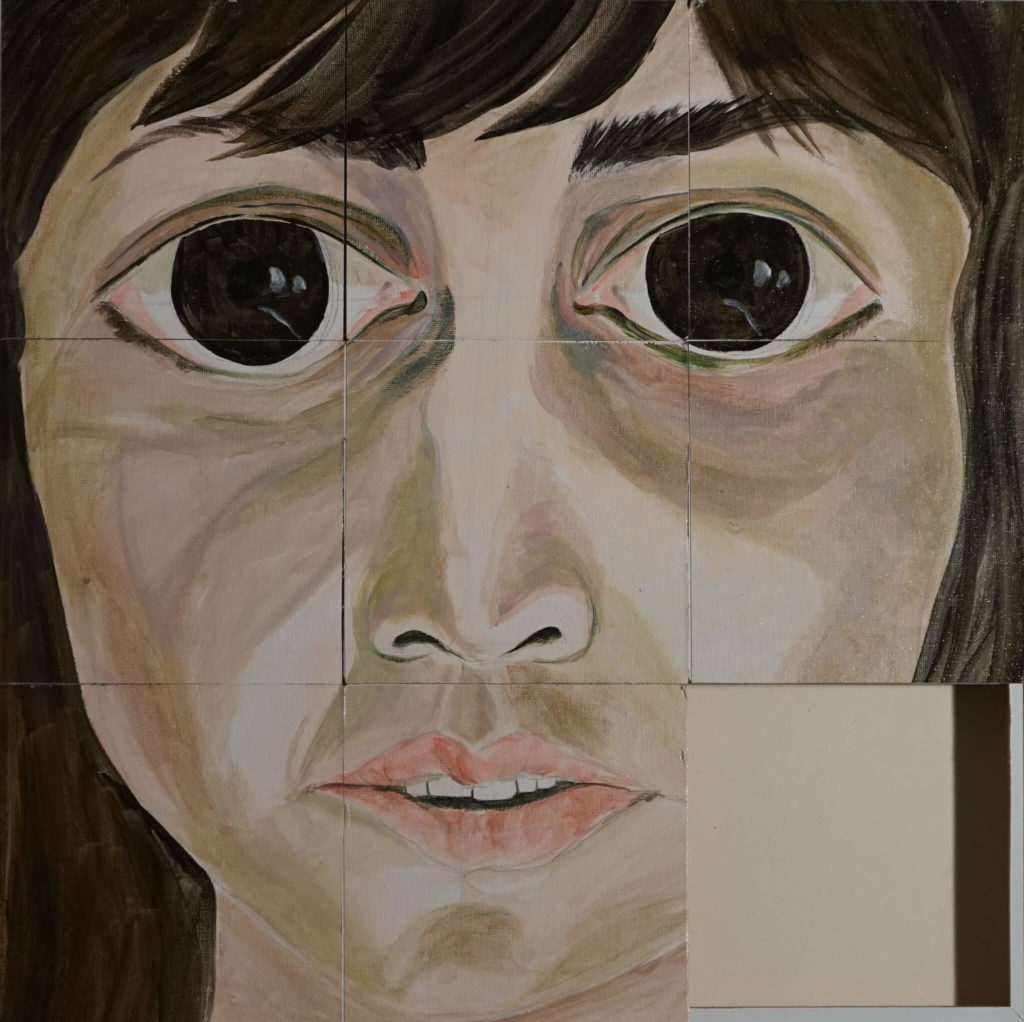
Ahoo Maher, Self-Portrait Slide Puzzle, 2018, Acrylic on canvas and wood, 50×50 cm
Another project, Hejleh, originated from my own interest. I once traveled to the south of Iran, where I attended a wedding party. The bridal chamber attracted my attention. This initial interest resulted in several years of research, that later led me to observed the chamber of mourning. The shapes, colors, and spaces intrigued me and transformed into an installation project that grew during the time of research.Moreover, I have always carried out other projects in parallel; I have worked in the field of performance and curated projects, and as a result, they affected and complemented each other. The subject of most of my work comes out of my daily struggles, and I really can’t tell when exactly the project starts and finishes, because it goes on for as long as needed. It might take me a while to get through a project, which can be a platform for new ideas while it is still in the works, and so several other sets that are ultimately related to each other pop up.
Farzaneh: I want to talk about your recent project, After Party. How do you decide what an artwork needs to say to the viewer? That is, what do you intend to achieve with After Party? I am asking this because I am constantly challenged by the balance between self-expression and communication with the audience. I think, “What will happen when I explain and show my inner feelings to others!?” Sometimes it is even hard for me to think about this issue because it is constantly possible that you are not understood and there is no connection between you and your audience.
Ahoo: I think art does not always need to have a function or purpose. Of course, it can be significant and convey meaning, but I assume that art is often produced out of necessity. I do not intend to criticize or confirm anything; I am just showing people’s lives from another angle so that other people may look at them similarly and agree with me or find recognizable elements in them. I do not intend to present news; rather, I want to think, to look around with no judgments, and invite others to join me. I want to look at my surroundings from the outside and notice the concerns of my generation and their effect on me.
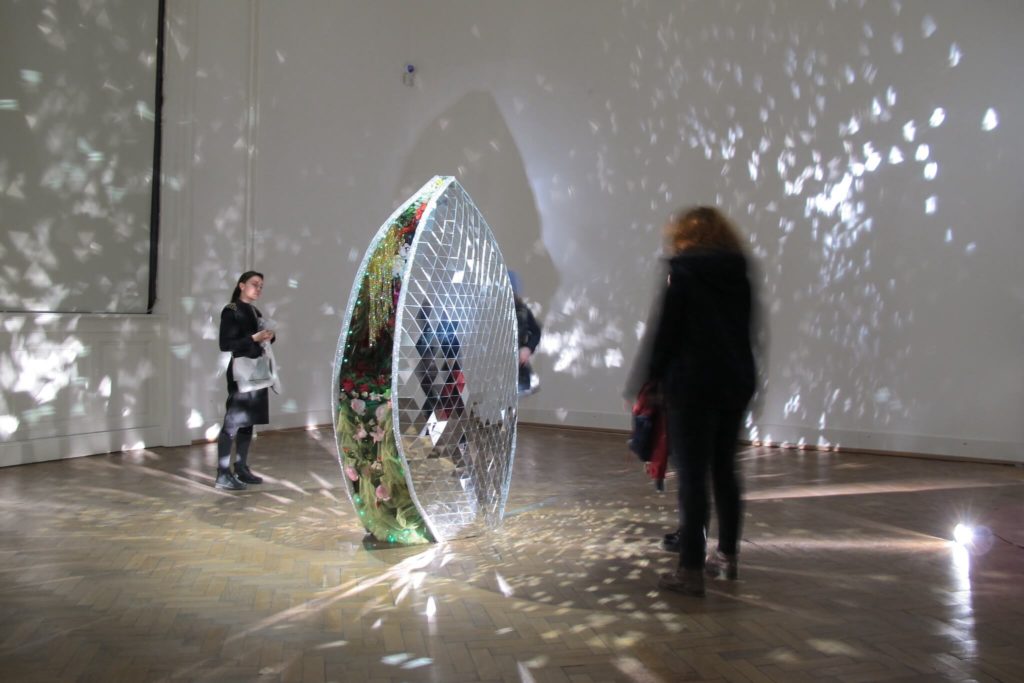
Ahoo Maher, Hedjleh, 2017, Metal, papier-mâché, acrylic mirror, LED light, plastic flowers, 220x135x120 cm
Farzaneh: In any case, you examine and analyze a subject and create an image, you bring that moment of reflection to your work, and eventually, you describe and write a story that you have created in your mind. Do you think it can be summarized by saying that you desire to create a moment of reflection?Ahoo: In regards to After Party, I would say that my starting point was the emptiness and meaningless feeling people sometimes experience when they go back to their lives after a party. In my view, this is not necessarily positive or negative. I desire to have a neutral perspective, neither approving nor rejecting it. I can say my standpoint is a moment of reflection.
Farzaneh: Do you intend to become more engaged with the issue as you work? Do you wish to convey a message that is driven by your personal perspective?
Ahoo: Absolutely. Since this subject is transmitted through my vision, it is personalized. Therefore, I set the details of the work in a specific order that can generate the feeling I wish to convey.
Farzaneh: I see a very clear and personal message in Banksy’s work, which conveys a social message using his way of observing and making the most beneficial use of his media. Would you agree that if the artist is informed by his/her surroundings, their perception will become stronger, and the artist can explain their messages more explicitly and clearly? I think that possibly, if this maturity increases, the artist can affect the audience more deeply, or maybe even ask deeper questions.
Ahoo: I assume people’s understanding of life changes as they get older. When it comes to artists, I believe this is also influenced by shifts in artistic periods because artistic work is not separate from the person – what happens to the artist also happens to their work. Of course, when a work of art reaches the point of presentation, the artist aims to convey a message and wants to share with the audience what they went through or learned. But I do not have a message about the dos and don’ts in the process of developing the work. For example, when I start a project, it is often after I have had questions and thoughts about the subject for years. I’m not just talking about whether this is a good thing or a bad thing; I am stating that we should simply look at it again because it’s ours. This is the life I am experiencing, I recognize this, and of course, it may not appear like a great social issue at first glance. I try to express myself in a simple and tangible language. There’s a wide variety of artistic practices, and art is not always critical. But as far as I have experienced, sometimes the issues that I introduce involve significant social concerns, even though I express them in terms of my perspective, experience, and cognition to make them tangible and to speak of them with honesty.
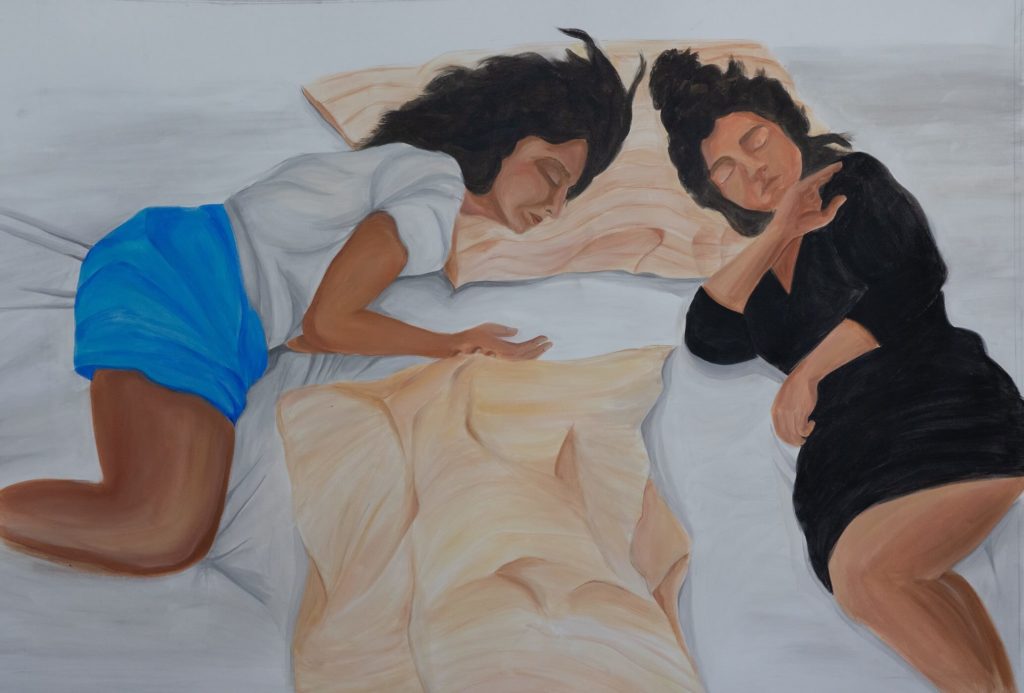
Ahoo Maher, Power nap, 2020, Acrylic on canvas, 110×150 cm
Farzaneh: As an Iranian artist who lives in Europe, how do you find your way and identity in the international field?Ahoo: Being a student in Europe was a wonderful opportunity because you are supported everywhere. As a young artist, when you hold or attend an exhibition or competition, you are always in the spotlight. But when this period is over, all this support is eliminated. Entering the art market becomes extremely difficult. Yet, there are opportunities to make a living and continue working as an artist by participating in art fairs, for instance, and performance and conceptual art are supported by public and private funds in order to create projects. There are also opportunities for the younger art spaces and projects, so that they can independently pursue their artistic activities somehow separately from the art market.
As to my nationality, here in Austria, I do my best to follow my independent path as Ahoo, apart from my nationality as Iranian. It is definitely not easy as a 30-year-old female painter, though. I am inspired by Iran and my background, which is undoubtedly visible in my work.
Farzaneh: Are there international artists that you value in particular?
Ahoo: There’s a difference between the international art world and the art market. When you enter the market, the value of your work increases exponentially according to the principles of the market, but when we look at the artist we still consider their background and artistic path. I think David Hockney is one of the most intelligent artists of our time. I saw his works two years ago at the Centre George Pompidou. He started first with drawing, and when Polaroid developed, he started to work with Polaroid photography while creating the well-known series of swimming pool paintings and his many other prominent works. Hockney is so intelligent that he is constantly in line with the changes and media of his time and has always progressed. Although he signed a contract with Apple to produce videos in partnership with them, he could never be identified simply by those videos. We know him due to the process he went through as an artist, and we give meaning to those videos. He follows the state of the art so well with a remarkably high social intelligence and adapts himself to societal changes. I think it is incredible.
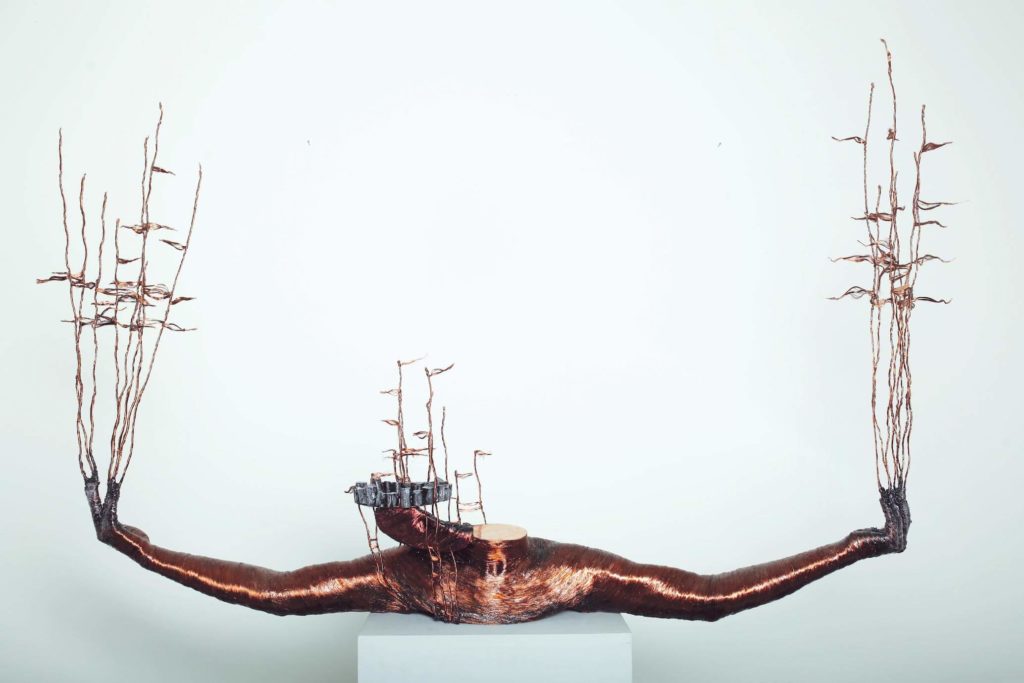
Farzaneh Abdoli, Postulate from the Melancholia Series, 2020, Copper , resin, charcoal, 150×100×25 cm
Farzaneh: How much do you think the market affects the concept? What is the relationship between the two? What is this distinction in your mind?Ahoo: I think it is entirely personal and they can be separated. We can have an idea of which works are more “sellable”, and sometimes that influences the types of work artists create. Some topics are noteworthy, such as global warming, which is currently a significant issue, and it is the right time to present a project on this topic. If you come from the Middle East, there is an exotic gaze, which is preferred by Western society. This generates temptation to work on such issues even though it’s not your concern, because it might draw the attention of the market. But frequently there are both concerns and cyclical synchronicity. I cannot imagine changing my subject based on the market because my work is driven by my personal need and interest. In fact, it is by choice that I have not yet entered the larger art market. The path I have chosen to pursue with my art will not take me there very promptly.
Farzaneh: I feel that those who purchase works of art are often quite conservative with their selections; they often prefer to purchase reproduced or modern concepts, or works that guarantee their investment. Innovation is not as valued. This influences artists’ activity.
Ahoo: Naturally, the path is difficult because you are not supported in some situations. But on the other hand, the path is more sincere. Because when we perform a task creatively or innovatively, it may not be accepted at the time or place of its debuted presentation, but it does not mean that the work is bad. I do not wish to see results very soon. I know that I am happy with the work that I am doing, and I think that when artists go their own way, independently and sincerely, they often see results at some point. Of course, we have to live and pay for living expenses, but more than that, we should not care about the market and we should move forward with confidence and strength and continue on our path.
Farzaneh Abdoli currently lives and works in Iran. She is a member of the Association of Iranian Sculptors and has participated in several exhibitions, including the 5th Tehran Biennial of Sculpture at the Museum of Contemporary Art. In 2008, she was part of the first Biennial of Urban Sculpture, and one of her works was selected to be installed in the city. In 2009, her first public sculpture, called Fish Wave, was installed along the Sattãri Highway in Tehran. Abdoli is also one of the winners of the second Urban Biennale. In the same year, another work of hers was installed in the public space, at Kosar Square in Mashhad. She furthermore created the rainwater fountain under the Seyyedkhandãn Bridge in Tehran. Farzaneh has participated in many group exhibitions of the Association of Iranian Sculptors.
Ahoo Maher was born into an artistic family in Iran and has lived in Austria since 2008. Between 2009 and 2011, she studied Music Education at the University of Music and Performing Arts in Vienna. In 2017, she completed her studies in Contextual Painting under the guidance of Ashley Scheirl at the Academy of Fine Arts in Vienna. She has participated in several solo exhibitions in Austria and Iran, as well as numerous international group exhibitions. As a co-founder of the organisation “ANN – Association for Art, Culture and Solidarity”, she is actively involved in various cultural initiatives. Her artistic work focuses on the representation of life realities from a female perspective, using multiple media such as drawing, painting, installations, and performances. She works as an independent artist, performer, and curator in Vienna.
-
Plants, Language and Politics—Alaa Abu Asad in Conversation with Victoria DeBlassie
Victoria DeBlassie: Is your current work about ethnobotany and its complex relationship to history and contemporary politics informed by your studies in agriculture at the Hebrew University of Jerusalem in 2007? Alaa Abu Asad: No. My studies there were not the reason why I was interested in plants, because then I was really looking at plants through an observational lens, as something to be studied, to be looked at; they were passive. Now I’m looking at plants in their active role through history and how they take part in shaping history. Victoria: When did you start looking at plants…
Plants, Language and Politics—Alaa Abu Asad in Conversation with Victoria DeBlassie
Victoria DeBlassie: Is your current work about ethnobotany and its complex relationship to history and contemporary politics informed by your studies in agriculture at the Hebrew University of Jerusalem in 2007?
Alaa Abu Asad: No. My studies there were not the reason why I was interested in plants, because then I was really looking at plants through an observational lens, as something to be studied, to be looked at; they were passive. Now I’m looking at plants in their active role through history and how they take part in shaping history.
Victoria: When did you start looking at plants differently?
Alaa: When I started working at the Palestinian museum in 2015 – 2016. The museum was preparing for a brochure to give to visitors for an opening ceremony about plants that are endemic to Palestine, growing in its gardens. I was asked to join two professors at the Birzeit University to observe flora in the Palestinian nature. The museum gave us a list of these plants to photograph them, but I was also looking at the topography of the place there and the terrain of the area of the West Bank, which is highly fragmented with roadblocks, military checkpoints, borders and separation in general, which also made me think about plants differently, the fact that we couldn’t find all of them due to the circumstances and limited freedom of movement. There were cut roads, fenced lands that were highly secured and we couldn’t reach some of the plants that were on the list because they were outside of the West Bank, and we were restricted to that area, whereas the museum wanted to include an image of all the Palestinian flora. This made me think about this image of the Palestinian flora, and what it means if you can’t capture all of it, or if you can’t even reach it all. So, from there I started really thinking about plants. But I can tell you something else, that when I came to the Netherlands, I was getting interested in how plants move around the globe, how they travel, whether naturally or relying on human activities. I also got interested in how some become deemed as invasive species, such as the Japanese knotweed.
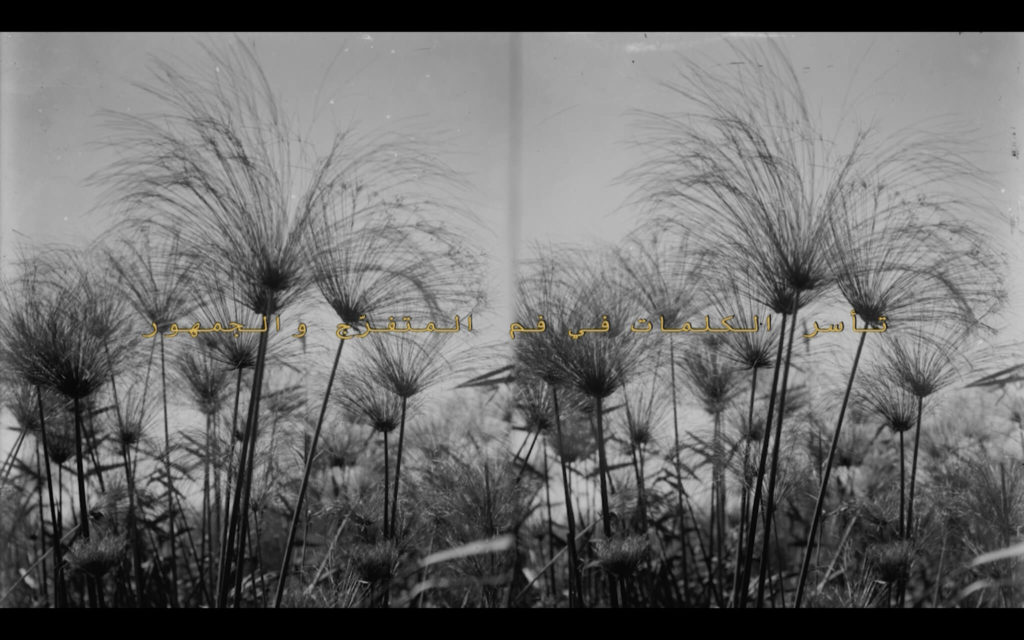
Alaa Abu Asad, Wild Plants of Palestine, video-essay 2018 Victoria: Yes, I was reading about it in your project The Dog Chased its Tail to bite it off, but tell me more.
Alaa: It’s one of the most hated plants in the Netherlands and UK, and it’s very badly represented in the media. I saw this plant for the first time when I was at the Veluwezoom National Park, a place where nature is highly controlled, which makes me think about what nature really is here in this park, or at least the concept of “Dutch nature” and the man-made landscape.
Victoria: Absolutely.
Alaa: Then I was thinking about how the plant came to England and the Netherlands, information which is often missing from the media when talking about the assumed problems of the Japanese knotweed. The plant was brought to the Netherlands in the early 19th-century colonial era by the physician, scientist, and botanist Philipp Franz von Siebold, who sailed to Japan with the support of the Dutch East India Company (VOC), receiving gifts from people for medical treatments. He also collected art, artifacts and botany to bring back to Europe. Once the Empire of Japan discovered he was collecting maps, they were offended, suspicious and kicked him out.
Victoria: Oh so only once they discovered he was collecting maps?
Alaa: Yes, and even accused him of being a Russian spy even though they knew he wasn’t, and they kicked him out because they were so offended. This was the break between the Kingdom of the Netherlands and the Empire of Japan because the Netherlands was the only western country that had a relationship with the Empire of Japan. So, Von Siebold came back to Europe with his collection of plants that he introduced and re-introduced to Europe from Japan. First, he went to Antwerp, Belgium, which at the time was part of the Netherlands, a contested area, so he didn’t feel safe with his plants, so he moved further north to Leiden, a city not far from Rotterdam, where the Japanese knotweed arrived for the first time and was planted. It’s important to note that he only brought a female specimen, which means that all of the Japanese knotweed in Northwest Europe and North America is from the same female specimen that Von Siebold brought, which means the plant has been reproducing itself asexually because it’s enough to have a small piece of about 3-4 millimeters of the root to make a new one. It was also during the time of Queen Victoria, where botany, gardens, and plants were all imperial tools. So, the plant moves from Leiden to London also because this was the ethos of the era, planting and gardening. From there it became a noble plant like hortensia, magnolia, and many of them are prominent in gardens even today. The Japanese knotweed was one of Queen Victoria’s favorite plants, so it got planted in London and beyond London. Only about a 100 years later did it become a problem– in the late 70s. They initially planted it to feed the cattle and around railways to stabilize the ground. However, in the 70s, they discovered that the plant basically presents some challenges to urban structures because its roots can go deep, and break through cement, pavements, it can stay dormant for several years and then wake up unexpectedly, so there was this need to fight the Japanese knotweed after it was spreading everywhere, and it costs a lot of money actually. The plant has appeared in many court cases because economic values of properties in the UK have been decreased or lowered due to the presence of the Japanese knotweed, and even insurance companies wouldn’t insure your property if the Japanese knotweed is around. You can also get fined £2500 if you have the Japanese knotweed around your house or in your house and you don’t treat it etc. etc. So, this fighting urge became a national fight against Japanese knotweed. I have to say that the plant is mainly moving around because of human activities. When building new areas, soil is moved too and that’s how the plant is also spreading. So in green areas in these new neighbourhoods, the first thing that appears is the Japanese knotweed because the soil they brought is “contaminated”. So then, they start to look for methods to get rid of this plant and all of that work costs a lot of money. For instance, they try to cover the soil for like 7 months with a thick layer of black plastic but it doesn’t really help, and the plant regrows anew. Then there is the use of chemicals (glyphosate), which is very toxic, as well as trimming, mowing and pulling the plant out, and pouring boiling water on it. A machine was invented which electrifies the plant! In the Deleuzian/Guattarian understanding, it’s a rhizomatic plant, which means that it doesn’t have one center. So, this acentric underground root system enables it to spread everywhere. If you want to get rid of a tree you can just chop it and you know you have one center and you just need to chop it down and that’s it, whereas the Japanese knotweed doesn’t have a center. So, they needed to be creative about how to deal with this. They invented this machine that electrifies the plant, and this high voltage of electricity goes into the root system to weaken the plant, but it’s also very expensive and minimally effective in treatment. Recently, in the harbor of Rotterdam, heat chambers were erected, where the soil is treated with 60° C to make sure that everything is killed including the Japanese knotweed roots / rhizomes, before it’s moved to other places. The plant is often accused of environmental disasters, while the real problem is human activities, which brought on climate change. This plant is just a strong one, and that’s not her problem! It’s our problem, but no one wants to think of it in that way, but only as a “horror plant”. I therefore started to collect newspapers and articles about this plant. The language used to describe the plant is quite striking, as it includes like invasive, outsider, triffid, uneconomic, but also Asiatic, water-thief, cancer, and gang rape!
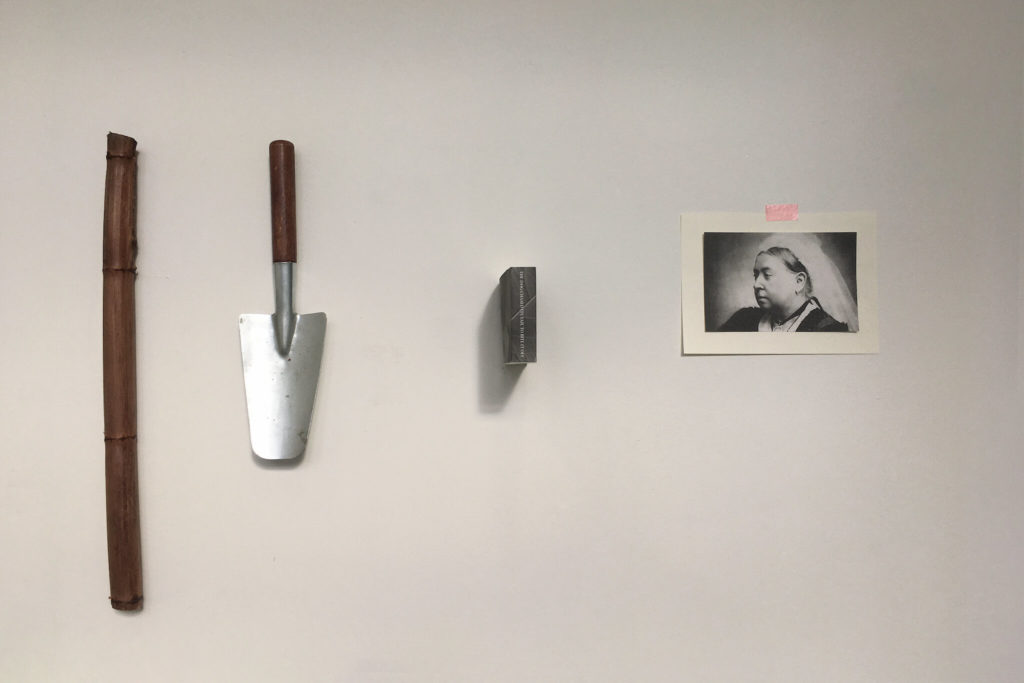
Alaa Abu Asad, The Dog Chased its Tail to Bite it Off, ongoing research, 2018 – today
Installation detail: Victorian imperial botany. Working tools, publication and research material, Van Eyck Academy, Maastricht, 2020Victoria: What? Seriously?
Alaa: Yes, yes! It’s really weird. This language not only strikes me, but also reminds me of the hate xenophobic speech used to describe the human beings immigrating for survival. What I’m saying is that by looking at this plant, I’m trying to show that there’s way more to study about society than the plant itself through the way each place is treating its plants. The way the Dutch and the English are dealing with the Japanese knotweed says a lot about them rather than about the plant. If you look at tulips, for instance, it’s not from the Netherlands, it’s not Dutch, it comes from Iran and Turkey, but it succeeded in becoming one of the national symbols of the country because it has a credit value that brings money to the country, while the Japanese knotweed has a debit value, which means that it costs a lot of money to get rid of it.
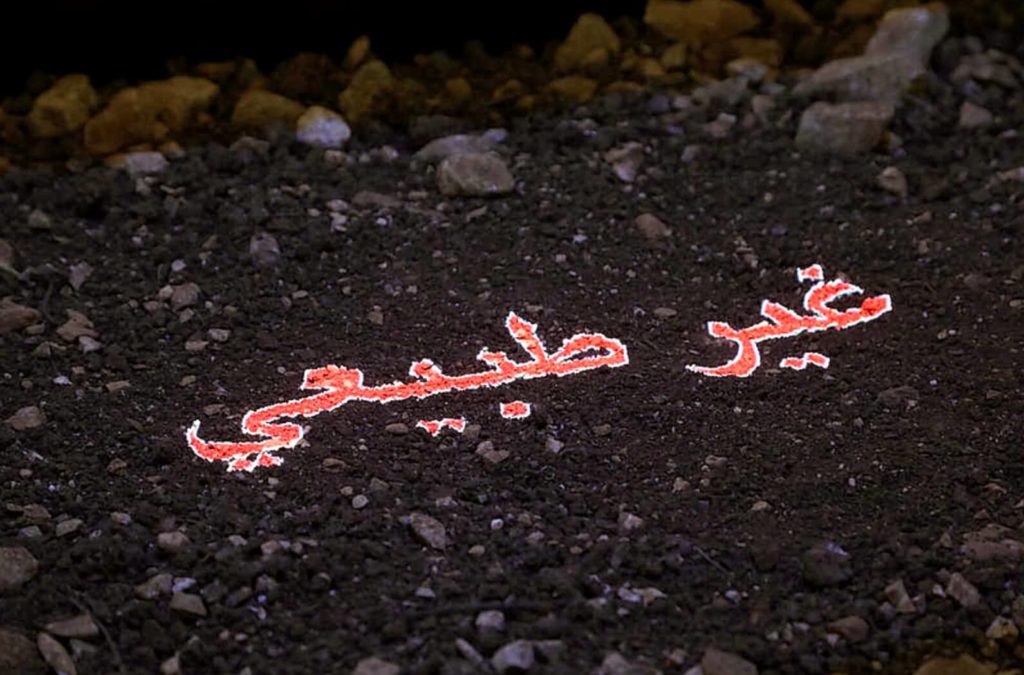
Alaa Abu Asad, “Unnatural”, The Dog Chased its Tail to Bite it Off, ongoing research, 2018 – today
Installation detail, Weed Control exhibition, A.M. Qattan Foundation, Ramallah, 2020Victoria: So, it’s costing them. The interesting thing to me about the Japanese knotweed is thinking about it in terms of like a metaphor for survival and resistance because a lot of societies are against this idea of rhizomatic growth. It’s interesting to think that a plant is actually stronger if it grows horizontally and without a center, instead of vertically. Especially being American, of course in American culture there is the tendency to really value vertical growth and individualism—which I don’t agree with—instead of horizontal growth as if vertical growth is the only way to grow, and that’s the way to become a strong empire or have power. If I were a creative writer I would like to talk about this plant as a way to survive…
Alaa: With its vast roots.
Victoria: Yeah exactly! If you’re growing horizontally, it’s stronger for everybody, I think it’s like a metaphor for being more inclusive.
Alaa: Yes, and recent researchers say that actually the plant is not as threatening to other species as much as claimed. Actually, the only problem with the plant is the urban problem, that it appears in places that they don’t want it to be in. Also, what would make someone invent a machine to electrify a plant rather than just to somehow accept its existence? I don’t think the Japanese knotweed will ever disappear. It’s here and it’s not as dangerous. And why not to think about a symbiotic way of living with the plant instead? Maybe it will be one of the only plants surviving in the future, as we don’t know what the future habitat will look like, as things are constantly changing. Look at us now with lockdowns and Covid and you know it might change even more and more and become more severe. So why don’t we instead somehow embrace the fact that this plant is growing and try to find a way to maybe eat it or do something with it instead of fighting it crazily. I don’t really understand this fear. Many people here when I talk about this plant, they say it’s a monster, but they don’t even know what the plant looks like. This plant is actually useful in other ways, because it blossoms late in autumn and its perfume and flowers attract bees when other plants are dead, which is so valuable. This blindness of nationalism bothers me and in defense of the Japanese knotweed, I think it’s good to think about it in another way.
Victoria: Yes, I think there needs to be a reconsideration for all of its potential. It’s heavy to think about how humans use nature as an attack against other people, to really weaponize plants. I mean this has always been the relationship sadly.
Alaa: Yes, weaponize it, but also foreignize it just as the Japanese knotweed was imported, localized, and then now foreignized again because it’s challenging national acceptance of how plants should behave.
Victoria: Yes, absolutely and I mean it’s curious to think that it was Queen Victoria’s favorite plant and that gardens especially were like a symbol of leisure time, which denotes also a type of economic power.
Alaa: Also, colonial power.
Victoria: Absolutely. I even did a collaborative project a few years ago with the artist Maria Nissan called Interpretation of a Seed about coffee, and I researched all of this history about where it comes from and so you can learn so much about history and colonization and you know why certain things became valuable. Take coffee, for example. It’s not grown in Europe of course, but it still tells us about how botany can trace colonial and domestic power. It basically only became valuable in Europe because it was blessed by Pope Clement VIII because he liked it. Before that, it was considered a devil’s drink of the Arabs and not to be drunk since it was considered lowly, and then when a man in power blessed it and it was no longer sinful.
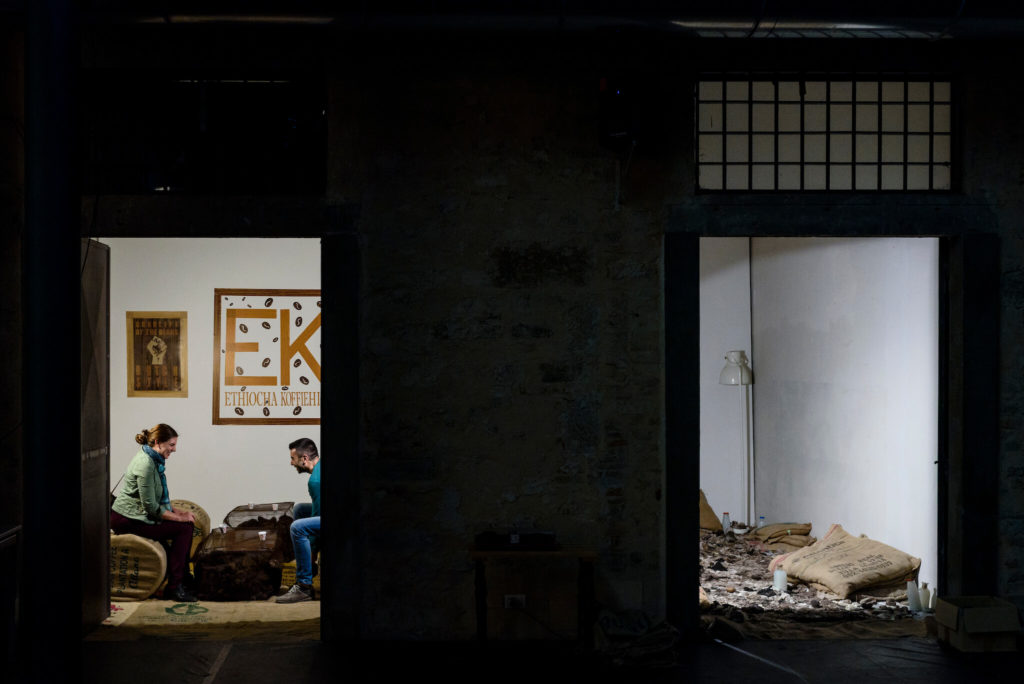
Collaboration by Maria Nissan and Victoria DeBlassie, Interpretation of a Seed, Murate Art District, Florence, Italy 2018 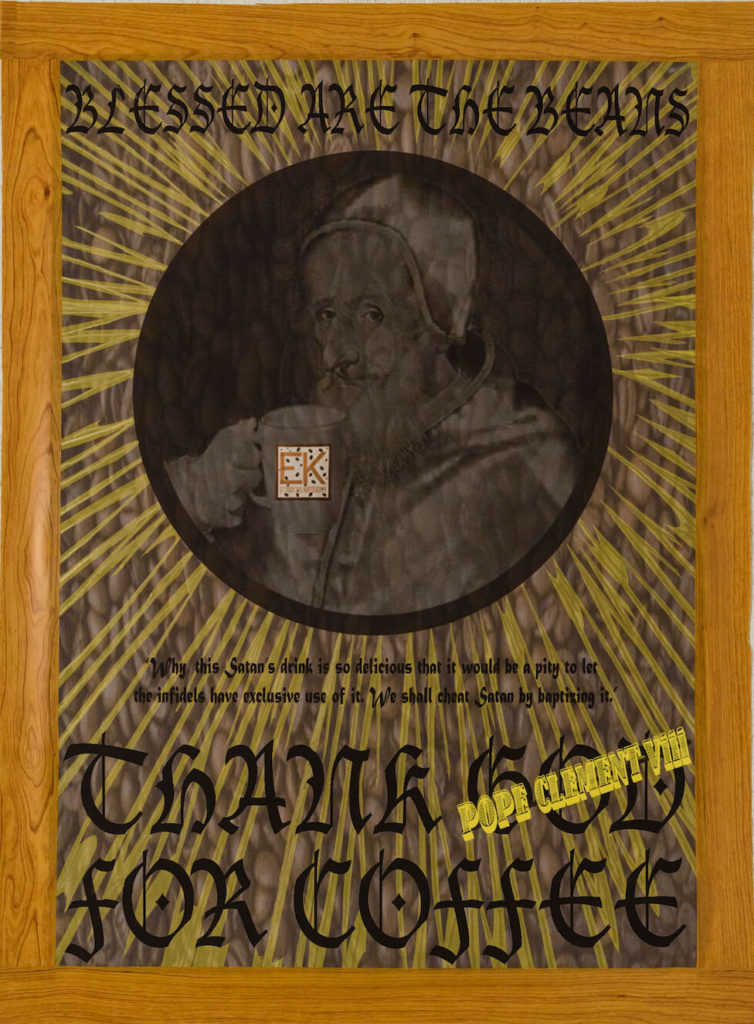
Alaa: Isn’t it amazing to learn about the involvement of the Royal families on these things or religious figures or the church as well?
Victoria: Yes, it is. It’s like what kind of plants get accepted or not accepted based on certain historical events. Then what’s fascinating is that you know coffee has become so embraced by Italian culture that people think you can only get the right type of coffee in Italy, or, for example, some of my friends thought that coffee was actually a crop grown and produced in Italy, which is in part due to the role of advertising in creating a sense of nationalism because coffee is part of the nationalistic pride of Italy.
Alaa: I think that one of the reasons why it’s easy to attack the Japanese knotweed and to accuse it of so many bad things is just because it’s foreign. For example, the horsetail plant is a European plant that is also very stubborn and problematic. Farmers do hate it but no one talks about it like they do with the Japanese knotweed, and it doesn’t take so much space in the media and advertisements because they just find ways to live with it but not for the Japanese knotweed because it’s Asiatic. It’s also the first thing that you hear in the name Japanese.
Victoria: Yeah and that’s actually what I wanted to elaborate on when I was talking about coffee culture and nationalism or whether plants are either negatively or positively accepted into a country, it still tells the story of nationalism either way and why they’re accepted or not if they’re non-native brought in by various means including colonization, just as the tulips reflect a positive integration only due to economic profit, exposing that something is valuable only if it is financially successful. When I was talking about coffee, I brought it up though too because it became a sort of symbol of Italian national identity really around the time of World War II, because Italy invaded Ethiopia and Eritrea, and so they were able to get coffee cheaper, and during that era Mussolini was trying to create this strong sense of Italian national identity, also by trying and ultimately—thankfully—failing to become colonizers, but in his attempts he created Italian symbols that have stayed until today. Even, for example, the Vespa and the Italian Moka pot that are still huge national symbols today, came from that period also because they were made from aluminum and native to Italy. Then as Ethiopia and Eritrea became colonies and therefore a territory of Italy in Mussolini’s mind, coffee was marketed more as Italian even though it originally came from the colonies.
Alaa: It’s the same with chocolate and Belgium.
Victoria: Yes, exactly. I have an ongoing project that talks about the cultural importance of citrus in Italian history and in the Italian Renaissance; the Medici constructed a new type of greenhouse architecture called the limonaia just to be able to keep citrus alive in a colder climate – harder to grow in without some sort of shelter. Then when France attacked Italy, they took with them the notions of the Italian Renaissance gardens along with the limonaia, and they constructed an even bigger greenhouse for oranges, called the orangerie, that housed other “exotic” plants obtained in questionable ways as well, but after that moment if you were a powerful king in Europe you had to show it by having an orangerie,so this ties back to our previous conversation about how gardens were a demonstration really of power in a very subtle way. You know, it’s interesting just to think that every little thing in life can have this whole colonial, post-colonial and neo-colonial history, that makes me question how we live with ourselves.
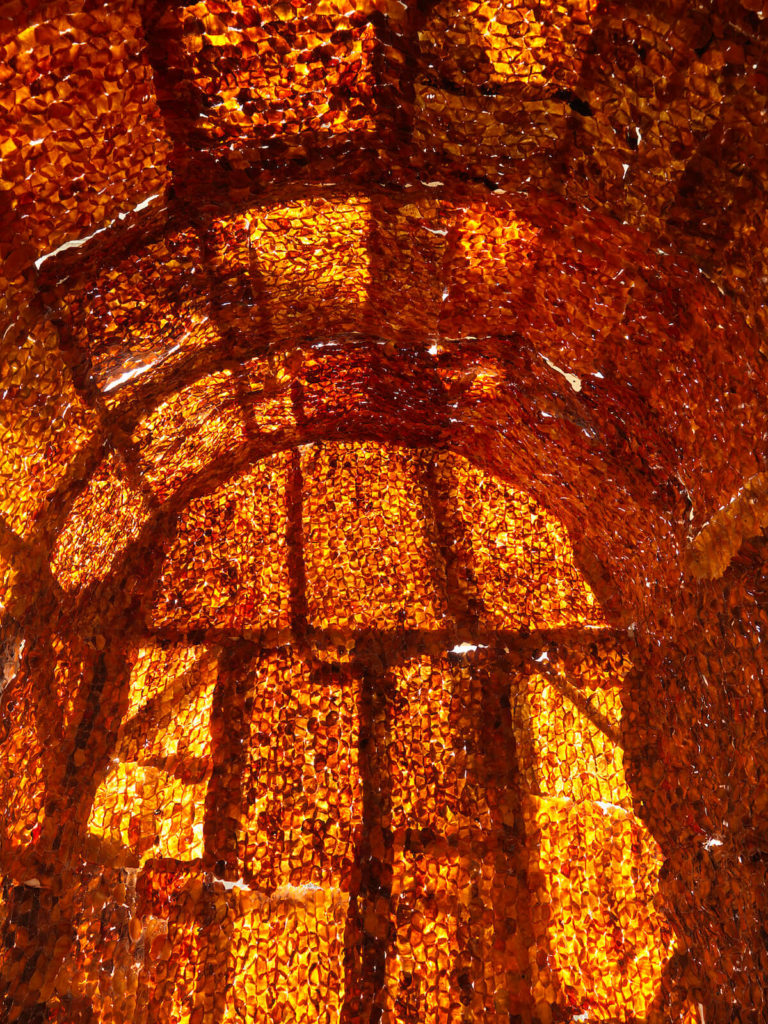
Victoria DeBlassie, Accumulated Matter, Interior View,2011 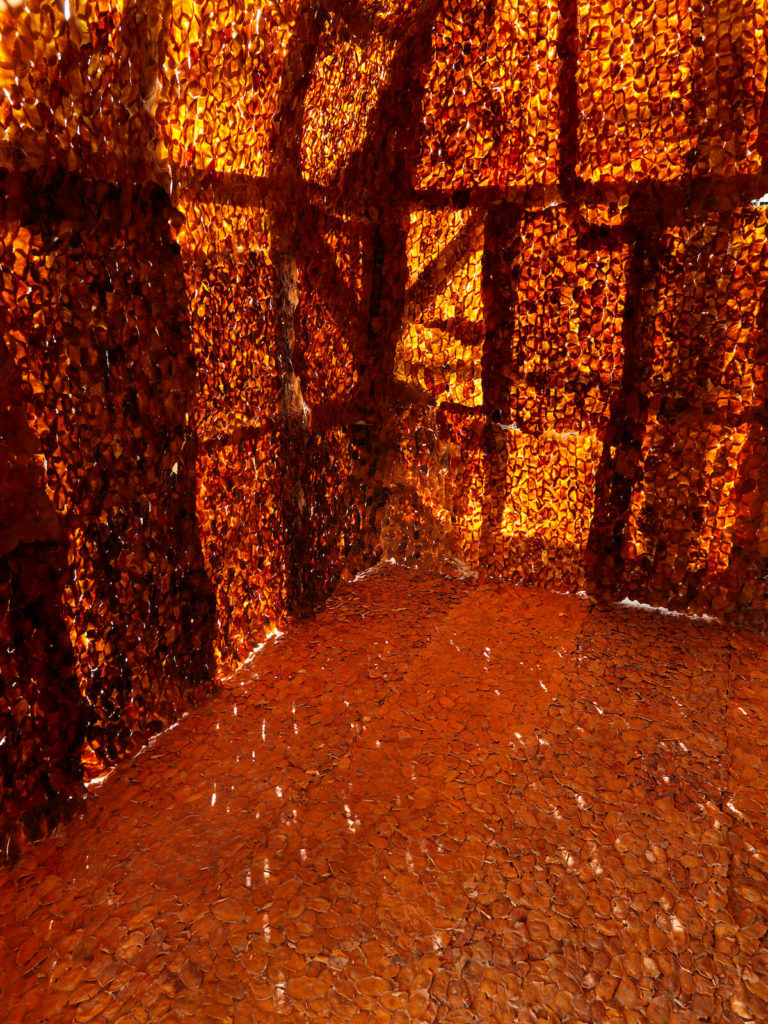
Alaa: I think this is where we are today. There is a tendency to depoliticize things which makes people take things for granted without questioning them, but I think we should do it the other way around. That’s the role of art actually, and that’s where art can impact or leave a trace––when art tries to make people think deeply about things, giving them a different image rather than a seemingly neutral one. I think, let’s share things and let’s talk about them and let’s see. Also, time will play a role in this and it doesn’t help if we keep just saying that everything is colonial and everything is bad without doing anything, or at least provide alternatives, or think and work together for better conditions. We should all work together towards a better reality, a better future, and a change. We should do it by working together and speaking to each other.
Victoria: I think that obviously we have to slow down and rethink things because of the climate crisis, which is a result of us trying to control nature in a way and using it for our benefit only, instead of working as you said more symbiotically, which I also talk about in one of my installations called Plasticaia.
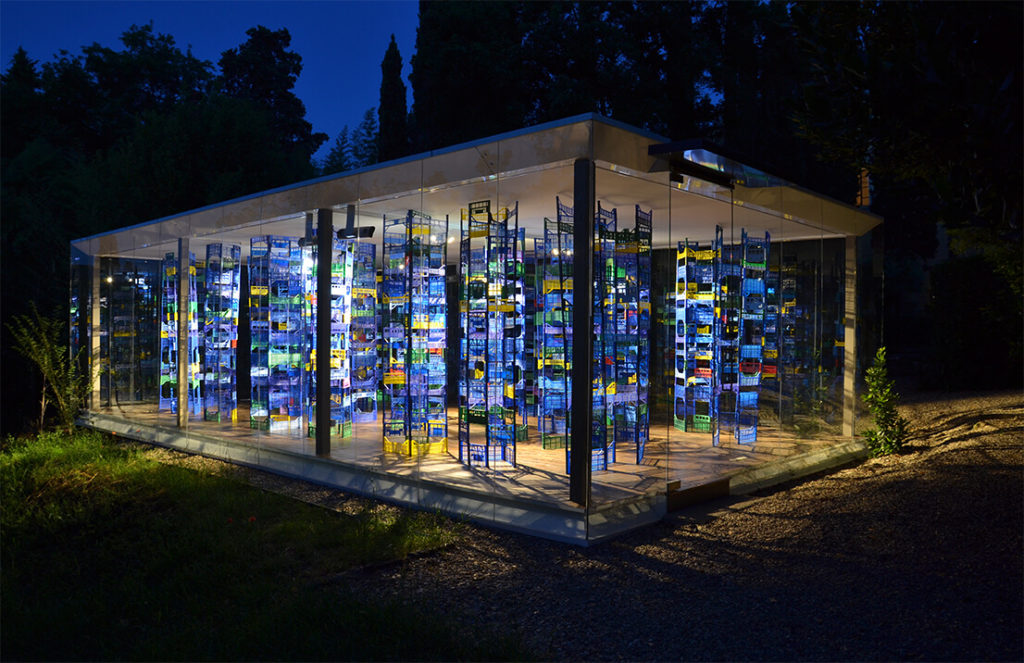
Victoria DeBlassie, Plasticaia, Installation shot at the Villa Romana, 2018 Alaa: We need to revise this relationship with nature, which doesn’t need to be of this beneficial value only. We should be given the time to explore nature (the meaning of the term too) and to decide if we want to be part of it or not. I think we don’t really like that nature is a mystery and is something that we don’t really know, or expect, but at the same time we have a clear image of what nature should be. Again, it’s time we really need and time to see to undo and revise this relationship that we’ve built with nature and with land. We will always be in the need of using land, therefore, we should find sustainable ways of living, producing and consuming. We should be given the freedom to try things as well and not only to receive them.
Victoria: I’m also curious about your older work and the role of photography. I love that you critique the role of the lens and the camera and the overall function of photography in general, and I’m particularly interested in Photowar, and Image: Imagination, Resurrection. Moreover, some say that photographs are objective, but at the same time it’s cropping out certain realities, certain parts of the image that could create a different narrative. It reminds me of our previous conversation about how in our current life generally people tend to focus on one aspect of an object, the product itself, without thinking of its backstory and what it says about contemporary culture. In a way, the lens represents a certain perspective. So, for me, your way of challenging photography is so important, and I find your questions in Photowar about switching the role/power of representation between the colonizer and the colonized particularly riveting.
Alaa: I think there are two things conflated here, which I will try to make clearer. The one of image reproduction, as today you don’t need a camera to reproduce an image, as cell phones can produce high-quality images. That’s one thing. The problem that I think you’re talking about is more about the photographic medium assuming to be egalitarian and neutral, which it’s not. I have been through a crisis with the medium as somebody who was trained to become a photographer, because the understanding behind the camera underlines its presence! It’s a weapon because whoever has the camera can choose what to capture, what to represent, what to keep, what to include and what to exclude/erase, so it’s never a neutral position and that’s my irritation with the medium. I’m not always comfortable behind my camera, photographing people or photographing things knowing this. For a while I couldn’t do it anymore, but now I think I’m in a better situation with this, because it’s important to understand and to acknowledge this problem of the medium. Producing images is producing information, which is more popular today, and many people can do this, but the real question is who owns this produced (photographic) information in the end and who can access this information. I mean it’s my work as a concept but also as a problem. I think that being a Palestinian is also somehow related to this, because Palestine has been represented through images, but we never could have the chance to represent and produce our own image. Also, on top of that, there’s the role of photography through history and in places like Palestine that have been colonized and occupied, and of course it’s not the only place that has gone through this. I think it’s important to be aware of your position, what you’re doing, why and who you’re presenting and representing. I think the moment I hold the camera I already somehow question the power and my position. Then, it’s a question of how to translate this, and all of these problematics into an artwork, by either creating an artwork explicitly talking about it or decentralizing images and the medium of the camera from the artwork. That’s why my recent work is not photography based. When you study photography or video, somehow because you’re not naive anymore and your eyes are so trained, it can be hard to enjoy images like you did before studying, but there’s also something nice about this naive perspective that can enjoy images as they are. Then somehow now I’m trying to find this balance between a trained and enjoyable viewpoint.
Victoria: I think that it’s interesting that you’re talking about decentralizing things, even images.
Alaa: Once, one of my teachers told me that the most important thing to learn is to know that what you’re doing is not the most important thing, because if you think that’s the most important thing, it doesn’t have any meaning anymore. I really owe thanks to this teacher, but what he was saying is just to be open-minded and to accept criticism and to always try to change the way you look at things, to make things better. I think because nature is changing and dynamic, that’s how we should work as well. We should also allow change to happen in our lives and the way we work and in the way we produce art.
Victoria: Yes, yes and then going back to photography, when you were talking about representation, it made me think about Susan Sontag’s On Photography in which she discusses how we live in an era where we have something represented for us, before seeing it ourselves and this creates a lot of assumptions and certain expectation, either positive or negative.
Alaa: The problem is that often the thing which is represented can look way better than reality itself! It happens that captured reality is much better than reality itself. It brings up notions of what reality really is and if it’s even possible to capture it and how we conceive reality as being, etc.
Victoria: This makes me think again about your clever approach to photography in your Photowar project and how you indirectly captured the image of your mom by capturing the reflected image on the LCD screen of her sitting on a sofa.
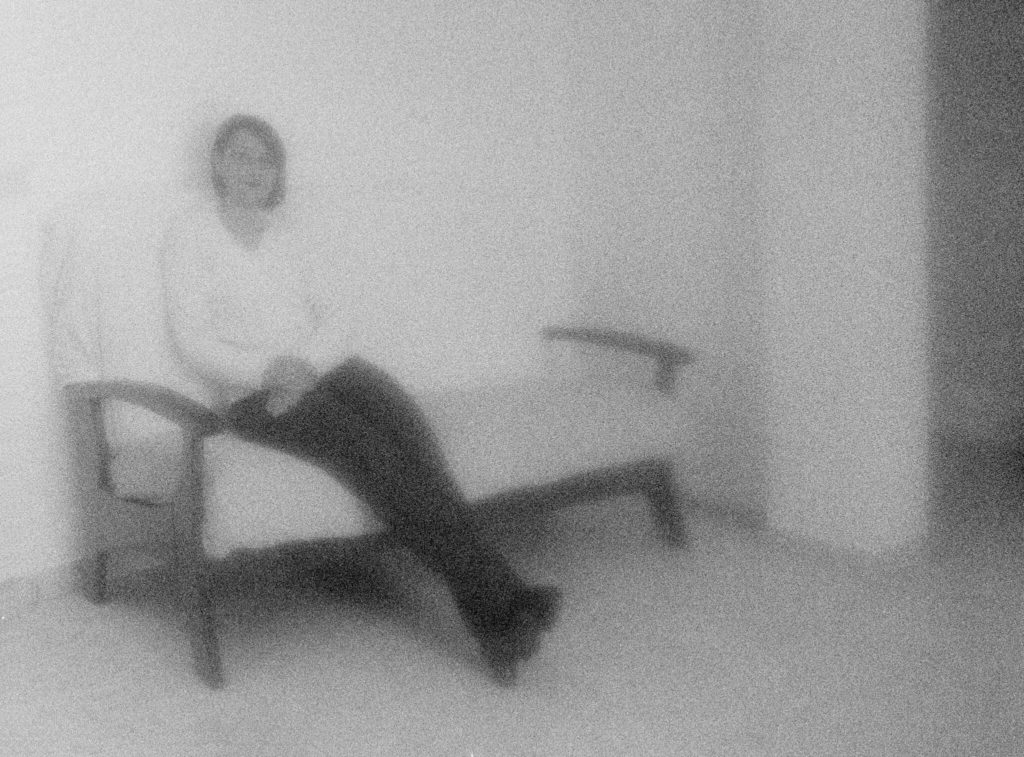
Alaa Abu Asad, Photowar, mum’s reflection on LCD screen, digitally scanned 35mm photograph, 2013 Alaa: This project was still about this ethical question of photography along with the dichotomy of the colonizer and the colonized. I thought if I want to show my mom, but I can’t photograph her then, I’ll just take a picture of her reflection on the TV screen when it’s off while she’s sitting on the couch. And, of course, everybody has the right not to be photographed because photography can provide information that you can’t control—it’s a kind of a copy of yourself and your existence. I always have this problem even with IDs and passports and how a photograph of you is required.
Victoria: I have a classic question for you: what do you think for you is the relationship between photography and memory or even the construction of memory?
Alaa: I don’t know because I really don’t think about photography anymore to be honest! Photography didn’t invent images because images have always existed as a natural phenomenon, such as a camera obscura creating the image of the outside “reality” as long as there is light, because light is the only necessary factor to create an image. What photography did in the way we know it today through analog forms to contemporary digital forms was that it enabled these moments in time to be fixed on a metal or glass plate and on negative film and paper and today in the digital file. I think it’s a very shallow or cheesy way if you just want to link photography to memory only. For me, photography is more than freezing memory.
Victoria: I see that you have been using more videos in your artwork recently too. So, for example in The Untranslatable Words of Love I can see your use of translation in relation to the moving image.
Alaa: I was trying to incorporate new things whether it was moving images and translation, or language and image and editing and translation. It was quite important for me to edit the image and the text together in one video. I appreciate what I learned technically from working on this project. In The Untranslatable Words of Love, “مشمش قلبي” in Arabic which is completely different from the English title and is actually one of these untranslatable words or expressions, which means, “the apricot of my heart”. I don’t know an English equivalent for this, but it’s just a way of saying loving things in Arabic. For me it’s about thinking how to translate words/expressions into English without having a literal translation; so, why not put one of these untranslatable words in the title because untranslatability is a field itself, and it’s quite political, as World Literature tends to be able to find a translation for everything, with which I don’t agree. Translation is also political too, like photography, because when you translate things you also imply your own perspective. It’s important to think of the personal and the collective as political, for it’s a matter of juxtaposing moving and still images, together with text, especially when you don’t want the text to work only as subtitles.
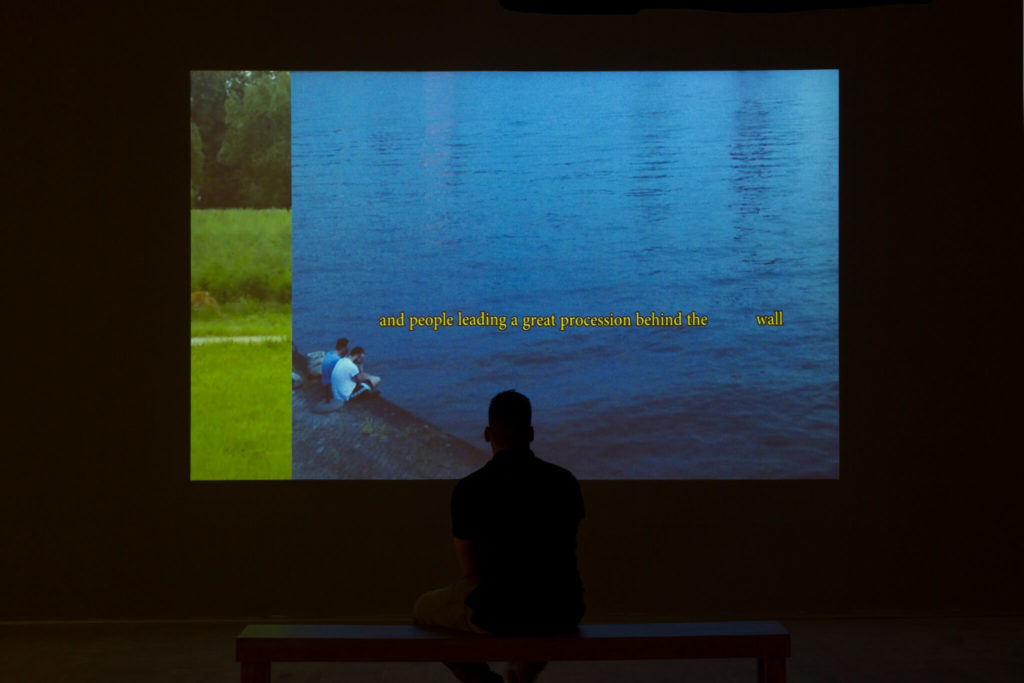
Alaa Abu Asad, The Untranslatable Words of Love, video, 2018
Installation view, We Shall Be Monsters (YAYA 2018), Qattan Foundation, RamallahVictoria: Speaking of untranslatable things, one of the things I like about living in a foreign country is that I’m fluent in Italian and I can understand it because if I see an English translation of something that’s in Italian, there is so much information left out. What is fascinating to me also is that different cultures have different ways of expressing themselves. Also, when I was studying cultural anthropology at the University of New Mexico, we studied how language is a reflection of culture, surroundings, and cultural beliefs. For example, certain past civilizations didn’t even have a word for snow, and yet in other areas where it snowed heavily, they had different types of words to describe different types of snow. So, language really is a representation of our reality and where you come from. So, I find this work really fascinating and that’s why I wanted to ask about it as well. Did some people find the concept of this work frustrating because not everything can be translated directly?
Alaa: There are not so many words in this work, and it was more about the concept of un/mistranslation. Also, when you were talking, I was thinking about the difference between both written and spoken languages, because they’re completely two different things in Arabic. The dialects we speak are different from the written formal Arabic. So, we have words for certain things but the formal Arabic doesn’t include these words. It’s interesting to look at how people talk in daily life and communicate between themselves.
Alaa Abu Asad is an artist, researcher, and photographer. His practice is centred around developing and experiencing alternative trajectories where values of (re)presentation, translation, viewing, reading, and understanding intersect.
www.alaaabuasad.comAlaa Abu Asad’s work was presented between 06.04. – 31.07.2019 at philomena+ in Vienna, Austria https://philomena.plus/programme/alaa-abu-asad-1-the-assembly-plants-observation-in-the-urban-sphere/
Victoria DeBlassie is a multidisciplinary artist who recontextualizes discarded objects and materials to suggests the excessiveness of material culture and the human impact on the environment. After receiving her BFA from the University of New Mexico in 2009 and MFA at the California College of the Arts in 2011, DeBlassie was awarded a Fulbright Grant to Italy. DeBlassie has participated in numerous residencies, includingVis à Vis Fuoriluogo 23 (IT),Bridge Art Residency (IT), and Hangar.org (SP). Recent solo exhibitions include Anthropomorphic Cosmesis at Finestreria (IT) and Plasticaia at the Villa Romana (IT). Her latest group selected shows include Per quanto tempo e’ per sempre, Celle Frigo (IT), The Recovery Plan, Fondazione Biagiotti Progetto Arte (IT), as well as two-artists shows including: Trame Plastiche—Bridge (Collaboration with Leonardo Moretti) Vicoli d’Arte (IT); Cenacoli Ombrellìferi (Collaboration with writer Connor Maley), Chille de la Balanza (IT).
-
The Semantic Diversity of Material—Nilbar Güreş in Conversation with Sırma Zaimoğlu
I would like to start by asking you to mention the places where you have positioned the cultural images of your origin. In my opinion, the way you use these images also hints towards your artistic production. What would you say? We all have our world of images based on the cultural diversity that we come from. Turkey is a very mixed geography and we are very different from one another, therefore it is even more impossible to generalise a country like this. But as we know, we are an ancient country with an incredible settlement and culture. The things…
The Semantic Diversity of Material—Nilbar Güreş in Conversation with Sırma Zaimoğlu
I would like to start by asking you to mention the places where you have positioned the cultural images of your origin. In my opinion, the way you use these images also hints towards your artistic production. What would you say?
We all have our world of images based on the cultural diversity that we come from. Turkey is a very mixed geography and we are very different from one another, therefore it is even more impossible to generalise a country like this. But as we know, we are an ancient country with an incredible settlement and culture. The things we think of as dating back to the last five hundred years may as well be much deeper rooted in a way we can’t handle when we research further; it turns out to be thousands, tens of thousands of years old. Regardless of where and when these cultures, beliefs and traditions came from, they are more or less dosed by the inhabitants of the region, somewhat according to class codes, in one way or another. I myself did not grow up in an abnormal conservative environment. After all, my father is a Kurdish Alevi; Kurdish Alevis are an isolated society that lives closer to natural religions. The funny thing is that I spent my childhood with conservative people in Istanbul – which is the most modernised city of Turkey.
In this case, we sometimes understand that it is migration and the vessels that actually position us. Going back to my first productions of early 2000, you can see that I am influenced by the dowry of the women around me, the bitter stories of the materialist investments they have accumulated for the marriage establishment, one of the only things that will determine their future social status. But again, you’ll immediately notice that I’ve transformed them and turned them upside down.
In your work, you often bring down the separations/comparisons of race, species and class. However, we are watching this not as a didactic protest, but rather as a deconstruction that you carry out through medium and composition. How does this fiction come about? How did you start working like this?
Didacticism is not a technique that has worked well for me, it is more a problem of the upper and upper-middle class. I cannot be sitting, thinking, calculating and producing books anyway because I am not a trained person, I am a self-made person.
This is probably why I work like this; I mean as someone who went against the structure and the order they come from …
In my opinion, there are more raw ideas and initial responses in my works. The difficulty of my production is not to make the works best suited to the place, the concept, whatever you call it, or the task given there, perhaps. The hardest thing for me is to stay with myself and involve my senses, not to corrode them. The hardest thing is to become emotionally strong, and rediscover what they still whisper to me as time passes, because we artists work and live under terrible pressure like most people. It is always the voice of our instincts that we lose first. I am trying not to be tamed. When I say no to something to a person, sometimes it is months later that I understand why I wanted it that way, but I will have done the right thing.
I do not want to go on without mentioning your relationship with photography. You say that you use photography as a medium, as a tool, but insist that photography is not an effective branch of art in a contemporary sense. I am sure that your detailed point of view will be inspiring for those who are new to you.
Photography is the oldest visual mechanical documentation technique. I am not a photographer, I use photography as a tool, like many other artists, to put it directly. I’m not a film director either, but again, like most of us, I sometimes work with video. The aesthetic power of photography is indisputable, but this situation does not make a wonderful shot a work of art. As a result, neither the picture, the photograph, nor the film of a thing that does not have a unique, constructed idea be art. We share the same virtual world with billions of iPhone photographers right now, right? How many of them are visual artists? If we look at it that way, maybe we can understand this better.
The Sea Said Okay, your latest solo exhibition in Istanbul, feels like you are on a journey where there are no norms. While traveling, you present a summer vacation libido on the one hand, and on the other hand, you feel a sense of escape from the realities of COVID-19. How did you produce this series? Does it have personal traces of the pandemic period? Is this period reflected in your production?
When the curfew began in March, when everyone was panicking, I just thought everyone was now a thousand steps closer to my reality. Almost everyone works during certain hours on weekdays and has regular personal time on weekends or evenings. But artists and workers cannot choose their own working hours. It doesn’t matter day or night, or on the weekend; my life takes place anywhere behind some walls anyway. So I never panicked, and just because I didn’t have to rush now, I was able to concentrate more and concentrate on one thing at a time. I have visited many places for project purposes in recent years, but I could not stay as I wanted, research, concentrate or go back to them. Because we cannot be free in the places and projects we are invited to because of the pressure of production. Therefore, in these pictures, there are palms that I see in the countries I have visited and I could not sit under, and mountains that I could not look up from.

Exhibition view, The Sea Said Okay, Photo © Galerist, Istanbul Can you talk about your approach to social roles? Unfortunately, many artists completely detach themselves from their personal bonds when criticizing norms of their origin; which appears orientalist and raw to me. Therefore, I would like to expand on this.
Real artists who live like themselves already find it difficult to adapt to any role because of their lifestyle, of course, I don’t know what kind of artists you are referring to. Because nowadays, what we call an artist has become a product that poses in hip places with a glass in hand or in a white cube, turning up in every zoom meeting with their black, serious and expensive jacket. This type of artist imitates the image aesthetics of the potential of the buyer and pretends to share the values of the same class as them, thus making themselves feel close to the buyer and facilitating their consumption. The use of orientalism is also a method to help avoid meddling, surviving with a top-class shell; It is also a method to be a ‘positive energy artist’ who is stylish and available at any time, open to anything at any time. It’s hard to know how people feel as long as any transformation is possibly real. After all, it is a world of art which is frequently used by those who want to climb up. This is the purpose of some people, I hope those who wish so will achieve this. If you ask me, I would personally be more interested in self-destructive artists; those who are avoided, feared, those who do not mix well with the crowd are the most original people in my opinion.
What is the reason for using textiles, especially dowry materials? What is the context you bring them together in?
Textiles and other materials show many semantic diversity, each material usually comes with its unique story. As an artist, I believe things and their meanings come to me. Sometimes, on the contrary when you research or go through it a lot, this meaning is never revealed. I personally take everything related to art very seriously. Its production, the feverish structure that moves with smoke behind it, and all its costs. I know that sometimes I have naive ideas, it is because of my pure belief in art. I guess those who see this state of mine send me fabric or gift me personally. Because I am a person lost in my own world, I am sure there are those who look at me with pity. The artist determines the context of using dowry or textiles for each work. It is impossible to make a common sentence for all works, but the first thing I do is free them from their original context and reinterpret them.

Exhibition view, The Sea Said Okay, Photo © Galerist, Istanbul We come across trans figures and compositions in your production. Likewise, you have many works that can be read related to feminist context. I wonder if your issue is with gender, with trends or with norms?
Feminism, queerness, veganism, consciousness of the right to life and all responsibilities for freedom or existence clinging together in the most organic ways is the reason behind their reflection in me. As long as I can remember, I have had a passionate state that can be regarded as overdose, because I never separated these things from each other. Now I am 43 years old and these are well visible as a chain. First, they will be extreme to everyone and then they will be adopted. I am satisfied.

Nilbar Güreş, The Sea Said Okay, 50 x 70cm, Oil on canvas, Photo © Galerist, Istanbul Despite your painting education, you did not paint for a long time until recently. Could you tell us the reason? Do you think that your artistic disciplines have an impact on your paintings today?
I have never painted before as a professional, or in a way I have deemed satisfactory. The paintings in the exhibition The Sea Said Okay are my first paintings. Of course, everything we put our noses in affects us. Since I have been making photographs, collages, videos and sculptures for the last ten years, these paintings now appear as such aesthetics and products of such a world. Since these paintings are works of today, they will interact with the photographs or the videos of tomorrow. This is a highly unpredictable and exciting adventure for me.
In a previous interview I remember you telling me that your art is your activism – which makes me wonder; what are the questions and issues have been occupying you?
It may sound strange but believe me when I say an exhibition made without asking anyone’s opinion or communicating with anyone is not easy today. When I first created these paintings, no one except one person was sure of them. I insisted I was going to show them and this was it. It is important to be able to suppress it this way. I find it tragic that the artist, who is finally able to remain in solitude at a time when everyone is insecure, became more aware of what they want more than ever. When death reminds itself, everyone shrugs off. What I think about the most lately is my freedom. The thing that imprisoned me behind four walls suddenly transformed when I could finally do what I wanted.
Is there anything you would like to add?
The future will never be as we order or desire it to be today.
Sırma Zaimoğlu (b.1992, İzmir) is an independent art advisor, the curator and director of the Corpus Gallery and Publishing House in Istanbul. She graduated from the Department of Art Management, took roles in project management in various institutions. Based on her independent research, areas she worked on are Turkish Art Market, Gender Studies in art and art publishing.
-
Interwoven Drawings. On Storytelling, Body Images and the Uncertainties of History—Azita Moradkhani in Conversation with Niklas Wolf
It could be argued that textile mediums almost by definition are associated with various communicative dimensions (cf. e.g. Harney, Elizabeth et al., eds.: Inscribing Meaning: Writing and Graphic Systems in African Art, Milan 2012). Tradition-based processes of production and modes of reception are often in the true sense of the word intertwined with certain practices of storytelling, be it in the process of making them or while performing them when being worn. What kind of stories do your representations of textiles tell? In my drawings, unexpected images incorporated in intimate apparel intend to bring humor, surprise, and a shock of…
Interwoven Drawings. On Storytelling, Body Images and the Uncertainties of History—Azita Moradkhani in Conversation with Niklas Wolf
It could be argued that textile mediums almost by definition are associated with various communicative dimensions (cf. e.g. Harney, Elizabeth et al., eds.: Inscribing Meaning: Writing and Graphic Systems in African Art, Milan 2012). Tradition-based processes of production and modes of reception are often in the true sense of the word intertwined with certain practices of storytelling, be it in the process of making them or while performing them when being worn. What kind of stories do your representations of textiles tell?
In my drawings, unexpected images incorporated in intimate apparel intend to bring humor, surprise, and a shock of recognition. Layers of shadowy images reveal stories, with the hope of leaving a mark on the audience. Two worlds – birthplace and adopted home – live alongside each other in my work, joining intimately at a single point.
My colored pencil drawings of intimate lingerie, negligees, and corsets explore interconnected narratives of pain and pleasure through abstract patterns and images based on photojournalism, art photography, and historical symbolism. I use eroticism to seduce the viewer, who finds, upon closer inspection, through the layers of colored pencil, past the details of lace and filigree, disruptive iconography narrating inherited histories of nation and belief.
Your drawings especially make use of one specific color each, which in my view calms them down visually – often in sharp contrast to their imagery – and therefore makes them more intriguing. Is there any meaning behind the monochromaticity of the images?
The details in my drawings are somehow overwhelmed with repeated abstract patterns of lace intertwined with shadowy figures. Choosing the right color for each piece is an important part of my art-making process. I try to stay away from a variety of colors and instead focus on one color that psychologically fits best in my mind with the piece. Sometimes, after working for forty hours on a drawing, I tear it apart only because the one color I’ve chosen doesn’t feel like a good fit for the piece. While the drawings are monochromatic, the layers of tonality with colored pencil bring the complexity of the presentation in their subtle way.
Pompeian red (it’s a shade of mauve with fleshy, bodily associations) and Indanthrene blue in Faber-Castell colored pencil are two colors that I use in most of my drawings. I found out later about their ironic connection with the stereotypical gender colors.
In the drawing Labour (2020) you intertwine a representation of femininity – a silky, light-as-a-feather-looking, maybe see-through nightgown – with the image of rough and heavy, patched working clothes. Both the bodies of women and workers are often exploited, forced and part of economic and global networks of consumption. What are your thoughts on these layers of meaning that one could see in such an image?
The image of heavy, patched working clothes in this drawing is based on a photograph of an Iranian photojournalist and artist, Kaveh Golestan, in Kaveh Golestan: Recording the Truth in Iran 1950–2003. The photo, which depicts a young worker boy, is shown alongside Golestan’s other photographs of sex workers in Shahr-e No in Iran before the Islamic Revolution in 1979. The abuse of the body, all along the gender spectrum, by societies for economic and political reasons is the basis of this drawing.
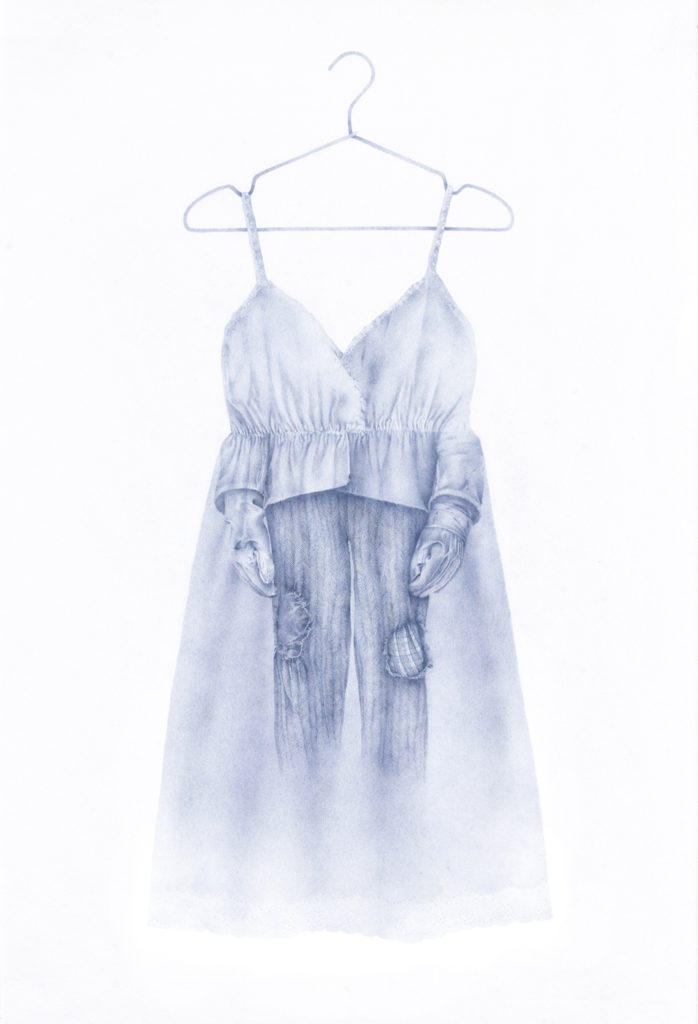
Labor, 2020, Colored pencil on Stonehenge paper, 66×101 cm In Enlightenment (2018) you show a Christian cross being a decorative part of lace lingerie, supposed to cover those body parts received as most female. What are your thoughts on religion and body images, the concealing and revealing of bodies, normalized religious (and often resulting political) concepts?
This drawing is about the notion of “religion” in general and the way it has suppressed women in many ways over the course of history. The vertical light on the cross finds its way out from the area on the lingerie covering the vagina to highlight the question of creation and the concept of god.
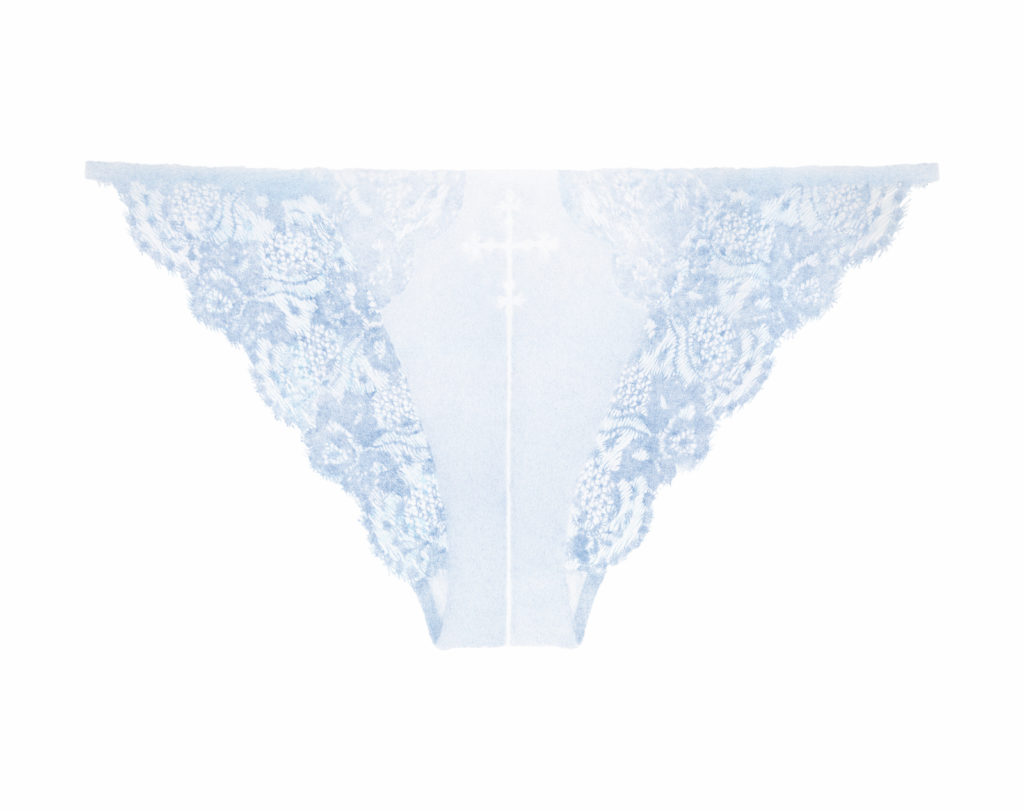
Enlightenment, 2018, Colored pencil on Stonehenge paper, 40,6×50,8 cm How to dress and/or undress bodies in public and private can be a highly charged and politicized topic. What do your images reveal about the differentiation and connection of the private and the public as social constructs, strongly connected to images of the body? Would you even make such a dichotomic distinction between the two?
My series of intimate apparel – lingerie, negligee, and nightgown – depicts the connecting narratives of how we experience life in private and how we express it, emotionally and physically, in public. Coming from a culture with a significant border between private and public, I create a bridge between these two worlds and invite the viewers to think about hidden experience versus what is made accessible in their own lives.
For the most part you are using a very beautiful materiality and a beautifying formal approach. Especially in drawings like Labour (2020) the concept of beauty seems to be only available for some. What are your thoughts on the concept of beauty and the body? How would that concept be performed differently in the private versus the public?
My drawings on paper and casts of my body represent a non-Western aesthetics of pleasure and beauty. Growing up in Tehran, I was exposed to Persian art and culture, as well as recent Iranian politics, and that double exposure increased my sensitivity to the dynamics of vulnerability and violence that I explore in my work and art-making process. Working at the intersections of drawing and sculpture, I locate my work in a feminist response to Edward Said’s Orientalism: ideas of womanhood in the post-colonial world and the post-revolution generation in Iran intertwine with conflicts at the borders of tradition and (post)modernity. Meanwhile, I pursue beauty and realism in contemporary art by deploying formality, virtuosity, and delicacy, connecting my work aesthetically to art of the past. In my sculptural work, through the images drawn on body casts, I mix imagery – tattoos of memory and history – to emphasize both inter- and dis-connections between sexual representation and national identity, between the public and the private.
Both body and artifacts can be thought of places for the accumulation and sedimentation of history. What does that mean for your work, mentioning terms and concepts like tradition and (post)modernity – especially thinking of the very strong interconnection between body and image (the performative narrated through fashion, for example)?
As Wangechi Mutu says, “Females carry the marks, language, and nuances of their culture more than the male. Anything that is desired or despised is always placed on the female body.”
My series of colored pencil drawings of intimate apparel is based on my first impressions from walking into a Victoria’s Secret store in the US. While being exposed to this public environment full of intimate lingerie, I was not only thinking about the power of censorship (including lingerie stores) in my country, Iran, but I also felt intimidated by the body image of a woman through the models and design. While my drawings are inspired by luxury intimate lingerie, the images on them depict global stories of different experiences – both figuratively and symbolically – across borders.
Also, my recent drawings are related to my own roots and inspired by the work of artists whom I admire – such as Louise Bourgeois, who says, “Clothing is a metaphor of the years that pass. For me fashion is the experience of living in this dress, in these shoes.” I have incorporated images from a private collection of Iranian Qajar-era historical photographs. As photography became more democratized and made its way to the Middle East, the medium was used to transgress cultural taboos: images of real people to be viewed for pleasure. While these photographic images of nude women with Westernized elements such as angel wings and European garden backgrounds, indicate the permeation of Western culture into Iranian norms, my drawings of them – inspired both by historical photography and contemporary photorealism – emphasize the clash of disparate cultural conventions of beauty.
In a different piece, Irezumi, a fellow Japanese-American artist, Jeremy Endo, and I staged a durational performance to create a representation of Orientalism over Endo’s body in the style of irezumi, the art of Japanese tattooing. The performance was after the event in 2015 when protesters complained of racism and cultural appropriation to the Museum of Fine Arts’ “Kimono Wednesdays” program. Jeremy Endo and I used ritual performance and the practice of painting to document and evoke conversations between communities of color and institutions. Here, both body and the kimono as an artifact can be thought of places for the accumulation and sedimentation of not only the past but also our current lived experience.
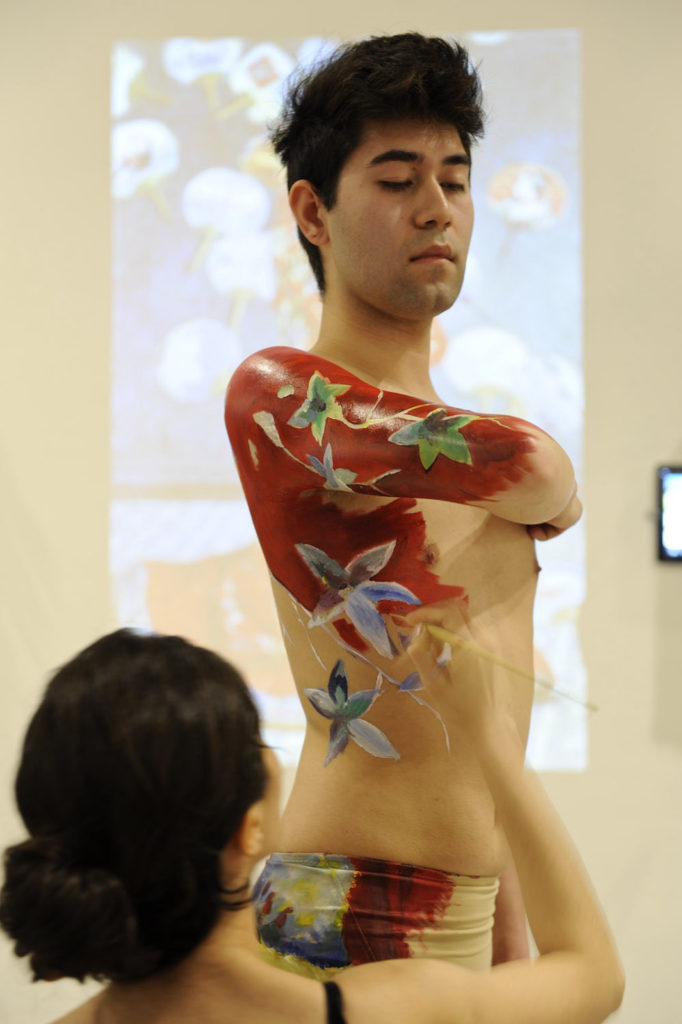
Irezumi, 2017, Performance 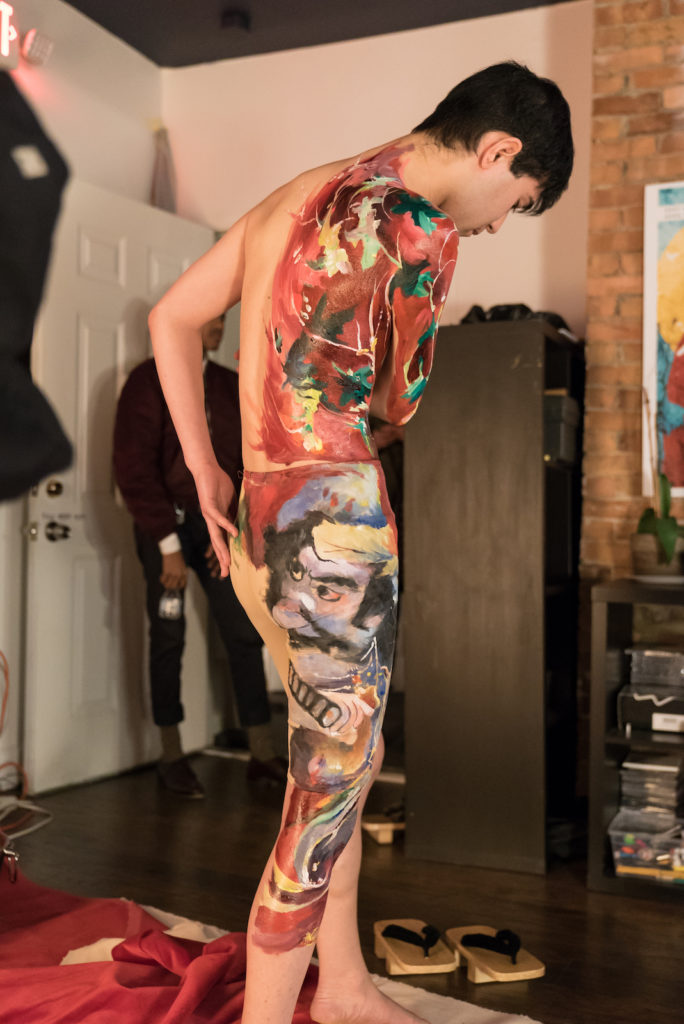
Irezumi, 2017, Performance In some works, you seem to interconnect attributes and images which are in society strongly connected to either concepts of masculinity or femininity (like a bearded man growing out of laces in Swimmer (2020) or distinct parts of male physiognomic features like a mustache becoming part of a laced bustier in Blue Pilot (2020)). What kind of idea of both concepts – femininity and masculinity – could be drawn from your work? What is the meaning of using fragile media like underwear and a very delicate and fine formal approach to deal with those questions? In Blue Mustache (2020) the male beard seems to kind of disappear inside the transparent negligee, blurring those artificial lines.
The contrast between stereotypically feminine and masculine qualities in my work confronts the dualities of power and vulnerability, Orientalism and feminism, political rhetoric and actual lived experience. Through my drawings and new project of actual designed intimate apparel, I emphasize the marks of history and memory on the body and its coverings. From imagination to manifestation, images, symbols, and text used in my work become a representation of life intertwined with our ideas regarding gender investment, pleasure and pain, what gets to be public and what needs to remain private. My new project of intimate apparel, The Real Beneath,seeks a new perspective on both fashion design and wearable art, creating lingerie across the gender spectrum – an artistic vision that can challenge the public perception of the most intimate clothing, making it a personal ideology rather than just a piece of cloth. Femininity in my work could be connected to the aesthetic and hidden details while masculinity is presented through boldness and being upfront.
Would you like to elaborate especially on Blue Bra (2015), your understanding of this iconic image and its connection to revolution, religion, politics, femininity and the politics of clothing? How does such an approach fit in your concept of beauty?
The female body is central to my work. It examines the experience of finding oneself insecure in one’s own body. To me this iconic image represents the many stories of violence on female bodies with the tension on their sexuality and its use as a vulnerability in society.
In this drawing, I use bright blue and gray to signify Blue Bra, the photograph of a woman being physically assaulted during the 2011 Egyptian Revolution. In the center of a sheet of white paper, viewers see detailed lace and filigree of expensive panties that are ascribed by both very light and heavy pencil markings. When viewers look more closely at the lines of the drawing – in its interior space – they are brought face to face with shadowy images of violence and the vulnerability of its victims made up of the same strokes that give shape/form to the more pleasurable aesthetics of the piece.
In some of your drawings you are citing commonly known pieces of Western (?) pictorial memory. For instance, in Becoming (2016) you are showing God’s and Adam’s fingers touching, referencing Michelangelo’s painting. What kind of underlying history are you dealing with? What does it mean for concepts of art, masters of art, and their narratives? Especially thinking of the concept(s) how to bring life into the world, as I would guess you are also dealing with in the drawing Delivery (2015) and the body cast Becoming (2018)?
Contrary to the physicality of birth, creation is generally seen as a clean, non-material phenomenon detached from the body and connected to the power of the mind. The contrast between the stereotypically feminine and masculine qualities in birth and creation, respectively, have been seen and expressed through different social norms and contexts over the course of history. An example could be Michelangelo’s overwhelmingly detailed fresco, The Creation of Adam (c.1512), from the Sistine Chapel. Its composition and masterful technique center around the two masculine figures of God and Adam in the moment of creation. Absent from this painting is any evidence of female birth; the bodily fertility of the goddess has been replaced by an invisible divine spark.
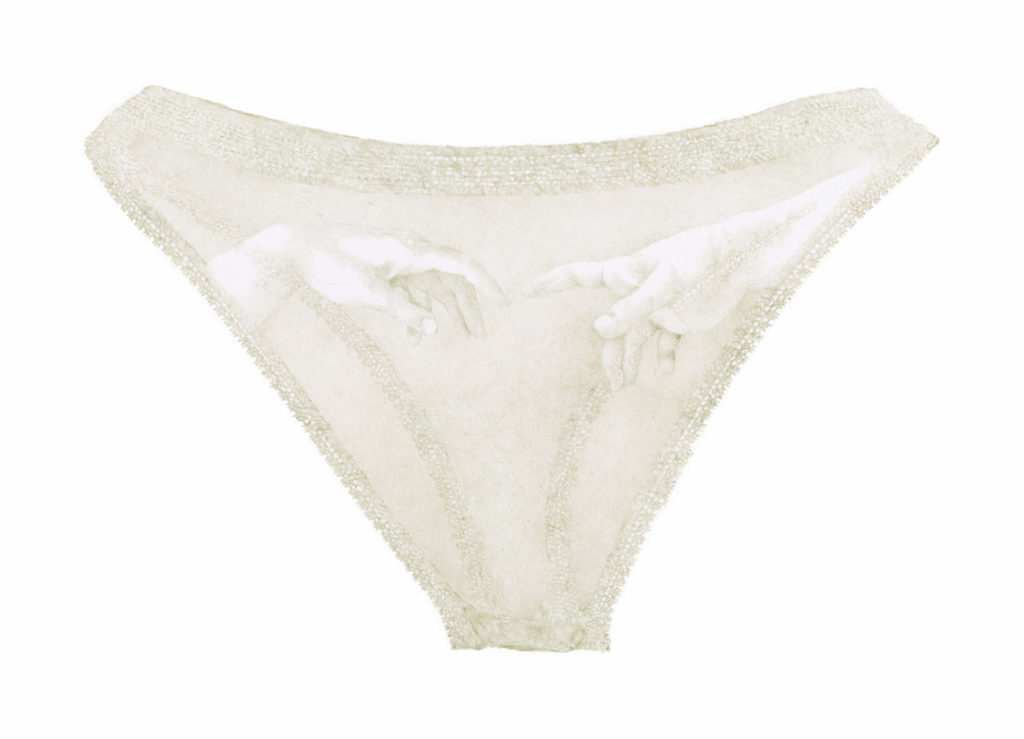
Becoming, 2016, Colored pencil on Stonehenge paper, 30,5×40,6 cm The question for me becomes: what distinguishes birth from creation?
Inspired by the tension between these dual notions of birth and creation, I used an image of the near-touching hands of God breathing life into Adam in one of my drawings of women’s underwear to comment on the idea of birth in a contemporary world. While my work Becoming is aesthetically connected to art of the past, it challenges the bloodless view of Adam’s creation as an idealized representation of the birth of man not of a woman. This drawing points out the power of women’s bodies to give birth to humankind while women are limited in decisions about their own bodies, from their shapes to abortion.In a different context but relative to the concept of birth, the image in the drawing Delivery is based on a photo by Ariana Cubillos/AP Photo. It shows Haiti’s maternity wards, where a woman gave birth on a mattress on the floor. As Jonathan M. Katz said: “Giving birth is a dangerous business for poor mothers in Haiti, the nation with the highest maternal mortality rate in the Western hemisphere. Some 630 of every 100,000 women died of pregnancy-related causes in 2006 – more than five times the Latin American and Caribbean averages, according to the United Nations.”
Delivery (Victorious Secrets), 2015, Colored pencil on Stonehenge paper, 40,6×50,8 cm The body cast Becoming is quite different from the two pieces mentioned above. It’s a female body cast with an image of a fetus drawn on the abdomen surrounded by drawings originating from the Iranian traditional floral patterns called “Golo Morgh.” This body cast emphasizes the impact of the environment on individual human beings before and after birth. I think our life experience – how we feel and think, what we expect from the external world and obligate ourselves to do, what we believe and doubt, what we like and avoid – is highly impacted by the society, family class, and the country where we were born and live. Although the depth of these influences can vary from person to person, their impact is inevitable.
Let’s also talk about your sculptural work a bit. Obviously in your body casts it is always a female body you are presenting – is that important to you? Could the same be done using a male body? I am thinking of another drawing of yours (Man in Red, 2018), which might foreshadow the connection (or visual separation?) of male and female bodies. How would it be different using a male model’s body for a cast?
I don’t think I am ready to use the male body as the center in my work yet. Man in Red was the first large-scale drawing of a negligee, which continues my earlier series of colored pencil drawings of intimate lingerie. The drawing depicts a delicate feminine drawing of a corset with the implied presence of a masculine figure with a traditional Iranian mustache. While it indicates the presence of a man, the drawing with its lacy pattern also emphasizes the transparency of how beauty and pleasure can be seen through different cultural perspectives. I hope Man in Red provides a frame to challenge national and sexual representation as well as ideas regarding gender investment. The border between femininity and masculinity has been crossed in this drawing and the consequences are left to the viewer to imagine.
Man in Red, 2018, Colored pencil on Stonehenge paper, 76×111,7 cm When I first looked at your sculptural works, the materiality and technical approach reminded me of the concept and history of face masks. These were introduced to preserve the deceased’s identity, which of course was (and is) strongly connected to individual facial features, for all time, representing the persona of a being – in a literal sense, a mask. What are your thoughts on body casts as canvas? Why would it be important for you to connect them to one specific body and therefore to one specific – to your – identity?
The majority of religions put pressure on the female body to conform to certain standards, as with the obligation to cover the body or issues surrounding access to contraception and abortion. So I began wondering whether my most trusted, accessible, and safe place could simply be myself. In the beginning, my body casting project was more about the process than any final piece. Through the collaborative process of casting my own body, I place myself in a vulnerable situation that challenges beliefs I grew up with. As Peggy Phelan says in Unmarked: The Politics of Performance, “There is no apprehension of the body of the other without a corresponding (re)vision of one’s own.”
Some of the body casts are not covered in drawings of underwear but in drawings of flowers, branches, and leaves. There’s even a branch growing from a female breast (Cycle) or woven flowers growing from underwear (Possession). What’s your understanding of nature when it comes to body images?
Inspired by nature and referring to the concept of nurturing through both this magnificent Mother Earth and breastfeeding of a woman, I have used a branch of a tree in my body cast, Cycle. Floral and lace patterns alongside of the images drawn on this body cast become a natural object itself: a branch of a tree. The body cycles here between the illusionary and the real, the artificial and natural, carrying its disruptive iconography along with it.
Cycle, 2017, Mixed-media (paper clay, colored pencil, and branch of a tree), 35,5×25,4×10 cm After all those questions, knowing you grew up in Iran and have lived in the USA for quite a while and continuing traveling there and back again – what are some similarities and differences in answering them in regard to your location? Are there any in the first place?
As an immigrant in the US and considering my country of origin, I don’t feel safe answering this question.
Niklas Wolf, M.A. works as a researcher and lecturer at the Department of Art History of the Ludwig-Maximilians-University Munich. As a research associate, he is assigned to the professorship for the values of cultural heritage und provenance research (Prof. Dr. Dr. Antoinette Maget Dominicé). His research interests focus on the art history of Africa (especially tradition-based art), photography, Material Culture, visual studies, art history and cultural anthropology, interculturality and aesthetics.
Currently he is working on his doctoral thesis Voodoo and the state of inter. The (re)production of images and media of West African Vodun between identity and alterity (working title), dealing with superordinate discourses of display, materiality and provenance, as well as the performative effects of specific, multifunctional objects in the construction of identity and alterity. In 2020 he co-curated the exhibition Photobook Africa. Tracing Stories and Imagery at the Zentralinstitut für Kunstgeschichte, Munich.
For more details see https://www.kunstgeschichte.uni-muenchen.de/personen/wiss_ma/niklas-wolf/index.html -
Poetic Repetitions Towards an Affirmation of Existence—Jafra Abu Zoulouf in Conversation with Aline Lenzhofer
As a Palestinian female artist, you are living in Haifa, which is today part of the state of Israel, a country that even denies the existence of Palestine as such. What role does your own identity play in your artistic practice? When I decided to be an artist, it was way of finding a place in the world I live in. I was searching for a place where it is possible to express myself and have an audience. I deal with identity struggles, struggles I face as a women in a patriarchal society as well as a Palestinian living in…
Poetic Repetitions Towards an Affirmation of Existence—Jafra Abu Zoulouf in Conversation with Aline Lenzhofer
As a Palestinian female artist, you are living in Haifa, which is today part of the state of Israel, a country that even denies the existence of Palestine as such. What role does your own identity play in your artistic practice?
When I decided to be an artist, it was way of finding a place in the world I live in. I was searching for a place where it is possible to express myself and have an audience. I deal with identity struggles, struggles I face as a women in a patriarchal society as well as a Palestinian living in Israel.
Identifying as a Palestinian in the Israeli context is often perceived as a negation of the existence of the state of Israel and is met with incomprehension. Introducing myself as a Palestinian and simultaneously stating Israel as my country of residence goes beyond the predominant logic. In order to affirm my existence, I turned towards contemporary art. Through my artistic practice, I have found a way to deal with my own political identity, tackle issues that are relevant in this context and try to make a change.
Wadi Salib, Camera Obscura, 2021 ©Jafra Abu Zoulouf Your work فرز (in English: to separate, to isolate), which is presented in the exhibition Present imperfect here at Sumac Space, deals with the remains of former Palestinian houses in the neighborhood Wadi Salib in Haifa. With cautious dedication you clean every single stone that you have picked up from the ground, as an act against a fall into oblivion. May I ask you to elaborate a bit on your own relation to the city of Haifa and the story behind your project?
Haifa is the city where I currently live and work, and I feel very connected to it. It is a historical Palestinian city. It’s a harbor city and has an important historical market. And even after 1948, it has continued to be an important city that has attracted young generations of Palestinians. Today it is considered to be the cultural center of historic Palestine, where many political and cultural movements were established.
The work فرز digs deeper into the history of one neighborhood in Haifa. It looks into the remains of houses of those Palestinians who were forced to leave their homes from one day to another and tells an often-untold story, which the Palestinian author Ghassan Kanafani also refers to in his novel Return to Haifa (1970). In this book a couple was kicked out of their house, deported out of Palestine, and even had to leave their baby behind. They were forced to leave their home in 1948, and in 1967 when they were allowed to come back for a visit, they see their son again, who was raised by the Jewish immigrants living in their home.
I first read that book when I was about 14 years old and perceived it as a tragic story of a family that was torn apart. Now, almost 20 years later, I am going back to this novel, seeing it in its historical and political context and relating to it through my art.
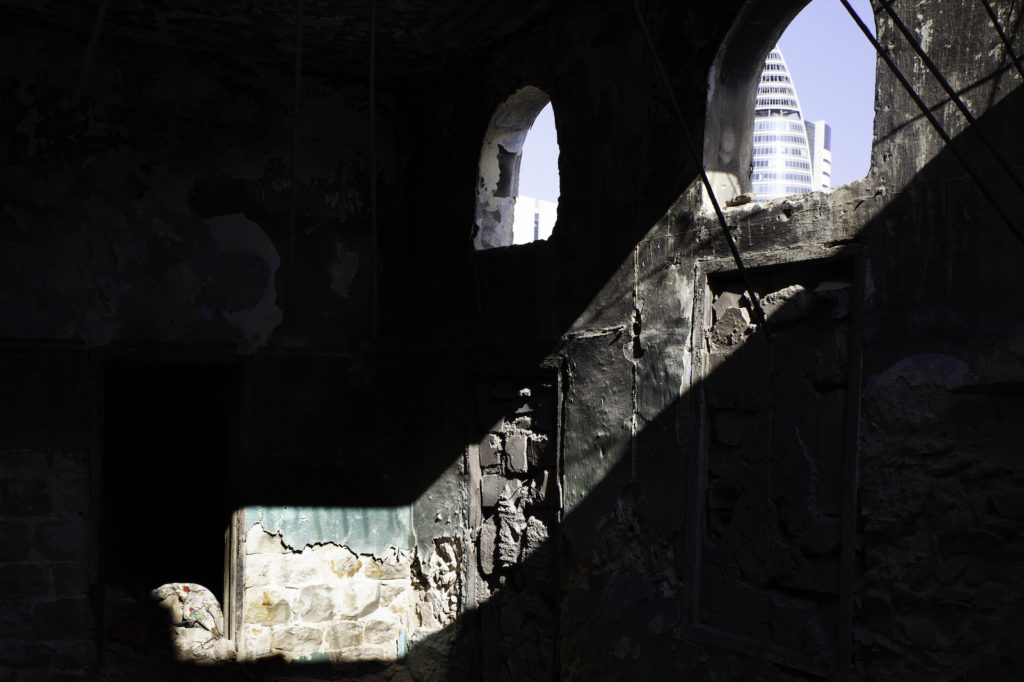
Wadi Salib, 2021 ©Jafra Abu Zoulouf Wadi Salib is one of the neighborhoods that was affected. In 1948 the Palestinian population was expelled from their own homes. Today, it is a neighborhood that has been totally renovated; new housing complexes are built and the establishment of an artist village will accelerate the gentrification process. The video work فرز looks back on the neighborhood’s history and attentively gathers evidence of its tragic history.
After working on it, I see the neighborhood with different eyes. It became not only my own neighborhood as I live here right now, but also a research topic where each stone tells a story and catches my interest.
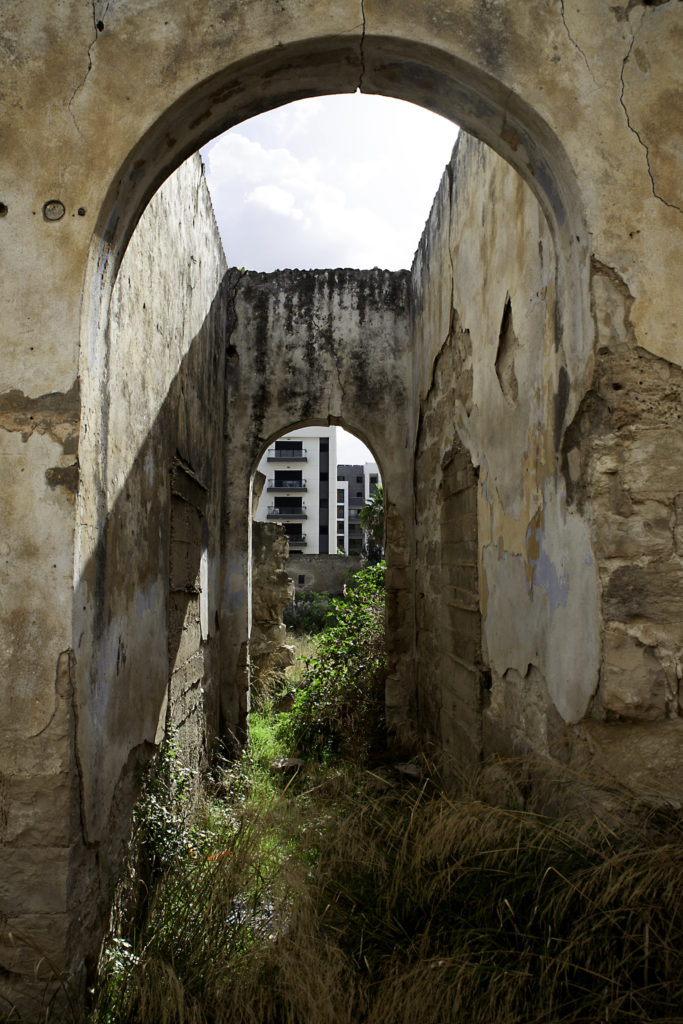
Wadi Salib, 2021 ©Jafra Abu Zoulouf After watching your video works فرز and 531 times, the repetitive, even meditative, actions that both have in common stand out. What role does repetition play in your work in general?
Repetition plays indeed an important role in several of my works. You have cited 531 times and فرز. The video piece 01:41 can also be added to the list.
In political discussions I often find myself confronted with the necessity to explain the same issues again and again. It feels like being stuck in a loop. Instead overcoming the problem and learning from it, the same problem has to be faced again and again, similar to Sisyphus in ancient Greek mythology.
My video works 531 times and 01:41 refer to the ongoing Palestinian struggle, the situation of being stuck in a loop, of having to repeat a claim for existence again and again.
531 times portrays a woman sifting flour 531 times, the number of Palestinian villages that were evacuated in 1948. It is also the first video in which I am in front of the camera. Actually, I filmed it first with different people. Every time something had to be adjusted: the lighting, the position of the camera. As nobody wanted to do it again, I finally found myself in front of the camera. As the video evolves, the pile of flour becomes a triangular shape that enters the space – a phallic form that refers to political topics such as occupation or patriarchy. The title 01:41 also references a historical number: the 1.4 million Palestinians who were deported in 1948. In a single frame setting, a man shifts blank papers from one side of the desk to the other side.
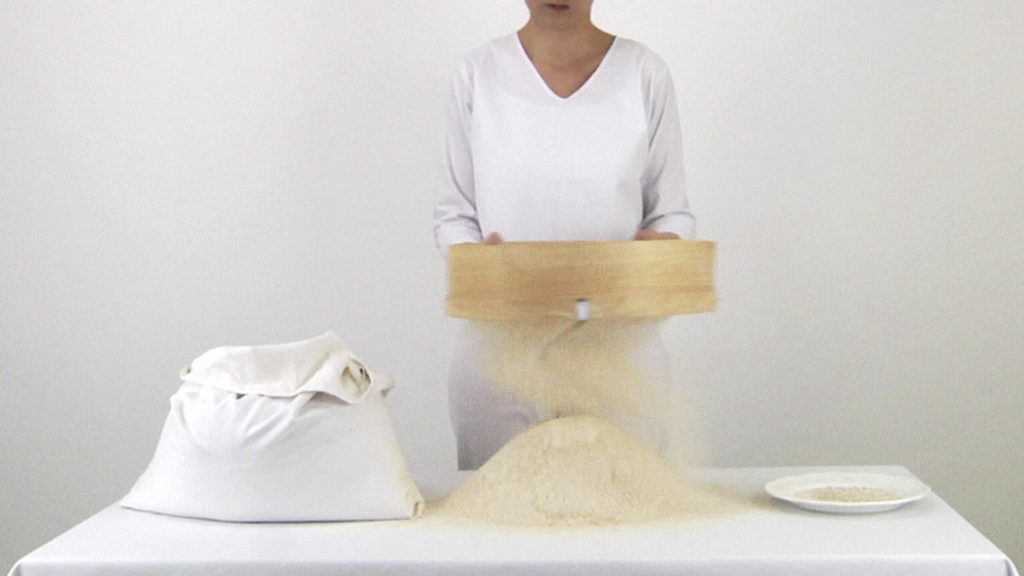
531 times, 2015, Video still References to numbers and dates as well as repetition are quite subtle ways to tackle complex political issues such as occupation or expulsion. I would like to come back to the neighborhood Wadi Salib in Haifa and your two-channel video Talqit 2’46’’ that links it with Daliat el Carmel, the place where you grew up. What was the idea behind linking these two places?
The video piece تلقيط (in English: to take, to pick up, to collect) is a two-channel video which shows on one channel myself picking up stones of demolished houses in Wadi Salib in Haifa and on the second channel it presents my aunt who is collecting the plants za’atar (زعتر) and akoub ( عكوب) from the ground in the surrounding area of our village Daliet el Carmel. In early 2020 I was wandering around the forest of the Carmel mountain together with my aunt and just had the idea of filming her in this scene. Later on, I decided to combine the two scenes as the actions, movements and even the meaning fit together.
In the ongoing renovation project, the city follows the claim to preserve the abandoned houses in Wadi Salib – but of course without acknowledging its history. In that sense the confrontation with the neighborhood’s history is endangered and so are these plants. Until 2018 they were classified as endangered plants and it was even forbidden to collect them. In that sense, both of us, me and my aunt, perform the same action – picking up things from the ground and collecting them so as to not fall into oblivion.
On another level this video piece is a discussion about where I come from and looks deeper into the family story. While my close family is very political and position themselves openly as Palestinians, the people in my village as well as my extended family belong to the Muslim spiritual group of the Druze, who were able to stay in their village because, historically, they presented themselves as loyal to Israel. Combining the two scenes in the video تلقيــط also reflects the complexity of the political history and situation within the Israeli–Palestinian context.
Coming back to your references and artistic influences, in your artist’s room here at Sumac Space we can see Shirin Neshat’s and Chantal Akerman’s works presented alongside a selection of your own works. How do you relate to these two artists and what role do they play in the development of your own artistic practice?
When I was putting together the content for the artist’s room, I decided to include my inspirations and references. I thought of this space more as an experimental platform, so I wanted this space to be something more experimental, instead of being a simple portfolio of my work. At first, I had a lot more references in mind; Shirin Neshat and Chantal Akerman finally made the cut.
Shirin Neshat’s work has an influence on my practice on a very personal level. The act of liberation that is inherent in her photographs and video works is something I can relate to. As an artist it’s this kind of feminist approach that is important for me.
In another way, I relate to Chantal Akerman’s movie Jeanne Dielman, 23, quad du commerce, 1080 Bruxelles (1975…), which influenced my work on a formal level. One of the scenes in the movie portrays a woman during the act of cooking; without any cuts the video documents the whole process. In a very subtle way she also deals with the daily struggles of a woman. Someone once described her work very pointedly: “Inside the calmness, there is a storm happening.“
What a powerful sentence! In my opinion, this also relates a lot to your art works, which explore political and historical issues through a very poetic and often repetitive aesthetic. They share this calmness and are yet full of societal references
Navigate through Jafra Abu Zoulouf’s Artist Room
Aline Lenzhofer is an art worker and curator based in Vienna with a focus on artistic practices from the WANA region, on socio-political topics and on collaborative projects. With a background in cultural and social anthropology and a degree in cultural management, she has worked with different cultural institutions in Morocco, Egypt and France and is currently part of the team of philomena+ and das weisse haus, two independent art spaces in Vienna.
-
I Grow My Own Peace in a World of Utter Alienation—Joana Kohen in Conversation with Ruba Al-Sweel
Your work is marked by self-referential irony, ‘It Girl’ disregard and unabashed autobiographical vulnerability. You chronicle your experience as a woman navigating certain societies. Could you explain how this came to be and why it is important to tell this story? I am not sure if it is entirely personal. The system pushed me to explore alternative spaces and express myself in this way, I assume. It’s really as simple as that for me. The earthy colors and minimalism in your latest Next Life Series is a slight aesthetic diversion from what we are used to seeing from you. There is…
I Grow My Own Peace in a World of Utter Alienation—Joana Kohen in Conversation with Ruba Al-Sweel
Your work is marked by self-referential irony, ‘It Girl’ disregard and unabashed autobiographical vulnerability. You chronicle your experience as a woman navigating certain societies. Could you explain how this came to be and why it is important to tell this story?
I am not sure if it is entirely personal. The system pushed me to explore alternative spaces and express myself in this way, I assume. It’s really as simple as that for me.
The earthy colors and minimalism in your latest Next Life Series is a slight aesthetic diversion from what we are used to seeing from you. There is a return to the elemental forces of nature that are both destructive and regenerative like allusions to carnivorous plants and reproductive organs. Could you elaborate further on this phase in your practice?
How I express my art in my drawings and paintings were always a bit primitive, in a way very much as if someone drew them from the prehistoric era or simply a child who is probably around 5-6 years old. For a while, I felt stuck in that time but now I can see that it is evolving into something completely different – something is growing in me and it’s rooted in this unconscious ancient setting where I am in a dangerous place full of eerie creatures I create, such as Freud’s vagina dentata inspired figurines to self-eating predators with its own reproductive organs, mixing all with memories from my childhood. These things shaped me. And now where the destruction takes place, even if not so overtly, is the sense of destruction in my brush strokes. This is renovation, remaking and retelling the story.
How has sci-fi found a place in your latest series?
I think it took a long time to settle with what I want to show in an artistic way. I was always interested in ancient civilizations, extraterrestrial life forms, H.R. Giger’s human-machine hybrids, Haeckel’s aquatic organisms, symbols of endless suffering such as Prometheus and other figures representing eternal damnation. I do find it quite inspiring portraying various celestial realms and symbolic imagery, but finding the right visual language takes time. I am still in a questioning phase, even though there are some scientific explanations out there. I am very much interested in the form of life and death and its reflection in nature. Recently, I’ve found myself in this surreal, fantastical phase. I also include so many other elements such as my figurines with no arms or legs, inspired by A Zed & Two Noughts from Peter Greenaway’s film, where the lead character loses her limbs. I guess the unconcerned and sophisticated attitude of the female protagonists inspire me – every time I draw my figures, they remind me of the scenes of this film.
There is a strong doomsday narrative permeating the series. One that cautions of a future in which mutants will take over. Especially with phrases like “How do you HUMANS avoid mating with the wrong species?” – is this inspired by the pandemic at all? If not, please explain your line of inquiry here.
The never-ending stress and excessive demands of modern life, current pandemic, alienation and loss of deeper meaning of life. These things shape the way I think now most probably. But I’ve got to be honest, I was always interested in the dark side of evolution. “How do animals avoid mating with the wrong species?” was the first question for me and then it evolved into “how do humans actually avoid mating with the wrong species?” It’s a mystery for me and for most people. Obviously, we are not mating with other living creatures but I’m not even sure we are doing that right.
I think I am trying to reach back to my origins again, and create my own network, growing my own peace with my parasite-like flowers in a world of utter alienation.
I find that I cannot really view your music separately from your work. With tracks such as There is No Hentai in Heaven, Vodka on the Fire, Enter your Void, Stealing Your Car the same irony-poisoned undertones emerge and the desire for destruction and rebirth are palpable. How does your music complement your work, if at all?
I think art and music go hand in hand for me.
I guess it’s coherent to say that these sets are the soundtrack of my art.
Obviously, it’s evolving, there are some sets from 8 years ago when I was very much into Gothic tunes. At that time my art was also rougher, darker, more show offy and a little more immature.
I used to title my artwork and exhibition titles after the music I listened to.
It’s been almost a year or more that I haven’t uploaded any new sets on my Soundcloud. I like listening to uncomfortable silence now.Joana Kohen, Stealing Your Car, 53’39” Navigate through Joana Kohen’s Artist Room
Ruba Al-Sweel is an arts and culture writer and researcher based in Dubai with words in Art Asia Pacific, Vogue, VICE, The Brooklyn Rail, Canvas Magazine, among others. She holds a master’s degree in media and creative industries from SciencesPo, Paris, and takes particular interest in the emergence of internet subcultures and online cultural wars as manifested in earnest Twitter threads, deepfakes and memes.
-
Beneath the Surface—Navid Azimi Sajadi in Conversation with Ofelia Sisca
[Scroll down for Italian Version] What kind of artist do you think you are at this point in your career? I’m still seeking for this, and maybe this search is also part of my identity! I’m always searching; it’s a characteristic that I discovered only by working, the other side of continuity, which in fact is the other cornerstone of my values, but all the dedication with which I recount the themes that are dear to me, I have discovered to be only a part of what I produce. The other expression of my work is precisely the voracity of…
Beneath the Surface—Navid Azimi Sajadi in Conversation with Ofelia Sisca
[Scroll down for Italian Version]
What kind of artist do you think you are at this point in your career?
I’m still seeking for this, and maybe this search is also part of my identity!
I’m always searching; it’s a characteristic that I discovered only by working, the other side of continuity, which in fact is the other cornerstone of my values, but all the dedication with which I recount the themes that are dear to me, I have discovered to be only a part of what I produce. The other expression of my work is precisely the voracity of the study, the curiosity and enthusiasm in testing as soon as I can to new ways of expression. I am not one of those artists who are materiality purists, someone who works with one medium only and who finds in that material the substance of the continuity of his work. On the contrary, I am an explorer; I like to experiment with different media, different languages and their relative vocabularies! It is a continuous journey in some way… The different techniques I come across make me go back to a starting point, so it’s a matter of learning a whole new vocabulary and at the same time challenging myself to find the crux of each idiom, the one that allows me to link my “language” to each of those I encounter. For me, it is fundamental to confront myself with different means to create different paths, making each piece unique, told in an original material code, the result of combinations of different cultures and approaches.
So where does continuity lie in my activity? In the materiality, which emerges through the method and through the themes (religiosity, mythology, culture, sexuality) in the characteristic signs that I give to each work, whether it is a drawing, a sculpture, an installation, a ceramic piece or even an online project, all of which must intimately speak to the space and with the viewer.
Let’s come to Sigillum, the project we see on Sumac Space. How does materiality disappear on the web?
Exhibiting online was a great challenge for me because, as I said, physicality is fundamental in my approach to work. The key that allowed me to express myself freely in this project lies in its dynamism. It is not a matter of forcing a photographic block related to the works into a two-dimensional space, but of the elastic fruition of these and of the entire identity of us artists. From this point of view the way it functions perfectly matches the multiform personality of my works and adds a further piece to the constellation I think of when I see my work in perspective: different pieces that, through multiple media, reveal a general, arcane and ancestral story.
So, in addition to being an end in themselves, your works, taken together, are thought of as a unique artistic path in continuous evolution? A sort of map, made up of clues, objects, forms that only when read together can build the picture of your work? And where is this map taking you as an artist?
You said a magic word for me: map. A map is a game in which you can get lost, among the stages of your life, in the places you already know you want to explore and those where you will unexpectedly end up. I had a map when I was a child in which every place represented something to me. The map has changed but at the same time remained the same. It started, for example, from the Rome of the ancient Romans and transformed to the Rome of today, where I live. The map does not give us times or certainties; no one knows when, if and what kind of journey awaits him, and yet it happens. Identifying the path is not possible; it passes under your feet. What you can do is to let it flow. That’s how the artist’s work is for me: it’s not so much deciding the path but learning to interpret, read, live and connect the different “places” that one finds oneself facing.
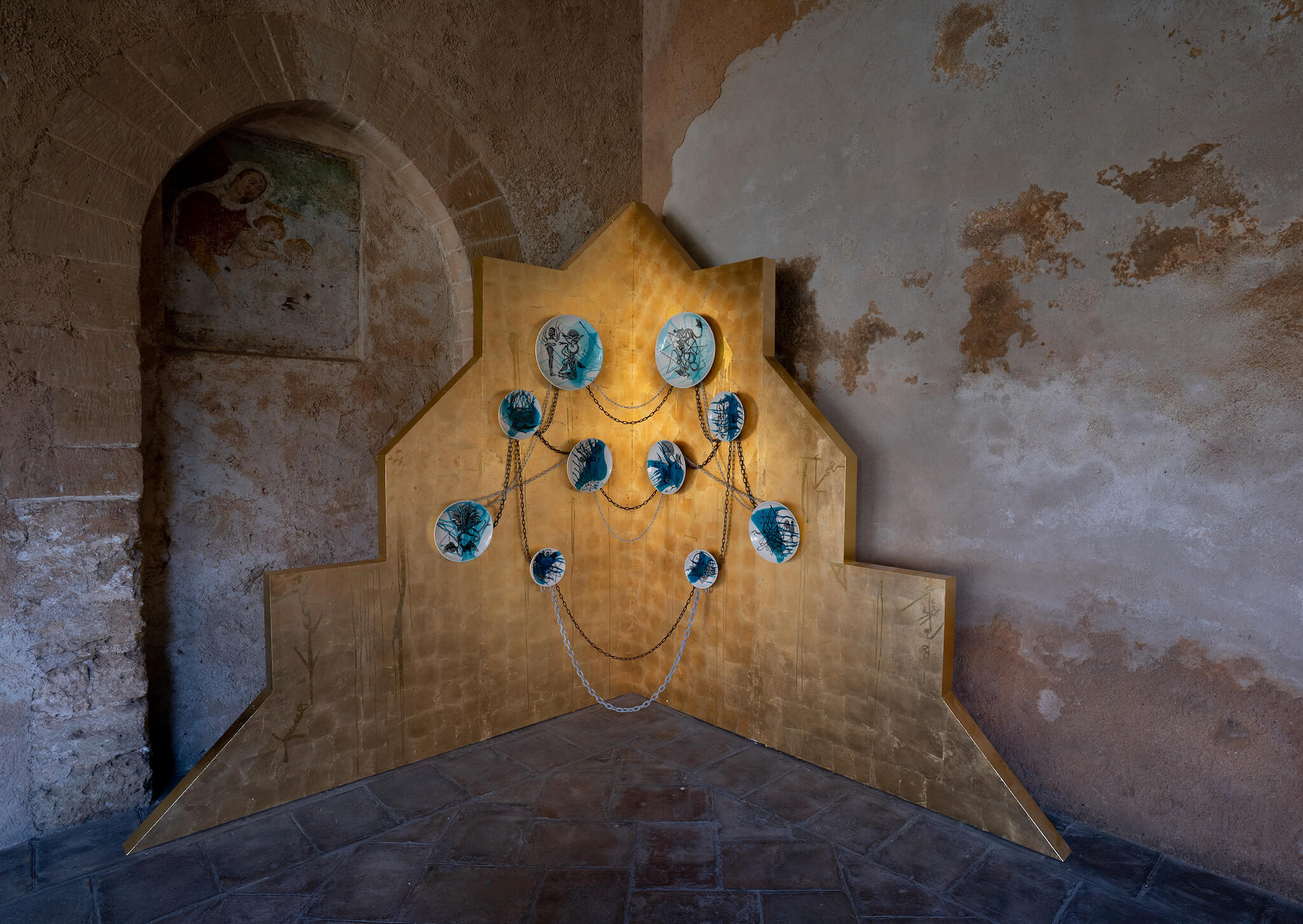
Exhibition, Oriente e Occidente. Allegorie e simboli della tradizione mediterranea. Installazioni di Navid Azimi Sajadi, 2020/21, Monreale, Palermo There is a strong geographical aspect to your words, both in an evocative sense and in the management of space and time in your art. You spoke to me earlier of two souls that coexist in your work, that of continuity, which in some way I feel is connected to your roots, and that of being always in search, a traveller, I would say. Am I wrong to read behind the double identity of your works and your personal history? Being born in Iran and always being with one foot in the “middle” that lies between East and West, what is there of one and the other in your life as an artist?
You are absolutely right to find this specularity between the soul of my work and my personal life. Certainly, my culture and experimentation are two sides of the same coin. As far as my Western side is concerned, I’ll ask you a question that is intended to be a little provocation, but what is the West we are talking about? I arrived in Italy several years ago, but what I found was certainly not the West with the canons that now seem to be standardized, which perhaps reflect more a Central European history, which has traced a trajectory in the last 300 years; what I found here in many ways is instead the same spirit that I left in Iran, that I would find in Turkey, Egypt or Greece, although the religious discriminant, which today is what makes the difference, seems to divide us; however, a very long line unites these peoples, and that is history.
Are you talking about a Mediterranean society, which unites a geopolitical scene that has lost in forced globalisation the common and communal identity of peoples who speak, eat, sing and pass on a way of being that is thousands and thousands of years long?
Exactly. I would like to tell you a short anecdote about something that happened to me during my last exhibition in the wonderful setting of Monreale, Sicily. There, I installed a series of ceramics with evocative and meaningful symbols. Many viewers and journalists (but also locals) asked me where I got those images from, if they were a legacy of my Persian origin. Well, it was very amusing for me to reveal that they were all figures that already existed right there in Monreale, and I had taken colours and symbols right from Palermo. However, there is also a kernel of truth in what they thought. The Middle East that they saw in the shapes was actually in the features, traced by a Persian hand and stroke, but the stroke and the sign interpenetrate so naturally that it becomes difficult to separate the two cultures, which are evidently more sisterlike than we remember.
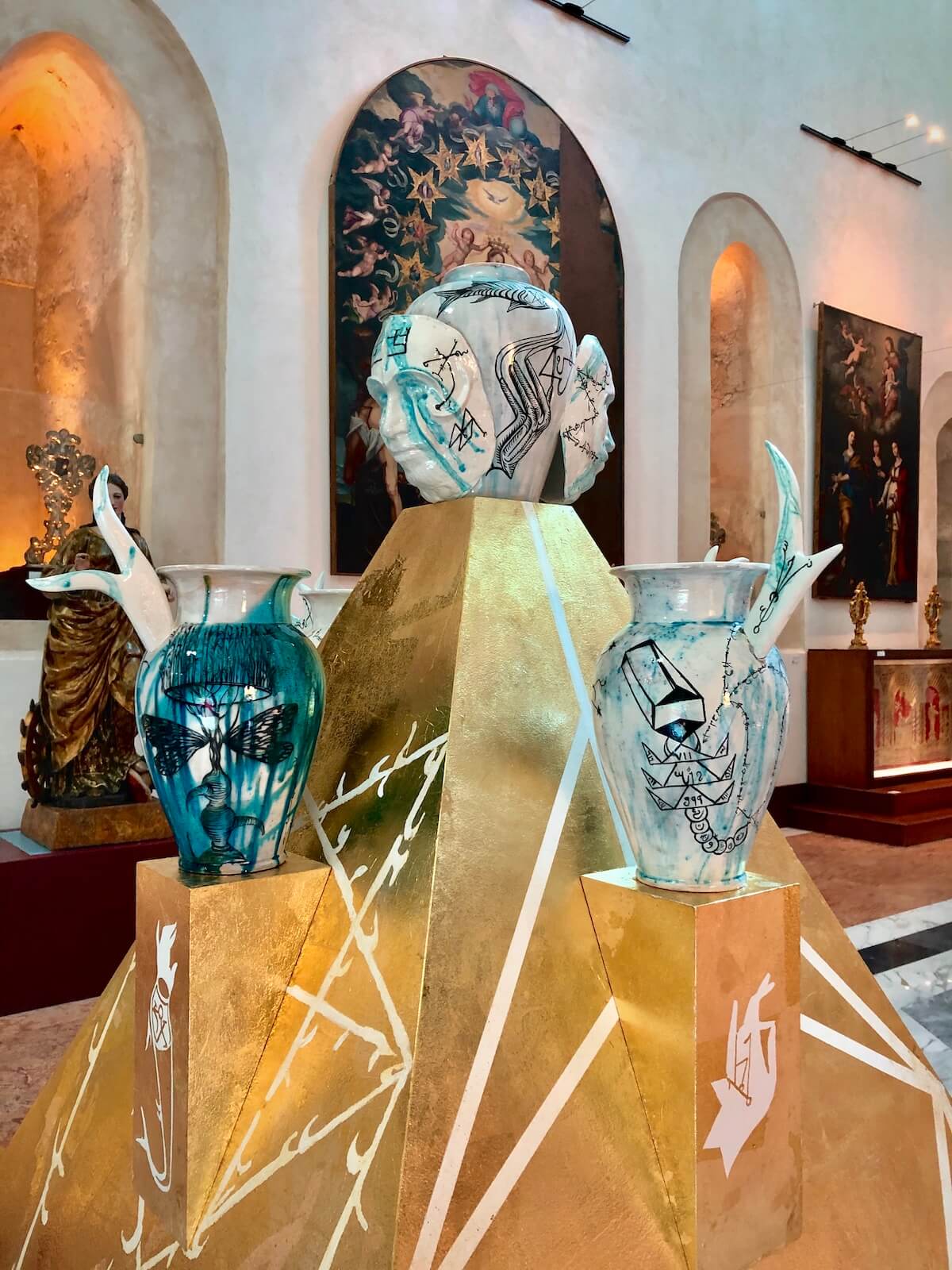
Exhibition, Oriente e Occidente. Allegorie e simboli della tradizione mediterranea. Installazioni di Navid Azimi Sajadi, 2020/21, Monreale, Palermo Your themes are always timely because they are ancestral, and somehow seemingly distant from the contingent facts of everyday life. The world we are living in now, among various insecurities, political, pandemic, environmental and social, is having a strong impact on every aspect of human life. How is art intervening, in your opinion?
What I say to you now is sacred to me. Living in various difficult situations, from my childhood in Iran, along with many kids of my generation, almost every month, every year, we have seen and experienced various disasters. War, injustice and various calamities seem to have necessarily turned us into political artists. Yet today I don’t want to “limit myself” to telling the story of reality as I see and experience it. In my view, the role of the artist is not to show others what is wrong with the world; that task is the responsibility of the journalist. For me it would be like scratching the surface. What I have to do as an artist is to live reality like all the people who are suffering now rather than disavowing it, to assimilate it before letting it go, allowing it to affect me and in an unconscious way letting it emerge in my work. The indirect effect will not have an immediate outcome but a poetic one, which will end up connecting that moment in a more intimate and at the same time more understandable and lasting way.
Paradoxically, this cultivation of the present as a seed in the heart of the artist to sprout in the future preserves an optimism towards life that we do not find in other aspects of our contemporary world, in which we want everything and everything now. Can we learn something from art in this too?
I would like to make a comparison with agriculture, both because I believe that the relationship with the land is a great parable for life and because I have a very strong passion for wine! It is a period in which it is very fashionable to drink the so-called blood wines, wines that taste a bit like iron. In order to obtain these wines it is possible to pragmatically decide to throw some minerals under the vines in order to give that taste to the first available grapes, or it is possible to plant the vineyard on a naturally clay-like soil, which means waiting for four years before having a good wine. However, in the first case even though the result will be immediate, the choice will imply the yield of just one vintage; on the contrary, the vineyard planted on the right, natural soil will always continue to produce the right grapes for the desired wine. Works of visual or poetic art do not invest in the short term, because they refer to the part of us that overcomes contemporaneity and our limited aims. This is also true for the career of an artist in my opinion. Anything that has to be truly lasting and worthwhile cannot happen overnight. If I’m a boy, I can’t grow two inches a day; I have to develop slowly. If they pumped me full of hormones I wouldn’t live long; it has to be a natural process.
Navigate through Navid Azimi Sajadi’s Artist Room
Sumac Space is a venue for raising questions and conversations.
It is updated every Thursday with a new, fresh dialogue/text.
Subscribe to the newsletter to be kept up to date.Ofelia Sisca (b. 1986) is a curator, journalist and content manager; she graduated with honours from the University of Rome La Sapienza with research on sonority in the artistic act. She specializes in cultural journalism and is trained in the design, communication and promotion of projects dedicated to artistic and cultural enterprises under the joint direction of the Ministry of Heritage and Culture, the University of Rome La Sapienza and the Research Center on Entertainment. She holds a master’s in management of museums and cultural enterprises from 24ORE Business School.
She has been responsible for the communication of cultural events, has written articles and essays for magazines in the arts, and is an editor and South manager for the magazine Artribune. She is currently the manager of an art gallery for which she deals with curatorship and management. She produces critical texts on art and international artists, curates independent exhibitions and interdisciplinary events, and structures projects and educational plans for contemporary art.
Navid Azimi Sajadi – Sotto alla superficie
Una conversazione tra Navid Azimi Sajadi e Ofelia Sisca
Che tipo di artista ritieni di essere a questo punto della tua carriera?
Ancora lo sto cercando, e forse questa indagine è anch’essa parte della mia identità!
Sono uno sempre alla ricerca, è una caratteristica che ho scoperto solo lavorando, l’altra faccia della continuità, che infatti è l’altro cardine dei miei valori, ma tutta la dedizioni con cui racconto i temi che mi sono cari ho scoperto essere solo una parte di quel che produco, l’altra espressione del mio lavoro è proprio la voracità dello studio, la curiosità e l’entusiasmo nell’approcciarmi appena posso a modi nuovi per raccontare. Non sono uno di quegli artisti puristi della materia insomma, uno che lavora con un mezzo e uno soltanto, che trova nel materiale la sostanza della continuità del proprio lavoro. Al contrario sono un esploratore, mi piace sperimentare diversi supporti, differenti linguaggi e relativi vocabolari! È una continua scalata in qualche modo.. Diverse tecniche in cui mi imbatto mi fanno ritornare al punto di partenza, si tratta quindi di imparare un lessico del tutto nuovo e insieme di sfidarsi a trovare il punto nevralgico di ciascun idioma, quello che mi permette di raccordare la mia ‘lingua’ ad ognuna di quelle incontrate. Per me è fondamentale confrontarmi con mezzi diversi per creare percorsi diversi, facendo di ogni pezzo un unicum, raccontato in un codice materico originale, frutto di combinazioni di culture e approcci differenti.
Dove risiede allora la continuità nella mia attività? Nella materialità, che emerge con il metodo e con i temi (religiosità, mito, cultura, sessualità) nei segni caratteristici che imprimo ad ogni lavoro, che sia un disegno, una scultura, una istallazione, una ceramica e non di meno anche un progetto on line, tutti devono dialogare intimamente con lo spazio e con lo spettatore.
Veniamo a Sigillum, il progetto che vediamo su Sumac Space, come si declina la materialità sul web?L’on line è stata una bella sfida per me, perché, come ho detto, la fisicità è fondamentale nel mio approccio al lavoro. La chiave che mi ha permesso di esprimermi in libertà in questo progetto sta nella dinamicità. Non si tratta di forzare un blocco fotografico relativo alle opere in uno spazio bidimensionale, ma della fruizione elastica di queste e dell’intera identità degli artisti. In quest’ottica l’operazione sposa perfettamente la personalità multiforme delle mie opere e aggiunge un tassello ulteriore alla costellazione a cui penso quando vedo il mio lavoro in prospettiva. Differenti pezzi che attraverso molteplici mezzi rivelano una storia generale, arcana e ancestrale.
Quindi oltre ad essere conclusi in sé stessi i tuoi lavori, presi insieme, sono pensati come un percorso artistico unico in continuo divenire? Una sorta di mappa, fatta di indizi, oggetti, forme che solo letti insieme possono costruire il quadro del tuo lavoro? E dove ti sta portando questa mappa come artista?
Hai detto una parola magica per me: mappa. La mappa è un gioco in cui perdersi, tra le tappe della proprio vita, i posti che si sa già di voler esplorare e quelli in cui invece finiremo inaspettatamente. Avevo una mappa da ragazzino in cui ogni luogo rappresentava per me qualcosa, che è mutata e insieme è rimasta la stessa, è partita ad esempio dalla Roma degli antichi romani ed è arrivata oggi a quella che ho vissuto. La mappa non ci dà tempi né certezze, nessuno sa quando, se e che tipo di viaggio lo aspetta, eppure accade. Identificare il percorso non è possibile, lui passa sotto ai tuoi piedi, quello che si può fare è lasciarlo scorrere, così è per me il lavoro dell’artista, non è tanto decidere il percorso, ma imparare ad interpretare, leggere, vivere e collegare i diversi ‘luoghi’ che ci si trova ad affrontare.
Mostra, Oriente e Occidente. Allegorie e simboli della tradizione mediterranea. Installazioni di Navid Azimi Sajadi, 2020/21, Monreale, Palermo C’è un aspetto fortemente geografico nelle tue parole, sia in senso evocativo che di gestione dello spazio e del tempo nella tua arte. Mi hai parlato prima di due anime che convivono nel tuo lavoro, quella della continuità, che in qualche modo mi sento di collegare alle radici, e quella sempre alla ricerca, viaggiatrice direi. Sbaglio a leggere dietro l’identità duplice delle tue opere la tua storia personale? Nato e sempre
con un piede nel ‘medio’ che sta tra oriente e occidente? Cosa c’è dell’uno e dell’altro nella tua vita d’artista?Hai assolutamente ragione a riscontrare questa specularità tra l’anima del mio lavoro e la mia personale. Non a casa lo specchio, inteso come riflesso, è uno dei topoi del mio lavoro. Di sicuro la mia cultura e la sperimentazione sono due facce della stessa medaglia. Per quanto riguarda la mia parte occidentale ti faccio io una domanda che vuole essere una piccola provocazione, ma qual è l’occidente di cui stiamo parlando? Io sono arrivato in Italia ormai diversi anni fa, ma quello che ho trovato non è stato di sicuro l’occidente con i canoni che ormai sembrano essere standardizzati, che rispecchiano forse di più una storia mitteleuropea, che ha tracciato i sui binari nel solco degli ultimi 300 anni; quello che ho trovato qui per molti versi è invece lo stesso spirito che ho lasciato in Iran, che troverei in Turchia, in Egitto o in Grecia, per quanto la discriminante religiosa, che oggi è ciò che fa la differenza, sembra dividerci, tuttavia una lunghissima linea unisce questi popoli, ed è la Storia.
Parli di una società mediterranea, che accomuna una scena geo-politica che ha perso nella globalizzazione forzata l’identità comune e comunitaria dei popoli che parlano, mangiano, cantano e tramandano un modo di essere lungo migliaia e migliaia di anni?
Esatto. Ti racconto un breve aneddoto capitatomi nell’ultima mostra allestita nella meravigliosa cornice di Monreale, in Sicilia. Lì ho installato una serie di ceramiche con simboli evocativi e significanti. Molti, tra spettatori e giornalisti (ma anche addetti ai lavori) mi hanno chiesto da dove avessi ricavato quelle immagini, se fossero un retaggio della mia provenienza persiana. Ebbene è stato molto divertente per me rivelare che erano tutte figure che già esistevano proprio lì a Monreale, avevo preso colori e simboli proprio da Palermo. Tuttavia c’è un fondo di verità anche in quello che hanno pensato. Perché il Medio Oriente che loro vedevano nelle forme era in realtà nei lineamenti, tracciati con la mano e il tratto persiano, ma il tratto e il segno si compenetrano così naturalmente che diventa difficile scindere le due culture, che evidentemente sono più sorelle di quanto ricordiamo.
Mostra, Oriente e Occidente. Allegorie e simboli della tradizione mediterranea. Installazioni di Navid Azimi Sajadi, 2020/21, Monreale, Palermo I tuoi temi sono sempre attuali perché ancestrali, e in qualche modo però apparentemente lontani dai fatti contingenti del quotidiano, il mondo che ci troviamo a vivere ora tra insicurezze varie, politiche, pandemiche, ambientali e sociali sta avendo un impatto fortissimo su ogni aspetto della vita umana, e sull’arte come sta intervenendo secondo te?
Quello che ti dico ora per me è sacro. Vivendo in varie situazioni difficili, dall’infanzia in Iran, insieme a molti ragazzi della mia generazione, quasi ogni mese, ogni anno abbiamo visto e vissuto vari disastri. Guerra, ingiustizie e calamità più disparate sembrano doverci trasformare per forza in artisti politici. Eppure io oggi non voglio ‘limitarmi’ al racconto della realtà così come la vedo e la vivo. Nella mia concezione il ruolo dell’artista non è quello di mostrare agli altri quello che non va nel mondo, quel compito spetta al giornalista. Per me sarebbe come correre sulla superficie, quello che devo fare come artista è vivere profondamente la realtà prima di smaltirla come tutte le persone che ora stanno soffrendo, assimilarla prima di lasciarla andare, permettendole di fare il suo effetto dentro di me ed in modo non cosciente lasciare che emerga nel mio lavoro. L’effetto indiretto non avrà un esito immediato, ma uno poetico, che finirà per raccordare quel momento in modo più intimo e insieme più universale e duraturo.Paradossalmente questo coltivare il presente come un seme nel cuore dell’artista per germogliare in futuro conserva un ottimismo verso la vita che non riscontriamo nel resto degli aspetti del nostro mondo contemporaneo, in cui vogliamo tutto e subito. Anche in questo possiamo imparare qualcosa dall’arte?
Farò un paragone agricolo, sia perché credo che il rapporto con la terra sia una grande parabola di vita sia perché ho una fortissima passione per il vino! È un periodo in cui è di gran moda bere dei vini ematici, quindi dal sapore ferroso, per ottenere questi vini si può molto pragmaticamente decidere di buttare un po’di minerali sotto le vigne così da imprimere subito quel gusto alle prime uve disponibili, oppure si può piantare la vigna su di un terreno naturalmente argilloso, questa vuol dire aspettare quattro anni prima di avere un buon vino, tuttavia nel primo caso pur se il risultato sarà immediato, la scelta implicherà la resa di una sola vendemmia, la vigna piantata sul terreno giusto per natura, invece, continuerà sempre a far nascere uva giusta per il vino desiderato. Le opere di arte visiva, o poetica non investono sul breve periodo, questo perché raccontano una parte dell’uomo che sovrasta la contemporaneità e le nostre mire limitate.
Questo vale anche per la carriera di un artista a mio parere. Ogni cosa che debba essere davvero duratura e valevole non può accadere dall’oggi al domani. Se sono un ragazzo non posso crescere mica di cinque centimetri al giorno, deve svilupparmi pian piano, se mi imbottissero di ormoni camperei certo poco, deve essere un processo naturale, se diventerò un uomo di due metri ben venga, altrimenti rimarrò un bassotto… e andrà bene così.Navigate through Navid Azimi Sajadi’s Artist Room
Ofelia Sisca (n. 1986) è curatrice, giornalista e content manager; laureata con lode presso l’Università di Roma La Sapienza con un lavoro di ricerca sulla sonorità nell’atto artistico, si perfeziona prendendo una specializzazione in giornalismo culturale, si forma nell’ideazione, comunicazione e promozione di progetti dedicati alle imprese artistiche e culturali sotto la direzione congiunta del Ministero per i Beni e le Attività Culturali, l’Università di Roma La Sapienza e il Centro di Ricerca sullo Spettacolo, e con un master in Management dei Musei e delle Imprese Culturali alla 24Ore Business School. Ha curato la comunicazione per eventi di cultura, ha scritto articoli e saggi per riviste di settore, è redattore e responsabile Sud per la rivista Artribune. Attualmente è manager di una galleria d’arte per la quale si occupa di curatela e gestione. Produce testi critici sull’arte e gli artisti internazionali, cura mostre indipendenti ed eventi interdisciplinari e struttura progetti e piani educativi all’arte contemporanea. -
Mirroring the Real—Elmira Abolhassani in Conversation with David Revés
In this email exchange between artist Elmira Abolhassani and David Revés, Abolhassani reflects on her unique journey as an Iranian artist living in Portugal, citing its international accessibility and cultural openness. She delves into her multidisciplinary background in industrial design and glass art, revealing how her artistic process intertwines with themes of identity, communication, and self-reflexivity. Abolhassani’s work, characterised by its meticulous attention to materials and subjects drawn from Persian culture, invites viewers to engage with complex narratives of individual and collective experience.
I think that we could start by noticing a very intriguing and relevant fact in your life path. You are an Iranian artist who chose to live in Portugal more than ten years ago and, in the meantime, you have even acquired Portuguese nationality. First of all, I would like to ask you what made you choose Portugal – and specifically Lisbon – to live, considering that these places do not seem particularly important in terms of contemporary art (a condition that, we might think, would discourage an artist from another country to move here). Second, I would like to ask you how the Portuguese cultural rhythms and specificities, as well as its distinct territorial scale and demography compared to Iran, have already influenced your artistic practice, or rather, how you and your work move between such different cultural and societal realities.
This question is always the first concern for Iranian and Portuguese citizens when they find out that I chose to live in Portugal. I think this is because for both countries the other one is somehow unknown. But I see Portugal, specifically Lisbon, as a calm place that can easily access the international art community. It has everything that you need in a small area.
I have always been curious about other cultures, what is happening in other places around the world, or the interconnections between people. We all can see how the politics of some countries have an effect on other countries.
In some cases, like Iran, it is straightforward. But Portugal is one of the last places in the West that I believe preserves its own character. For someone like me, it gives room to think about my project out of the box but within a society that doesn’t have any negative or positive preconceptions about your background.I came from a country with a history as long as the history of the civilisation itself. Living in Iran as an artist gives you an opportunity to engage with many subjects that can inspire you to create artworks. But, personally, I need a space to think out of the place I am used to being in. For me, Portugal has all of the characteristics that I was looking for.
I got my master’s degree in Glass Art and Science from the Faculty of Fine Arts of the University of Lisbon.During my master’s studies, I had classmates from all over the world, even Murano, Venice. Because the way you look at the glass is very different from the traditional one. Around the world it is common to use glass as they do in Murano – to make high technique objects. So, there aren’t lots of schools in the world specialising in glass art.
For your second question, I have been curious about humans, identities and cultures for as long as I can remember. Therefore, super-modern countries with a character that I believe is a mere copy of other countries are not the places I want to spend my time in. I love walking in Lisbon and smelling the pastéis de nata or hearing a piece of fado. I don’t know if Portugal has had a direct effect on my artwork, but my background and the atmosphere that this country has are part of me and my art.
Your professional career is also quite distinct and atypical: you are a visual artist who first graduated in industrial design and later did a master’s degree in art and glass technology. That connection is evident in your artistic work, precisely because of a constant interest in and attention to certain objects of daily use, which you appropriate, reformulate, animate, duplicate or invoke. I would like you to tell me a little more about the specificity of this path and those interests.
Before I graduated with a bachelor’s degree in industrial design, I got a diploma in painting, which I think has had a massive role in my journey. Also, I believe objects have different characters, so I tried to feel these differences even when I studied industrial design. For example, why does a customer chose a particular colour, this shape or that material, etc.? All of this gives us information that comes from people’s characters or identities. In other words, you can read people through their choices.
I wanted to go further and understand more about identity, communication and self-reflexivity, and design does not have this capacity. However, all the knowledge and imagination that help me create my installations come from my experience as an industrial design student. The nature of glass can be transparent or opaque, hard or soft, melting hot or solid, which gave me an opportunity to think beyond the objects.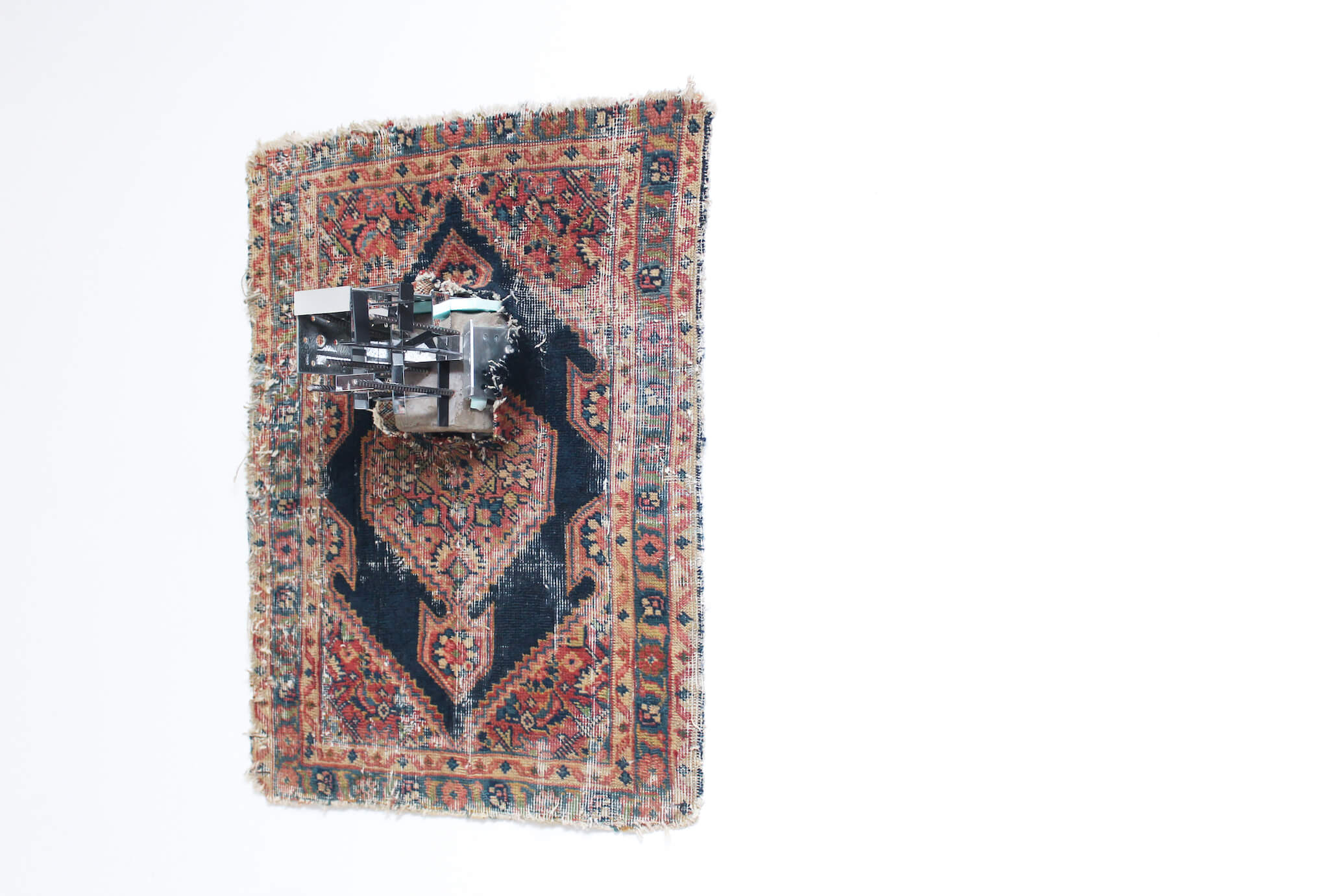
Elmira Abolhassani, What happened with your face?, 2019, Persian carpet, foam, cement, plexiglass, iron At certain times you are interested in precise material elements of daily life – which in your work come mainly from the symbolic fabric of Persian culture – though this is not always the case. Other times you address specific social events or movements whose material delimitation is less evident, as is the case with The Silent Hands that you are currently exhibiting on Sumac Space. There I find a political dimension to your work but above all it also intends to act within the articulations of an oikonomy of appearances, characterising and established within a certain culture. In that sense, I would even dare to say that your work is less about objects as autonomous material forms than about subjective networks, or even a collective unconscious, of which they are expression and a result.
I am working on three rings of a single chain – identity, communication and self-reflexivity – and I express them in all the ways I can. I try to know each material’s properties and use them in my work, but the subject is my priority.
Therefore, although we witness the use of a wide range of materials in my work, the time I spend researching the subject is far more than the actual making of the work.
For example, The Silent Hands is still an ongoing project. I have spent at least three years researching Afghan immigrants who live in Iran and other countries. Almost every day, I have an interview with someone from Afghanistan, or I talk to other artists or journalists working on this subject. The collection of sounds becomes more abundant and more prosperous. On the other hand, I only spent one month making the glass part of the installation.Despite all this, it is unquestionable how you wanted to become an expert craftswoman, namely regarding glass, a material that you master with extreme accuracy and wisdom. I would like you to tell me a little more about your relationship with glass, its techné and the intuitive processes that are established, in addition to the way this material assumes a special predominance in your artistic practice.
I have experience using wood, plaster, metal, plastic, ceramic and a lot more with my industrial design background.
But I believe working with glass is technically the hardest one to master because what you can do with glass is done in a very short time and in a sweltering place like a furnace or the flame of a glass torch.
Also, because of the thermal shock, you never know what will happen in the next second. So, you need to have lots of patience. I try to find myself while trying to master glass. Glass is a material, a living creature that you have to befriend to be able to work with. In glass science, there are lots of different types of glass, and each of these types has its own behaviour in terms of heat, annealing time, etc., which I think is just like different people’s personalities.
It is true that I am a professional glass maker, but again I use all the skills and materials that I have as a tool for sending my message to my audience. It is easy for me to make a work that everyone marvels at because of its delicacy or its craft aspects. But I am trying to avoid making crafts.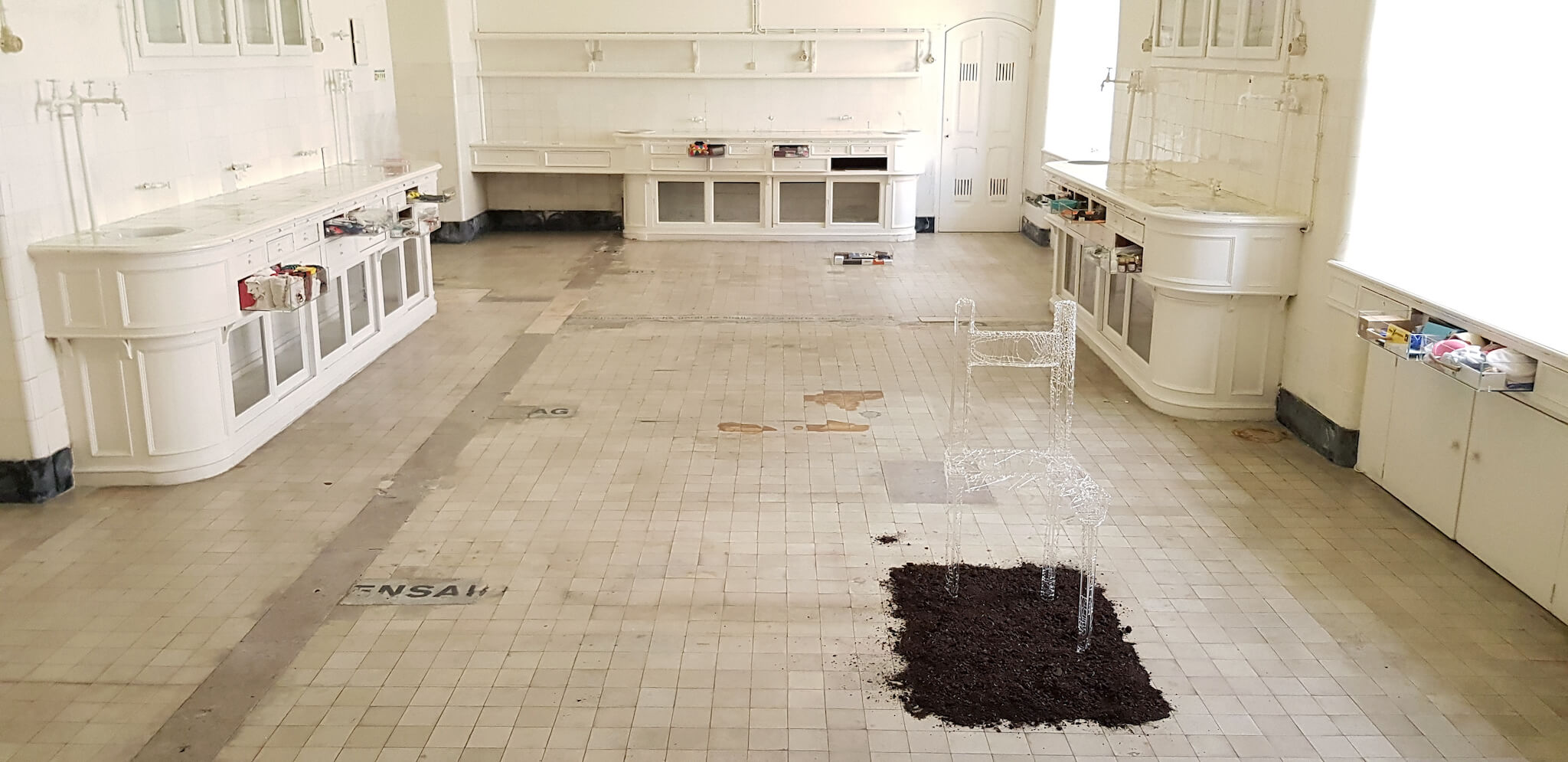
Elmira Abolhassani, Like every day, 2018 Let’s look at the mirror, another element that frequently recurs in your work and that immediately establishes an intimate relationship with glass itself. I noticed that you invoke it within some associations with certain elements of traditional Persian architecture, but it seems to me that, above all, the way you use the mirror (and mirroring) establishes a mechanism that destabilises its traditional moralising or dominating role in a closed process of individuation. When using mirrors, you are asking us to do the opposite of that, showing that the real and the individual are composed of a myriad of never-stable fragments that always recompose and update depending on the positional dynamic character of a relationship. There I see a strong ethical sense – an ethos – in the core of your poetics, which inevitably develops, as a political proposition for the contemporary world and of the forms of constructional subjectivity.
I can’t analyse myself or even my work the way that other people can do because they are a part of me and my life journey. But I can tell you about some issues that I have been interested in since I was a child and then I can see how they have affected my work.
I was born in Mashhad, the second largest city in Iran. The biggest holy shrine in the world is there; it is one of the most popular destinations for many people. Because of all the trade happening there, Mashhad is one of the main economic hubs in Iran with a huge turnover. From when I was a child, I can remember believers from all over the world coming there to pray. Their reflection on mirror mosaics on the holy shrine’s walls and the whisper of them meant something for me. Many years later, we can see the mosaics emerging in my work. In another example, we see merchants from our neighbouring countries on the street with their traditional clothes.
Politics and history have always been my concerns. But, as a citizen who lived in Mashhad, I witnessed all the ups and downs that happened in the Middle East. With each war, we have seen immigrants flooding our city, and I deeply believe we, as humans, have an impact on other people’s lives. One of the reasons I migrated to Portugal was that I wanted to have a better perception of the human network and interconnection between people. The political flavour in my work comes from my experience and the way I look at the world.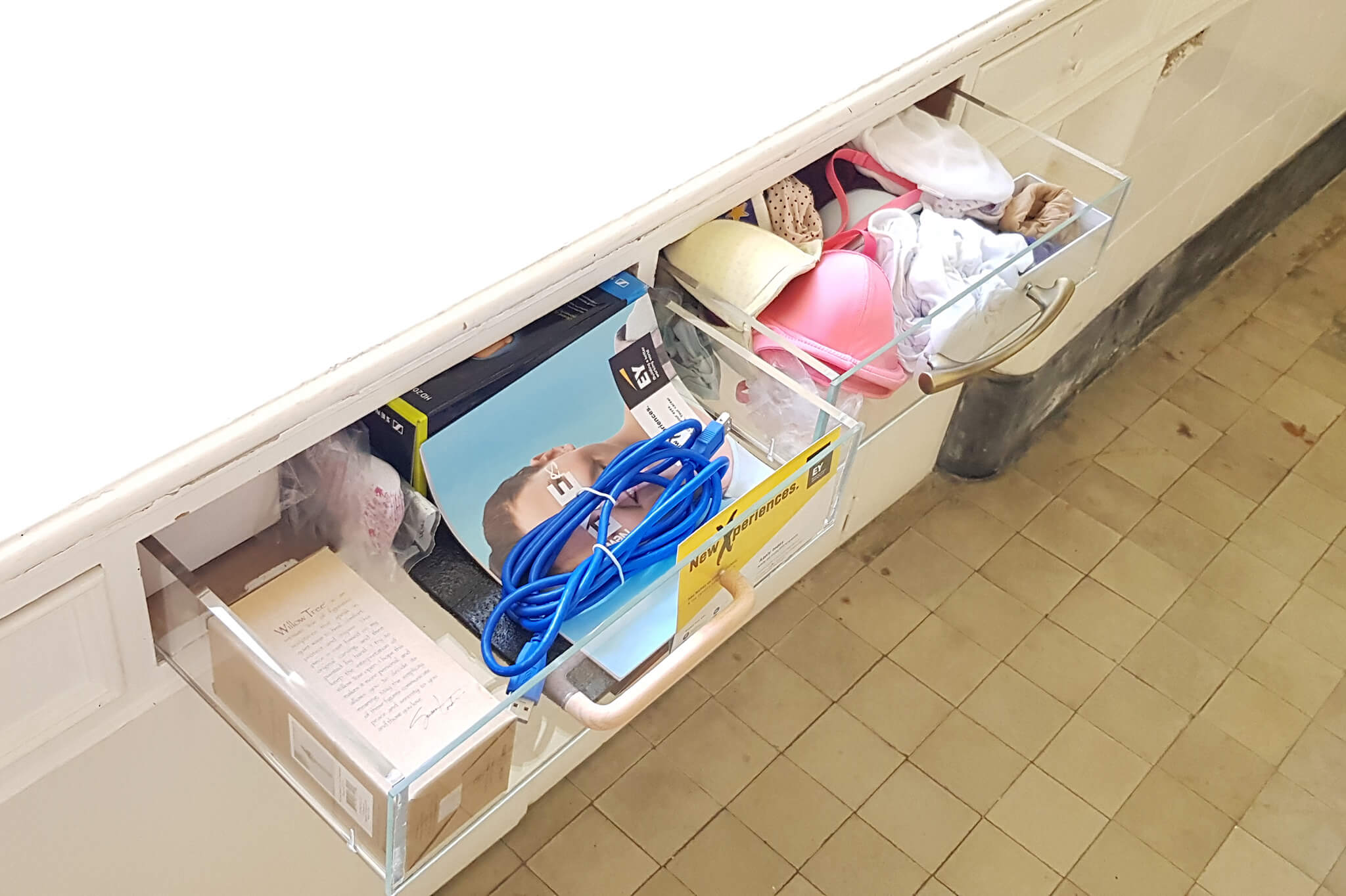
Elmira Abolhassani, Like every day, 2018, Detail There is yet another evidence, at least in the relationship I have established with your work, that I think is interesting to underline about your poetics. Despite your keen interest in sociocultural forms and structures, in the objects that are born in the Middle East, as well as in the processes of constructing individual and collective bodies within the world, there is always something that is present and seems to escape – almost in a Nietzschean sense of both construction and implosion of shapes1. That, I would say, could be located in the vocation that your work has in bringing together the chaotic forces of the Earth, an ambivalence between life, will and destruction, that always overcome any attempt to control or stabilise the forms of culture and the supremacy of the individual.
I totally agree with your interpretation. Every day I look for questions, and art is just a tool to express myself. But the more I proceed, the more I realise that I know less. I am proud to be aware of this emptiness. Lots of us are fighting for things that we believe in, but the truth can be the complete opposite of that.
I try to bring these questions to people’s minds with my work: How can I criticise my beliefs? or Do my beliefs reflect reality?
This ambivalence about what I know generates the form of my work. NAVIGATE THROUGH ELMIRA ABOLHASSANI’S ARTIST’S ROOM.1 F. Nietzsche, Nietzsche Werke. Sämtliche Werke. Kritische Studienausgabe, 15 volumes. Edited G. Colli and M. Montinari, Berlin: Walter de Gruyter, 1980.
Elmira Abolhassani, b. 1989, Mashhad, Iran.
Lives and works in Lisbon, Portugal.Abolhassani holds a master’s degree of glass art and science from the Lisbon Fine Art University. The ultimate purpose of her artistic journey, to date, has been to understand how human networks and identities are formed and what their underlying structure is. Her works reflect her attempt to understand the meaning of network systems and, in particular, her role and position – as an individual node – in this complex web, as well as the nature of her artistic task as an interpreter of this all-encompassing network. Her works and thoughts stem from her belief that we must first attain a clear vision of ourselves in order to apprehend significant aspects of our world.
Therefore, as a visual artist who uses glass as the primary material in her works, she tries to find herself while trying to master glass. Glass is a material that can be soft or hard, transparent or opaque, solid or liquid: a living creature that you have to befriend to be able to work with. However, as an artist, she uses any object that can demonstrate her concerns.Her works have been exhibited in both solo and group exhibitions in international galleries and institutions such as S12 Gallery, Bergen, Norway (2019); Redgate Gallery, Beijing, China (2019); National Museum of Natural History and Science, Lisbon, Portugal (2018); and the City Museum, Almada, Portugal (2016).
David Revés, b. 1992, Lisbon, Portugal.
Lives and works in Lisbon.Revés is an art critic, independent curator, and researcher. He holds a master degree in Art Studies – Art Theory and Criticism (University of Porto, Portugal) and is studying for a master degree in Communication Science – Contemporary Culture and New Technology (NOVA University, Lisbon, Portugal). David has explored the field of new media and is interested in the way it entwines with art, exhibiting devices and politics of the image. He writes critiques and essays, contributing regularly to several publications, as well as artistic and academic projects.
-
A Garden of Tongues—Camila Salame in Conversation with Zahra Zeinali
This email conversation between artists Camila Salame and Zahra Zeinali delves into Salame’s artistic journey and her current project, Speak Mnemosyne: An Ocean of Words and some Middle-Grounds (2020) Ongoing. Salame, a Colombian-Lebanese artist based in Paris, explores the intersections of art, identity, and memory through her sculptures and installations. The interview navigates her views on Contemporary Art, emphasizing the importance of establishing a connection between the viewer and the artwork. Salame discusses her ongoing project, which emerged during the lockdown in Paris and centres around the exploration of language(s) as territories of plural identity, intertwined with memory and forgetting…
A Garden of Tongues—Camila Salame in Conversation with Zahra Zeinali
This email conversation between artists Camila Salame and Zahra Zeinali delves into Salame’s artistic journey and her current project, Speak Mnemosyne: An Ocean of Words and some Middle-Grounds (2020) Ongoing. Salame, a Colombian-Lebanese artist based in Paris, explores the intersections of art, identity, and memory through her sculptures and installations. The interview navigates her views on Contemporary Art, emphasizing the importance of establishing a connection between the viewer and the artwork. Salame discusses her ongoing project, which emerged during the lockdown in Paris and centres around the exploration of language(s) as territories of plural identity, intertwined with memory and forgetting processes. The series of sculptures, predominantly crafted from materials like paper, ceramic, paraffin, and translucent elements, invites viewers to reflect on the embodiment of “immaterial” language and its profound impact on personal and collective experiences.
Can you tell us a bit about you?
I am a Colombian-Lebanese artist based in Paris. I work in Paris, Bogota and Beirut.
While doing my fine arts and art history undergraduate studies in Bogota, I enriched my core art program with sociology and philosophy courses. These two areas of study were quickly integrated in my creative process up until today. Notions such as ‘Place of Origin’, ‘Reconstruction of Memory’, ‘Identity’, ‘Home’, ‘Loss of the Mother Tongue’, ‘Exile’, ‘Diaspora’ and ‘Migration’ amongst others, echoed in my own life experience and became part of my areas of artistic thought. As part of the third generation of Lebanese diaspora in Colombia and currently living in France for more than 10 years, I am constantly confronted with these subjects. I “weave” my own reflections about them through my sculptures and installations in an attempt to grasp responses. By creating semantic relationships at the heart of my artwork, I aim to invite the viewer to engage in sensorial or poetic narratives.Before speaking about your artwork in the Sumac Space – Past Continuous exhibition, I would like to have your point of view regarding Contemporary Art. What is art for you today?
Art is today what art has always been, a means of communication, an expression of our cultural context, our rituals and beliefs, our vision(s) of the world and moreover an aesthetic experience that aims to connect the work and the viewer. Art triggers emotions, sensations, arises questions or provokes indifference in the “eye” of the beholder. Art has wished to convey different messages and meanings through its history.
I think that messages and meanings that Contemporary Art wishes to convey are much broader today than ever before and it reaches out to many other fields of thought and discourse such as politics, gender, history and then of course intimate and very personal stories. It has also the capacity of revealing voices from artists of diverse cultures and backgrounds.
Yet, sometimes I feel that the message that some very interesting artworks wish to transmit is lost because of a lack of context. The message is then totally encrypted and the viewers feel excluded from part of the experience that the artwork would potentially bring them. I believe that this might be the reason why some spectators find Contemporary Art hermetic. I have always considered it fundamental to accompany my artwork with text which helps to open a dialogue with the viewer. I have a personal writing practice and it is in the writing process that many of my reflections and thoughts come together.
You alluded to the importance of establishing a link between the viewer and the work of art.
In my opinion, today’s art has elevated the position of the viewer to the questioner. Accepting this, can we say that today art is no longer what it has always been?I believe that art has not changed in the sense that as I said before, to me, art aims to communicate. What has changed and what characterises Contemporary Art is the “shape” it takes, hence changing the experience. For instance, the plural and diverse means that artists use to convey their message to the viewers, make them no longer only viewers but actors of the artworks themselves. In that sense, our way of understanding and seeing art, of experiencing art has changed. I believe that the idea of the ‘viewer as a questioner’ is not new and it is an attitude on behalf of the spectator and his/her desire to engage with the work of art. I would say that, because “images” are omnipresent in our everyday life, the process of relating, interpreting or understanding visual material is more demanding.
For centuries, only painting and sculpture were considered art. Art historian studies allow us to tell important facts about a particular painting or a sculpture, that can speak to us about their potential use and meaning at the specific time and place they were made. We can tell things about their technique and their materiality. That information may influence our experience in front of an artwork. Art Historians question and sometimes create relations between artworks of very different periods of time -past present- and produce new meaning through these relations. Spectators do this too, in their own way, through their own subjectivity, through their own questioning glance. There is always a possibility of relating our personal experience or not to what we see. In this manner, Art has an inexhaustible meaning and power to communicate regardless of the period of time in which it has been produced. Let it be Renaissance our present time, the art experience renovates itself in the “eye” of the beholder. And I believe that it is in this, sometimes unutterable experience in the presence of an artwork, what makes the experience of art a unique place of meaning for each person.
You are presenting several sculptures, how are these artworks conceived? What are you exploring through this series of work?
The project I am presenting here is called Speak Mnemosyne: An Ocean of Words and some Middle-Grounds (2020) Ongoing. It is an exploration of language(s) as territory(s) of plural identity, and the function of memory and forgetting is the very process of language construction.
It was born during the lockdown that I spent in Paris. During these months, I did a lot of writing and reading and I began to explore a subject that had interested me before, but from a more personal point of view; my relationship with my mother tongue, Spanish. With English, which is the language in which I did all my scholar years, and which is my language of study. With French, which I learned at the beginning of my pre-adolescence and in which I also developed the notions of my practice and that nourished me greatly, especially in the field of philosophy and literature. It constitutes my language of thought. Finally, my relationship with Arabic, the lost language, which I try to decipher in my own way and at my own pace.
Our memory encapsulates sensations, images, but memory passes more often through language, through the narration of our memories, through oral and immaterial memory. In this new project, I am also interested in exploring the relationship of language with biological processes related to learning such as sleep and dreams, themselves also related to the processes of memory and forgetting in a scientific way as well as poetic, and even mythological as in Greek mythology, which is a source of inspiration for me.
This series of sculptures is made up of poetic images that speak of this relationship to language and for that I wanted to use words, texts and books -objects of memory. I wish to invite the spectator to reflect on the way in which “immaterial” language “embodies” in order to be able to speak of our relationship with it.
You have mentioned materials. I consider you choose the materials you use in your sculptures meticulously; can you tell me why? Where does this particular attention to materials come from?
I have always been aware of the evocative power of materials even from my earliest artwork and have chosen to use mainly natural ones for my sculptures and my installations. Let it be raw wool, flower petals, fabric, soap, sugar, beeswax, honey, paper, gold leaf, ashes, metal or rock, each has a symbolic value thanks to the different uses it encounters, its origin or the mythology that has been built round it. The precise choice of materials helps me establish a poetic dialectic that materializes in each piece. Each material has a story and a particular use, and according to this I create relations between them and notions I am exploring in the artwork. In An Ocean of Words and some Middle-Grounds (2020) I use mainly paper, ceramic, paraffin, thread, translucent cloth or translucent materials stones such as Quartz. Most of the pieces are white or transparent and evoke the intangible aspects of language. NAVIGATE THROUGH CAMILA SALAME’S ARTIST ROOM.
Camila Salame, b. 1985, Bogotá, Colombia.
Lives in Paris and works in Paris, Bogotá and Beirut.Having finished her studies in fine arts and art history at the Universidad de Los Andes in Bogotá, Salame moved to Paris, where she pursued a master’s degree in fine arts at the Université Paris 1 Panthéon-Sorbonne.
Her artistic practice is expressed through the use of a diversified and often unconventional range of media and materials charged with personal and symbolic resonance. In the form of sculptures, installations, drawings, her work seeks to create semantic and poetic relationships that evoke narratives, fragments of an individual mythology still inscribed in a universal history. Echoing a personal quest around her origins, her work explores notions of place of origin, reconstitution of memory, and territories of affection, as well as emotional and intimate architecture.
Salame was selected to exhibit her work at the 64th Salon de Montrouge, the most important exhibition for young emerging artists in France in 2019. She participated in the exhibition Attaches – Young Colombian Artistic Scene in Paris, which took place at the Cité Internationale des Arts in Paris as part of the France-Colombia Cross Cultural Year in 2017-2018. Her work was furthermore shown in Beirut at the exhibition Exposure -Young Lebanese Artists at the Beirut Art Center in 2013, connecting her to the contemporary Lebanese art scene.Recent Solo shows are: But I am no more I, nor is my house now my house – at the Rincon Projects Gallery, Bogota, Colombia 2019 and Rose Water and Orange Blossoms at the Arts and Humanities Faculty exhibition space – Universidad de los Andes, Bogota, Colombia 2019.
Zahra Zeinali, b. 1975, Tehran, Iran.
Lives and works in Paris.Zahra Zeinali completed her bachelor’s degree in painting from the Islamic Azad University of Tehran and worked as an art instructor for fifteen years. She developed an interest in photography and studied analog photography at the House of Iranian Photographers. In 2012, she relocated to Paris to continue her artistic journey as a painter. Later, in 2022, she completed her studies at the EFET Photographie École. This milestone prompted her to explore merging the two techniques in her recent works. Additionally, she commenced her role as an art teacher for children and young students at Le Cercle des Arts in 2022, allowing her to tap into the realm of childhood inspiration.
Zahra Zeinali has participated in several groups and solo exhibitions, including the recent Le Pays des Merveilles, Le Monde Invisible at Galerie Claire Corcia, and Alerte Rouge at Galerie Linda Farrell, Femme Vie Liberté at Galerie Sahar K. Boluki, Artcité à Fontenay, Comparaison au Grand Palais Éphémère, and Figuration Critique à Salon de Dessin Paris, among others.
Dialogues is a place for being vocal. Here, authors and artists get together in conversations, interviews, essays and experimental forms of writing. We aim to create a space of exchange, where the published results are often the most visible manifestations of relations, friendships and collaborations built around Sumac Space. SUBSCRIBE NOW TO STAY CURRENT.
-
Painting as Thinking Act—Taha Heydari in Conversation with Davood Madadpoor
You moved to Baltimore in August 2014. What is the situation like being an “Iranian artist” living in the USA? It has been pretty tough and fun. It depends where you land in the US, in LA or NYC or Baltimore… I actually do not know about being an Iranian artist in the US. I think it requires an insane amount of relentless reductionism to talk about an Iranian artist in the US in terms of identity. I can only talk about Taha in Baltimore from 2014 to 2020. The amount of uncertainty for individuals who happen to be from…
Painting as Thinking Act—Taha Heydari in Conversation with Davood Madadpoor
You moved to Baltimore in August 2014. What is the situation like being an “Iranian artist” living in the USA?
It has been pretty tough and fun. It depends where you land in the US, in LA or NYC or Baltimore… I actually do not know about being an Iranian artist in the US. I think it requires an insane amount of relentless reductionism to talk about an Iranian artist in the US in terms of identity. I can only talk about Taha in Baltimore from 2014 to 2020.
The amount of uncertainty for individuals who happen to be from certain countries and represent different ethnicities can be insanely overwhelming, but also productive. I decided to take all of it and try to examine my capacity and thresholds, and turn it to an existential challenge. The continuous anxiety about my status and visa made me so conscious of the presence of state sovereignty, my own physical presence in this country, and the idea of borders, passport, and ID. The language and culture were also a big project. In the last six years I have barely had anyone from Iran around me and most of my friends are Americans, and that itself has required a massive rewiring of my brain. I have not been able to go back to Iran in the last five years, and adding that to dramatic financial turbulence and maintaining a full-time artist status, I had to be a tightrope walker and be careful about my lifestyle to manoeuvre through life with minimal support.
There are also professional and art world issues which I can write a novel about. One of the biggest challenges for people like me is the Western gaze, which creates sets of very rigid categories and fetishistic expectations for POC in both society and art institutions. There is a lot of temptation to submit to those expectations, and I have been trying to be cautious about them. I mean, the art world demands that artists of color paint certain things and use identity branding, in my case with a hint of Iran/Islam, just at surface level and in a way that is easy to consume for Westerners. It is easy and boring to play the identity card and overdose on it so the art world can call you a successful artist without the art world itself having to do any heavy lifting in understanding the complexity of “the other” and their fundamental role in creating the other.This strategy seems very important if one considers the attempts of art history to break away from a Eurocentric orientation. What is the remedy for this art world issue? How can artists escape from this labelling system of art institutions?
The Eurocentric orientation is too omnipresent and embedded in every particle of each museum and every word of art history that it is impossible to locate it as an empirical system or realm, so we can not find ourselves out or inside of it. However it is possible to recognise its attributes; for example, the fact that I am responding to this question in English or that I am called a “Middle Eastern” artist is capitulating to Eurocentrism.
I don’t think it’s a question of breaking away or finding a remedy. I think it’s a matter of messing with Eurocentrism’s attributes and creating new concepts. When you try to fix something, you’re investing in it. There’s an impulse to try to “tip the scales” by inflating representation of non-Western identities, but this in itself affirms that East-West polarisation. I prefer to take a more Deleuzian approach, which says that identity is not prior to difference. So we need to establish new dialogues that invest less in identity and more in non-hierarchical and rhizomatic connections.
You received your BFA from the Art University of Tehran. How does art university work in Tehran?
My understanding of my education at Art University of Tehran has changed since I attended the Maryland Institute College of Art, which gave me a dichotomy to compare and contextualise the differences in education in the US and in Iran. It is also hard to separate Tehran as an ever-changing, living being from Art University as an institution. The time I was a student at Art University of Tehran coincided with many social and political turmoils in Iran between 2009 and 2010, so my experience of Art University was very much influenced by its location in the heart of Tehran.
There were definitely many great things happening in Art University of Tehran which I have not seen or experienced here in the US. I am talking about an urgency and necessity to be critical and have continuous conversation about things happening in our peers’ work as well as our social and political environment. My classmates and I formed an independent, small group of students within the school, engaging with ideas that were more contemporary and progressive than what Art University of Tehran was offering, and younger teachers like Alireza Sahafzadeh had a major role in forming those circles. We were working in our studios before teachers showed up and stayed late till the security kicked us out. We kept pushing and challenging each other because there was a sense of lacking in the institution. The structure of Art University of Tehran draws from Western concepts, and the content of the class is also Western, and the education itself is the recycled education our teachers received in a bygone era, so as a student in Iran it all feels secondhand. It feels like there is a gap between what we’re doing and what’s actually happening in the contemporary artworld. I mean, who needs a teacher who has not changed his syllabus since he graduated from Beaux-arts in the ‘60s? That gap breeds distrust in our experience of art school.
What I have experienced here in the US is a trust in institutions as job providers or gatekeepers of success in the artworld, though that trust is based on myth, and a more democratic class structure in which the mentors have less authority than they would in Iran.You are interested in “the simultaneity of multiple material applications to create the painting [that] reflects the various modes of image reproduction and dissemination that occur at any given moment in the history of an image”. Could you elaborate on this?
I am interested in painting as a medium and its material condition including the technique or mechanical approaches of applying paint on the surface, from the cave paintings to Jackson Pollock and Katharina Grosse. All these different systems of mark making, or technics, are symbolically and historically shaped by political, social and economical forces. So technics is not just a possibility; as Bernard Stiegler puts it, “technics is the condition of culture.” I tend to focus on this question of application, through which I am left with how instead of what. How do these pictures of Zan-e rooz magazine from before the Islamic revolution of Iran exist? Are they analogue existing on light-sensitive paper coated with silver emulsion, or on inkjet printer paper, or are they pixels on my screen or algorithms in a data center in China, or all at once? And how does one paint that multiplicity and simultaneity?
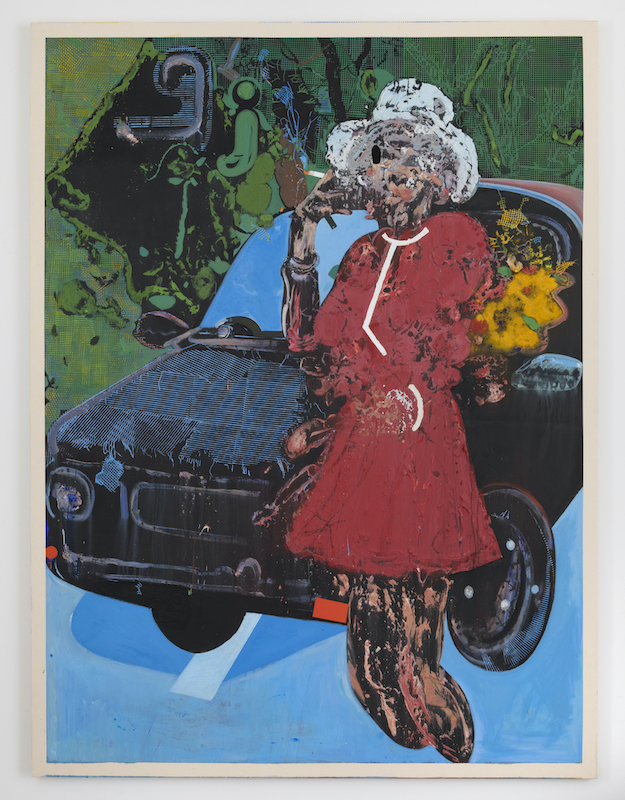
Ladylike, 2020, Acrylic on canvas, 182×233 cm 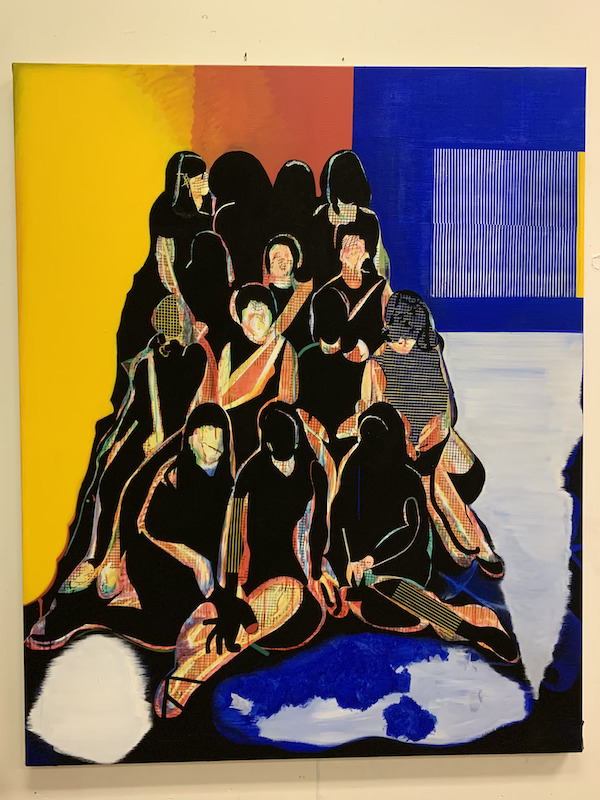
Sunlight, 2020, Acrylic on canvas, 165×132 cm You claimed that “you keep working on your old paintings”, meaning you don’t see any finishing point for them. Does this relate to the idea of painting as a “thinking act” instead of “expressing thoughts”?
Thinking act is actually a good way of putting it, but it becomes very Cartesian. I am not sure if I think as much as I stand, breath, touch and drink, listen and dream… so it would be great if we can add life to this thinking act. Everything we do is “in order to” — I drink water in order to not be thirsty, I make chairs in order to sit, and I sit on the chair in order to relax but I cannot simply apply this to the act of making a painting. I do not make paintings in order to do something else; that itself makes the act of painting an open ended act. So instead of using the word “finished,” painting I would use “a temporal pause.” This pause sometimes happens as a result of someone else’s comments on the painting, and other times when I reach a point that I surprise myself, like oh, I did not know I could do that.
Could you explain how you work with source images? The photographs are not images that you’re copying but rather images that you’re using in some way to create the painting.
Copying is dealing with what photographs look like rather than what they are. I take my source images not only as images that represent something, but also as ever dynamic objects with potential pasts and futures. So I am interested in the relationship between what they show and what they are made of and how they appear to me. I think painting, due to its history, provides a very complex perspective to think about the simultaneity of image and object.
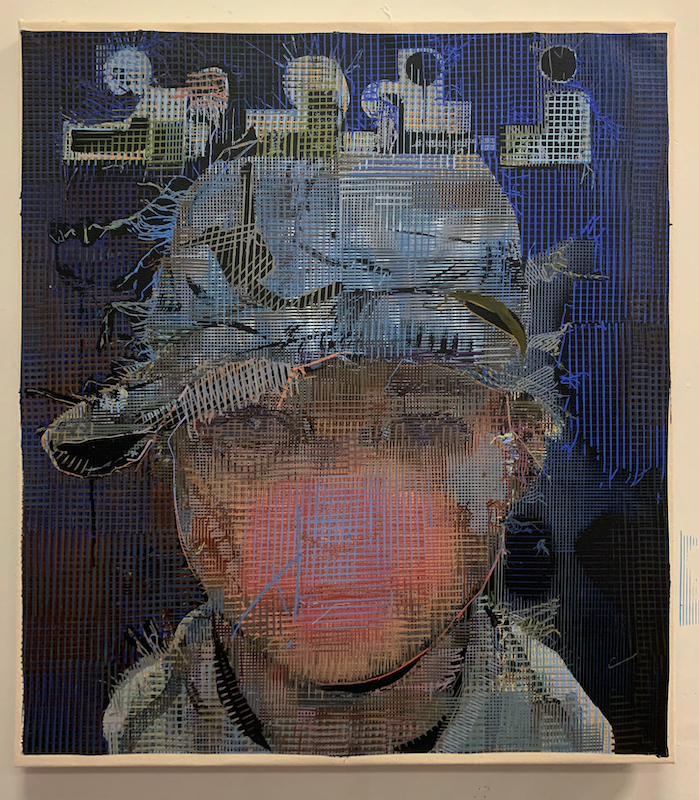
The Boy on Cover, 2020, Acrylic on canvas, 68×78 cm 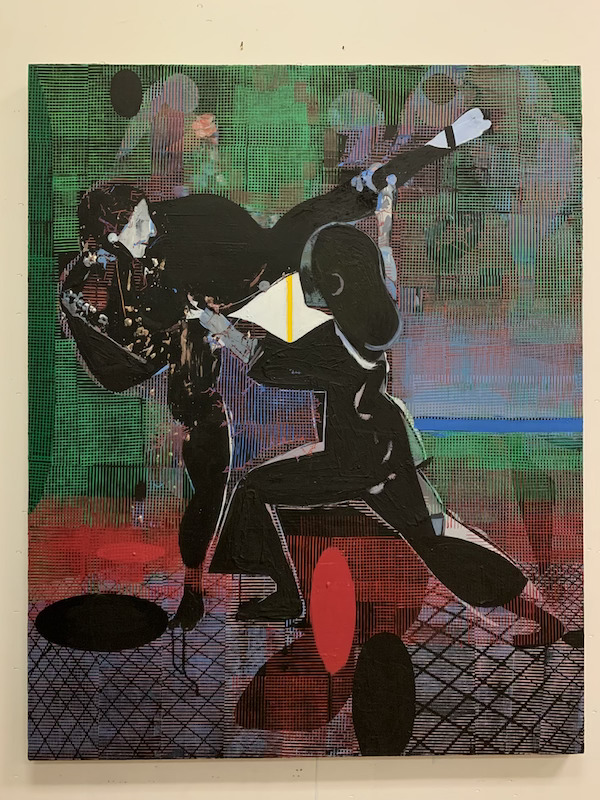
Fatality, 2020, Acrylic on canvas, 122×152 cm How do you choose the photographs? Specifically for this body of work that you present in this exhibition, you mentioned that you received around 400 scanned covers of Zan-e Rooz?
I tend to choose photographs with subjects that have an uneasy or twisted relationship to the act of representation, through which the medium is being acknowledged. I would like to catch the camera and photographer red-handed and reveal that moment in painting. But this is not always the case and I sometimes choose them intuitively.
Your canvases are massive. Can you talk about the sense of scale in your work?
I like when the size of the painting acknowledges the size and location of the viewer. Depending on where you are located as a viewer, you might miss something in the painting — getting close to see the details you might miss the whole composition, and then stepping back means missing the details. So there is always a sense of an incomplete image through the experience of the painting.
Navigate through Taha Heydari’s Artist Room
Sumac Space is a venue for raising questions and conversations.
It is updated every Thursday with a new, fresh dialogue/text.
Subscribe to the newsletter to be kept up to date.Davood Madadpoor (b. 1981, Tehran Iran) has worked as a librarian, dealing with archiving methods, and later as office manager in the Tehran Art Center (Hozeh Honari) before he studied photography at the Iranian Photographers’ House and the Tehran University of Applied Sciences and Technology. After moving to Florence in 2013 and received a bachelor’s degree in fine arts from the Accademia di Belle Arti. He then graduated in Curatorial Studies with a master’s thesis focused on the local context as an impetus and inspiration for the art practices of artists-in-residence. He is currently working at Villa Romana, Florence, as assistant curator and project coordinator.
-
Language as Source and Subject—Christine Kettaneh in Conversation with Katharina Ehrl
What was the impulse to finally quit economics and become an artist? I loved the theory of economics and I loved teaching it. However, I felt the theory did not capture well the complexity of our reality. I soon became convinced that our experience of life was multilayered and trying to understand it through only one angle (the economic one in my case) felt too limiting. I needed to be in a field that acknowledged and welcomed interdisciplinarity as a way of thinking. That questioning eventually led me into arts, the space that gave me the freedom to explore all…
Language as Source and Subject—Christine Kettaneh in Conversation with Katharina Ehrl
Dialogues publishes contextual and visual essays, interviews and conversations, reviews, and experimental writing. It is a textual space that encourages critical thinking. At the same time, Dialogues extend conversations across borders, making visible insights and relationships that might still be unseen and helping grow this Network. If you have a collaboration proposal or an idea for a contribution to the Dialogue section, we’d be happy to discuss it.
[sibwp_form id=5]
What was the impulse to finally quit economics and become an artist?
I loved the theory of economics and I loved teaching it. However, I felt the theory did not capture well the complexity of our reality. I soon became convinced that our experience of life was multilayered and trying to understand it through only one angle (the economic one in my case) felt too limiting. I needed to be in a field that acknowledged and welcomed interdisciplinarity as a way of thinking. That questioning eventually led me into arts, the space that gave me the freedom to explore all that mattered to me like language, economics, systems, history, fiction, etc… and in any combination. It was also the space that accepted the attempts at understanding, rather than finding definite solutions, as a valid working method. I know that if I ever work in economics again, or in any other field actually, I would definitely carry that way of thinking with me.
Your works are always accompanied by texts. Can you talk about your own writing?
Language is both my muse and my tool; both my excavated material and my excavating technique. I am interested in language and its frailties; I like to explore the effect on language when we suspend our literalness. That’s when we may have to accept the partialness of experience and the fallibility of memory, and then allow both perception and remembering to be tools of invention rather than recording. That way, a new sense may develop not from History alone but from Fiction as well. The visual, the research and the writing in my practice inform each other. The verb ‘to essay’ means, “to attempt at”; I like to consider my art, like the essay, as attempts at understanding. So writing is an essential layer to my practice. Sometimes it is the scaffolding of the artwork; other times it ends up in the art work; or becomes the art work.
If I understand correctly, research is the basis or/and starting point for your work. Is there a way to describe how your work leads from one way of working into the next?
My work usually starts with an instance of inspiration: a certain situation, an encounter, an accident, or an invitation to collaborate… Once my attention has been caught, I start on a path of exploration in the attempt at understanding. That includes research, experimentation, writing… The research can range from scientific documents to revisiting children’s books; the experimentation may involve trials in different media; and the writing may range from analytical or poetic to something in between. But there is no specific order of how things should work. The process builds intuitively. The writing, the research, and the experimentation with different media inform each other.
Dear Dad,
You had grown a beautiful garden but left just before the trees bore their first fruit. With our bitter hearts and salty tears, we welcomed the remarkable sweetness of that first harvest. After your 10th memorial I went into the garden in search of you. Over two months I prepared and served sugar letters to the garden. The ants responded.When an ant stumbled across a letter it marked a scented trail on the way back to the nest so that more ants might follow. When an ant encountered another ant, it felt the other ant with its antennae; they then kissed as they recited scented liquid letters to each other. After that long sweet affair with the ants, the underground became a mine of smells, touches and kisses.
Touch Me, 2016, Cold press bright paper, ed. 1/4, 24×32 cm Christine
Despite our advanced forebrains, we remain ignorant at a macro scale. We are, like ants, only conscious of our micro decisions – to build this or that, to move here or there and their very immediate effects on our lives. Yet those same conscious decisions contribute to a longer term global behavior like that of an ant colony, an ‘emergent’ intelligence, that we have no way of immediately perceiving.Our reality at any point resides in our cultural artifacts and in the debris of history, the products of a complex macro course; but we can only experience reality and interact with it at a local, micro level. That is why, when we observe more closely life at home and on the street, we feel a sense of alienation – because of that mismatch in scale between what we encounter and how we interact with it. We also feel alienated because there is no clear correspondence between what we know and what we perceive. Our reality is a product of more than the known history, so our knowledge always falls short. To define an object, a person, or a system by its history would only limit it. We might need to trust our immediate experience of it, our very gnawing sense of alienation, to attempt a more complete understanding.
In my work, there is always an intrigue in the everyday matter. In this project, I explore, the ants in my garden, the sugar on my kitchen table, and the language on my tongue. My search, as always, involves an enquiry into language. There is a temporary forgetting of meaning as I feed the alphabet to the ants, only to pick up the words again and use them as triggers for rituals in the hopes of smelling, touching and kissing matter’s more metaphorical possibilities.
Can you tell us about your choice of the materials? For Smell me, kiss me, touch me you use sugar and for Hayat and the Soap Coins soap – both ephemeral products if they come in contact with water.
My work usually engages with our everyday material, the mundane, the normal. The sugar on our kitchen tables and the soaps on our wash basins just like language on our tongues are examples of our everyday. I also like the playfulness in the ephemeral aspects of those materials and the performative rituals that dissolve them. I find them as opportunities to embed my texts in the objects. When the object is then abandoned in favor of a trace; it leaves me exploring the nature of the trace whether material or immaterial. When the Soap Coins were consumed they left behind the holes in our system. When the sugar words were consumed the underground became a mine of smells, touches and kisses.
Smell Me, 2016, Cold press bright paper, ed. 1/4, 24×32 cm The “Artists’ Rooms” on Sumac Space seem to be a new challenge for artists as it’s about presenting oneself, one’s practice, etc. Here, you show beside other material a video that tests the limits of the letter H. How did you choose the works for your “Artist’s Room”?
I liked the idea of the Artist Room and how you left it open ended, undefined. I took it literally as a room where I store things that might not necessarily be exhibited as final artworks. That includes mostly process works but more importantly thoughts that are on the margin of my personal life and artistic practice, and products from my ongoing trainings. For example, ‘the limits of H’ is a recent piece I did while learning how to code. The other items I selected work well as ‘code’: hand gestures, keys, and metaphors.
The art scene in Lebanon (and in most of the Middle East) is characterised by contrasts: On the one hand it is young, lively and aspiring, and on the other hand it is exposed to political tensions and problems. What is it like to act as an artist in this field of tension?
I think art comes usually as partially a response to the artist’s environment. The environment with its own set of problems, challenges, and sensorial aspects trigger the inaccessible within the artist. It is the impulse – the motivation to perceive, to act, to create. Lebanon, inspite and perhaps because of its inherent wealth, has always been a ground for conflict. The past year has been exceptionally trying politically and economically, making an artist of almost every Lebanese. Touching and inspiring photos, thoughts and essays gushed through social media by the minute. Citizens ran to the streets and made art by just being there. The recent explosion devastated many, but not all. The Lebanese organised themselves in seconds and held each other, totally oblivious of the risks of COVID-19, and swept the glass across the capital together and made art of it. So to answer your question, I think the Lebanese artist of the past year is no longer represented by the artist of the gallery, but by every Lebanese.
Katharina Ehrl (b. 1985, Munich Germany) studied Art History in Munich and Venice. Her research focus is on the development of modern and contemporary art in the Arab world and its diaspora, with an emphasis on Lebanon. She is currently a PhD candidate at the Ludwig-Maximilians-University in Munich. From 2016 to 2018 she was assistant curator on the research and exhibition project Forms of Flow / Flow of Forms. Design histories between Africa and Europe, which was presented in Munich and later at the MARKK in Hamburg. (As of 2020)
-
On the Challenges of Being an Artist—Farzaneh Hosseini in Conversation with Davood Madadpoor
On the Challenges of being an Artist
On the Challenges of Being an Artist—Farzaneh Hosseini in Conversation with Davood Madadpoor
[Scroll down for Farsi Version]
What is it like being an artist in today’s Iran?
Being an artist in today’s Iran is both hard and an endowment. It is hard to make a living through that. I live in a place where there is an economic recession caused by years of sanctions, along with the coronavirus disease. Under these complicated circumstances in today’s world, being an artist is somewhat insane. The artists who lived in previous periods also faced many crises, such as the Iranian revolution, war, economic recession, etc., and we, in turn, have some new challenges. The main differences between the present period and the previous ones is the innovation of cyberspace. It is now possible to become aware of and get access to the news and events of the art world. An exhibition can now also be held in the virtual world, like this current one at Sumac Space. Artists from previous periods were deprived of experiencing these possibilities.
The reason for calling art an endowment is the fact that, despite all the difficulties, through the work of art we can forget everything and concentrate. In a world where controlling the mind needs years of work, through art we can practise that and relax.
Unfortunately, there is no doubt that Covid-19 has affected work of artists all over the world. Within this triangle of sanctions, inflation and the coronavirus, how do artists acquire their primary working materials? It seems that in order to achieve the mentioned tranquillity, a further step should be taken.
In artistic works where creativity plays a major role, we gradually realize that sometimes even limitations lead to creativity. Imagine a prison with nothing: what will you do there? You can get depressed, or you can use the power of your mind to think about the time that you are no longer in prison and have no limitations; what do you want to do then Victor Frankl, the author of the book Man’s Search for Meaning, was a psychiatrist and neurologist imprisoned in the Auschwitz concentration camp during World War II. In his book, he talks about the significance of the meaning of life in the most difficult situations and quotes a very beautiful sentence: “If living is suffering, then in order to survive, a meaning must be found in suffering.” As an artist, if I have a meaning for creating my works, then sanctions, inflation, coronavirus, etc. won’t be an obstacle for me.
I’m glad to learn of Victor Frankl’s attitude; it is energizing and motivating. Although, in the project you present on Present Continuous, you are talking about the lack of hope and getting used to its absence and how the media and the internet facilitate and change the acceptance and the absence of hope, which is becoming a habit in people’s lives. This lack is also seen in works of other Iranian artists. What are your thoughts about this contradictory point?
Artists are the product of the times in which they live. There are some differences and similarities in the concerns of previous artists, and there are similar mental concerns between me and my generation. Perhaps it can be said that artists are more sensitive to the present difficulties and inequalities than other people. Because we are unable to make changes in these adversities, sometimes they lead to frustration and disappointment. Getting used to difficulty becomes a kind of response of the mind. When you come to this understanding that you can’t make a change, you get used to it subconsciously. In order to tolerate the present situation, like me, other artists are using these issues in their artistic works. On the other hand, it may not be possible to make fundamental changes in many issues; however, referring to the problems, we can raise questions. Raising questions in a society where censorship removes the question may not be very effective at first glance as we always get used to things, but it can act as a reminder for the viewer and it can get them out of complacency caused by habit for a few minutes.
You say that you choose the subject of your work from day-to-day matters so that the viewer can easily communicate with it. What is the important point in your works that you expect the viewer to take with them after visiting your exhibition?
I believe that if I motivate my viewer with my work and create a question in their mind, and finally make them think, I have achieved my intended artistic goal. If I can hold my viewer in front of my work for a few minutes and make them see, think, and finally act, I will be successful. Dr. Hamid Kashmir Shekan is an Iranian historian. When visiting the statue of a woman in the Achmez collection, he stated that this statue reminded him of the famous and terrifying image that was published a few years ago of one of the Abu Ghraib prisoners. In that picture, the prisoner is wearing an orange prison uniform and a funnel-shaped hat that has covered his face and is crucified. (I have and had this picture clearly in my mind.) I said that I haven’t created this sculpture intentionally; actually, I have created the image that today’s society wants to see from a woman. This sculpture shows a woman who does not have an exact identity, and her face is covered with a cloth, but she opens her arms and accepts everything. Kashmir Shekan said, “We see a large number of images in our everyday life, in some cases only for a few seconds, but they are all saved somewhere in our minds and can be used where we do not even think.” I hope my works would save my viewers’ minds.
So do you actually consider the artist somehow responsible or somehow a social activist?
Through the creation of artistic works, the artist can use different aspects of art; for example, an author can combine words together to make sentences and narrate a story and express a message through the story. There are some writers who use words as words without a particular meaning. In praising words, they enjoy the combination of words and pass it on to us. The creator of any work can choose to create a work in praise of beauty or add a meaning along with beauty. For me, creating an artistic work is not limited to beauty, and I like to connect more deeply with my viewers. Affecting the viewer through beauty is possible, but by adding meaning, we can open a place in the mind of the viewer and affect them. Through my artistic works, I talk to my viewer and tell them what is on my mind these days and what I think about them. An artist has a powerful tool in their hand that he can use or not. This is an individual choice.
During the past year, I have created works with a concern for femininity. This is the view of the female artist who lives in a patriarchal society. Femininity in these works does not occur in the form of using the female body or objects attributed to women as a beautiful form. Femininity is defined as the lack of equal rights, the compulsion to accept discrimination, acceptance and lack of the right to object, persistent limitations that have become common among people, it is censorship and veiling. In most of them, there are no female organs. They have been mutilated, like many throughout history. They don’t have any faces, which expresses the fact that their identities have been taken from them. They are suffering. Some of them are referred to. For me, this series started with the issue of gender, but because art currently has a nature-like life, it went through this issue. I gave this explanation to say that, as an artist, I can decide what to offer to the viewer.
You are a member of the Association of Iranian Sculptors. Explain about this association and your relationship with them.
The Sculptors Association began its activity in 1988 and has been officially active since 1998. In recent years, the association has been more active than before, and some of the good activities it has done include pursuing members’ insurance and cooperating with the municipality to carry out urban projects. Actually, the Sculptors Association sets calls and the municipality finances the projects, which means that most of the urban sculptures pass the filter of experts in this field, and this seemingly simple event plays an important role in the appearance of cities. On the other hand, every year, a lot of sculptors graduate from art universities, and through these, they can take advantage of job opportunities. At the same time, there is a lot of criticism about the association’s performance; for instance, as a supportive institution for sculptors, why does the association not take any action about the payment of the contracts of urban projects that aren’t suitable for an artist? Implementation of urban projects needs well equipped workshops and expert assistants, and providing these items needs a lot of money. Usually after starting work, the first down payment for an urban project is paid, which means that the artist has to start the work using his own budget. For each day of delay in installing the work, the artist must pay a financial penalty, but this part of the contract is not the same for the municipality, and sometimes the artist is paid months after the installation of the work.
Two years ago, I cooperated with some friends in volunteering on the exhibition committee, and after completing a project, I stopped working after a few months because of personal reasons.
This is an interesting discussion and, as you mention, it has positive and negative dimensions. Speaking of that, what requirements need to be met in order to enter and become a member of this association?
To apply for membership in the association, the applicant must either have a university degree in sculpture and present a work sample or have worked in this field experimentally and present a work sample. The documents that are presented by the applicant are reviewed by the admissions committee, which usually includes five people, and are finally approved by the board.
Are there other new initiatives – private or public – to support sculptors?
As far as I know, besides the Sculptors Association, which supports artists spiritually, as I mentioned before, the municipal beautification department also supports some artists by commissioning occasional or urban sculptures, but in my opinion, it doesn’t provide enough support. Also, Didi, which is a private museum, was opened in the north of Iran a few years ago. This museum purchased a lot of works from young sculptors and painters, which in addition to promoting the cultural level of society, played an extraordinary role in supporting artists. I hope that the day will come when many lines can be written in response to such a question.
I understand you have a strong connection with literature. Does this interest in literature play a direct role in the creation of your sculptures?
It sure does. In my way of thinking, people are largely the product of the knowledge and experience that they gain in life, and studying is one of the ways of getting experience. Through reading about others’ experiences, we can travel to some places that we may never be able to see and to communicate with people that we never even think about. Generally, we are a collection of the music that we listen to, the food that we eat, the movies that we watch, the friends that we communicate with, and the books that we read. We study. That means we are all a collection of these puzzle pieces.
One last question: If you had to choose only one book from the world of literature, which one would it be?
You know that you have asked a very difficult question. In different periods depending on my mood I have liked different books, but if I want to name only one book now, I would say: The Unwomanly Face of War by Svetlana Alexievich (editor’s note: Alexievich was awarded the 2015 Nobel Prize in Literature “for her polyphonic writings, a monument to suffering and courage in our time”). This book is a documentary narrative about Russian women who took part in World War II. The memories of these women, who were in positions of snipers, laundry workers, nurses, minesweepers, commanders, machine gunners, etc., are dreadful.
Navigate through Farzaneh Hosseini’s Artist Room
در ایران امروز چگونه میتوان هنرمند بودن را تعبیر کرد؟
هنرمند بودن در ایران امروز، هم دشوار است و هم یک موهبت محسوب میشود. دشواری آن از جهت تأمین مخارج زندگی از این راه است. من در جایی زندگی میکنم که بیماری کرونا به رکود اقتصادی ناشی از سالها تحریم اضافه شده و در این شرایط فقط در صورت مجنون بودن میتوان به کار هنری ادامه داد. هنرمندان دورههای پیشین هم هر یک به نحوی بحرانهای زیادی مثل انقلاب ایران، جنگ، رکود اقتصادی و غیره را پشت سر گذاشتهاند و ما هم به نوبه خود درگیر هستیم. اما یکی از تفاوتهای دوره ما با دورههای پیشین، وجود فضای مجازی است. این که امروزه شرایط آگاهی از اخبار و اتفاقات روز دنیای هنر وجود دارد و حتی مثل این پروژه، میشود در دنیای مجازی نمایشگاه برگزار کرد، امکانیست که هنرمندان دورههای پیشین از تجربهاش محروم بودند.
موهبت بودن هنر که اشاره کردم هم از این جهت است که با توجه به تمام دشواریها، میتوان از طریق کار هنری همه چیز را فراموش و تمرکز کرد. در دنیایی که به دست گرفتن کنترل ذهن نیازمند سالها تلاش و کوشش است، از طریق هنر میتوان تمرکز را تمرین کرد و به آرامش رسید.
بدون شک و متأسفانه، بیماری کرونا به شعله سختی کار هنرمندان در همه جای دنیا دامن زده است. اما اکنون این سؤال در ذهنم است که در این مثلث تحریم، تورم و کرونا، هنرمندان چگونه با تأمین مصالح اولیه کار خود کنار میآیند؟ به نظر میرسد برای رسیدن به آن آرامشی که به آن اشاره کردید، باید گامهای بلندتری برداشت… درست است؟
در کارهای هنری که خلاقیت نقش پررنگی ایفا میکند، به مرور متوجه میشویم که گاهی حتی محدودیتها باعث ایجاد خلاقیت میشود. یک زندان را که هیچ چیزی در آن پیدا نمیکنید، تصور کنید. در آنجا چه میکنید؟ میتوانید افسرده شوید یا که از قدرت ذهنتان استفاده کنید و به زمانی بیاندیشید که دیگر در زندان نیستید و محدودیتی ندارید. حالا میخواهید چه کار کنید؟ ویکتور فرانکل، نویسندة کتاب در جستجوی معنا، روانپزشک و عصبشناسی است که در زمان جنگ جهانی دوم در اردوگاه کار اجباری آشویتس زندانی میشود. او در این کتاب از اهمیت معنای زندگی در سختترین شرایط میگوید و جملة بسیار زیبایی نقل می کند: “اگر زندگی کردن رنج بردن است، پس برای زنده ماندن ناگزیر باید در رنج بردن معنایی یافت” اگر من به عنوان هنرمند معنایی برای خلق آثارم داشته باشم، آنگاه تحریم، تورم، کرونا و غیره نمیتوانند مانعی برای من باشند.
از شنیدن این نوع نگاه خوشحالم. این جنس نگاه همیشه برای رفتن به سمت جلو انرژیبخش و محرک است. اما در مجموعهای که ارائه میدهید از خالی بودن امید و عادت کردن به نبود آن و فضای مدیا که به ساختن این عادات کمک میکند، صحبت میکنید. این فضا در بخشی از اثرات دیگر هنرمندان ایرانی هم پیداست. شما این نکته به ظاهر متضاد را چگونه میبینید؟
هنرمندان محصول زمانهای هستند که در آن زندگی میکنند و همانطور که در دغدغههای هنرمندان پیشین تفاوتها و شباهتهایی دیده میشود، درگیریهای ذهنی مشابهی بین من و همنسلانم وجود دارد. شاید بتوان گفت حساسیتهای هنرمندان در مشاهدة معضلات و نابرابریها از بقیة مردم بیشتر است و عدم توانایی ما در ایجاد تغییرات در این ناملایمات گاهی تبدیل به یأس و ناامیدی میشود. عادت کردن به ناگواریها به نوعی واکنش ذهنی تبدیل میشود. وقتی به این درک میرسی که نمیتوانی تغییری به وجود بیاوری، به طور ناخودآگاه عادت میکنی. احتمالاً هنرمندان دیگر هم مثل من برای تاب آوردن در برابر این مسائل، آنها را دستمایه کارشان قرار میدهند. از طرف دیگر، شاید نتوان در بسیاری از مسائل تغییرات اساسی به وجود آورد. اما میتوان با اشاره به مشکلات طرح سؤال کرد. شاید در نگاه اول در جامعهای که سانسور صورت مسئلهها را پاک میکند، ایجاد پرسش تأثیر چندانی نداشته باشد. زیرا ما عادت کردیم که عادت کنیم. اما میتواند برای مخاطب جنبه یادآوری داشته باشد و برای دقایقی ذهن مخاطب را از آن حالت خوابزدگی ناشی از عادت بیرون بیاورد.
شما اشاره میکنید که موضوع کارهایتان را از مسائل روزمره انتخاب میکنید تا مخاطب بتواند به راحتی با آن ارتباط برقرار کند. چه چیزی در کارهایتان وجود دارد که برایتان مهم است مخاطب پس از بازدید از کار شما، آن را با خود ببرد؟
من باور دارم اگر با آثارم تلنگری به مخاطبم بزنم، پرسشی در ذهن او ایجاد کنم و در نهایت او را به فکر وادارم، به غایت هنری که در ذهن دارم رسیدهام. اگر بتوانم مخاطبم را برای دقایقی جلوی کارم نگه دارم و به تماشا، فکر کردن و در نهایت درگیر شدن با کارم وادار کنم، من موفق شدهام. دکتر حمید کشمیرشکن، تاریخدان ایرانی، در بازدید از مجموعه آچمز در مورد مجسمه زن اشاره کرد که او را به یاد تصویر معروف و هولناکی که چند سال پیش از یکی از زندانیان ابوغریب منتشر شد، انداخته است. در آن تصویر زندانیای با لباس نارنجی زندان و کلاهی قیفمانند که صورتش را پوشانده، مصلوبوار به جایی بسته شده است (من این تصویر را به خوبی در ذهن داشتم و دارم). من در جواب گفتم: من این مجسمه را با قصد ارجاع به آن تصویر نساختم. من تصویری را ساختم که جامعه امروز ما میخواهد از زن ببینه. زنی که هویت مشخصی ندارد و صورت و اندامش با پارچه پوشیده شده، اما آغوشش را باز کرده و همهچیز را میپذیرد. کشمیرشکن در جواب گفت: ما هر روز با تعداد زیادی تصویر، در بعضی موارد فقط برای چند ثانیه، مواجهیم. اما همه آنها جایی در ذهن ما ذخیره میشوند و در جایی که حتی فکرش را هم نمیکنیم، به کار میآیند. امیدوارم آثار من هم برای خودشان جایی در ذهن مخاطبانم باز کنند.
پس در واقع شما به نوعی هنرمند را مسئول یا بهتر بگم به نوعی فعال اجتماعی میدانید؟
هنرمند به واسطه خلق آثار هنری میتواند از جنبههای گوناگون هنر استفاده کند. به طور مثال، یک نویسنده میتواند از همنشینی کلمات در کنار هم جملات را بسازد، داستانی را نقل کند و به واسطه داستان پیامی به ما انتقال دهد. نویسندههایی هستند که کلمات را بدون معنای خاصی و برای خود کلمات استفاده میکنند. در ستایش واژگان از همنشینی کلمات لذت میبرند و آن را در اختیار ما میگذراند. این انتخاب خالق هر اثریست که در ستایش زیبایی، اثری خلق کند یا در کنار زیبایی معنایی به عنوان چاشنی اضافه کند. برای من، خلق اثر هنری به زیبایی محدود نمیشود و دوست دارم با مخاطبانم ارتباط عمیقتری برقرار کنم. به واسطه زیبایی میتوان مخاطب را تحت تأثیر قرار داد. اما با اضافه کردن معنا میتوان در ذهن مخاطب جا باز کرد و بر جانش نشست. من از طریق آثارم با مخاطبم حرف زده و درددل میکنم. به او میگویم که این روزها چه چیزی ذهن من را مشغول کرده و من درباره آن چه فکری میکنم. هنرمند ابزار قدرتمندی در دست دارد که میتواند از آن استفاده کند یا نه. این یک انتخاب شخصیست.
من در سالهای اخیر، آثاری با دغدغه زنانگی خلق کردهام. این نگاه از قاب زن هنرمندی است که در جامعهای مردسالار زندگی میکند. در این آثار، زنانگی به شکل تنانگی (استفاده از بدن زن یا اشیا منتسب به زنان به عنوان فرمی زیبا) رخ نمینماید. زنانگی به عنوان عدم برخورداری از حقوق برابر و اجبار به پذیرش نابرابری، پذیرش و عدم حق اعتراض است و سانسور و پوشش، محدودیتهای مزمنی هستند که در باور عمومی ریشه دواندهاند. در بیشتر آنها، اندام زنانه وجود ندارد. همانند بسیاری در طول تاریخ مثله شدهاند. چهره و صورت نداشتهشان گویای هویتیست که از آنها ربوده شده است. به خود پیچیدهاند و درد میکشند. برخی از آنها ارجاع دارند. برای من این مجموعه با مسئله جنسیت آغاز شد. اما به دلیل جاری بودن هنر، همچون زندگی، از این مسئله گذر کرد. این توضیحات را دادم که بگویم من به عنوان هنرمند تصمیم میگیرم که چه چیزی به مخاطب پیشکش کنم.
شما عضو انجمن مجسمهسازان ایران هستید. دربارة این انجمن و ارتباطتان توضیح دهید.
انجمن مجسمهسازان، از سال ۶۷ فعالیت خود را آغاز کرده و از سال ۷۷ به طور رسمی فعال است. انجمن در سالهای اخیر فعالتر از گذشته عمل کرده است. از جمله اقدامات خوبی که این انجمن انجام داده، پیگیری بیمه اعضا و همچنین همکاری با شهرداری برای انجام پروژههای شهری است. در حقیقت، انجمن مجسمهسازان فراخوانهایی تنظیم میکند و شهرداری بودجه پروژهها را تأمین میکند و این بدین معنی است که بیشتر مجسمههای شهری از فیلتر متخصصین این رشته میگذرد و این اتفاق به ظاهر ساده تأثیرات زیادی در چهره شهرها گذاشته است. از طرف دیگر، هر ساله تعدادی مجسمهساز از دانشگاههای هنر فارغالتحصیل میشوند و از این طریق میتوانند از فرصتی شغلی بهرهمند شوند. در عین حال، انتقادهای زیادی نیز به عملکرد انجمن وارد است. به طور مثال، چرا انجمن به عنوان نهادی که باید حامی مجسمهسازان باشد، در نحوه پرداخت مالی قراردادهای پروژههای شهری، که واقعاً در حد و شأن یک هنرمند نیست، وارد عمل نمیشود؟ اجرای پروژههای شهری به کارگاه مجهز و دستیاران متخصص نیاز دارد و تأمین این موارد هزینهبر است. معمولاً اولین پیشپرداخت برای پروژهای شهری بعد از شروع کار پرداخت میشود و این بدین معنی است که هنرمند باید کار را با بودجه خودش شروع کند. هنرمند باید به ازای هر روز دیرکرد در نصب کار، جریمهای مالی پرداخت کند. اما این بند قرارداد شامل حال شهرداری نمیشود و گاهی تسویه حساب با هنرمند ماهها پس از نصب کار انجام میشود.
دو سال پیش، من در کنار دوستان دیگری، داوطلبانه و به مدت چند ماه در بخش کمیته نمایشگاهی فعالیت کردم و بعد از انجام یک پروژه به دلایل شخصی این همکاری را قطع کردم.
بحث جالبی است و همینطور که اشاره کردید دو بعد مثبت و منفی دارد که البته من نمیتوانم بگویم کدام بعد سنگینی میکند. اما سؤالی که برایم پیش میآید این است که برای وارد شدن به این انجمن و عضویت در آن باید از کدام فیلتر گذر کرد؟
متقاضی برای عضویت در انجمن باید یا دارای مدرک تحصیلی دانشگاهی در زمینه مجسمهسازی باشد و یا در این زمینه به صورت تجربی فعالیت کرده باشد و نمونه کار ارائه دهد. مدارک ارائهشده متقاضی توسط کمیته پذیرش اعضا، که معمولاً پنج نفر هستند، بررسی میشود و در نهایت توسط هیئت مدیره به تصویب میرسد.
آیا اقداماتی تازه از سمت دولت یا بخش خصوصی در حمایت از مجسمه سازان اخیرا شکل گرفته یا در حال شکل گرفتن است؟
همانطور که پیشتر گفتم، تا جایی که من اطلاع دارم، غیر از انجمن مجسمهسازان که بیشتر حمایت معنوی از هنرمندان را به عهده دارد، بخش زیباسازی شهرداری هم با سفارش مجسمههای مناسبتی یا شهری از بعضی هنرمندان حمایت میکند. اما به نظر من این حمایت در حدی که باید نیست. همچنین چند سال پیش موزه خصوصی “دیدی” در شمال ایران افتتاح شد. این موزه آثار زیادی از مجسمهسازان و نقاشان جوان خریداری کرد که علاوه بر ارتقای سطح فرهنگی جامعه، نقش ویژهای در حمایت از هنرمندان داشت. امیدوارم روزی برسد که بتوان سطرهای زیادی را در جواب به همچین سؤالی نوشت.
از بین کلامتان، رابطه قویتان با ادبیات را برداشت میکنم. اگر برداشتم درست است، آیا این علاقه به ادبیات نقشی مستقیم در خلق مجسمههایتان دارد؟
قطعاً تأثیرگذار است. به نظرم آدمها تا حد زیادی محصول دانش و تجربهای هستند که در زندگی کسب میکنند و مطالعه، یکی از راههای کسب تجربه است. ما میتوانیم به واسطه خواندن تجربیات دیگران به مکانهایی که شاید هیچ وقت امکان دیدنشان را نداشته باشیم، سفر کنیم و با آدمهایی که هیچ وقت فکرش را هم نمیکنیم، معاشرت کنیم. به نظر من، ما به طور کلی مجموعهای از موسیقیهایی که گوش میدهیم، غذاهایی که میخوریم، فیلمهایی که میبینیم، دوستانی که با آنها معاشرت میکنیم و کتابهایی که مطالعه میکنیم، هستیم. یعنی ما همگی مجموعهای از این قطعات پازل هستیم.
و به عنوان سوال آخر، اگر بخواهید از دنیای ادبیات فقط و فقط یک کتاب انتخاب کنید، آن کتاب کدام است؟
حتماً می دانید که سؤال بسیار سختی پرسیدید. من در دورههای مختلف، بسته به حال و هوایم، کتابهای متفاوتی را دوست داشتم. اما اگر در این لحظه بخواهم فقط عنوان یک کتاب را نام ببرم، میگویم: جنگ چهرة زنانه ندارد، اثر سوتلانا الکسیویچ. این کتاب روایت مستندی از زنان روسی است که در جنگ جهانی دوم شرکت داشتند. خاطرات این زنان که در مقام تکتیرانداز، رختشوی، پرستار، مینروب، فرمانده، مسلسلچی و غیره نقل شده، تکاندهنده است.
-
Speaking Nearby Iran—Anahita Razmi in Conversation with Laura Vetter
What does being an artist mean for you? Is it a way to reflect the world, to distance yourself from it or to point to certain topics? I recently saw a list of the “top five non-essential jobs”, published by the Sunday Times. The job “artist” scored highest in the survey, which caused some controversy and debate on social media. I found this weird, as being non-essential within a running neo-liberal system is precisely the whole point of working as an artist. It is the position an artist immanently needs – it enables distance, criticality, alternative thought. I still like and…
Speaking Nearby Iran—Anahita Razmi in Conversation with Laura Vetter
What does being an artist mean for you? Is it a way to reflect the world, to distance yourself from it or to point to certain topics?
I recently saw a list of the “top five non-essential jobs”, published by the Sunday Times. The job “artist” scored highest in the survey, which caused some controversy and debate on social media. I found this weird, as being non-essential within a running neo-liberal system is precisely the whole point of working as an artist. It is the position an artist immanently needs – it enables distance, criticality, alternative thought.
I still like and believe in the idea of an artistic avant-garde and in the possibilities of subversion, even though strategies might look very different in 2020 than in the last century. Outsiders that possibly do not look like outsiders. Intruders. Invaders. For my own practice, this has always meant searching for a position that is as independent as possible from the forced necessities of a global capitalist system – while simultaneously making artistic work that has a relevance in relation to that system. This position is really not easy to find and maintain, especially when your own background is defined by precarity and economic hardship.
Are there visual things that inspire or influence you?
My work very often makes direct connections to other artistic works and different art histories.
I am interested in reusing artists’ works, concepts and artefacts that are embedded in a “Western art historical canon” – testing them out in newly revised versions and in relation to Middle Eastern contemporary conditions.You are a German/Iranian artist, living and working in Germany. Your art often shows a certain familiarity with and, at the same time, a critical, ironic distance towards Iran. How would you describe your relationship with the country in which you didn’t grow up but which owns a part of your identity?
It is a complicated relationship that has been changing during the years. I have been travelling to Iran a lot in the last ten years, realising different projects, but I have never lived in the country.
Iran currently is in an incredibly difficult political and economic situation, and the temporality and the privilege of coming and going, collaborating, and making work within the country becomes a challenging and problematic endeavour. As an artist, I find it necessary to ask myself: For whom is my work “working”? What power relations come into play? What position do I speak from – or is it perceived that I speak from? In my case, this position is the position of an outsider that doesn’t look like one. Maybe we can call it part of a diaspora, but the idea of a diaspora is incredibly complex, and there are so many different diasporic experiences. When a country is in such a difficult and often sad situation, the question “what can we do to make it better” often seems dominant and central here.But, as an artist, I do not see any relevance in me trying to answer that question or in making big opinionated statements. Instead, I am trying to produce my work under fair conditions, stay resilient – while making societal and relational complexities visible, asking questions concerning histories and media narratives, using humour as a means to enable states of ambiguity and contradiction, reconsidering set “meanings”.
I like it when the Vietnamese filmmaker Trinh T Minh-Ha stated to “not wish to speak about, only to speak nearby”, challenging the rules of anthropological filmmaking. When it comes to challenging new modes of cultural imperialism, this is what I can try to do as an artist: speaking nearby Iran.Which relation do you want to create with your audience?
A radically open, challenging relation beyond easy signification, with room for speculation, disagreement, misunderstanding, reconsideration. Ha, that’s impossible maybe. I think it is essential to take seriously all the different knowledge and subjective perceptions that the audience brings into an exhibition. Having the possibility of working and exhibiting in a variety of different international contexts has been such a blessing when it comes to these different interactions – I have been learning a lot through them – especially through the difficulties.
A work of art only exists in a connection, in a relation to others, and it changes with the context it is placed in. This thought isn’t new, but I find it worthwhile to test out what it can practically mean and facilitate in the now – considering the pandemic, the travel restrictions and the heightened focus on the online space as a context.You mentioned the heightened focus on the online space as a context – where do you see potential and limitations in comparison to a physical art space? How can online spaces enable transcultural exchange these days?
In theory, they are ideal: no need to travel, no visas, no borders. Yet, in practice, we don’t see this being made use of too much – often the people who would have flown in for an event now come together for public talks on Zoom.
Then look at Iran, where the internet itself is restricted and a proper bandwidth is very expensive. The seclusion through travel bans extends into the global online space through this.
I recently got thrown back to the first time I used the internet (I think I was 13). I entered some random chat room and talked to someone from Australia. We spent five hours together reciprocally typing all names of the characters that appear in The Simpsons into the chat box. We had to remember all names by heart; proper search engines didn’t exist at that time – and we were not aware of that possibility anyhow. It was a fucking exciting historical moment in international cross-cultural discourse.
Maybe if we found better ways to connect to people beyond our established internet bubbles and their algorithms, some of this excitement could return – even in 2020.Your work often deals with cultural transfers and translocation and the role of media and propaganda in relation to Eastern cultures and politics. Can you tell us what your new work is about?
scroll stock, pluck stock, click stock, drum stock, tap stock, rattle stock is a work in progress. I was interested in working with video stock footage of scrolling hands and fingers – there are quite a plethora of these on platforms like Shutterstock. These stock footage videos are usually deployed by companies that want to show the navigation of their online content by inserting this content into a green-screen background.
I wanted to test what happens when I don’t follow this purpose and instead focus on the actual gestures in the videos – applying a new “non-fitting”, “exotic”, sonic connection to them. A relation to musical instruments – tapping, plucking, scrolling… How are we touching a touch screen? How are we touching a drum or a string instrument? Are there similar ways of navigation? Are there ways to “exoticise” and “orientalise” a finger scroll, a gesture that seems completely common, intuitive, internalised by now?
Navigate through Anahita Razmi’s Artist Room
Sumac Space is a venue for raising questions and conversations. It is updated every Thursday with a new, fresh dialogue/text.
Subscribe to the newsletter to be kept up to date.Laura Vetter, (b. 1990, Siegen Germany) holds a bachelor degree in Fashion and Design Management. After working in press and communication agencies for more than three years, she completed her master studies in Arts Management at the Istituto Europeo di Design in Florence and Rome. She was a curator of the exhibition project GOMITO/GOMITO, which was realised in collaboration with Palazzo Strozzi and took place at Le Murate PAC in Florence, and later on part of the project management of the performative arts event DILEMMA, which was presented in Rome.
-
The Investigation of Material as an Archive—Benji Boyadgian in Conversation with Agnes Stillger
The Investigation of Material as an Archive
The Investigation of Material as an Archive—Benji Boyadgian in Conversation with Agnes Stillger
The first part of this interview was originally published under the title “Reverberations of a Pandemic” on the website of Villa Romana, Florence.
Benji, your artistic work centres on observations of the interaction of bodies and space, of building structures and infrastructures and you investigate all these materials as an archive. In 2015 with Phantasmagoria of Drones you mapped in great detail the urban fabric of Bethlehem including the separation wall, roads, checkpoints, refugee camps etc. What are the new layers of control and restriction that have now additionally been physically inscribed in this landscape with the Corona pandemic?
I was actually thinking about the drawing when the curfew began, it felt premonitory, but not for the reasons one could have imagined. The drawing depicts the entrance of Bethlehem devoid of people, activities and closed borders, fitting the times of the pandemic pretty accurately. This scenery is not unfamiliar to the memory of this place, because of Israeli military curfews imposed in times of high tension. Lockdown /occupation analogies have come up quite frequently in social media platforms since the pandemic began, but those are totally different circumstances, and this analogy downplays the nature of the occupation, which is not a state of exception but rather a permanence. Since I did the drawing in 2015, some small changes have happened, a few new buildings were erected, and the neighbourhood blossomed into the epicentre of occupation tourism. I probably would not have thought of doing this drawing had I not been commissioned to imagine a subjective map of this place. I find the use of images of the Wall conflicting, because it has the potential to assert itself in the imaginary of this place, to commodify it and normalize it. Contrary to the incentive of shedding light onto a situation, it seems to shine a light onto it. Inadvertently but predictably, the wall becomes a monument of the 21st century, commemorating our times and the perpetual present events we live through. A monument understood as an idea that stems from hegemonic structures to remind us of something. In the process of elaborating this work, I noticed that views from above of this area are not accessible to the public and you cannot fly a drone because it is a politically sensitive area: Basically, this image did not exist. In that respect, I thought the only thing that made sense was a map that attempts to show realistically the different layers of the landscape and the Wall being another trace, a sense of looking at the distant past of a present that unfortunately is here to stay.
Bethlehem was the first city to go under lockdown in early March; a couple of weeks ago those orders were relaxed. The Israeli checkpoint re-opened, but with tougher crossing restrictions, a few hundred metres apart, a mobile Palestinian Authority patrol car sifts those who enter through the checkpoint, an ironic momentary reversal of roles considering the context at large. Life is slowly getting back on course, but tourists are absent and not about to come back. It will be quiet in this open-air museum whose image overshadows the hopes of people dreaming of a better life and equality.
Phantasmagoria of Drones, 2015, Ink on paper, 75×55 cm I want to quote Indian novelist Arundhati Roy who, in a long text on the situation in India, published recently in the Financial Times, noted “The lockdown worked like a chemical experiment that suddenly illuminated hidden things . . .as the wealthy and the middle classes enclosed themselves in gated colonies, our towns and megacities began to extrude their working-class citizens—their migrant workers—like so much unwanted accrual.” I think her observation can be adapted to most societies right now. What did you observe?
It is difficult to paint a general picture of the situation here, because of the social complexities, the territorial fragmentation, etc… Regarding the occupation, the colonial steamroller is in full swing. Control of mobility is already set up, aided by an array of tools. The territory is designed to potentially lock down neighbourhoods and cities. This situation is all very well documented, to the extent that it feels like we have reached a tautological impasse. With the pandemic the gates shut, unexpected ones too, and unexpected ones opened. When the lockdown started, Israel called on the Palestinian labour force to cross the border and stay there, something unheard of, but logical in terms of the economic dynamics of colonial exploitation. Some workers cross illegally through breaches, others legally through checkpoints; the lure of working in Israel is financial, as salaries and opportunities are better. There was this story about Palestinians reporting to the Israelis breaches in fences that workers use to cross back and forth to Israel, but they were lenient in closing them. This is another example of an ironic reversal of the imaginary, only temporarily. As Israel was reaching its peak and the lockdown got stricter, a lot of workers returned to the Palestinian cities and villages. This created all kinds of fears based on the idea that they would bring back the virus. The first reported death in Palestine was a consequence of this situation, and there are other cases of spreads related to this.
As I mentioned earlier, Bethlehem was the first city to go under lockdown, because it is a tourist attraction. It is a small agglomeration, made up of a few municipalities and some refugee camps, and sealed on all sides by the Wall and settlements. The northern municipalities are wealthier, but in general the population is socially mixed and the social structure is to a large extent family or clan based. Apart from the refugee camps and historic centres that have their own identity, the urban fabric is heterogeneous. There are no gated communities as such but upper-class villas, pockets of wealthier compounds and luxury residencies scattered around. What struck me in the beginning was a wave of xenophobia, because the foreigner brought the virus. Prices on Italian pasta dropped. The first few weeks the atmosphere was eerie, the streets were nearly empty, many of them were blocked, stone boulders were named road-blocks of peace. Different agencies of the PA forces were all over, essentially controlling the movement between neighbourhoods, saving the population from the virus through the resour-ces invested in security. The fact that very few cases were reported made people more relaxed, especially as Ramadan started and continued, as it is social holiday. One could see more people in the streets and questionable corona distancing. Except for an event where the Israeli army took advantage of the lockdown to raid a camp and arrest people, the political atmosphere in Bethlehem was quiet. There were also a couple of confrontations with the PA regarding the return of workers for the Eid al-Fitr, the holiday that marks the end of Ramadan, a four day curfew was imposed, which ended up with an anti-lockdown incident at the entrance of a refugee camp that resulted in some heavy gunfire and few injuries. There was also an anti-lockdown clash midway through Ramadan, tyres were burned at a junction, and riot police intervened. But the general atmosphere is the anxiety of economic hardship. To sum up the lockdown, it started with fear of the foreigner, and then moved to the fear of poverty.
The question of class displayed itself on all sides, like all over the world, the virus revealed broken systems. As class identification has been altered by national or ethnic identification, it plays a role in the political imaginary of the occupation in terms of the way we identify the protagonists. Class is not a topic that is much talked about, apart from the logical association of capitalism and colonialism, hence the Palestinians are imagined as the poor, which is not false, but the lack of class discourse shapes generalizations in the collective subconscious. Both societies are far from being socially and economically homogenous. To make matters worse, since it was instated in the nineties the PA has been coerced by the donor countries to create a market economy, this, combined with their security obligations, makes them actors in maintaining economic peace, hence the status quo, or, the management of the occupation.
If we take the art world and look at the imaginary of the occupation, it is not very different. Decolonisation discourses occupy a hegemonic space, they present a set of legitimate critiques, but they also have their limits. There is what Arundhati Roy highlights, an underlying problem of class that is not being addressed. Their methodology follows a top down approach and leaves any form of social science to be desired. The attention shifts to the representation of the consequences of the situation, or dystopic imagery mirroring its subject of criticism. Rather than reflecting on the source and causes of the problem, it is an imaginary that reiterates the condition of the dominated and, by corollary, maintains a form of alienation that is the goal of colonisation: the prevention of emancipation.
Your work Reverberation, aka The Spaceship (as I read on your FB page) has been presented recently at the Istanbul Modern. The two titles of this work leave room for interpretation. The Spaceship has both a scientific and utopian connotation. Could you talk a bit about this science fiction /utopian moment in your work? I am even more curious about the title Reverberation – reverberation of what?
The notion of utopia has been in my mind since my architectural studies, the idea of imagining an alternative is compelling. Those utopias shaped the fictions of the 20th century and beyond, like sci-fi. The sci-fi moment as a tangible reference in my work happened during the Armenian Triennial in 2017. When I was doing my research trip, Soviet and prehistoric traces fascinated me, bus stations that looked like spaceships and prehistoric caves turned into ritual sanctuaries. I decided to work with steel because I was looking for some reflective surfaces, and the imaginary of this material is interesting, both as one of the mediums that designed all those utopian fantasies, but also in terms of its historical significance. It is hybrids of associations that I extract from the archives of the imaginary.Utopias, or alternative fictions is one way to deal with the lack of distance that we have from the current political events and their temporality, especially when the event prolongs into something that feels permanent. I look for different ways to evoke present day preoccupations, alternative fiction can be a way to reflect on the cause of those preoccupations, and utopia a way to imagine a better world.

Reverberation, 2020, Stainless steel, 230x230x200 cm The title Reverberation refers to the echoes of collective subconscious emotions or the phantom phantasmagorias. Being partly of Armenian descent and doing a work in Istanbul is not anodyne. My surname stimulates projections and expectations, whether I like it or not, and they emanate from different sides. The only approach I felt I could have was to question my agency in those circumstances, to live the absurd and do something in the process of it. So, I decided to land a spaceship in Istanbul. I had in mind to make an interactive sculpture that would function as a mise en abimes device, a space that put bodies in interaction with one another and their images, using a system of mirrors. The form came at later stages of the process. During that time I visited Hrant Dink’s memorial and read his book. What struck me was his outspoken anti-racism and claim for equality, and the way the memorial detaches itself from the image of the victim, from the condition of the dominated. From the perspective of the historical loser, equality is a tricky claim. That is where utopia comes in, because it is time to imagine real alternatives, a better world.
Documenting to preserve is an aspect of your work that particularly strikes me. Especially the long processes you are going through in documenting call for patience and perseverance – I am thinking of the water color drawings of The Temporary Ruin (2014) and The Discord (2016). The Discord (2016) is a series of drawings based on industrially produced cement tiles, an invention of modernity that has spread throughout the Mediterranean in the early 20th century. In a recently published book on this work, curator and writer Jonatan Habib Engqvist points to similarities with American artist Agnes Martin. Even though The Discord opens up many references, I am also touched by a transcendental moment in what I want to call an artistic meditation and a stretching of time. Do you see parallels to Agnes Martin yourself?
Before reading Jonatans text, Agnes Martin didn’t really cross my mind, although Abstract Expressionism is something that also influenced this work. When I was a student, I did a semester in San Francisco, I had learned about the Jeffersonian grid before that trip, but experiencing and practicing a city like san Francisco and seeing the grid from a plane was a telling experience, the contrast between the man made and morphology of nature was so stark, I can understand why Martin refers to the grid as expression of innocence. For me the grid is the contradiction of an underlying structure, something rigid and an ex-nihilo space, a space of possibilities. Thinking about it, the parallel I can see with Martins work is a whim for repetition, the slow and evolving process of making, observing and thinking about the same thing. Maybe to reach something, and in the case of abstractness and tessellations, this thing might be a sense of a transcendental moment which is one of the qualities of these paradigms.

Exhibition The Discord, 2017, Multimedia installation 
Odyssey N6, 2016, Watercolor and pencil on paper, 80×80 cm I would like to return to the subject of material and materiality. We have already talked about tiles, steel and also ruins. The critical attempt to understand the modernist narratives of progress, how and where their power and material effects are located, seems to me to be present in almost all of your works? How is one material history erasing others? Matter, material and material ecologies are also at the centre of discussions on the antropocene…
Can you dissociate something from its memory? reduce it to dust? Even particles contain physical properties with factual information and those can be a source for speculations. As long as there are humans around, matter will absorb memory. If we look at the recent ‘Black Lives Matter’ events and the corollary destruction, dismantling and removal of confederate monuments and other figures with racist pasts, it shows an ineluctable relation between matter and memory.
Maybe it’s because of my educational background in architecture that materiality presents itself in an overarching way in my work. Architecture is by excellence the field for materialist psychoanalysis. It started off as a functional solution for a practical problem, and has evolved into something that encompasses everything related to space, from physical matter to political imaginary. As the Architects joke goes, ‘the engineer knows everything about nothing, the architect knows nothing about everything.’
Materiality is one aspect I take it into consideration in my work, whenever I am working on an idea or with a medium, I question the materiality of it. It comprises everything from the physical properties of matter to its human appropriations and interactions. This notion sheds a light on the complex relationship of humans with their surroundings, especially when dealing with politicized matter, which are magnets to all sorts of projections. I like to think of materiality also through Walter Benjamins notion of phantasmagoria, a critic of the suppression of the practical values, supplanted by the poetic value, in an age where perception changed irreversibly because of modernity. It is through phantasmagoria that the world reproduces itself to us and we perceive the world. Since Benjamins writings our means of production and reproduction have evolved to an extent that its potentialities raise the question on the role of reproduction of images in shaping our belief systems. In the conversations around materiality, some ideas propose objects as autonomous, placing the ‘human’ and ‘non-human’ actants on the same level and suggest an ontological approach to objects. It is not so much the idea of autonomy of objects that preoccupies me, but rather the un-autonomous nature of perception.
Your latest work, which you also present in this online exhibition, is entitled Variations on a map: An Anthology of 31.7683° N, 35.2137° E. Karim Kattan, a Palestinan writer describes the territory of current Palestine as “a set of breadcrumbs”, a description that came to my mind seeing one of the maps you have been creating in watercolor. It is a map that represents a territory that has no coherence and no unity. What kind of maps of Palestine did you chose for the narrative you are telling in your sequence of map drawings? Or let me ask, is this series of maps creating a narrative at all?
I was also wondering about the act of copying. When seeing your drawings for the first time, I tried to figure out, if you are subverting the original maps. You reduce information, but are you also interfering and changing realities? Where would you locate your maps on a scale of objectivity?I started this work in 2016, now is an opportunity to add some more maps to the collection. Back then I was working with a friend on a piece that revolved around a monument for the Palestinian struggle in Tehran. The allegorical object had a funny detail, there was a silhouette of the map of Palestine in the middle that was unconventionally oriented: upside down. This way of showing the map made me think about the many representations that exist and keep on being produced.
For this work I chose to focus on cartography and started collecting diverse representations of map from a general macro outline. Maps interest me for what they are: from tools of power to the something that belongs to the visual jargon of the ‘ex-habitant’. The work is a simple gesture to create an anthology of maps of this territory. Generally, you do not come across those maps side by side, but on their own, in their context. When you see them together, I think it has the potential to do something. All the maps are taken from the internet, the archive of everything and nothing, the process is like a virtual derive, every time I find a map, I download it, and copy it. I do not change them, I only interfere by duplicating them as miniature watercolors, I omit information by default of the medium and the format, which in turn emphasizes the graphical value. I don’t mention anything about their provenance, because I consider this place as a hyper-signifier, ubiquitous in the political imaginary, and the temporality of the imaginary is not based on any linear reading of time. My intention was not to create any narrative, they already exist, and in the case of this territory, the signified precedes signification. The work is not an attempt to describe the real but rather an attempt to locate the conversation in the domain of the imaginary, by showing the spectrum of political imaginaries projected onto this place.
There are all sorts of maps, some similar and others contradictory, there is a varying degree of fictionality and factuality, I choose whatever I can find, as absurd or random as they get, my only concern is to encompass the whole spectrum. The closest representation of reality is the OCHA (United Nations Office for the Coordination of Humanitarian Affairs) maps, which is an agency of the United Nations, so it is supposedly unbiassed. The problem is that they are unreadable because they literally contain so many graphical layers of information, but in terms of visuals, they look like “a set of breadcrumbs”, and you get a sense of the territorial fragmentation and the complete control of mobility. By collecting all these maps, one can observe a pattern, maps are followed by variations, they don’t necessarily state anything new or have an added value of information, but the graphics and analogies change, there is a sense of repetition, variation and contradiction. One can imagine all kinds sequencings, from logical classifications to arranging them by drawing from the lot. I am more inclined to create different variations of sequences, because, depending on how they are arranged they highlight different things.
Navigate through Benji Boyadgian’s Artist Room
Sumac Space is a venue for raising questions and conversations. It is updated every Thursday with a new, fresh dialogue/text.
Subscribe to the newsletter to be kept up to date.Agnes Stillger is an art historian and curator, currently based in Florence, Italy. Her research focusses on decolonisation processes, postcolonial networks and material cultures. She is a PhD candidate at the Ludwig-Maximilians-Universität in Munich with a thesis project on the entanglement of art, activism and agriculture in West Africa. In 2019/20 she has been a participant in the workshop series Anthropology and Contemporary Visual Arts from the Black Atlantic, a collaboration of the universities of Dakar, Port-au-Prince and Hannover.
-
Calvino: Beyond The Visible—Abir Gasmi and Anna Gabai
Exhibition Note. Calvino: Beyond The VisibleAhmed Ben Nessib, Aymen Mbarki, Kamal Zakour, Othman Selmi, Seif Eddine Nechi, Sonia Ben SelemCurated by Abir Gasmi and Anna Gabai Organized by the Italian Cultural Institute of Tunis as part of the Calvino In Tunis Series, October 17 – November 30, 2023; Millefeuilles Bookstore, La Marsa. How can one interpret a story or an idea through images? At first, the task seems daunting and incongruous. Yet, that is precisely what we asked six artists to do: select a novel by Italo Calvino and translate it into images, even if they were unfamiliar with his…
Calvino: Beyond The Visible—Abir Gasmi and Anna Gabai
Exhibition Note.
Calvino: Beyond The Visible
Ahmed Ben Nessib, Aymen Mbarki, Kamal Zakour, Othman Selmi, Seif Eddine Nechi, Sonia Ben Selem
Curated by Abir Gasmi and Anna GabaiOrganized by the Italian Cultural Institute of Tunis as part of the Calvino In Tunis Series, October 17 – November 30, 2023; Millefeuilles Bookstore, La Marsa.

How can one interpret a story or an idea through images?
At first, the task seems daunting and incongruous. Yet, that is precisely what we asked six artists to do: select a novel by Italo Calvino and translate it into images, even if they were unfamiliar with his work. They had to discover the author, read him, digest him, dream about him, make his stories their own, explore the hidden corners of his oeuvre, and finally, like alchemists, transform his words into drawings.
Ahmed Ben Nessib, Il Cavaliere Inesistente, 2023, charcoal on paper It is in the corners and crevices of language, in the spaces in between, where a hidden, underground narrative can be found—one that words cannot fully capture, but which images freeze, like a drop of water in the heart of winter. Calvino’s stories are full of these hidden spaces. His books are half-open doors leading to entire universes, and his sentences do what writing does best: they suggest, indicate, and conceal to reveal. His subtly, light, playful, and evocative prose transforms each reader into an imaginary illustrator.
Othman Selmi, Il Barone Rampante, 2023, digital But more than merely illustrating the text, the images in this exhibition suggest what the written word cannot say or manifest. They go beyond the visible. The result is an enchanting and kaleidoscopic exhibition where refined blacks and whites intertwine with vibrant colors, shadows dance with glimmers of light, and tiny creatures find the space we never knew they needed.
Kamal Zakkour and Abir Gasmi, La Città Spaventata, 2023, charcoal on paper Seif Eddine Nechi, Il cavaliere Inesistente, 2023, digital These illustrations make us feel at home by drawing on familiar motifs and stories while illuminating new dimensions of Calvino’s prose that we had not previously considered. They transcend their role as mere complements to the text, allowing us to discover a microcosm—that of each artist—whose imagination draws from the writer’s nuances yet maintains its unique substance. The works combine two creative realities that overlap and blend surprisingly, uniting opposites in the same space: classicism and experimentation, light and darkness, color and black and white…
Sonia Ben Salem, Favole italiane, 2023, digital Like the Ligurian author, these artists have embarked on a journey through worlds and eras, using their talents to allow us to experience an aesthetic encounter that transcends the every day without abandoning it. Instead, it enriches it, making it more lovable and comprehensible.
While walking through a Ligurian forest, for a brief moment, it seemed to me as though I saw Cosimo, the Baron in the Trees, dashing among the branches of oaks and chestnuts. Calvino had an extensive knowledge of plants and nature and a profound love for his Ligurian mountains, which rise steeply above the Mediterranean. He could have boarded a ship in Genoa and reached Tunis, moving from one city of alleyways and palaces to another, rich in narrow streets and grand buildings. I can picture him pausing along the avenues of Tunis to observe which trees grow there, taking a moment to cool himself beneath their canopy. During such a walk, he might have dreamed up a new invisible city—a welcoming city colored by pink and orange bougainvillea.
In preparing for the exhibition, I read the books the artists had chosen as their sources of inspiration. At times, when I came across particularly detailed passages, I wondered how these might influence the illustrations and whether those phrases would be perceived as too restrictive. Predictably, I was proven wrong. Each artist interpreted the works through their own unique perspective.
My curiosity to see the paintings grew weekly: What would I recognize? How would the landscape be transformed?
We can recognize Agilulfo, the Nonexistent Knight, in Ahmed Ben Nessib’s work. He walks pensively among bats and lampposts, sleepless and full of existential doubts like Nat King Cole swearing that it will be forever when he falls in love. It is a nocturnal scene set in the dark, deserted streets of a city, which bears traces of daytime activity like the camp in the novel. Yet, the protagonist finds a way to carve out a space for meditation.
Ahmed Ben Nessib, Il Cavaliere Inesistente, 2023, charcoal on paper The empty armor of the Nonexistent Knight as a metaphor for artificial intelligence—a double-edged sword of our creativity—is perfectly captured in the illustrations by Seif Eddine Nechi. Here, Agilulfo is not the sole protagonist; his squire, Gurdulù, also has a place. The artist thus manages to give form to the dichotomy at the heart of this novel: the personification of rules and discipline in contrast with instinct. The knight’s colorful plume stands out amidst the blue and white that characterize these digital illustrations and echoes the colored pencil drawing that portrays the four main characters as puppets reminiscent of Sicilian marionettes. Here, the rational Agilulfo, the impulsive Rambaldo, the passionate Bradamante, and the exuberant Gurdulù regain a classical physicality that would have been understood even at Charlemagne’s court.
Seif Eddine Nechi, Il Cavaliere Inesistente, 2023, digital Italian folk tales come to life thanks to the vibrant colors and whimsical creatures that inhabit Sonia Bensalem’s works. In one illustration, a young man sleeps alongside a dog and a cat. In the background, the phrase “fairy tales are true…” hints at what they are dreaming. In another beautiful panel, creatures of the sky and sea gather around a giant resting beneath a large tree: an octopus, many small birds, a few donkeys, queens, and cottages—so many loving details drawn with the same care as the characters in the third illustration, where they tidy another giant’s beard using rakes.
Sonia ben Salem, Favole Italiane, 2023, digital Thanks to Aymen Mbarki’s flowing lines, the characters from the complex novel If on a Winter’s Night, a Traveler become perfectly comprehensible. A play of volumes characterizes the illustrations: the delicate features of people engrossed in reading are framed by bolder lines that guide the eye across the three illustrations. In this work, aged paper creates a welcoming environment for the black ink, giving it even greater depth.
Aymen Mbarki, Se Una Notte d’Inverno Un Viaggiatore, 2023, inc on paper Othman Selmi brings us into the treetops to chase after Cosimo, the rebellious baron who will never descend again. Selmi gives the work a contemporary touch, choosing almost pastel-like colors and capturing all the love the protagonist feels—for freedom, his friends, Viola, and the forest. In the illustration where young Cosimo reads to the bandit Gian dei Brughi, all these themes come together: the young baron, with an open book, sits on the back of the bandit, crammed into a cell too small for him. A blossoming tattoo adorns the bandit’s giant arm, and small trees grow at his feet.
Othman Selmi, Il Barone Rampante, 2023, digital Then, Abir Gasmi and Kamal Zakkour created the three new invisible cities, suspended between shadows and sea breezes. Fiorita, Spaventata, and Pretenziosa are projections of the soul drawn in charcoal on paper. Many of us would love to live forever in Fiorita. Still, we know all too well that without knowing Spaventata and Pretenziosa, we would never appreciate the value of the city where “restless souls find peace.”
Kamal Zakkour and Abir Gasmi, La Città Spaventata, 2023, charcoal on paper The search for the proper nails to support so much beauty led me to a small hardware store, where an attentive and precise apprentice helped me. We chose small, dark nails—discreet yet intense—and hammered them into the white walls, freshly repainted for the occasion. There was a dance of the paintings until one evening, after sunset, everything fell into place, and we left, satisfied. We hung books on the walls to share the stories we had loved with all those who came to visit.
Once everything is in place, there is that slightly dizzying moment when you look around and remember the empty room when everything was still packed against the walls. Yes, something could still be changed. No, everything will stay just as it is.
Calvino would have liked it.
The catalouge “Calvino a Tunisi,” edited by Chiara Comito, will be published by Mesogea at the end of November 2024.
_Abir Gasmi and Anna Gabai
-
And We Remain Silent for a While—Akram Ahmadi Tavana
And We Remain Silent for a While…1Exhibition Review: Dear Fractured StonesAkram Ahmadi Tavana The exhibition Dear Fractured Stones evokes an image similar to the one drawn in Mehdi Akhavan Sales’s poem, “Katibeh” (Inscription), a poem telling the story of a group of people chained together on a cursed moonlit night. Similar to the characters of the poem but with looser and lighter chains, the artists presented in this exhibition work together to “turn” the stone. And as they “turn” their inscriptions they seek to reveal the secrets of that which is unsaid. But in this process of “turning” the stone…
And We Remain Silent for a While—Akram Ahmadi Tavana
And We Remain Silent for a While…1
Exhibition Review: Dear Fractured Stones
Akram Ahmadi TavanaThe exhibition Dear Fractured Stones evokes an image similar to the one drawn in Mehdi Akhavan Sales’s poem, “Katibeh” (Inscription), a poem telling the story of a group of people chained together on a cursed moonlit night. Similar to the characters of the poem but with looser and lighter chains, the artists presented in this exhibition work together to “turn” the stone. And as they “turn” their inscriptions they seek to reveal the secrets of that which is unsaid. But in this process of “turning” the stone over hours and days – not moments and minutes – they find themselves silent in shock, where their main action is that of remembering. The artists all look back and remember, but stone neither remembers nor forgets; instead, it continues to collect and to record and to carry the burden which it then passes down.
Stone as a material is comprised of mineral bonds; in its essence it is becoming rather than being, and this becoming is a process occurring over time with changes and observations. It is as if stone records its observations in layers, “turning” itself into an archive of the known even as it is an archive of a selection of bodily sediments. The stone takes events in and then accumulates their traces in the style of a documentary. It is a thing of the past with its historicity; however, time never stops within it but rather the stone encompasses the dialectic between the past and the present. Indeed, it is for this very reason that stone needs to be cut to be read. When a stone is broken, it cannot be remedied or mended, and in this sense, the narratives within are unveiled and disseminated immediately. At this moment, the untold is revealed. From this point on, the rigid reports of the past are not only divulged but also precarious. Another account is added to the memory of the past, but then it is cast away until it will become someone else’s concern one day. In this manner, Baharak Omidfard builds, through the nine artistic interpretations of this material stone, an intertextual network in the exhibition “Dear Fractured Stones”. In this collection, Omidfard addresses not only stone, but broken stones, stones which have been cast away and scattered, separated into pieces of an older body. Here, the stone which is normally used to break is now itself broken. In this sense, a piece of stone is like a material that finds a new nature and “transforms” into the agent of a unique narrative in a different form and medium; yet, one which is still connected with other narratives.
Throughout the history of art, stone has always found a new shape through both the process of being carved and through the removal of excessive parts, an act which diverts attention from the material to the form. In subsequent art forms which replaced the work with the idea, stone could be then present in its natural form. Nowadays, meaning is created not only through acts of reduction, but also, sometimes, through the addition of another material, or at other times, through the altering of the background. This means that the stone itself matters, and it is no longer simply a material subservient to other content. This was the moment when stone became a historical-archival material. In contrast to its physical nature, this hard material is actually fluid and flowing when faced with history and the past; at times welcoming effacement yet always prepared to be refreshed and renewed. Thus, the artist’s activism in “Dear Fractured Stones” casts doubt on and questions official reports through the use of this very quality contained in the stone. Indeed, the significance of this exhibition is that the artworks – regardless of their past contexts and presentations – remind us of the possibility of reading unreliable texts and establishing new layers, adding to the stone’s archival state. In this exhibition, the artists seek to liberate reality from the dominance of the familiar – and sometimes manipulated – historical and official reports.
The archive of a stone is when nature, earth, and geography bond with humans and historical events in such a way, that through the mediation of one, another becomes available. Using nine different approaches, the nine artists in this exhibition, linked through one history and geography – yet nevertheless in different parts of the world – present nine different narratives. The narratives of the artists, whether they are in Iran or not, are rooted in their memories of and their lived experiences in Iran, and ultimately, in their concerns about Iran. The works stand together through a common characteristic: the archival and sociopolitical state of stone located in this specific geography of Iran. Disengaged from power, stone is able to narrate social reports and reflect political affairs, not from the view of the powerful, nor from the annals of official accounts, but from the perspective of the people. In this way, the stone is on the people’s side and stands with them at night when “moonlight pours damnation upon us”. The works in this collection place stone in a position that symbolizes the gathered collective social energy that has to be released and freed. With the intervention of art, stone enters into the sociopolitical discourse without departing from its natural essence.
Broken stones — whether they be as large as rocks, as small as pebbles, or perhaps even reduced to dust; whether located in the hands of one or upon the grave of another; whether valued and worn as part of a ring, or shaped for the conducting of local traditions, or even used to designate or destroy property lines — are, as historical observers, always ready to testify. Stones are impartial observers of events, of resistances, of dethronings, and of inaugurations. Since they are prone to gradual erosion, the results of their observations always need to be recorded by someone. Indeed, every time a new event adds a new layer to this archive, someone is required to “turn” the stone over. When people of vision “turn” the stone, they do so by annotating the historical inscriptions and not by seeking to develop a resplendent canon. They shape a metaphorical network of freed narratives just like the eternal “turning over” of the inscription in Akhavan Sales’s “Katibeh”:
He shall know my secret
who turns me over!1 Allusion to a line in Mehdi Akhavan Sales’s “Katibeh” (Inscription): “And we remained silent”.
Mehdi Akhavan Sales (1929–1990) was an Iranian poet whose works deal with historical, social, and political themes using an epic tone and are indebted to classic Persian poetry. In 1961, Akhavan composed “Katibeh” (Inscription), which refers to the dominant social and political oppression at the time. The poem can be summarized as follows: A group of people are in chains in a place like a mountain. A voice directs their attention to read a secret on a nearby inscription. However, the group endures the situation in silence and passivity until a moonlit night when they cannot endure it any more. One of them, whose chain is loose, climbs up to the inscription and reads: He shall know my secret who turns me over! Struggling painfully, the group then works together to turn the stone. Again, one of them with a lighter chain climbs up and reads in surprise after taking his time:
“He shall know my secret
who turns me over!” -
Zahra Zeinali. au-delà—In Conversation with Davood Madadpoor
Exhibition Note. A:D: Curatorial hosted Zahra Zeinali’s exhibition au-delà from July 15th to August 30th. The exhibition brings together a series of Zahra Zeinali’s paintings and installations from the last three years for her first solo show in Berlin, Germany. In au-delà, Zahra Zeinali uses the prism of her experiences as an Iranian immigrant to examine themes of exile, displacement, and trauma. She employs this to explore the sensations and memories of loneliness and vulnerability, expressing the agony and concussion of being uprooted and forced to navigate an unknown backdrop. In the following text, we extend an invitation to read…
Zahra Zeinali. au-delà—In Conversation with Davood Madadpoor
Exhibition Note.
A:D: Curatorial hosted Zahra Zeinali’s exhibition au-delà from July 15th to August 30th. The exhibition brings together a series of Zahra Zeinali’s paintings and installations from the last three years for her first solo show in Berlin, Germany.
In au-delà, Zahra Zeinali uses the prism of her experiences as an Iranian immigrant to examine themes of exile, displacement, and trauma. She employs this to explore the sensations and memories of loneliness and vulnerability, expressing the agony and concussion of being uprooted and forced to navigate an unknown backdrop. In the following text, we extend an invitation to read about four series featured in the exhibition: Perdu (2020), REM (2021), Elle ferma les yeux (2021), and Adaptation (2021-2022).
The Perdu series (2020) marked a significant turning point in Zahra Zeinali’s life. After spending seven years in Paris, she returned to Iran with a strong desire to rediscover a sense of belonging that had eluded her in her adopted country. However, upon her return, she found that both she and her homeland had undergone significant changes, leading to a profound disconnection between them. This resulted in a feeling of rootlessness, characterized by loneliness, emptiness, and uncertainty.
During this period of self-exploration, Zeinali focused on questions of identity, reflecting on her past and present self, while also delving into her inner world with great curiosity. This introspective journey revealed a hidden realm of depth and complexity that, unknown to her, had silently accompanied her throughout her life. In her paintings from this phase, the use of color was notably limited to white, red, and black hues. She believed that vibrant colors represented the external world, whereas the inner world required a more muted representation.
The narrative of her work revolved around a central figure, a young girl, surrounded by personal artifacts such as vintage dolls from Parisian second-hand stores, self-made masks, fabrics, and theater-inspired puppets. These elements were arranged in front of a dimly lit backdrop, evoking a theatrical stage where the unfolding drama takes place in an obscure black box, hidden from the audience’s full view. This symbolic approach conveyed the idea that human perception provides only a partial glimpse of truth, much like witnessing only a fraction of events backstage. Zeinali assumed the role of a theatrical director, skillfully orchestrating these representations on the stage to manifest various states of mind and inner emotions – a manifestation rooted in a cognitive perspective.
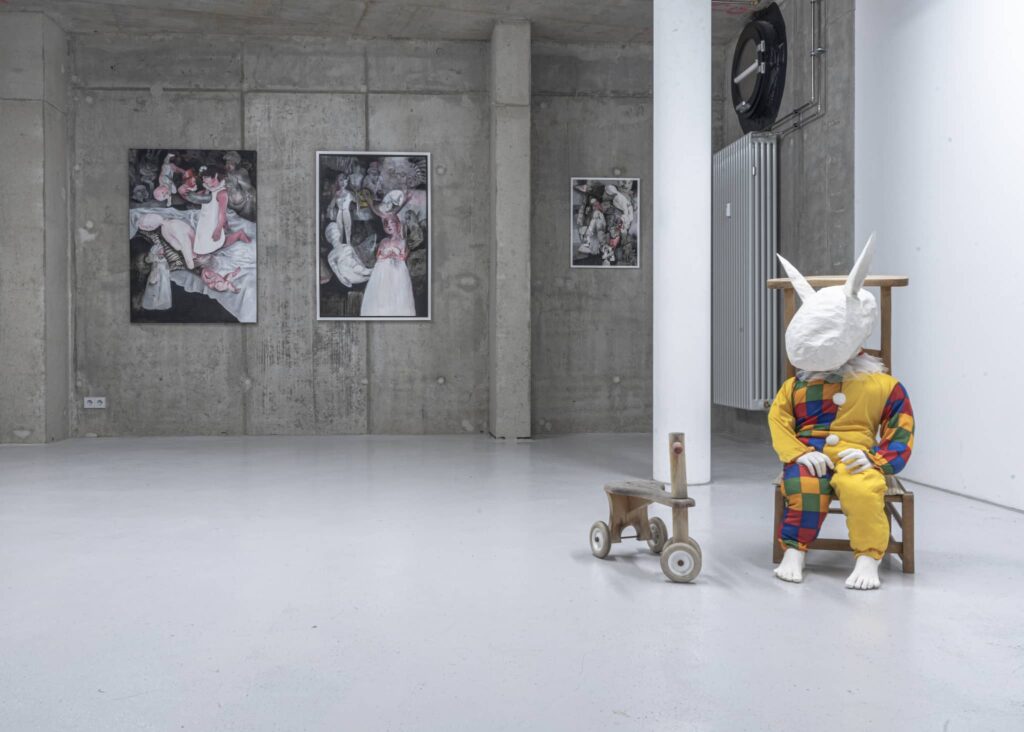
Zahra Zeinali, REM series, 2021 The series REM (2021) and Elle ferma les yeux (2021-2022) continued to focus on the inner world she had discovered – a realm characterized by contradictions, fears, and dreams, akin to the enigmatic nature of dreams or nightmares. Zeinali translated this peculiar inner world onto canvas, naming the collection “PARADOX SLEEP (REM)”. This denotes the state between deep slumber and wakefulness, where reality and imagination converge, echoing the essence of her paintings.
The paintings in these series featured doll-like figures often shrouded in shadows, resembling theatrical scenes. The overall outlook towards the world and reality was somewhat pessimistic and bitter. The backgrounds of the paintings avoided depicting specific locations or spaces, emphasizing the emergence of the characters from darkness, like figures on a theater stage. Zeinali’s choice of colors remained limited, with a focus on using acrylic as her medium, resulting in expressive and emotionally intense paintings from subjective perspectives.
The series Elle ferma les yeux (2021) was influenced by a deeply unfortunate event in her life toward the end of 2021, the impact of which resounded until late 2022. During this period, new colors, such as blue and yellow, were introduced, imbued with symbolic meanings. As a result, the artworks gradually incorporated surrealistic procedure, prompting contemplation on death and the intricacies of the human subconscious. This phase revealed Zahra Zeinali’s newfound sense of independence in her expression.
The essence of each entity’s existence, as perceived by the artist, holds a bitter and disconcerting truth. As she delved deeper into exploration, more unsettling facets of this truth surfaced. This newfound understanding of the world significantly influenced the artist’s actions and mindset, leading her to question the very meaning and purpose of life.She grapples with the daunting task of navigating life in a peculiar and fearsome world. This internal struggle gave rise to the Adaptation (2021-2022) series. In these artworks, subtle shifts in the main characters’ dispositions are portrayed, reflecting a sense of acceptance of one’s circumstances and a confrontation with enigmatic and unsettling realities. This phase is deemed crucial and challenging, as it supports reconciliation of the artist’s relationship with both herself and the world.
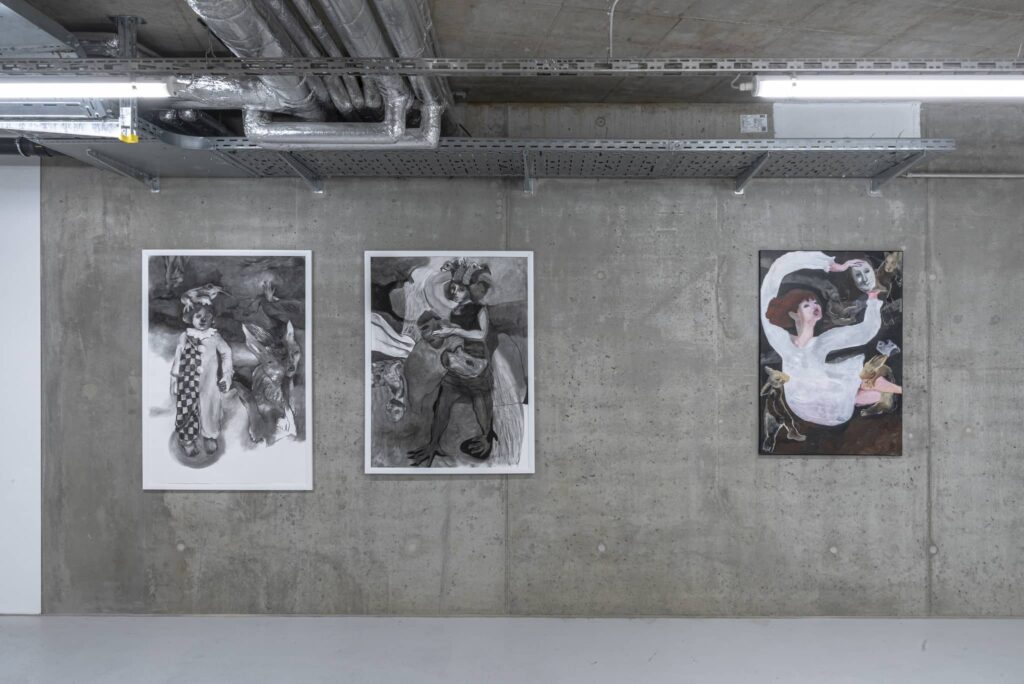
Zahra Zeinali, Adaptation series, 2021-2022 Technically, Zahra Zenali embarks on a journey into unknown territory by using relatively large canvases for the first time. The characters in the artworks move from unfamiliar spaces to more familiar places that remind us of untouched nature. The artworks show the coexistence of unique entities and characters, blending together harmoniously in a single frame, without any resistance or conflict. Her subsequent works, while not explicitly labeled as part of the Adaptation series, continue to be strongly influenced by her explorations during this period.
_ In conversation with Zahra Zeinali
Zahra Zeinali (b. 1975) completed her bachelor’s degree in painting from the Islamic Azad University of Tehran and worked as an art instructor for fifteen years. She developed an interest in photography and studied analog photography at the House of Iranian Photographers. In 2012, Zahra relocated to Paris to continue her artistic journey as a painter. Later, in 2022, she completed her studies at the EFET Photographie École. This milestone prompted her to explore merging the two techniques in her recent works. Additionally, she commenced her role as an art teacher for children and young students at Le Cercle des Arts in 2022, allowing her to tap into the realm of childhood inspiration. Zeinali has participated in several groups and solo exhibitions, including the recent Le Pays des Merveilles, Le Monde Invisible at Galerie Claire Corcia, and Alerte Rouge at Galerie Linda Farrell, Femme Vie Liberté at Galerie Sahar K. Boluki, Artcité à Fontenay, Comparaison au Grand Palais Éphémère, and Figuration Critique à Salon de Dessin Paris, among others.
A:D: Curatorial runs by two young curators from the USA and Ukraine, Christy Woody and Maria Isserlis, the mission of the space is to focus on creating a platform for today’s innovative artists to be heard in a non-commercial environment. Inviting artists from around the world, we aim to keep the cultural bridges open for collaborations, exchanges, and the development of new works. Through young, vibrant voices in the current art and music scene, we would like to thoughtfully reflect on the current political, social and environmental climate and progress with a successful example of cooperation in the field of art and culture in Berlin.
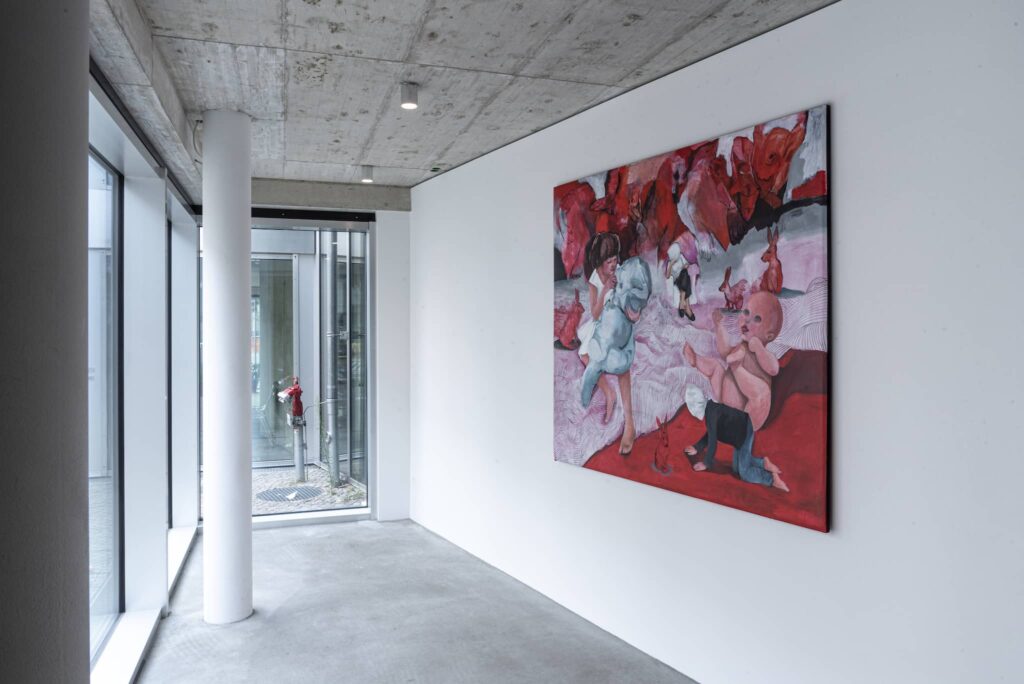


Installation view, Zahra Zeinali, au-delà, 2023, Berlin Germany


